The Pallbearers Club
Cover
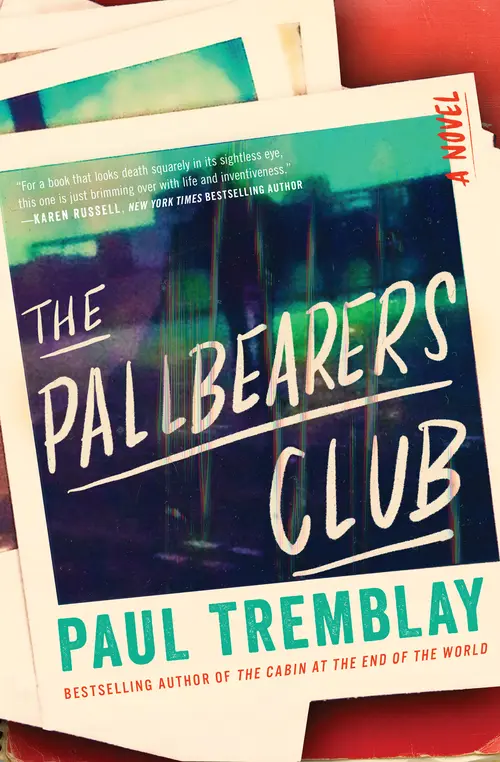
Title Page
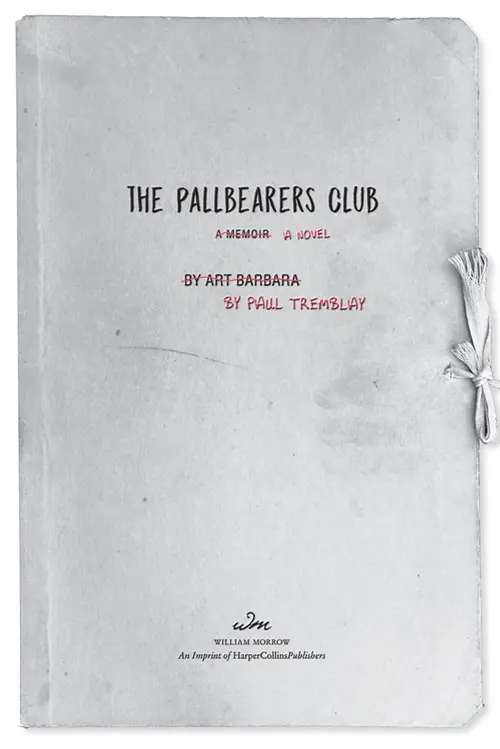
Dedication
DEDICATION
For Lisa, Cole, and Emma
Who are they?
Epigraphs
EPIGRAPHS
Maybe out of everything I thought I knew, there was nothing I was more wrong about than my own life story.
—Sara Gran, Claire DeWitt and the Bohemian Highway
So some of him lived but the most of him died.
—Rudyard Kipling, “The Vampire”
The swollen hollow of my wobbly heart.
—Bob Mould, “Thirty Dozen Roses”
If I Told You
IF I TOLD YOU
(2007)
I am not Art Barbara.
That’s not my birth name. But at the risk of contradicting myself within the first few lines of a memoir, I am Art Barbara.
Imagine my personage, the whole of me (I prefer that phrase to “spirit” or “soul”) exists in Plato’s World of Forms. That me, the one slicked in the amber of Greek philosophy, is Art Barbara. Sorry, Mom and Dad, the name you assigned was a valiant effort, but it does not sum up who I was, who I am, or who I will become.
Art Barbara is bold, declarative, striking, and upon first hearing it spoken your brow furrows, head tilts, and mouth smirks. Admit it; your face is in thrall and acting on its own. You might know a Barbara or even an Art, but you haven’t met, nor do you know, Art Barbara.
However, the initial “Oh” upon the shores of appellatory discovery soon gives way to incredulousness, to there-must-be-some-mistake. Let’s be honest, here (and you have my promise I will always be painfully honest) the name tries too hard. It is more than a little ridiculous, shading toward pathetic (a word derived from the Greek pathos, of course), particularly when spoken with a Boston or Rhode Island accent as the coterie of r’s disappear into obnoxiously long ah’s. Even without the accent, there’s a slant-rhyme clunkiness to the first two syllables, or three if you insist upon pronouncing Barbara as Bar-bar-ah as opposed to the shortened Bar’bra. Regardless, the combination of the first two syllables, the Art-Bar, forces the speaker to comply, to slow down and enunciate the harsh coupling before dumping an auditory body into the dark water of r’s and a’s. I make no claim to be an expert of phonesthetics (the study of inherent pleasantness of the sound of words, according to Wikipedia), but clearly Art Barbara is no cellar door.
I saw the name written on the bathroom wall of Club Babyhead, spring of 1991. The letters were capitalized, angular slashes of neon-green ink; a cave painting glowing in the lovely darkness of the early 1990s. I have never forgotten it. And by the end of this memoir, neither will you.
Isn’t time strange? Time is not linear but a deck of cards that is continuously shuffled.
I will change all names to protect the innocent and not-so. I will take great care to choose the names appropriately. As astounding and beyond-belief the goings-on to be detailed are, the names will be the only fictions.
Beyond the act of communication, sharing my story and experience and life, exploring fear and fate and the supernatural (for lack of a better word) and the unknown universe big and small, vulnerable confessions, and base gossip (Truman Capote and the nonfiction novel this is not), perhaps a lame excuse or two for lifelong disappointments and why I am and where I will be, the purpose is hope. Hope that one reader or one thousand and one readers might empathize with the “why” behind the poor decisions I made, make, and most certainly will make.
I assume you intended for me to find this. Maybe that’s a lot for me to assume. Maybe it’s not. I mean, you left it on your cluttered desk with a literal yellow bow tied around the manuscript. Holy shit, I bet I’ll have a lot to say about this book based on the opening chapter.
Art Barbara. Jesus, dude.
I promise my commentary will be as honest as you are claiming to be. That sentence by itself makes it sound like I am already accusing you of lying. I don’t mean to. We’ve had our ups and downs, but I’ve always considered you to be one of my dearest, oldest friends, and I hope you feel similarly.
Frankly, I’m a little scared to read more, to find out what you really think of me.
Based on the title, I don’t think it’s vanity to assume I’ll play a large role in this, um, memoir.
Memory is a fucked-up thing, especially as time passes, stretches, and yawns. Your comparison of time to a shuffled deck of cards comes close to the truth, or a truth. I think time is better represented as a house of cards, an unimaginably large castle of cards, one in which rooms and entire wings collapse and are endlessly rebuilt. Those collapsed rooms and wings hold memories, both personal and collective. That card house is forever haunted by the lost memories and by the ones that are retained but changed.
Sorry, I know this is your book, not mine.
It occurs to me if our memories of certain events differ, that doesn’t necessarily mean one or both of us are lying, certainly not lying on purpose.
I’ll attempt to keep my comments solely to after each chapter. I will read and comment as I go without skipping ahead. I can’t promise that I won’t mark stuff up within the manuscript though. As you know, I’ve always been a bit impulsive.
Looking forward to reading what name you’ll give me, Mr. Art Barbara.
New Day Rising
NEW DAY RISING
(October 1988)
A chapter in which a club’s hero rises, or at the very least, raises a shaky hand.
A-House was one of three wings attached to the main building of Beverly High School and it telescoped out, as vast and empty as the cold universe. A yellow hall pass clutched in my sweaty adolescent hand granted permission to go to the AV room so I could assist with the morning announcements broadcast on our closed-circuit Panther TV. As a senior who regularly achieved honor roll, I’d earned “senior privileges,” which included the ability to traverse the campus during homeroom and free periods without need of a pass. My asking for a pass from my calculus teacher, Mr. Langan (a kind if not awkward middle-aged man who wore sweater vests and an Abraham Lincoln–style beard) represented the kind of student I was; skittish, afraid, desperate for approval of any kind.
I ghosted past rows of lockers dangling their bulbous locks. Most of me ached to turn around, to return to homeroom, to give up on this foolish idea, to forget it ever occurred to me. There was another part that realized this was a Robert Frost path-choosing moment. If I went through with my plan, this smallest AV step for humankind, my life would be irrevocably changed. By the time I swung open the creaking metal door of the AV room, my resolve leaked away, literalized as flop sweat.
Ian, one of two Panthers newscasters, he of the swimmer’s shoulders and beer-keg leer, greeted me with “Hey, it’s Artie the one-man party.”
[Note: Ian did not say that. As we’ve discussed, my name was not Art. I will not break in like this again to point out other, minor factual name discrepancies. It’s enough for you to know Ian was the kind of chud who would’ve said that if my name were Art. What he did call me wasn’t my real name either. He called me Bones. I had always been the skinniest, most slight kid in my class, and at that AV moment in time I weighed a scant one hundred and forty pounds. Most of my male classmates called me by that nickname, which I never had the option of approving when it was pinned to me at age eleven along with another kid’s fist to my big nose. (I fought back, but all that earned was another, bigger kid’s fist to the stomach.) At ages seventeen and eighteen, the nickname was uttered with tradition if not endearment, certainly with less intentional cruelty, but it was there in the name’s history, so I will not use nor refer to it again. We will stick with Art to the end.]
The other newscaster, Shauna, gave me a wave and a slightly puzzled tilt of the head as she buzzed around the small studio, handing out photocopies of the morning’s announcements to the producers, to Ian (slouched behind the news desk, a combo of James Dean and a pile of dirty laundry) and the camera operator. She wore the high-school equivalent of a business suit, her black blazer with shoulder pads of a size somewhere between a football player and David Byrne’s Stop Making Sense suit. Shauna and I were in the same calculus, English, and French classes and she had always been cordial if not coolly competitive. She had the third-highest grade point average in our graduating class of three hundred and twenty-four. I was number nineteen, one of only two boys in the top twenty, which told you all you needed to know about my male classmates.
Shauna asked, not unkindly, why I was there. I told her I had an announcement about a new club.
She said “Okay” about ten times while scribbling on her announcements sheet, and said (to herself, I assumed), “I can talk about it between the student council and powderpuff football sign-up.” Then, to me: “Got it, Art.”
“Oh. Thanks, but, well, because it’s a new club and as the founder and president I think I need to make the announcement myself, and, um, Mr. Tobin said that I could do it.”
Shauna smiled but her eyes moistened, as though on the verge of you-can’t-do-this-to-me tears. Before I could say sorry, she said, “We have five minutes to air, do you know what you’re going to say and how you’re going to say it, and when it might be best suited for airing?”
I shrugged, offered something mostly committal. She shoved me into the adjacent secondary studio, an isolation chamber encased in thick windows so no one could hear me scream.
The announcements began when they were supposed to. They were piped through a small box of a speaker perched above the door of my studio. Ian and Shauna sounded trapped in a tin can, but I was the one sardined in here with barely enough room for me (standing, no chair), a tripod, and a bored underclassman lurking behind a camera.
Instead of practicing what I was going to say while awaiting the go signal, I uttered a silent mantra in my head: This is so you can get into college. My guidance counselor, Mr. Brugués (he of the novelty fish ties, walrus-thick ’70s mustache, overstarched dress shirts, and brown-bag lunches that were always open and left half-eaten on his desk), said my grades were great but I didn’t have any extracurricular activities. No sports, no student council, no clubs, no volunteer work outside of school. My lack of well-roundedness as a student was, well, a lack, and, to quote, “lessened my college acceptance prospects.” Panic set in as soon as he said it. Now that my chance to finally flee these people and this town was within sight, I was desperate to get into a school that wasn’t Salem State or North Shore Community College (not that anything was wrong with those schools—well, their proximity to my house was wrong with those schools).
I stood in front of the camera, trapped under a mini spotlight that might as well have been a heat lamp from the cafeteria. This was the last place in the world I wanted to be, and I normally spent most of my school days trying to not be seen.
See me:
I was six feet tall, having grown six inches in the prior eighteen months. The rapid height gain exacerbated my scoliosis. The condition had been discovered later than it should’ve, as I somehow slipped through the cracks of the embarrassing annual scoliosis checks during gym class. The checks consisted of a line of boys with their shirts off (my head down, wishing I were invisible, my arms matchsticking across my chest), and after a properly lengthy time of mortification I was in front of a disinterested school nurse holding a school-issued clipboard. I bent over to touch my toes, so skinny that my vertebrae stuck up through my skin like the back plates of Godzilla, and the nurse’s cold hand fish-slapped onto my right shoulder blade, her audible “hmmm” and “you look a little off” (me being a little off was her diagnosis) and then she told me to switch to carrying my bookbag with my left shoulder. Since being diagnosed eighteen months prior, I attended physical therapy sessions and slept in a hard-plastic-and-metal-framed back brace at night (the doctor had never insisted I wear it to school, knowing I would not), which improved the curvature in my lower spine, but not in the upper region between my shoulder blades where scoliosis was most difficult to correct, where the curve to the right measured thirty-five degrees. The prospect of spinal fusion surgery loomed if the curvature increased in my upper spine. I wore baggy enough clothes so other people wouldn’t notice the encroaching kyphosis, my curling into myself. No one at school commented on my back, and I never told any of them about it. Maybe no one noticed the burgeoning hunchback because of my other unpleasant physical attributes. We’ve already discussed my ectomorphic build (or lack of build). Additionally, my skin was a raw and angry map of acne. Archipelagos of pimple volcanoes regularly erupted on my face and my back and chest. That no one would ever see my back and chest was a small consolation. Of course, now, on announcement morning, I had a new Mount Washington red nodule, its craggy peak above my right nostril.
In the secondary studio, I sweated under the interrogation lamp. The kid behind the camera breathed too loudly, sucking up all the air. Where was the goddamn go signal? Was Shauna going to purposefully dump me from the announcements, like I was a never-been Z-list celebrity in the talk-show green room, bumped for an animal act that went too long? I’d be trapped standing in this tiny soundproof room forever.
The speaker above the door cut out. The light on the front of the camera pointed at my head finally burned red. I took a deep breath. And I spoke.
“Hi, for those of you who don’t know me, my name is Art Barbara, I’m a senior, and I’m starting a new club. It’s called the Pallbearers Club. We’ll volunteer at local funeral homes to be attendees and pallbearers at funerary services for homeless people or for elderly who have outlived family members and won’t have many or any mourners show up. I’ve already called Stephens Funeral Home on Cabot Street and they would love to have our, um, help.”
I glanced to my right, out the studio window. Ian looked smug, bemused, and disgusted, or smusegusted. Shauna manically spun her hands in front of her, which I assumed was a wrap-it-up gesture. But I was not ready to wrap it up. I’d just started talking.
“I know it sounds a little scary or weird, but we’d be doing a great service for the community, and um, for the people who died, of course, even if they don’t know it. It’s still a very nice thing to do. It would look good on a college application too. Mr. Brugués told me it would. We’d mainly attend services on the weekends. And um—”
Shauna was at the window and banging on it with hammer fists. A crack spidered through the soundproof glass.
“Yeah, I guess that’s it. If you’re interested, keep an eye out for flyers I’ll post around school, or just find me to learn more. My homeroom is A-113, or you can leave a message for me in the front office, or if you forget my name, leave a note addressed to the Pallbearers Club. Thank you. Back to you, Shauna and Ian. Um, go Panthers.”
I like your use of “chud” though an editor or copyeditor might be confused.
This chapter is a little “woe is me,” don’t you think? I’m not judging and I’m not belittling your school-aged experience nor your state of mental health, but by way of perspective, you have white cis-male privilege, did not grow up in poverty, and you did not suffer tragedies during childhood, none that I’m aware of anyway. Apologies if there are revelations to come regarding the latter.
I get it, though. Kids/teens are confused and cruel and then they generally become confused and cruel adults. The emotional scars you described, the type so many of us wear and conceal, are the crucible in which we are formed, especially if we dwell on such things. I hope the act of writing this finally purged some of this poison. However, given everything that happened since you wrote this chapter, I guess that it did not.
For what it’s worth, I do not remember the you from that age as being a hopelessly ugly duckling. If you were, your appalling lack of self-confidence and self-awareness did not help. I do not blame you, but it’s a point of fact.
I’m not saying this very well, but the person who is cruelest/hardest on you is almost always the person looking into the mirror. We never see a reflection of ourselves in the mirror, do we?
Sorry, I sound like a self-help guru. I always wanted to help you. I tried to help you. I truly did.
None of what I’ve read so far is a surprise. I recognized what you needed the first time I saw you and your hunched back.
Sorry, bad joke.
Something I Learned Today
SOMETHING I LEARNED TODAY
(November 1988)
A chapter in which we introduce the dead.
The Pallbearers Club Meeting Minutes
Did you really write up minutes? I hope you’re joking . . .
Opening: The meeting was called to order by Art Barbara. Wednesday, November 5th, 2:37 P.M. It was held outside of Mr. Brugués’s office. He offered us a sandwich bag half-filled with pretzel sticks.
Present: All current/initial members. Art Barbara, Cayla Friedman, Eddie Patrick.
Approval of Agenda, Approval of Minutes: Two votes to zero. Eddie Patrick abstained from voting. He said it was dumb.
Business from Previous Meeting: None. This is our first meeting.
New Business: We will be pallbearers/attendees at a small service for a homeless woman. Her name hasn’t been shared with the club yet.
Additions to Agenda: After a brief period allowing for motions (none were brought forth), Art Barbara was elected president, vice president, and secretary. One person probably shouldn’t hold all three offices at once, but as pointed out by Cayla Friedman there are no bylaws preventing such a result. Perhaps a topic for future meetings.
Adjournment: Meeting ended when Eddie Patrick pretended to choke on pretzel sticks and insisted Cayla Friedman perform the Heimlich Maneuver on him. She declined. Next meeting is at the Stephens Funeral Home, Saturday, 9:00 A.M., which is thirty minutes prior to the start of the 9:30 A.M. service to be held within the funeral home.
Minutes submitted by: Art Barbara
Minutes approved by: Art Barbara
[I submitted the minutes along with my college applications to Bates and Middlebury Colleges as an attempt to appear both creative and disciplined. I did not get into either school. The 2007 me is still salty about it.]
You deserved not to get in
* * *
I pulled my parents’ beat-up blue station wagon into Stephens Funeral Home at 8:45 A.M. I hated being late. As vast as the night ocean, the parking lot funneled me toward a hearse parked under a trellis-lined awning shading the home’s main entrance. Set back a considerable distance from busy Cabot Street, the converted colonial house was painted white with black trim, the official colors of a New England funeral home. I do not know anything about architecture, but let’s call it Colonial Gothic. At three-stories in height, the mournful manor lurched and sprawled at the edges of the well-manicured lot.
The Story Continues on BooksBarbecue!
Enjoyed this preview? ❤️ Do not stop here!
Read the complete book free online → 🔗
Continue reading now on BooksBarbecue and discover every page!
Love reading? Bookmark BooksBarbecue.com for more amazing books!
Happy Reading!