The Painted Queen
Cover
Dedication
To Barbara Mertz,
with love and respect
Foreword
Egyptologists Together: Amelia Peabody, Elizabeth Peters, and Barbara Mertz
Salima Ikram,
Distinguished Professor in Egyptology, American University in Cairo
One of the great delights of the Amelia Peabody books is that in each one, Amelia combines murder, mayhem, and mystery with solid doses of Egyptology and history. As a scholar, Barbara Mertz (Elizabeth Peters) meticulously researched every historical point in her Peabody novels, and these root the series and give it a life beyond its pages, illuminating the world of the ancient Egyptians, historic events of the nineteenth and twentieth centuries, and the lives and discoveries of Egyptologists. Through her books, Barbara managed to seduce readers into caring not only about Amelia, Emerson, and their circle, but also about Egyptology. She managed to educate without bludgeoning people with too many facts; she humanized archaeologists and explained what we do in the field, dull though it often is, with its endless sifting of sand in the quest for telling “odds and ends.”
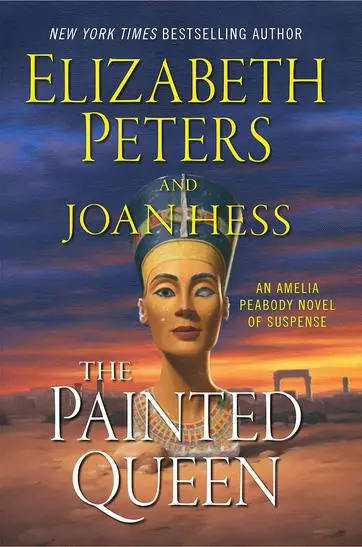
Barbara’s inspirations for each Amelia book varied. They were often triggered by a particular moment in the history of Egyptology that intrigued her, a site that she loved, or a single artifact that was iconic, both to her and to the world—particularly ones that had good stories attached to them, with a hint of intrigue, and which still today remain the subjects of Egyptological speculation (though some might rudely call it gossip). The inspiration for The Painted Queen falls into the latter categories: the famous Nefertiti bust (discovered in December 1912 by German archaeologist Ludwig Borchardt) is an iconic object with a muddy past and a contentious present, her discovery and departure from Egypt the subject of endless speculation by archaeologists and aficionados of ancient Egypt.
I remember when Barbara first told me about starting The Painted Queen. “You’ll never guess what I am going to tackle next! It will be such fun, and hopefully set the cat among the pigeons—and everyone will be happy as we are going back to Amarna!” From that moment on, she embarked on a frenzy of research, reading all she could on the topic, whether it was Borchardt’s excavation reports, diaries and letters from the time, newspaper reports about the appearance and disappearance of Nefertiti, the opinions of scholars past and present about the bust, or websites dealing with the exit and return of Nefertiti. All the while she kept track of what Egypt and Europe were like in the early part of the twentieth century. She also polled her Egyptological friends, asking their opinions about Borchardt’s character, whether German governmental officials might have conspired to remove Nefertiti illegally from Egypt and keep her in Germany, and their thoughts on the accuracy of modern studies on the Nefertiti bust. Barbara’s Egyptological friends entered into the spirit of the book by sending her any relevant material that they thought might be of interest, whether it was a new book in German about the history of the German Institute that figures prominently in this book (the Deutsche Orient-Gesellschaft, at that time) or obscure notes and opinions about the queen and her excavators, or by visiting the actual house that belonged to the German Institute in Cairo, and where Nefertiti might have temporarily rested (and where people were imprisoned).
The controversy about the bust of Nefertiti is one of the great debates of Egyptology. Was the bust found on December 6, 1912, as reported by excavator Borchardt (Barbara took some liberties with this portion of the tale—libel is unattractive), and later illegally removed by Borchardt? And how did Borchardt accomplish this removal? Did he hide the bust, disguise it with a liberal application of plaster, or put pressure on Gustave Lefebvre, the young inspector who had come to select the finds that were to remain in Cairo? If Lefebvre did not examine all the contents of the boxes, and used only the list of items that Borchardt had prepared (after all, he was a senior and very well respected scholar who had been working in Egypt for a long time), he would have merely noted that this was a bust of gypsum, as Borchardt had been economical with the truth. The bust was of limestone with its gypsum covering and paint still surviving—a rarity. By misleading Lefebvre, it was speculated, Borchardt defrauded Egypt of its rightful share of the finds at Amarna. In Berlin, the bust was displayed publicly for just one day, after which it was whisked off to the home of James Simon (appearing here as James Ridgemont), who had funded the excavation, and remained with him (but visitable by a select few) until 1920. The fact that Borchardt failed to publish news of the bust’s discovery until 1923, although details of other items from the same excavation made it into print earlier, fueled the controversy as to whether Nefertiti had been “kidnapped.” Private letters and papers in Germany, and official complaints made by the Egyptian Antiquities Service, fed into speculation about the exit of Nefertiti from Egypt. Additionally, later allegations that Hitler fell under the spell of the bust and took the original, leaving a fake in its place, only strengthened the Nefertiti mystique, making her discovery a prime candidate for a mystery that Barbara (and Joan)—and Amelia—had to tackle.
Barbara’s books were always well researched on Egyptological and historical levels, as she remained an Egyptologist and scholar at heart. Although she never excavated in Egypt, she had visited more sites than many archaeologists. I particularly remember a bumpy ride to the rarely visited Abu Rawash, a site that Barbara had wanted to see for some time, as she was thinking of featuring it in a new book. When we got there, we carried out an almost total suspension of Barbara over the burial pit of the pyramid so that she could see what it looked like, and concluded with an Amelia-style picnic at the edge of the pyramid, in the mortuary temple. While traveling through Egypt, Barbara was happy to try anything (I had the privilege, all in the name of research, of introducing her to sheesha smoking), talk to anyone, and had a very real “feel” for the country and its archaeological sites. She knew the ins and outs of an excavation, having visited many and interrogated their directors, à la Amelia, about the techniques that they used. It is this intimate knowledge of Egypt and its sites that makes Amelia’s experiences so immediate for the reader. When she writes of crawling through bat guano, handling ancient bones, inspecting mummies, trudging through sand, or enjoying the cool north breeze on the Nile, it is because Barbara had experienced all of this firsthand. Luckily for us, Joan accompanied Barbara on one of her trips, thus she too has had a “taste of Egypt.”
Perhaps this intimacy with Egypt is why so many Egyptologists are devotees of the Amelia Peabody series. No other fiction author has spoken so directly and truly to us, skillfully blending historic fact with fiction, giving a very real sense of place, including in-jokes, all while telling a ripping tale. It is with great sadness that I bid farewell to the idea of enjoying any new adventures of the indomitable Amelia and Emerson, the “most brilliant archaeologist of the nineteenth and twentieth centuries.” However, I find comfort in knowing that I have the old stories to return to, and, no doubt, even if they are not being chronicled as before, Amelia continues to contend with another ruined shirt as she and Emerson embark on fresh adventures.
Preface
Joan Hess
I met Barbara thirty years ago at a mystery convention, when I timidly approached her as a wide-eyed fan. We clicked because of a shared sense of humor (sardonic) and perspective (jaded), and became close friends over the years. She offered wisdom as I floundered through the publishing world. We laughed often, engaged in a lengthy exchange of weird presents involving sheep, and had weekend parties with our clever friends. She invited me to accompany her on one of her annual trips to Egypt, where she was revered by local shopkeepers and international Egyptologists. On the occasion of her eightieth birthday party, I rented a camel.
I was still stunned by her death three years ago when I arrived at Mertz Manor for the funeral. Beth (her daughter), Dominick Abel (her agent and dear friend), and I were sitting at the kitchen table when the topic turned to Barbara’s unfinished manuscript. I will admit my gut froze as I sensed the inevitable question: would I complete The Painted Queen? My first response was an adamant refusal. The idea of attempting to capture her voice, her erudite style, her wit, and her vast knowledge of archaeology in the early twentieth century, seemed ludicrous. I lost that one, obviously.
Barbara and I had discussed the plot in the preceding months, and I’d made suggestions. I was assured that she had made extensive notes and plotted the entire thing. I knew better. Yes, the notes were extensive—to a certain point. Interesting things were happening, and I suspect that she intended to let the plot develop as she wrote. Her illness overcame her.
I kept almost all of Barbara’s prose, although some changes were necessary. Salima Ikram and I brainstormed via Skype to come up with the how, the who, the why. Beth offered comments and referenced earlier novels. Ray Johnson and Dennis Forbes gently corrected my missteps. It took me nearly three years to complete The Painted Queen due to personal health issues, but I am pleased with the result.
All factual and translation errors are Salima’s fault. Or somebody else’s, anyway. Maybe Google’s.
I still miss Barbara.
Introduction
The Trustee of the Barbara Mertz Trust
It is our sad duty to introduce this last of the Amelia Peabody Emerson volumes. The devoted Editor of Mrs. Emerson’s memoirs, Elizabeth Peters, died in August of 2013 while in the midst of working on the manuscript of The Painted Queen. She had contemplated this project with excitement, knowing that publishing Mrs. Emerson’s recollections from that time would shed new light on a famous moment in the history of Egyptology. With her usual thoroughness, Ms. Peters had begun research on many aspects of the event in question, hoping to clarify some of the more difficult-to-decipher entries in Mrs. Emerson’s journals. It bears noting that Ms. Peters had made the effort of writing out the final page of The Painted Queen before she died, a page that is reproduced herein verbatim. Happily, as she worked on this last manuscript, Ms. Peters was in constant conversation with her dear friend and fellow mystery writer, Joan Hess, who valiantly took on the very difficult task of completing the work. Ms. Hess sought the help of another close friend of Ms. Peters, the distinguished archaeologist Dr. Salima Ikram, in working through the nitty-gritty of the Egyptological details. Dennis Forbes, editor of Kmt, and Dr. Raymond Johnson read the penultimate draft and offered suggestions as well.
We all owe Joan Hess an enormous debt of gratitude for the years of work she devoted to this undertaking, persevering through unimagined difficulties and prioritizing this work over all else during that time period. Greater friendship one could not imagine.
For many years, Elizabeth Peters (and her alter ego, Barbara Mertz) relied on the calm, constant, and utterly reliable guidance of her agent, Dominick Abel, who also became a cherished friend and ally. As they always have shared a dislike of maudlin sentiment, we won’t elaborate further. Even a skilled editor like Ms. Peters needed help with her manuscripts—although she would have told you that she didn’t suffer foolish edits gladly; thus it is a real testament to the skill of her longtime editor, Jennifer Brehl, that Ms. Peters approved of (and even privately admitted to enjoying!) the work they did together.
Ms. Peters accumulated a group of other friends over many years in the book business, including fellow authors, who carried one another through highs and lows. Their exploits at various conventions (including their own “GroucherCon”) and elsewhere probably are best left undescribed. Let us just say that they certainly could hold their own with Amelia when it came to beverages of genial and other types—and that their commentaries shared with Emerson a literate, if at times intemperate, character. And that leads us also to Ms. Peter’s comrades-in-arms within Egyptology and allied fields, similarly sturdy companions through all kinds of adventures. The prefaces of previous Amelia volumes are filled with specific acknowledgments of individual scholars and sources—but they name only a small swath of the colleagues she counted as friends.
We hope she would forgive us for saying that her friendly and warm embrace extended broadly across family and friends, from nearby neighbors to far-flung pen pals—despite her attempts to pass as a curmudgeon. We miss her wicked sense of humor, her warmth, her intense curiosity, and the enthusiasm she used to create a sense of adventure in even the most mundane of settings.
And finally, we are certain that Ms. Peters would want to thank her and Amelia’s “dear readers” for decades of shared enjoyment in this adventure. As many readers know, for some years now the books in this series have been going back in time to fill in missing seasons in the saga. The Painted Queen does just this, also. The final chapter of the tale chronologically was published some years ago, in The Tomb of the Golden Bird, allowing Amelia and Emerson to exit triumphantly, on their own terms. And now we come to the moment when we must allow Amelia’s very dedicated editor to depart in the same fashion.
Indeed, there have long been striking similarities between Elizabeth Peters and Amelia Peabody—not the least of which being that they both liked to have the last word. To honor this preference, we close with some admonitions that Ms. Peters included in her 1986 preface to The Lion in the Valley—which we find to be just as appropriate now as they were then:
In this . . . volume of the memoirs of Amelia Peabody Emerson (Mrs. Radcliffe Emerson), the editor once again deems it expedient to explain certain anomalies and obscurities in the text. Mrs. Emerson was not as careful as she might have been about noting the dates of her entries. She seems to have picked up the current volume of her journal and scribbled away until something happened to distract her. . . .
As the editor has had occasion to mention, the names of most of the persons involved have been changed, in order to spare the feelings of descendants of said individuals. The informed reader will recognize some names as those of well-known archaeologists, who appear only peripherally. Mrs. Emerson seems to have been fairly accurate in describing their activities; however, it would be a serious error to assume that she was equally accurate in reporting their conversations with her for, like her distinguished husband, she had a decided tendency to attribute to other people opinions of her own.
Another obscurity in the ur-text (if the editor may so describe the journals themselves) arises from the fact that at some point Mrs. Emerson apparently decided to edit them for eventual publication. . . . Since she was as inconsistent about her revision as she was about dating her pages, the result is sometimes a peculiar blend of journalistic and novelistic styles.
In other words, none of the eccentricities of the present volume are the responsibility of the editor.* She has done the best she could and would suggest that complaints, criticisms, and other pejorative comments be addressed to the heirs of Professor and Mrs. Emerson, not to her.
One
From the harbor, the port of Alexandria is an attractive sight, its whitewalled houses and red tiled roofs framed by azure sky and sea. Since I had been there many times, I knew that the walls were disfigured by dried mud and rude graffiti and that the streets were inches deep in evil-smelling debris. I never arrived in Alexandria without wishing to leave it as soon as possible.
However, our welcome was warm enough to cheer the saddest heart. Our arrival had been heralded by the mysterious network of communication that operates in countries such as Egypt, and cries of greeting arose as our ship approached the dock. “As-salaam-alaykum, o Father of Curses. Marhaba, ya Sitt Hakim!”
Egyptians enjoy inventing soubriquets, and that of Emerson, I believe, requires no elucidation. As I have often said, and never tire of saying, my husband is the greatest Egyptologist of the nineteenth century (of the Christian era), and although the present century is still in its infancy, I do not doubt he will dominate it as well. His physical endowments are no less remarkable than his intellectual skills. As he stood beside me at the rail, his thick black hair was disheveled by the breeze, and his sapphirine orbs shone with anticipation, for we were returning to a particularly intriguing excavation that certain events of a particular nature had prevented us from finishing the previous season.
My own name, Sitt Hakim, means Lady Doctor, and although I had never acquired formal training in medicine, I could not help but feel that I had done some good. My excellent spouse’s comment “No one would dare die if you told them to live” was no doubt meant as sarcasm, but it held a seed of truth. A positive attitude is vital to recovery, and so is confidence in one’s medical attendant.
But I digress.
Emerson shouted greetings in response to the respectful salutations of his numerous disreputable “old friends” (of whom he had far too many, in my opinion). I waved my parasol in a jovial manner, and was amused to observe certain members of the receiving committee back off a few steps. My parasol was regarded by the more superstitious of the fellahin as a device of potent magical power. It certainly was a useful weapon, not only because the victim was not expecting attack by parasol, but because my parasols were made to my specifications, having a rather sharp tip and a stout steel shaft.
With the assistance of some of Emerson’s admirers (whose devotion was not so great as to refuse the baksheesh he dispersed), we got ourselves and our belongings onto the train to Cairo. A similar scene ensued when the train arrived at the Cairo station. How the word of our arrival had got out so quickly I do not know, but more of Emerson’s old friends awaited us on the platform. I had resigned myself to the inevitable delay when an individual in formal morning dress pushed through the crowd and addressed my husband. “Professor Emerson?” he inquired unnecessarily. (There is no mistaking Emerson; his stalwart form is known the length and breadth of Egypt.) “I come from M. Maspero,” he went on. “He asks that you do him the honor of calling upon him as soon as is possible.”
The Story Continues on BooksBarbecue!
Enjoyed this preview? ❤️ Do not stop here!
Read the complete book free online → 🔗
Continue reading now on BooksBarbecue and discover every page!
Love reading? Bookmark BooksBarbecue.com for more amazing books!
Happy Reading!