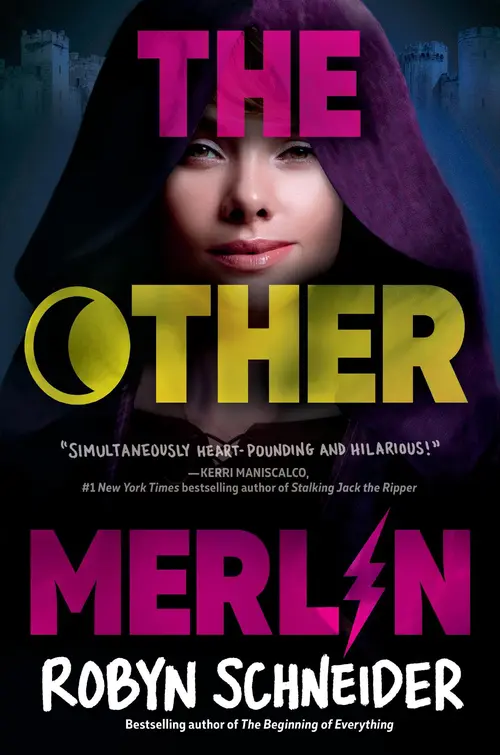
The Other Merlin
Cover
Dedication
To the girls who dream out loud, want too much, and refuse to give up.

PROLOGUE
The Crooked Spire isn’t remembered in any history books. No important documents were signed at its tables, no heroes rode into battle fortified by its ale, and no revolutions began in its back room. The drinks were watered down, the barkeep turned a blind eye to gambling (how he’d injured it was a constant source of speculation), and the barmaids made no secret that they were willing, for a price. And yet, the Spire does have a place in history—by the pure coincidence of its location—which is, perhaps, why it goes unmentioned.
If you stood with your back to the Thames, just north of St. Paul’s Cathedral, you’d need only walk down the narrowest alleyway that borders the churchyard to arrive at the steps of the tavern. The sheer nerve of such a place to set up shop alongside the greatest cathedral in London raised more than a few eyebrows. But the Spire endured, largely because no one could remember which had come first. The only part everyone agreed on was that the magic sword in the courtyard between them had been there since, well, forever.
It stuck there, buried to the hilt in a block of veined marble, waiting. Occasionally, a knight riding through on his way to Castle Camelot would stop to try his luck. Or a dockworker might stumble out of the tavern, flexing his muscles and calling to his friends, Hey, come and watch this! But the sword stuck fast, and the words chiseled into the stone wore smooth over time.
Whoso pulleth out this sword of this stone
is rightwise king born of all England.
Now there was an idea. Anyone could tell you that, ever since the Saxons invaded and mucked things up, there had been half a dozen kingdoms of England. Sure, the borders shifted on occasion, whenever a restless royal rode off and conquered a neighboring castle. But a united kingdom? The thought, although far-fetched, was intriguing.
Yet no knight came who could pull the sword from the stone, and no great hero arose to unite the Britons. The sword had been waiting for hundreds of years, and to be honest, it was bored.
CHAPTER 1
Arthur Pendragon was drunk. Enormously, blissfully drunk. He slouched down in the booth of the Crooked Spire, enjoying the gentle way the tavern had begun to spin.
Everything about the place fascinated him: The arched stone ceiling that gave the impression of an underground cellar. The iron chains that served as handrails to the back staircase. The fat purple candles that dripped wax indiscriminately over floor and table. And then there was that odd sword in the courtyard. If the rumors were true, the last knight who’d attempted to pull it free had strained so hard that he’d actually soiled himself.
Arthur would have laughed if he’d been there to see it. But then, he hadn’t seen much of anything lately. Tonight, however, he was free of the castle’s oppressive gloom, if only for a few hours. And he intended to savor his freedom.
He drained his mug of ale and glanced across the table, where his friend was fiddling with a deck of cards. Lancelot shuffled them with a practiced snap, sifting them into a bridge. He did it a second time, and then a third.
“Please tell me you’re going to do a magic trick.” Arthur smirked, and Lance shot him a look.
“I was going to make the ale disappear,” Lance retorted, “but you already did that yourself.”
“Well, we are in a tavern.”
“Stop looking so pleased with yourself. I’m the one who snuck us out.”
That part was true: Lance had conjured some absurd excuse that sent Arthur’s guards back to quarters, tossed him a shabby cloak, and announced they were going for a drink. It was bold and reckless, but it had worked.
And for that, Arthur was immensely grateful. He hadn’t realized how badly he needed to be somewhere else until they were hurrying through the maze of London streets, the night thick with the promise that they could spend it as they pleased.
“I guess I owe you one,” he said.
“You owe me six hundred and twenty-three,” said Lance, “but who’s counting?”
Arthur reached for his ale, finding his mug empty. He glanced hopefully toward the bar. “Another round?”
“Bad idea.”
“Terrible,” Arthur agreed.
“But how will we learn from our mistakes if we don’t make any?” Lance’s eyes danced with mischief as he climbed to his feet.
“My thoughts exactly.” Arthur offered up some pennies, but Lance waved them off, scooping some petty coins from his vast pile of winnings and sauntering over to the bar.
Lance had left the cards faceup on the table, and the King of Cups stared back at Arthur, bearing more than a passing resemblance to his father. He sighed and pushed the cards away. Of course the great Uther Pendragon would commission his likeness on something so trivial. The king wasn’t even the highest card in the deck. And worse, there were four of them. Arthur would have laughed, if it wasn’t so depressing.
He glanced toward the bar, where Lance was leaning forward, a flirtatious smile on his lips, turning his charms on the barmaid. The girl blushed from the attention, and Arthur snorted, knowing Lance would just as happily flirt with the barkeep, or, probably, the barstool.
It was nights like this he wished he could make a girl smile and laugh, and know it was for real. These days, too much of his father’s court treated him like a prize to be won, or a piece of clay they intended to mold. He wasn’t sure he’d ever get used to it. Especially when, for most of his life, they couldn’t dismiss him fast enough.
It was the end of September, and he was supposed to be at university, dividing his time between the library, the laboratory, and whatever dark watering hole everyone crammed into, just another scholar in the crowd. But that dream was long gone, replaced by a future that was never supposed to be his.
He tried to put it out of mind as Lance sauntered back to the table with two frothing mugs of ale, sending one in his direction with a practiced slide.
“These ones aren’t stale,” Lance bragged, nodding his chin in the direction of the barmaid. “I think she likes me.”
“She likes your purse,” Arthur said. “Anyone can see you’ve won half my coin.”
“Consider it charity.” Lance swallowed a mouthful of ale. “Guard’s pay is a joke.” He paused, calculating. “Hold on, was that only half?”
Arthur shrugged, pushing the cards the rest of the way across the table. In truth, Lance had almost cleaned him out, but he wasn’t about to admit defeat. He just needed to bluff a hand or two, let his friend get cocky, and wait for his moment. Or else get so drunk that he didn’t mind staggering home with an empty purse. Honestly, both were solid options.
Lance gave the deck an elaborate shuffle and started to deal, just as the bells over the door jingled. A blast of cool night air rushed into the tavern—along with a rumpled, nervous squire whom Arthur recognized immediately.
“Everyone, come quick!” the squire urged. “Sir Kay is about to pull the sword from the stone!”
Arthur stiffened. This was bad—very bad. He shot a panicked look across at Lance, who’d slid low in his seat, his hood shadowing his face. Arthur did the same, just as a stout man at the bar let out a booming laugh.
“Sure he is,” said the man. “Just like the sop last night, and the night before that.”
Suddenly half the tavern was laughing, and the other half shouting insults.
The squire blanched. And then he held up a heavy purse that clearly belonged to his master. “S-see for yourselves,” he stuttered. “For those who b-bear witness, the next round is on S-Sir Kay.”
“Why didn’t ye say that in the first place?” someone called.
The tavern emptied in an instant, its patrons stampeding eagerly toward the door. Arthur slid lower in his seat, but no one paid his table any attention. Games of cards and dice sat abandoned, the tavern empty of all but Arthur and Lance, and one old drunkard snoring contentedly by the hearth.
“Sard.” Arthur groaned. “It had to be Sir Kay.”
The knight was Lance’s uncle, and would enjoy nothing more than dragging the two of them back to the castle and throwing Lance under the horse for their unsanctioned adventure.
“I’m dead,” Lance murmured, rubbing a hand over his face. “Speak kindly at my funeral.”
“There’s still a chance he won’t spot us,” said Arthur. “Come on. We’ll slip through the crowd. Just keep your head down.”
“It’s not my head I’m worried about,” Lance grumbled.
Arthur adjusted his hood. His cloak was old and far too short for him, revealing boots of polished calfskin. Even worse was Lance’s sword, the unmistakable blade of the royal guard, which he’d refused to leave behind.
Sloppy. They wouldn’t make the same mistake next time, if there even was a next time.
Arthur yanked open the door, and his last scrap of confidence fell away.
The courtyard was packed. Sir Kay had obviously sent his squire to the cathedral first, gathering a sizable audience there. It was impossible to push past the steps of the tavern, much less through the tightly pressed crowd.
They were stuck.
Lance swore under his breath.
“At least we’ll get to watch,” Arthur whispered, trying to make the best of it. They had a decent view, and no one would spot them all the way back here.
“I guess.” Lance bit his lip as he surveyed the crowd.
“Maybe he’ll shit his armor.” Arthur was mostly joking, but Lance brightened considerably at the suggestion.
The crowd, growing thicker by the moment, buzzed with whispers, and coins changed hands as hasty bets were placed. The well-heeled church-goers huddled together, shooting apprehensive looks at the unsavory tavern folk who had joined them, most with drinks still in hand.
And at the front stood Sir Kay, with his fair skin, ice-blue eyes, and pointed beard the same honeyed color as Lance’s curls. The knight’s crimson cloak flowed behind him, and his armor, although dusty, was gold-plated—designed for tournaments rather than combat. The young, fumbling squire saw to his master’s horse and equipment. From the amount of it, Arthur surmised that Sir Kay had ridden directly from the tournament in Cameliard. Where no doubt he had triumphed again in the joust.
Sir Kay preened, motioning for cheers from those pressed against the gate, and then the onlookers in the alley, letting the excitement build.
If they had any chance of sneaking away, this was it. Lance jerked his chin toward the alley, and Arthur nodded grimly. They shoved into the crowd, keeping their hoods low. They just needed to get to the gate, and then they could make for the Strand.
Deeper in the crowd, a man bellowed for more beer, waving an empty flagon in the air.
“Comin’ through!” a barmaid shrilled, shoving past Arthur with a pitcher filled to the brim.
She slammed into him—hard. Beer slopped down the front of his cloak, and he tented his soaking tunic with a grimace. She must have spilled half the pitcher.
“Don’t stop,” Lance urged, his expression tense. He kept a hand on his sword as he wrenched his way between two thick-necked dockworkers.
Arthur followed, beer dripping onto his boots. Coming to this tavern had been their worst idea in a long time. And that was saying something.
“Where do you think you’re going?” the barmaid accused.
With every step and push, the crowd protested and glared. And then Lance stopped short, and Arthur bumped into him. They were stuck.
“You! In the cloak! You better pay for that,” the barmaid snapped, laying a rough hand on his shoulder.
Arthur whirled around in disbelief. “You’re the one who spilled on me,” he accused.
He expected at least a mumbled apology, but none came. Instead, she shot him a fierce glare. And then her eyes went wide.
“No, please—” Arthur begged, but it was too late.
“I didn’t r-recognize you,” she stammered, and he held his breath, as though that would prevent her from ruining everything. “Your R-Royal Highness.”
Goddamn it, Arthur thought. This evening was just determined to go terribly.
The barmaid sunk into a panicked curtsey, and Lance shot Arthur a horrified look. This was the opposite of sneaking away quietly.
“Get up,” Arthur whispered urgently. “It’s all right.”
It wasn’t all right. Already, a ripple was going through the courtyard, and heads were turning in their direction.
“My friends, what distracts you?” Sir Kay boomed.
“It’s the sardin’ prince of Camelot,” someone called, making the churchgoers gasp at both the news and at such a coarse swear.
Arthur wanted to disappear. But that wasn’t happening, so damage control would have to do. He painted on a smile and pushed back his hood.
“Your Highness,” said Sir Kay, with a small bow in Arthur’s direction. “Lance,” he added, barely hiding his disappointment. “I didn’t realize you’d been at church.”
Lance grimaced, but Arthur’s shoulders stiffened at the barb.
If Sir Kay wanted a verbal sparring match, then so be it. Lance wasn’t getting in trouble for this. Not if he could help it. So Arthur lifted his chin, squared his shoulders, and tried to summon a semblance of his father’s stern command.
“And I didn’t realize you wished to be High King of England,” Arthur returned.
The knight’s smile faltered. “You misunderstand me, Your Highness,” said Sir Kay. “I aim only to prove a point.”
“That winning is your greatest ambition?” Arthur suggested, earning some snickers from the crowd.
“That it’s impossible for any man to pull this sword from the stone,” said Sir Kay.
“So you’ve assembled us here to watch you fail?” Arthur asked with a frown.
“I—well—no,” said Sir Kay.
“I see,” said Arthur, surprised he’d managed to gain the upper hand. “By all means, continue.”
No one was cheering now. Still, Sir Kay stepped forward, dramatically wrapping both hands around the hilt of the sword.
The courtyard was silent as Sir Kay pulled. And pulled. Sweat dripped from his brow, and he groaned from the effort. But the sword didn’t budge.
Of course not, Arthur thought. It takes more than brute strength to overpower magic.
Sir Kay let go, and a disappointed murmur rang out.
“Knew he couldn’t do it,” someone complained.
“As I said, impossible,” the knight repeated, trying to save face. It was obvious he’d believed he would succeed.
“What a waste!” someone called.
“Oi! Make the prince try!” someone else yelled.
Arthur stiffened.
“Let’s see him pull the sword from the stone!”
More people shouted in agreement.
“Well, Your Highness?” Sir Kay challenged.
Arthur desperately wanted to refuse. But of course he couldn’t. Because this was what it meant, being heir to the kingdom. He was supposed to lead the people. To listen to them. And they were calling for him to pull the sword from the stone.
“Why not?” he said with a shrug, as though he hadn’t just agreed to humiliate himself.
He could feel the press of everyone’s stares as he made his way through the churchyard. They weren’t stares of encouragement. He was the boy who would be king, and it was clear on their faces: they didn’t want him.
But he already knew that. He’d spent his whole life as the embarrassment of the realm: King Uther and Queen Igraine’s bastard son. Even though he wasn’t, technically, a bastard. Born five months after his parents’ wedding, he was merely a scandal. And there was no law against putting a scandal on the throne.
Still, the courtiers had whispered. And King Uther had hastily made it clear that, although firstborn, Arthur would be raised as a spare. When the queen produced a rightful heir, the Royal House of Pendragon would have its crown prince. Except their next two children were stillborn. Then there was a daughter so weak that she had lived only a few hours. The queen had grown frail, but still Uther held out hope. A few months ago, it had seemed a grand celebration was in order. But neither mother nor child had survived the birth. Which meant Arthur was, well, it.
The funeral was barely finished before Arthur was summoned before his father’s advisors, who declared him utterly lacking. He was, they accused, deficient in every subject that a royal heir of eighteen should have long since mastered. No matter that his French was fluent, his Latin excellent, and his knowledge of medicinal herbs first-rate. He knew nothing of hunting, hawking, or combat. And even more troubling, he preferred the company of Sir Ector’s bastard, Lancelot, a lad so questionable that his own uncle had refused to take him on as squire.
And now he was going to embarrass himself over a magic sword. Perfect.
He stumbled a little, unsteady from the drink, but his gaze stayed fixed on the sword. It was buried to the hilt in a block of stone, just like in the stories. If he squinted, he could make out the engraving: Whoso pulleth out this sword of this stone is rightwise king born of all England.
Fair chance. He wasn’t even rightwise prince born of Camelot.
The crowd was keen for his defeat, and Sir Kay was eager for Arthur’s failure to eclipse his own.
He could sense everyone’s scorn bubbling up around him. They didn’t think he could do it. They just wanted to have a laugh at his expense. He was never going to be enough. For his father, or for Camelot.
“Get on with it!” someone shouted.
Arthur closed his hands around the sword’s cool iron hilt, feeling foolish.
Here goes nothing, he thought, as he squared his shoulders and pulled.
The sword came loose as easily as if it had been resting in a well-oiled sheath.
He stumbled backward in surprise, gripping the blade in both hands.
The crowd stood frozen and silent, their eyes wide with shock. For a long, shuddering moment, no one reacted. And then a tremendous cheer rippled through the courtyard, and the alleyway beyond.
He’d done it! He’d pulled the sword from the stone! But—but how? His head spun, and he realized belatedly that Sir Kay wasn’t cheering.
“You all saw that I loosened it,” the knight claimed. “It’s only fair that we try again.”
Before Arthur could protest, Sir Kay had fitted the sword back into the stone, his smile wide. The knight eagerly clasped his hands around the hilt and pulled. And pulled again, harder this time, grunting loudly from the effort.
But the sword stuck fast once again.
Sir Kay finally stepped away, bidding Arthur try with a mocking sweep of his hand.
The courtyard fell silent. No one dared to jeer after what they had just seen: the king’s bastard, all of eighteen, skinny and bookish and so drunk he could barely stand, had pulled the sword from the stone like it was nothing. While the famous Sir Kay, tournament champion, had failed—twice.
Arthur’s heart hammered, and he wondered if he really could do it again. The whole thing felt like a dream—surreal and dizzying—or maybe that was the pitcher of ale he’d downed.
He once again stepped up to the sword, grasping it with a single fist. This time, when he pulled it free, he didn’t stumble. Instead, he held the gleaming blade high.
The crowd went to their knees.
Here was their one true king, a leader who would unite the Britons, the king to defeat all kings.
“Hail, Prince Arthur! Rightwise King of England!” someone cried.
Arthur grimaced. He didn’t want to be King of England—to be honest, he didn’t even want to be King of Camelot. And he certainly didn’t want any of this.
All he’d wanted was to slip away from the castle for one night. To kick back and down a few drinks with a friend, shedding his troubles and his responsibilities—not gaining more of them.
But it was too late. The crowd took up the cheer, and as Arthur surveyed them, he felt sick.
He’d set something in motion, something he didn’t know how to take back. He looked for Lance, expecting to find him leaning against the side of the tavern with a smirk, but his friend had taken a knee along with the rest of the courtyard.
Arthur stared out at the sea of bowed heads and deferential faces, at the people who, for the first time, truly wanted him as their leader, and his stomach heaved with alarming force.
Oh no, he thought, as he turned and vomited all over Sir Kay’s gleaming armor.
CHAPTER 2
Everything was going to be fine.
Emry Merlin staggered out the back door of the theater and gulped down the warm summer air. It wasn’t much cooler outside than backstage, but at least it didn’t stink of unwashed armpits. She hunched forward, hands on her knees, willing her heart to stop pounding.
There was no reason to be nervous. She’d filled in for a missing player plenty of times before. Besides, Pell’s was a small part. A few lines, a skirmish of swords, a quick death halfway through the first act. And it was only the town theater—it wasn’t as though they were performing for their patron, the Earl of Brocelande, at his manor.
And yet, it was dangerous. There was nothing wrong with employing a girl to help with the special effects—so long as Emry stayed backstage. But the theater troupe would be in trouble if anyone discovered she was also their understudy.
The Story Continues on BooksBarbecue!
Enjoyed this preview? ❤️ Do not stop here!
Read the complete book free online → 🔗
Continue reading now on BooksBarbecue and discover every page!
Love reading? Bookmark BooksBarbecue.com for more amazing books!
Happy Reading!