The Orchard
Cover
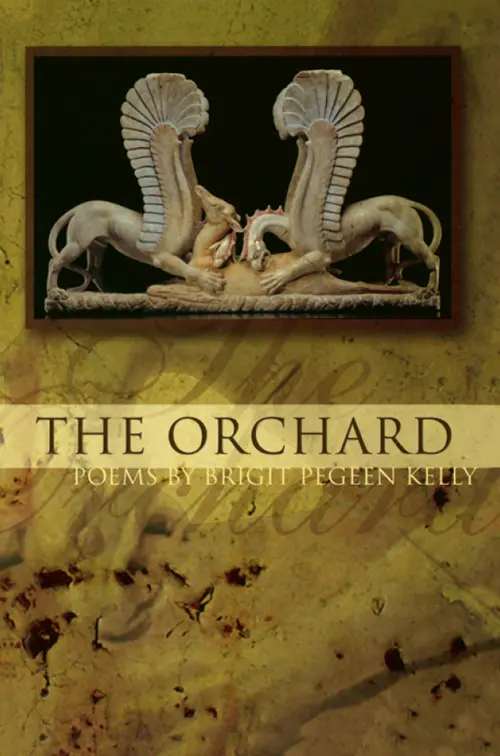

THE ORCHARD
Dedication
for Maria

I
Black Swan
I told the boy I found him under a bush.
What was the harm? I told him he was sleeping
And that a black swan slept beside him,
The swan’s feathers hot, the scent of the hot feathers
And of the bush’s hot white flowers
As rank and sweet as the stewed milk of a goat.
The bush was in a strange garden, a place
So old it seemed to exist outside of time.
In one spot, great stone steps leading nowhere.
In another, statues of horsemen posting giant stone horses
Along a high wall. And here, were triangular beds
Of flowers flush with red flowers. And there,
Circular beds flush with white. And in every bush
And bed flew small birds and the cries of small birds.
I told the boy I looked for him a long time
And when I found him I watched him sleeping,
His arm around the swan’s moist neck,
The swan’s head tucked fast behind the boy’s back,
The feathered breast and the bare breast breathing as one,
And then very swiftly and without making a sound,
So that I would not wake the sleeping bird,
I picked the boy up and slipped him into my belly,
The way one might slip something stolen
Into a purse. And brought him here....
And so it was. And so it was. A child with skin
So white it was not like the skin of a boy at all,
But like the skin of a newborn rabbit, or like the skin
Of a lily, pulseless and thin. And a giant bird
With burning feathers. And beyond them both
A pond of incredible blackness, overarched
With ancient trees and patterned with shifting shades,
The small wind in the branches making a sound
Like the knocking of a thousand wooden bells....
Things of such beauty. But still I might
Have forgotten, had not the boy, who stands now
To my waist, his hair a cap of shining feathers,
Come to me today weeping because some older boys
Had taunted him and torn his new coat,
Had he not, when I bent my head to his head,
Said softly, but with great anger, “I wish I had never
Been born. I wish I were back under the bush,”
Which made the old garden rise up again,
Shadowed and more strange. Small birds
Running fast and the grapple of chill coming on.
There was the pond, half-circled with trees. And there
The flowerless bush. But there was no swan.
There was no black swan. And beneath
The sound of the wind, I could hear, dark and low,
The giant stone hooves of the horses,
Striking and striking the hardening ground.
Blessed Is the Field
In the late heat the snakeroot and goldenrod run high,
White and gold, the steaming flowers, green and gold,
The acid-bitten leaves....It is good to say first
An invocation. Though the words do not always
Seem to work. Still, one must try. Bow your head.
Cross your arms. Say: Blessed is the day. And the one
Who destroys the day. Blessed is this ring of fire
In which we live....How bitter the burning leaves.
How bitter and sweet. How bitter and sweet the sound
Of the single gold and black insect repeating
Its two lonely notes. The insect’s song both magnifies
The field and casts a shadow over it, the way
A doorbell ringing through an abandoned house
Makes the falling rooms, papered with lilies and roses
And two-headed goats, seem larger and more ghostly.
The high grasses spill their seed. It is hard to know
The right way in or out. But here, you can have
Which flower you like, though there are not many left,
Lady’s thumb in the gravel by the wood’s fringe
And on the shale spit beneath the black walnut that houses
The crow, the peculiar cat’s-paw, sweet everlasting,
Unbearably soft. Do not mind the crow’s bark.
He is fierce and solitary, but he will let us pass,
Patron of the lost and broken-spirited. Behind him
In the quarter ring of sumacs, flagged like circus tents,
The deer I follow, and that even now are watching us,
Sleep at night their restless sleep. I find their droppings
In the morning. And here at my feet is the self-heal,
Humblest of flowers, bloomless but still intact. I ate
Some whole once and did not get well but it may strike
Your fancy. The smell of burning rubber is from
A rabbit carcass the dog dragged into the ravine.
And the smell of lemon is the snakeroot I am crushing
Between my thumb and forefinger....There could be
Beneath this field an underground river full
Of sweet liquid. A dowser might find it with his witching
Wand and his prayers. Some prayers can move
Even the stubborn dirt....Do you hear? The bird
I have never seen is back. Each day at this time
He takes up his ominous clucking, fretting like a baby,
Lonely sweetling. It is hard to know the right way
In or out. But look, the goldenrod is the color
Of beaten skin. Say: Blessed are those who stand still
In their confusion. Blessed is the field as it burns.
The Garden of the Trumpet Tree
Someone stuck an apple in the stone head’s open mouth. A grave insult. But I did not take it out. Maybe a boy did it, running through the gardens at night, his pockets full of fruit. Or maybe it was a ghost bored with its lot. It does not matter. Today I stood for the first time before the bodiless head and the strange flowering tree it guards. I tried not to laugh. The head on its post stood no taller than I. The head that had bullied me for so long, the great stone head that only the darkness had been able to silence, bagging it each night with a soft cloth sack, the way the heads of those to be hanged are bagged, made no sound. I tried not to think: This is your just dessert: Pillar of pride, pilloried. I touched with both hands the eyes of the head the way a blind person might. They were huge and swollen like the eyes of the deaf composer, or the eyes of the mad poet who left his wife alone while he spent his days in paradise. I touched with one finger the warm fruit. Against the pale cast of the stone the apple shone uncommonly bright, and behind it the thousand and thousand blossoms of the trumpet tree shone uncommonly bright. The fruit and the blossoms were the same scarlet color, and I could see for the first time in the yellow morning light the curious tree for what it was. Not a tree in flower, as I had so long thought, but a flowerless tree coupled with a blossoming trumpet vine. The vine had grown snakelike up and around the trunk, and it had grown so large it had half-strangled the small tree, crawling over every branch and shoot, until the vine and the tree were almost indistinguishable, green flesh and charred wood, flowers and rot, a new creation, a trumpet tree, tree out of time, the smoldering center of some medieval dream. The flowers swam forward in the light, each scarlet bloom so intricate and unlikely—downswung, fluted, narrower than the narrowest piping, forked with yellow silk—it looked as if it had been sewn by hand, the whole improbable tree looked as if it had been worked with impossible patience by a woman’s pale hands. Bees stumbled in and out, shaking the flowers. From nowhere a hummingbird appeared, iridescent, green, flipping its shining tail, a creature more fish than bird, more insect than fish, spinning and sipping. To nowhere it returned. The garden stood perfectly still. And for a moment in that garden it seemed as if sound and silence were the same thing, for a moment it seemed as if the thousand and thousand tiny trumpets were blowing a thousand and thousand shining notes, blown glass notes, the liquid substance of the air itself, glass and fire, the morning flushed to perfect fullness. I stood for a long time, breathing in the strange perfume of those scentless flowers. I thought of how the crow would come in an hour or two and plant his dusty feet on the carved head and pluck the fruit apart, piece by sweetened piece. I looked at the blossoming tree. I looked at the stone head. I touched the warm fruit. And I took the apple out. There was no sound. It was like closing the eyes of the dead.
Blacklegs
The sheep has nipples, the boy said,
And fur all around. The sheep
Has black legs, his name is Blacklegs,
And a cry like breaking glass.
The glass is broken. The glass
Is broken, and the milk falls down.
The bee has a suffering softness,
The boy said, a ring of fur,
Like a ring of fire. He burns
The flowers he enters, the way
The rain burns the grass. The bee
Has six legs, six strong legs,
And when he flies, the legs
Whistle like a blade of grass
Brought to the lips and blown.
The boy said, The horse runs hard
As sorrow, or a storm, or a man
With a stolen purse in his shirt.
The horse’s legs are a hundred
Or more, too many to count,
And he holds a moon white as fleece
In his mouth, cups it like water
So it will not spill out.
And the boy said this. I am a boy
And a man. My legs are two,
And they shine black as the arrows
That drop down on my throat
And my chest to draw out the blood
The bright animals feed on,
Those with wings, those without,
The ghosts of the heart—whose
Hunger is a dress for my song.
The Wolf
The diseased dog lowered her head as I came close, as if to make
Of her head a shadow, something the next few hours
Would erase, swiftly, something of no account. And what came
To mind was the she-wolf, beneath the wild fig, nursing
The boys who would build what amounted to a lasting city
On this earth. And it was as if, on that hot afternoon, I was standing
Not in the empty aisle between the gardens, that have been
Reduced to nothing except the most rudimentary plants
And the eroding outlines of brick walls and barren terraces,
But in the white light of a studio, in which a sculptor,
Working from the only model he has, a poor dog, is carving
Out of the blackest of black stones a female wolf with two rows
Of triangular tits, which look like the twin rows of cedars the dog
Swam through and from which two boys are suspended,
Fat-thighed and fated. And the truth is both dog and wolf
Are ancient, for the sick dog comes not from the garden
But from another time, in another city, a sabbath day, foreign,
The street completely empty, the day shapely around me,
The houses, the walks, all ordered and white; and then
Out of the ordered whiteness proceeds a thing of great disorder,
A shape from the world of shadows, something to drive
Away. But I did not drive her away, though I could do
Nothing for her. And now I would make of her something
Better than she could make of herself—though the wolf
Is only remembered in her prime, and not as she must
Have been years later, after all that would pass had passed.
Brightness from the North
Bright shapes in the dark garden, the gardenless stretch
Of old yard, sweetened now by the half-light
As if by burning flowers. Overture. First gesture.
But not even that, the pause before the gesture,
The window frame composing the space, so it
Seems as if time has stopped, as if this half-dark,
This winter grass, plated with frost, these unseen
Silent birds might stay forever. It seems as if
This might be what forever is, the presence of time
Overriding the body of time, the fullness of time
Not a moment but a being, watchful and unguarded,
Unguarded and gravely watched this garden—
The black fir with its long aristocratic broken branches,
The cluster of three tiny tipped arborvitae
Damp as sea sponges, the ghostly sycamore shedding
Its skin, and the sweet row of yews along the walk
Into which people throw their glittering trash....
And who, when the light rises, will come up the walk?
We can say no one will come—the day will be empty
Because you are no longer in it. We can say
The things of the day do not fill it. We can say
The eye is not filled by seeing. Nor silenced
By blinding. We can say, we can say your body
Appeared on the table, and swiftly disappeared—
Do not let the sun go down on the dead figure,
Do not fix the dead figure in mind, the false face,
Remember as you should remember, by heart,
In the garden’s dark chamber—and the ground
Took the body, and the ground was pleased.
And oh, now, the busy light comes too quickly,
The gray grass unrolling, birds mewling in the trees,
Dawn raising the walls of day, the rooms we live in,
All our murals, pictures of gardens and presiding deities,
Things painted on plaster to keep the dying company,
A toppled jar, a narrow bird, an ornamental tree
With no name, and crouched beneath the stone table,
The lion with four heads, who looks this morning
As he rises from the shadows, like the creature
Who carries on his back the flat and shining earth.
Sheep Child
I wanted a child. What then, this? The sheep
Stands dumb behind the fence. Stands dumb.
Demanding what? Pity? Affection? A breast full
Of milk? He’s up to his neck in his filthy fur.
Honey to the flies. Rancid honey. Each coarse
Curl dipped in it. The flies reeling. A sullen
Moment....Oh, Sheep, Sheep, this is my undoing,
That you have a thought and I would read it. I would
Put my head up to your smelly head and watch
The pretty pictures sliding past: Look! there goes
The flowerless larch, lurching over the ground
Like a skiff. And that black thing spinning in the dung
Is a truck tire stuffed with hay. And here, now,
Down from the elm, comes the crow, bully bird
Beating and beating the air with his wide wings,
As if calling the field to order....There is no order.
What day of the week is this? Wash day?
Bake day? What hour of what day?....Behind you,
Flanked by steely thistle, stands the old goat,
Contemptuous, uninterested, gnawing on the last
Of a Sunday dress; and “I had a goat once,”
The thought that comes to me, “I had a small
Black goat, who pounded his head against a tree
Until he was dead. His name was Bumblebee....”
Well, night is coming on. No, it is dead afternoon.
But there is something about night in this cloud-
Shadowed field. Perhaps the stars are shifting
Behind the veil of day? Perhaps. Perhaps....Oh,
I would turn this pretty. You see the cowbirds
Riding the boney heiffer by the overturned bathtub?
The birds are dung-colored, yes, but when
They rise and swim together they change color,
Brown to red, the way the light changes color
At dusk. And, yes, the swans by the back fence
Are foul-tempered and mean as sin, but look
How their necks wave about now like the stems
Of lilies in the wind....lilies blowing in the wind....
The goat snorts and turns his back. He has
Swallowed the last of the dress....Oh, Sheep, Sheep,
This is my undoing, that you have a thought
And I can read it. Dear Monstrous Child, I would
Nurse you if I could. But you are far too large,
And I am far too old for such foolishness.
The South Gate
Light cups the breasts of the lion. Who remains
Unbothered. Stone lion. Stained breasts suddenly
Full of milk. And no one to feed on them. No one
To catch the warm liquid as it falls, sweet and fast,
To the ground. Moss on the lion’s legs. Moss
Bloodying her small feet. Moss darkening the fruit trees
Dressed now in the snow that raises the ghosts
Of dead flowers: a visible shadow: a touchable shadow:
Flesh of water and ash. Like the sun, the lion
Is a two-faced creature. One face looks forward.
The other back. One grins. The other grimaces.
Her four eyes are old. Oh, it is a far, far country
The lion comes from. A place almost unimaginable,
So dull are we. The lion herself almost unimaginable,
Even with her curious form stationed above us.
Wide the arms of the roses nailed to the wall below her.
Dry the weeds. White the snow dressing the ground
And then dressing it no more. Low the sound
Where no sound should be. Deep in the heart of the ground.
The lion will bear a child. How can a stone lion
Bear a living child? Because still in the corner
Of her deformed head a dream lodges. Her breasts
Produce milk. The sweet milk falls to the ground.
The ground is a flock of dead birds. The wind
Rises. The fed offspring stirs. Soon he will stagger
From burial. Terrible. Wrapped in soiled cloth.
Stinking. Lion flesh and bird flesh and man flesh.
We would prefer this were a trick. Strings
And ropes. But it is not. The lion will grow large.
The greenness is his hunger. His hunger will overtake
The ground and soon devour even the mother.
She will sleep in his belly. He will rock her softly.
Sheet Music
If you cannot trust the dog, the faithful one?
And is this anyway a dog? The shadows move,
Dog and dog, two lanky figures, three, sniffing
The garden’s charred terrain, the darkening grass
The bleeding beds of flowers, sniffing the stones
And lunging at the rabbits that spring from the beds,
Wet creatures, mad with haste, mad and wet
And white as the half-hearted moon that stepped
Behind the clouds and has not come back....The rain
Fell hard, and now the mist rises, consolidates, disperses,
That thought, this, your face, mine, the shapes
Complicating the air around the abandoned birdhouse,
Big as a summer hotel, thirty rooms
For thirty birds, thirty perches from which to sing.
Such is the moon when it is full. A giant birdhouse
Tilted high on a steel pole, a pale blue box
Full of the shredded sheet music of long-dead birds....
The dogs move fast. How will I follow? And which one?
They are not in agreement. If the dog cannot be trusted,
Then what? The foot? But the foot is blind, the grass
Cold through the thin socks, the instep bared like a neck.
And now the flowers rise. The mums and asters,
The tall gladioli knocked back as the rain creeps up
In the mist, and the mist thickens and moves about me
Like a band of low-bred mummers, dripping scent,
Pulling my hair, my arms, trying to distract me,
But still I hear it, the dark sound that begins at the edge
Of the mind, at the far edge of the uncut field
Beyond the garden—a low braying, donkey
Or wolf, a low insistent moan. If I whistle
Will the dogs come? Can I gather their trailing leashes
And hold them in my hand? They cannot be held.
How pale the paint of the birdhouse. How ghastly pale
The sound of the cry coming closer....If I forsake
The dogs?....If I forsake the mummers?....If I step
Like a fool into the glassy outer darkness?....O self....
II
The Satyr’s Heart
Now I rest my head on the satyr’s carved chest,
The hollow where the heart would have been, if sandstone
Had a heart, if a headless goat man could have a heart.
His neck rises to a dull point, points upward
To something long gone, elusive, and at his feet
The small flowers swarm, earnest and sweet, a clamor
Of white, a clamor of blue, and black the sweating soil
They breed in....If I sit without moving, how quickly
Things change, birds turning tricks in the trees,
Colorless birds and those with color, the wind fingering
The twigs, and the furred creatures doing whatever
Furred creatures do. So, and so. There is the smell of fruit
And the smell of wet coins. There is the sound of a bird
Crying, and the sound of water that does not move....
If I pick the dead iris? If I wave it above me
Like a flag, a blazoned flag? My fanfare? Little fare
With which I buy my way, making things brave?
No, that is not it. Uncovering what is brave. The way
Now I bend over and with my foot turn up a stone,
And there they are: the armies of pale creatures who
Without cease or doubt sew the sweet sad earth.
Two Boys
The boy drowned in the bog. Not a pretty sight.
Not a pretty end. And it no accident. And him
A stranger in town. Rank the berries in the bushes.
And mute the birds. Not like birds at all.
And afternoon come too soon, and then
Come no longer....What is the life of a man?
Or one not even a man? Has it the shape of a bird?
Or a dog? Or an insect dressed in robes of white
And robes of green? And if a life takes its own life?
If a man takes from himself a man? Or a bird
From a bird? Or a dog from a dog? What is
That like? Birds may fall faster than thought,
But a dog is no lamb, it will not easily strangle—
Greenness like fire will not swiftly stamp out....
The boy drowned in the bog. He came from
A long way off to lie down in such sickly water.
Not like water at all. Poor and brown. Not one
Fish in it, not one blind fish. There would
Have been a better time. Or place. Better.
But fate, what is it? Who met the boy
By daylight? And how did he know him? By
What seal on the forehead? Talon or star?
Who said, Thus far shall you come and no
Farther? This circle of beaten trees. This ring
Of dark water. Who raised the curtain?
Who prompted the action? Who conceived
It in the first place? What prophet in what
Dark room? Did he weep when he wrote
Down the words? Did he watch till the end,
Or did he leave that for others? And what
Did the flesh smell like when the prophecy
Was sealed? A burned flower? Or ripened fruit?
What sang in the trees before the boy
Lay down or after? A child? Or the light?
Or nothing. Just a bird. Nothing. And then
Night coming on. And morning coming after....
And so we have a story. But still the story
Does not end. Green the cress by the water.
Green the insect’s wing. Now the living boy
Finds the dead one. A gift for early rising.
The Story Continues on BooksBarbecue!
Enjoyed this preview? ❤️ Do not stop here!
Read the complete book free online → 🔗
Continue reading now on BooksBarbecue and discover every page!
Love reading? Bookmark BooksBarbecue.com for more amazing books!
Happy Reading!