The Nightmare Thief
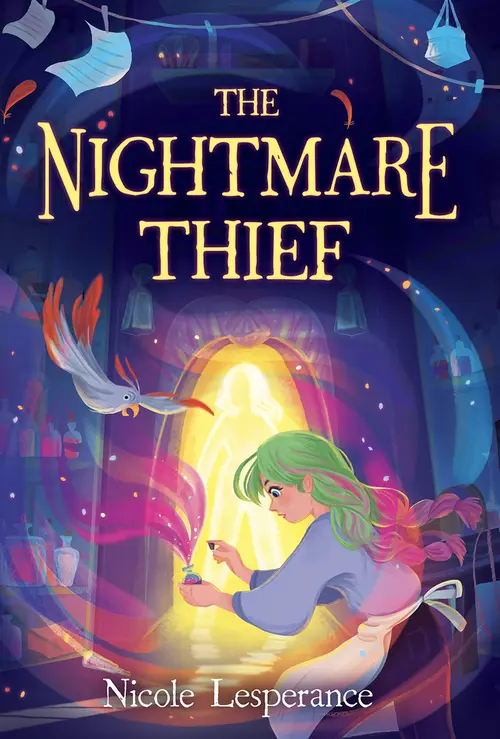
Front Cover
Title Page
Thank you for downloading this Sourcebooks eBook!
You are just one click away from…
• Being the first to hear about author happenings
• VIP deals and steals
• Exclusive giveaways
• Free bonus content
• Early access to interactive activities
• Sneak peeks at our newest titles
Happy reading!
CLICK HERE TO SIGN UP
Books. Change. Lives.
Copyright
Copyright © 2021 by Nicole Lesperance
Cover and internal design © 2021 by Sourcebooks
Front cover design by Jordan Kost/Sourcebooks
Jacket design by Allison Sundstrom/Sourcebooks
Cover and internal illustrations © Sourcebooks
Cover illustration and internal illustrations by Federica Frenna
Internal design by Danielle McNaughton/Sourcebooks
Sourcebooks and the colophon are registered trademarks of Sourcebooks.
All rights reserved. No part of this book may be reproduced in any form or by any electronic or mechanical means including information storage and retrieval systems—except in the case of brief quotations embodied in critical articles or reviews—without permission in writing from its publisher, Sourcebooks.
The characters and events portrayed in this book are fictitious or are used fictitiously. Any similarity to real persons, living or dead, is purely coincidental and not intended by the author.
Published by Sourcebooks Young Readers, an imprint of Sourcebooks Kids
P.O. Box 4410, Naperville, Illinois 60567-4410
(630) 961-3900
sourcebookskids.com
Library of Congress Cataloging-in-Publication Data
Names: Lesperance, Nicole, author.
Title: The nightmare thief / Nicole Lesperance.
Description: Naperville, Illinois : Sourcebooks Young Readers, [2021] | Series: The nightmare thief ; 1 | Audience: Ages 8. | Audience: Grades 4-6. | Summary: When Maren breaks the strict rules of her family’s dream shop to help her comatose sister, she is caught and blackmailed by a woman with evil plans for the town of Rockpool Bay.
Identifiers: LCCN 2020034485 | (hardcover) | (epub)
Subjects: CYAC: Dreams--Fiction. | Nightmares--Fiction. | Coma--Fiction. | Family life--Fiction. | Family-owned business enterprises--Fiction.
Classification: LCC PZ7.1.L4732 Nig 2021 | DDC [Fic]--dc23
Contents
Front Cover
Title Page
Copyright
One
Two
Three
Four
Five
Six
Seven
Eight
Nine
Ten
Eleven
Twelve
Thirteen
Fourteen
Fifteen
Sixteen
Seventeen
Eighteen
Nineteen
Twenty
Twenty-One
Twenty-Two
Twenty-Three
Twenty-Four
Twenty-Five
Twenty-Six
Twenty-Seven
Twenty-Eight
Twenty-Nine
Thirty
Thirty-One
Acknowledgments
About the Author
Back Cover
For Isla and Neil. Thanks for the disco donuts!
One
Maren Partridge wondered what her sister dreamed about. She wondered if people in comas even had dreams. And she wondered if she’d ever find the perfect present for Hallie, who’d lain in a hospital bed for weeks, fast asleep like some sad fairy-tale princess. The fact that it was Hallie’s birthday made the need to find the exact, perfect thing so intense that Maren had cracked under the pressure. She’d visited every store in her seaside town, walked every inch of the rocky beach, searched every website she could think of. But none of the presents were right.
A pair of extra-fluffy fleece pajamas.
A set of noise-canceling headphones.
Recordings of herself reading three of Hallie’s favorite books, to go along with the headphones.
Ten fresh-out-of-the-package black scented markers. Vanilla, not licorice. The kind Hallie used to carry around in her purse so she could smell them whenever she wanted. The ones that left dark specks on Maren’s nose when she stole and sniffed them, instantly giving her away.
Usually Maren had a knack for finding the exact right gift for a person. Not this year, though. Three weeks ago, she’d lost her sister and her knack.
As she dragged her feet along the wooden boards of the town pier, the not-quite-right presents clanked against the tap shoes in her backpack. All around her, lights flashed and jaunty organ music piped. The foamy edges of the waves splashing at the shore were the palest shade of lavender, and the air smelled of salt and, very faintly, cinnamon. No one knew why Rockpool Bay always smelled like baking, even when the bakery was closed. It was just one of the many reasons people traveled miles and miles to vacation there.
“Singing bubbles, five dollars a bottle!” A freckled woman blew a stream of purple bubbles skyward, and the air filled with a shimmering melody. Maren smiled but kept walking. People in comas had no need for bubbles or balloons or riding the world’s most rickety roller coaster. Their brains were so badly injured that all they could do was sleep. Nothing could wake them, not bright lights or loud noises or even earthquakes.
It was time to give up. There was nothing here for Hallie.
A little girl shot a rainbow puff of edible fireworks into the sky, and as the fruit-flavored sparkles rained down, she and her brother rushed around, catching them in their mouths. Dodging around the kids, Maren headed down a set of stairs and joined the throngs of sunburnt families on the boardwalk that ran along the waterfront.
A growling rumble announced that the bus was on its way, and she fished four quarters out of her pocket. She had just enough time to make it to her grandmother’s dream shop, help for an hour, and get to the hospital. Her mother would meet her there at five thirty, bringing a cake that Hallie couldn’t eat.
With a heavy heart, Maren climbed aboard the inky-blue bus, which was dotted with silver stars and golden starfish, and found a seat. The bus lurched forward, turned onto Main Street, then roared and strained up the cobblestone hill that grew steeper and steeper. It inched past the ice cream shop, the grocery store, and the tavern, the crooked structures all leaning on each other for support. The buildings of Rockpool Bay were painted each spring in canary yellow, turquoise, and tulip pink, but as the year wore on, the salty fog stole in and slowly licked the color from their facades.
At the top of the hill, the bus stopped and Maren leapt to the curb in front of the post office and Mr. Alfredo’s Splendid Salon, where everyone always got the perfect haircut. Avoiding the potholes and the puddles that smelled like motor oil and brine, she ducked into the alley between the two buildings.
At the end of the alley, beside a dry cleaner that was almost never open, sat a quiet little shop. The sign over the door said TYPEWRITERS in bold black letters. Tucked in the bottom corner of the window was a sign the size of a business card.
(and dreams), it said in faint cursive.
Fitting her wrought-iron key into the lock, Maren tugged and twisted and pushed. As the door swung open, she inhaled the wonderful scent of ink and paper and musty old machinery. People often stopped to poke their heads inside the shop just long enough to take a whiff of that comforting typewriter smell.
Once her eyes adjusted to the dimness, Maren threaded her way through the jumble of tables. Pastel-colored electric typewriters mingled with ancient manual contraptions whose keys tangled into an impossible clump if you typed on them too fast. In his usual spot beside a Remington Model 5 Streamline lay a gray cat. He opened one eye as Maren approached.
“Hello, Artax.” Maren scratched the cat behind his ear, then headed for the narrow door at the back of the room. To a first-time visitor, it would look like someplace only employees were supposed to go—or maybe a bathroom. As Maren turned the brass knob, a croaking screech burst out from the other side.
“GROSSE PATATE.”
Maren sighed. “Hello to you, too, Henri.”
The room was not, in fact, a storage closet or a bathroom but a space even larger than the typewriter showroom. Shelves and cupboards and drawers rose all the way up to the ceiling. They were crammed with bins and boxes, jars and beakers, measuring cups and spoons. In the corner an old-fashioned silver machine burbled and let out the occasional puff of steam. A rolling ladder had been pushed to one side of the shelves, and on its top rung perched a gray parrot with red tail feathers and a vicious gleam in its beady eyes.
“AVEC UNE FACE DE MARMOTTE.” It punctuated the statement with a terrible squawk and began preening its feathers.
“Henri, that’s no way to speak to your human-niece. She looks nothing like a potato or a marmot.” A wrinkly old face appeared from behind the counter in the center of the room. Maren beamed at her grandmother, Lishta, whose hair was the same shade of gray as the parrot’s feathers. Today, it was braided and pinned to the top of her head, and she wore a blue dress with an apron tied over it.
“That bird is not my uncle,” said Maren. She’d done her braids just like Lishta’s today, except that one of hers was pink and the other green. At four-foot-eleven, Maren was one braid-width taller than her grandmother.
“Given that I adopted him long before you were born,” said Lishta, “that technically makes him your uncle.” With a cheeky wink, she hurried around the counter and pulled Maren into a hug. Her clothes smelled like lemons, and her body was frail and small-boned, as if she might be the one related to birds. “How are you, my sweet child?”
“Not great,” said Maren. “I couldn’t find the perfect present for Hallie.”
The lines in Lishta’s forehead deepened as she sighed. “You’ve still got time, dear. When she wakes up, you’ll have found the perfect thing.”
Maren bit the inside of her cheek. She wanted Hallie to wake up now, and failing that, she wanted to find the perfect present now. “How was Connecticut?”
Lishta sprang back behind the counter where she rummaged, elbow-deep, in an enormous carpeted bag. “Marvelous. Just look at all the ingredients I found.” She began pulling objects out and setting them on the counter. Broken crusts of cement; a handful of tiny flags on toothpicks; stoppered vials of various liquids; a tuft of sheep’s fleece with twigs tangled in it. Maren tugged on the rolling ladder, which let out a rusty squeak as it trundled along the floor. Henri shuffled and flapped but maintained his perch at the top.
“One-oh-seven,” said Lishta, opening a tube of lipstick and scooping out its fuchsia insides. Maren climbed halfway up the ladder and retrieved a purple hatbox with the number 107 stenciled onto its side. She passed it down to Lishta, who dropped the empty tube of lipstick inside and slid the lid back on. It still felt strange, working at the dream shop without Hallie or her mother. But her mother had switched from part-time to full-time at her office job to help cover Hallie’s medical bills and had no time to help at the shop anymore.
“What next?” said Maren.
Lost in contemplation, Lishta rubbed her thumb over the lid of a faded metal tin that had once held breath mints. Her lips moved silently.
“Gran-Gran?” Maren stepped onto the lowest rung of the ladder and shoved off, rumbling toward the old woman. Just before they collided, Maren hopped off. Lishta jolted and almost dropped the tin.
“What number?” said Maren, reaching for the silver box.
Lishta set the tin on the counter and pulled a hairpin from one of her braids. She stuck the pin between her teeth, set her hands on her hips, and stared at the tin as though expecting it to do something. Maren wasn’t sure what.
“What’s in there?” said Maren.
“Whispering dust,” said Lishta. “I’ve been searching for the stuff for years.”
She broke off as the handle of the door leading back into the showroom jiggled and squeaked. It turned halfway, then stopped. On the other side, Artax meowed, and a man’s voice murmured.
“It’s open,” called Lishta, scooping up the tin and tucking it into her apron pocket. “Please do come in.”
The door opened a crack and Artax slipped through, triggering a string of French profanities from Henri. Flapping her hands at the bird, Lishta crossed the room and pulled open the door, revealing a short, startled, bald man.
“I’m sorry,” he said, fiddling with the button on his tweed jacket. “It’s just… Well, this sounds ridiculous, but it seemed like the cat wanted me to let it in here, or maybe it…”
With an encouraging nod, Lishta clasped her hands behind her back and waited.
“It wanted me to come in.” The man’s voice dropped to a whisper. He cast an apologetic smile at Maren, who returned the expression and busied herself with tidying up the scattered spools of thread on the counter. Hallie always threw them in the sewing box in a tangled mess, but Maren liked to keep them neat.
“Perhaps he did,” said Lishta, scratching Artax’s back as he wove around her ankles.
The man coughed and blinked, staring up at the towering shelves. “Is it really true?” he whispered. “That you sell dreams?”
“It is, indeed.” Beaming, Lishta took the man’s elbow and led him to the counter. “What are you looking for, my dear?”
“I’m not sure.” The man didn’t seem to know what to do with his hands; he stuffed them in his pockets and yanked them out again. “How does it work?”
Maren tucked the last spool of thread into the sewing box and stowed it away under the counter. She opened a wide-mouthed jar and slid it over to Lishta, who reached inside and pulled out a handful of pale pink packets. They looked like tea bags but were the size of buttons.
“We craft them ourselves,” said Lishta, holding out the sachets. The man picked one up cautiously and sniffed it. “Everything is hand-collected, portioned, mixed, and ground.” Lishta gestured at the coffee grinder on the counter, an ancient contraption with a hand crank on the top and a little red drawer in its base. “And sterilized, of course.” She pointed to the silver machine in the corner, which let out a burp of steam. “We’ve got hundreds of premade dreams, but we can craft anything you like.”
“I wouldn’t know where to start.” The man held the sachet up to the light to inspect its hand-sewn edge.
The door swung open again, and a tall woman strode in. Her dark hair swirled behind her, and she wore a slash of deep-plum lipstick. She slapped her purse onto the counter beside the bald man, who jumped and dropped the dream sachet he’d been looking at.
“We’ll be right with you, madam,” said Lishta. The woman gave her a curt nod and picked a thread off her cardigan. On her collar, she’d pinned a brooch in the shape of a snow-white moth.
“JOLIE MADEMOISELLE. BONJOUR, BONJOUR, CHERIE.” Henri flapped down to the counter beside the woman. Maren had purposely chosen to take Spanish instead of French at school because it was better not to understand what Henri said. But she was fairly sure “jolie” meant pretty, but she had never heard Henri say anything nice about anyone besides Lishta. He sidled up to the woman’s purse, and then Maren understood. The clasp was shaped like a safety pin. Henri was obsessed with safety pins.
“That dream you’re holding is one of our most popular,” said Lishta to the bald man. “It’s a flying dream. Our customers often tell us the euphoria lasted the whole next day. Sometimes two or three days.”
Maren nodded along as Lishta spoke, feeling the dark-haired woman’s steely gaze on her. Customers generally didn’t want to hear a sales pitch from a twelve-year-old, but Lishta said her presence made them more trusting. And this year, Lishta had finally started teaching her how to create her own dreams.
“Our dreams can help with all kinds of ailments, physical and psychological,” said Lishta. “High blood pressure, gout, thyroid conditions, lovesickness.” She gave the man an appraising look. “Anxiety, perhaps?” He nodded nervously, and Lishta pulled out a wooden box filled with green sachets. Maren had helped her mother craft this batch of calming dreams: powdered midsummer raindrops, the softest edges of goose-down feathers, a scratching of fresh nutmeg, and a tiny snip from the lining of a brand-new pencil box.
“How do I take this?” The man handed the pink sachet back to Lishta. Beside him, the tall woman let out an irritated tsk and ruffled the feathers on Henri’s chest. Maren couldn’t believe he didn’t snap at her finger.
Lishta selected three fresh green dreams from the box and tucked them inside a plastic pouch. “Place one of these under your tongue when you get into bed,” she said. “You won’t even notice it, I assure you. The mesh will dissolve as you sleep, and there won’t be any trace when you wake up. Just make sure not to get it wet before then.”
Lishta’s Canadian cousin hand-wove the dream sachets and mailed them to her in giant boxes. Maren wasn’t sure exactly what they were made out of, but they were designed to let the dream leak out as soon as moisture touched them. You had to be very careful about keeping the dreams dry—especially the nightmares, which let out a nauseating smell when they were released and could seep through a person’s skin and give them terrible hallucinations, even if they were awake.
The man nodded eagerly and took out his wallet, but Lishta held up a finger. Maren ducked under the counter and pulled out a sheet of paper with the dream contract printed on it.
“We have one key rule,” said Lishta, and, although this was all part of the usual spiel, Maren’s chest warmed, as it always did, at the word “we.” At the fact that it was her rule, too. “You must agree to the rule and sign this contract before we can sell you the dream.”
The tall woman sighed again and made a show of checking her watch, but Lishta ignored her. Following her lead, Maren gave the man the kind, yet serious expression she’d been working on all summer, and slid the contract across the counter.
“This dream is only for your personal consumption.” Lishta pulled on a pair of wire-framed glasses and switched from her kind voice to her stern, rules-following one. “You must promise never to give it to anyone else without their consent. The subconscious brain is a fragile and easily influenced thing. No person should ever take or be given a dream he or she does not understand or expect, and no dream should ever be given with the intent of influencing another person’s thoughts, fears, hopes, memories, or wishes.” Lishta peered over her glasses. “Is that clear?”
“Perfectly,” said the dark-haired woman, though nobody was speaking to her. She rolled her eyes at Maren, who pretended not to notice.
“If we find out that you’ve broken this rule, the next time you come to the shop, the door will be locked,” said Lishta to the nervous man. “And the next time, and the next. There are no second chances. You’re banned for life.”
The first time she’d ever taken a dream, Maren had signed a copy of this contract, too, and Lishta had been very clear that she’d face the same consequence if she broke the rule. But as she listened to her grandmother recite her speech for the thousandth time, a seed of an idea sprouted in Maren’s head.
A birthday-present-shaped seed.
Even more than a birthday present. If dreams could cure all kinds of ailments, why not a brain injury? Maybe there was a way to fix Hallie that the doctors hadn’t thought of. Maybe it was worth breaking the rule if it meant getting her sister back. Maren’s feet began quietly tapping the steps for her upcoming dance recital.
Step toe toe heel step shuffle ball change.
The bald man picked up a pen. “Is that it?”
“That is it,” said Lishta. “Do you solemnly swear?”
“I do.” He printed out his name and address in tiny, meticulous writing, then signed the bottom of the page while Lishta wrapped up his dreams in a square of brown paper. As the man slowly counted his change and pocketed his wallet and the paper parcel, the dark-haired woman let out a loud huff. She drummed her long fingernails on the counter until he was gone.
“Now, the jolie mademoiselle,” said Lishta, closing the lid of the wooden box. “How may I help you?”
The woman’s mouth stretched into an oily grin. “Give me a dozen of your worst nightmares.”
Two
Lishta slid the box of calming dreams over to Maren and folded her arms across her narrow chest. “Ms.…Malo, is it?”
The dark-haired woman hesitated for a flicker of an instant. “Yes, that’s right.” She tugged her cardigan around her slender waist, and the moth on the collar opened and closed its wings. It wasn’t a brooch; it was a real insect.
“How do you get it to stay there?” Lishta eyed the moth with keen interest, and so did Henri. The fuzzy-bodied creature would make a perfect addition to some dream—once it died of natural causes, of course. Lishta would never kill something just for that purpose.
The woman smiled down at the moth, which extended its long antennae and crawled up to nestle against her collarbone. “I have a…certain way with winged insects, you might say.” Her dark eyes flashed to Lishta’s, and the two women held each other’s gaze.
There was something in the lavender-edged waters of Rockpool Bay, people said, or maybe the town had been settled by fairy folk or witches a long time ago. Whatever it was, like in other pockets of the world, a small percentage of its residents were born with very specific, small magic. Maren’s family on her mother’s side had dream magic, from Lishta to Maren’s mother to Hallie and Maren. If anyone else tried grinding up ingredients and putting them in a sachet, nothing would happen. When the women of Maren’s family did that and then blew on the ingredients, they made dreams.
Other people had different kinds of small magic. If you went to the post office and bought a certain stamp from the vending machine and gave it to Edna Frye, the crotchety postmistress, your letter or package would arrive at its destination the very same day, regardless of where in the world you sent it. At the Green and Fresh grocery store, a massive yellow rosebush sprouted out of the floor, right in the middle of the produce aisle. The owner, Ernesto Perez, kept it well pruned so the thorns wouldn’t scratch any customers. On Thursdays he handed out free roses to anyone who wanted them, and on Fridays they all grew back.
The Story Continues on BooksBarbecue!
Enjoyed this preview? ❤️ Do not stop here!
Read the complete book free online → 🔗
Continue reading now on BooksBarbecue and discover every page!
Love reading? Bookmark BooksBarbecue.com for more amazing books!
Happy Reading!