The Night Season
Title Page

Dedication
For my husband, Marc Mohan. Go, Pack!
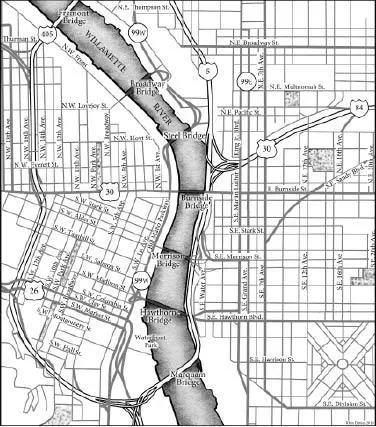
Downtown Portland
DOWNTOWN PORTLAND
Epigraph
REMEMBER:
DIKES ARE SAFE AT PRESENT.
YOU WILL BE WARNED IF NECESSARY.
YOU WILL HAVE TIME TO LEAVE.
DON’T GET EXCITED.
—Statement issued by the Housing Authority of Portland to the people of Vanport, Oregon, on May 30, 1948.
CONTENTS
Title Page
Dedication
Downtown Portland
Epigraph
Prologue
Chapter 1
Chapter 2
Chapter 3
Chapter 4
Chapter 5
Chapter 6
Chapter 7
Chapter 8
Chapter 9
Chapter 10
Chapter 11
Chapter 12
Chapter 13
Chapter 14
Chapter 15
Chapter 16
Chapter 17
Chapter 18
Chapter 19
Chapter 20
Chapter 21
Chapter 22
Chapter 23
Chapter 24
Chapter 25
Chapter 26
Chapter 27
Chapter 28
Chapter 29
Chapter 30
Chapter 31
Chapter 32
Chapter 33
Chapter 34
Chapter 35
Chapter 36
Chapter 37
Chapter 38
Chapter 39
Chapter 40
Chapter 41
Chapter 42
Chapter 43
Chapter 44
Chapter 45
Chapter 46
Chapter 47
Chapter 48
Chapter 49
Chapter 50
Chapter 51
Chapter 52
Chapter 53
Chapter 54
Chapter 55
Chapter 56
Chapter 57
Chapter 58
Chapter 59
Chapter 60
Chapter 61
Chapter 62
Chapter 63
Chapter 64
Chapter 65
Chapter 66
Chapter 67
Epilogue
Acknowledgments
Also by Chelsea Cain
Copyright
Prologue
PROLOGUE
Memorial Day, 1948
Floyd Wright came bursting into Williams’s office, red-faced and out of breath, his clothes dusty from the speeder.
“It’s bad,” Floyd said.
Williams stood up at his desk. He took the news in stride. You didn’t get to be president of the Portland Union Stockyards without having an iron stomach. He’d known this could happen. It’s why he’d sent Floyd out on patrol. He was already calculating their losses, rerouting cattle cars on alternate lines. If the tracks were down for a few days, they could still get the butchers their meat.
Williams’s secretary scrambled into the office after Floyd, but Williams didn’t want her interrupting. He motioned for her to wait, and she stopped a few steps inside the door.
“What are we looking at?” Williams asked Floyd.
Floyd held his hat in his hands. “It’s the west side,” he said. “Complete collapse. Fifty feet, at least.”
Fifty feet? They had expected that the dike might spring a few leaks. Those could be repaired. A fifty-foot breach was something else entirely. There weren’t contingencies for that.
“Oh my lord,” the secretary said.
She was staring out the window, her hand covering her mouth.
Williams had spent enough time at that window watching the cattle cars come in to know exactly what she was looking at.
He stepped around his desk and moved quickly to her side, motioning for Floyd to do the same. It was a clear sunny day, seventy-six degrees. There wasn’t a cloud in the sky. The office was on the top floor. Beyond a hundred acres of wooden pens that held cattle waiting for slaughter, they had a good view of the city of Vanport, and to the east, the railroad tracks that formed the city’s eastern boarder. Seventy-six two-story apartment buildings were arranged in groups of four around utility buildings. A movie theater. An elementary school.
The railroad bed functioned as a dike, holding back Smith Lake from the Vanport floodplain. The breach was visible even from the window. Brown water gushed from where the gravel and dirt had given way to the lake’s pressure, over the tracks and down toward the city.
Vanport was going to flood, and fast. Williams felt his stomach knot. The stockyards were above the floodplain. The cattle, the buildings, the water wouldn’t reach them. But those people in Vanport. All those people.
“Call the Vanport city manager,” Williams barked at his secretary. “Tell them there’s a fifty-foot gap in the railroad fill near the northwest corner of the project.”
The girl hesitated. Her eyes looked wild.
“Now,” he said.
“Yes, sir,” she said, turning and running to her desk outside the office.
Fifteen thousand people lived in Vanport. Working people. Families. Plenty less than lived there during the war. The apartments were cheap, but the walls were paper thin, and there wasn’t hot water or heat at night.
“They don’t have telephones,” Floyd said. “Company decision.”
As the minutes ticked by, the two men listened in silence for the emergency siren. Williams didn’t hear anything. He lifted the window. The smell of cattle and hay settled in the office. He could hear the moan of the cows, the tremble of their hooves on the bare beaten ground. But he still didn’t hear a siren.
It was 4:35 P.M.
His secretary returned.
“Well?” Williams said.
“I told them,” she said.
Several more minutes passed. Williams began to fume. He picked up the pair of binoculars that he kept on the windowsill and aimed them out the window. The breach had widened, and was now nearly a city block long. The water from Smith Lake spilled through the dike like a gleaming brown waterfall. It was coming with such force that Williams could see it moving, see it spreading on the west side of the dike, a new lake forming, widening by the second, the muddy water transforming as it advanced, reflecting the calm blue of the sky, deceptively tranquil. He followed the water west with the binoculars, toward Vanport. A boy riding his bike in the two feet of water that had already collected on North Portland Road. A car driving up Victory Avenue. A couple walking together across a park.
“What’s taking them so long?” Floyd asked.
It was a good goddamn question.
Williams put down the binoculars, picked up the phone on his desk, and fumbled with it, his palm slick with sweat. But he didn’t make calls. His girl did. He looked at her helplessly and she came around his desk and took the receiver and dialed, and then handed him the phone.
“Hello?” a man’s voice asked.
“For God’s sake,” Williams hollered into the phone, “alert those people.”
It was a few minutes after that that the sirens finally started.
Williams glanced at his watch. It was 4:47 P.M.
The entire railroad bed had given way now, and the lake flowed freely over it. The railroad tracks, snapped in half by the surging water, the ground washed away beneath them, now seemed to hang in midair.
The secretary began to cry quietly. Williams thought he should say something, but he didn’t know what. Floyd coughed. No one spoke. The three of them stood together at the window, wordless, as the water continued to swell. The binoculars sat on the sill. Williams didn’t want to look.
Chapter 1
CHAPTER
1
Present day
Technically, the park was closed.
But Laura knew a place where the wire fence was split, and she had let the Aussies through and then climbed over behind them. It looked like a pond. There was, in fact, no place muddier in the winter in Portland, Oregon, than West Delta Dog Park, and that was saying something.
The dogs ran ahead of her in the standing water, splashing it behind them, already matted with wet dirt and dead grass. Occasionally they turned to look back at her, their warm breath condensing in the January air.
Laura wiped her nose with the back of her hand. It was a terrible day to be out. Her rain pants were slick with rain, her trail runners were soaked. She’d spent the early morning sandbagging downtown and her back ached. The stress fracture in her foot stung. Stay off it for six weeks, the doctors had said. As if.
The cloud cover hung so low that the tops of the trees seemed to brush it.
She loved this.
The worst weather, body aching. Nothing could keep her inside. Biking. Running. Walking the dogs. She was out there every day, no matter what. Not like all those poseurs who came out in the summer in their REI sun shirts and ran along the esplanade with their iPods and swinging elbows. Where were they in the dead of winter? At the gym, that’s where.
God, Laura hated those people.
Franklin glanced back at her, wagged his stubby tail, barked once, flattened his ears, and took off across the old road to the slough. It was their usual route. Penny, the puppy, stuck closer to Laura, zipping ahead ten feet and then circling back.
Laura heard it then. She had heard it all along, but it had faded to white noise, an ambient sound, like a jet passing overhead.
The Columbia Slough.
She knew it would be high. They’d had a ton of snow in December. Then it had warmed up and started to rain. That meant snowmelt from the mountains. Lots of it. The storm drains were backed up. The Willamette was near flood stage. The local news was live with it day and night; they were considering evacuating downtown. But that was the Willamette. Miles away.
As Laura rounded the corner, past the trees, where the old concrete pavilion sat sinking into the slough bank, she was aware of her mouth opening.
In the summer, the slough was still and flat, blanketed by algae so thick it looked solid enough to walk on. That slough was so stagnant that Laura was surprised anything could survive in it. That slough looked like a bucket of water that had been left on the back porch all summer.
This slough was alive. It moved like something angry and afraid, churning fast and high. Whitewater swept along the bank, pulling up debris and washing it downriver. Laura saw a branch get sucked into the water and lost sight of it in an instant as it was swallowed by the seething froth.
Franklin was up ahead, nosing along the old concrete pavilion at the slough’s bank. He whined and gave her a look.
She called his name and slapped her thigh. “Let’s get out of here,” she said.
He turned to come to her. He’d been a rescue dog. Her husband had found him on the Internet. He’d been kept in some barn in Idaho, given little food and no human comfort. It had taken them years to teach him to trust people. And it filled Laura with pride to know that he had turned into such a good dog.
Even with the noise of the slough, he’d heard her. He’d turned to come.
And that’s when it happened.
Did he slip? Did the slough rise up suddenly and take him? She didn’t know.
He was looking right at her, and in a second he was gone.
It took her a moment to move. And then she snapped into action.
Her dog was not going to die. Not like this. She ran. She didn’t think about the stress fracture. The sore back. The raging river. She ran to the edge of the bank, scanning the water for him, as Penny barked fiercely at her heels.
Her heart leapt. She saw him. A glimpse—a wet mound of fur struggling in froth. He was already moving down the river, but he was alive, his black nose just above water.
She had several options.
Maybe if Franklin hadn’t been looking her in the eye when it happened she would have considered more of them. She would have called for help, or run alongside the river, or tied a rope around her waist.
She knew what happened to people who went into water after pets.
They died.
But Laura had seen something in Franklin ’s brown eyes. He’d looked right at her.
“Stay,” she said to Penny.
And she plunged into the cold water after him.
Laura’s first sensation, in the rushing dirty sludge, was of not being able to breathe. She’d been hit by a car once, on her bike. It was like that. Like having all the air forced out of you by an impact of steel and concrete. Laura forced herself to take a deep breath, filling her lungs, and she tried to orient herself. Her head was above water, her wet braid around her neck. She was already turned around, already ten feet away from Penny, fifteen, twenty. The roar of the slough was unrelenting. Twigs and branches snapped against Laura’s face in the current, stinging her skin. Penny stood barking at the shore, pawing at the ground. Until Laura couldn’t hear her anymore.
Where was Franklin?
Laura struggled to see him, but at water level all she could see was more water. She was fifty feet away from Penny now. Sixty. She couldn’t see. She couldn’t see the shore. Just the sky, dark clouds, above her.
Float.
Cold water survival. You lost heat swimming.
Just float.
She took a deep breath and lifted her hands, already numb, foreign, like they belonged to someone else, and she spread her arms and bobbed on her back, and let the current take her.
The current had taken Franklin.
It would take her to him.
Cold water filled her ears. They ached. Her teeth chattered, the sound lost in the roar of the slough. Her clothes felt heavy, filled with water, dragging her down.
And then she heard him.
Laura rolled over and used the last of her strength to fight her way through the current toward the whimper. He was there, caught against the roots of a fallen tree, the water trapping him. He saw her and his ears perked up, and his paws paddled in vain toward her.
She got to him.
She didn’t know how.
She got to him and wrapped her arms around his neck. He could have fought her. Animals did that. Panicked. But he didn’t. He went limp. He went limp into her arms, and she was able to use the tree as leverage and push her heels into the silt at the bottom of the slough, and she managed to somehow inch them both to the muddy riverbank.
She collapsed beside him in the mud, still holding on to him, still not letting him go. Her heart was pounding. They were soaked. Franklin whined and licked her face.
They’d made it.
She rolled onto her back, almost giddy. They were alive. She’d like to see one of those fair-weather esplanade runners survive something like this.
Franklin shook the water from his mangy coat and Laura turned away, lifting a hand over her face. “Hey, boy,” she said. “Easy.”
He growled, his upper lip tightening. He was looking at something behind her.
“What?” she said.
Franklin’s eyes narrowed, still focused over Laura’s shoulder.
She shivered. Whether it was from cold or fear, she didn’t know.
Laura turned around.
In the mud of the bank, partially exposed, was a human skeleton.
Chapter 2
CHAPTER
2
Susan Ward was singing along to “Smells Like Teen Spirit” when she almost hit the seagull.
Portland, Oregon, was an hour from the ocean. But when it was windy at the coast, the seagulls were blown inland.
Since the storms started two weeks ago, the city had been infested with them. They got into open Dumpsters, and shat on decks, and stood around on the sidewalk arguing in small groups like first-grade girls at recess. They were angry, bossy birds. But Susan figured she’d be angry, too, if she’d just been blown fifty miles.
Susan laid on her horn, and the gull gave her an accusatory look and flapped off into the rain. He was a western gull—white with slate wings and a yellow bill. They were big birds, knee-high, and built like bouncers, not the scrawny gulls of the Atlantic. Susan didn’t know for sure he was male. It was just a theory. Something about the look he gave her.
She spotted Archie’s unmarked police car on the last dry patch of asphalt in the parking lot and managed to squeeze her old Saab in beside it, then put the hood of her slicker up and stepped outside into the rain.
It was early afternoon, but it looked like evening. That’s how it was in Portland in the winter. Permanent twilight.
The rain on her hood sounded like grease popping in a skillet. It made her crave bacon.
She looked down the hillside to where Oaks Park nestled up against the flood-swollen Willamette River.
Susan felt about parks the way she felt about nature in general. She liked knowing it existed, but didn’t feel the need to partake personally. This was not a popular point of view in Portland. Portlanders, in general, took great pride in their parks, and felt compelled to visit them regularly, even in the dead of winter when it was dark and the grass had gone to mud and no one bothered to pick up their dog poop. There were wilderness parks, rose gardens, rhododendron gardens, Japanese gardens, classical Chinese gardens, skate parks, public plazas, parks with fountains, public art, food carts, tennis courts, swimming pools, hiking trails, monuments, and amphitheaters. There was even the world’s smallest park, Mill Ends Park, which was roughly two feet by two feet. Susan had always found that last one sort of ridiculous.
Then there was Oaks Park. (“Where the Fun Never Stops!”) It had been around for as long as anyone could remember, which is to say about a hundred years. A couple dozen rides, a roller-skating rink, carnival games, picnic grounds. Wholesome good times for the whole family, punctuated by a few brief periods when it was the go-to place for drugs and a van quickie.
A dead body had been found on the carousel.
Susan smiled. Sometimes this stuff just wrote itself.
She finished slogging down the hill and made her way through the pretty white wooden archway to the fairway.
The cops standing around the carousel looked miserable. Hunched over, their black rain ponchos lifting in the wind, they reminded Susan of crows loitering around a carcass.
All but Detective Archie Sheridan.
He was standing away from the others, wearing one of those coats with fur-trimmed hoods that you get at army surplus stores before expeditions to the Arctic.
It was fifty degrees. Practically tropical for January, but he had his hood up. She only knew it was Archie because of how he was holding himself perfectly still, one hand in his pocket, the other around a huge paper cup of coffee, just watching. And because he was alone.
He looked over and saw her and held up the coffee cup in a sort of absentminded wave. His hangdog face was as creased as ever, crooked nose, heavy lids, but he had color to his skin again, and his eyes had more life. A green scarf covered up the horizontal scar on his neck. His brown curls poked in odd angles around his forehead.
“Is it her?” Susan asked him.
“Looks like it,” he said. “Robbins will issue an official ID from the ME’s office.”
Stephanie Towner had been reported missing two days before. The cops had found her car in the parking lot at the Bishop’s Close, an estate garden along thirteen acres of high river bluffs on the west side. Portlanders liked to take peaceful walks there when they weren’t crouching to take pictures of plants with their iPhones. The cops had found Towner’s purse at the top of a slick of mud where it appeared someone had taken a header down the riverbank. You could blame Darwinism. Or you could blame the bottle of wine her husband had reported that she’d had before she left. Maybe a little of both.
“I thought she drowned,” Susan said.
The corners of Archie’s mouth went up slightly. It had taken Susan a year to recognize the expression as a smile. “I think she did,” he said.
She followed his gaze to the carousel. It was housed in an octagonal-roofed pavilion that was open on all sides. Fifteen or twenty seagulls fought for space on the roof. They shifted their weight from one foot to another and squawked nervously. The iron fence that ringed the ride was open and Susan walked inside. One of the poncho-wearing cops put a hand out to stop her. “Not on the platform,” he said, jerking his head toward the muddy footprints on the carousel’s oak flooring.
She nodded and peered forward from the platform’s edge. The corpse was positioned on an ostrich. The ostrich was beautiful, carved out of wood, brown with a red and gold saddle. His yellow legs stretched apart, as if frozen in a joyful skip. Stephanie Towner was posed as if riding the thing. But it wasn’t convincing. She’d slumped down, her chin now pressed against the base of the ostrich’s neck, her arms dangling on either side of its belly. Thankfully, her hair covered her face. Susan couldn’t see well enough to make out many details. But it was clear that she’d been in the water. Or at least in mud.
Archie stepped up behind Susan. She could smell the coffee in his hand and the wet fur on his coat. The rain fell against the carousel roof. The seagulls squawked. “She was moved,” he said. “There’s mud and grass.” He turned to face behind them and motioned across the park to the picnic area at the river’s edge, where a chain-link fence lined the riverbank. “We found hair on the fence. Looks like the current washed her downstream and she got tangled up there. Then someone found her, got her over the fence, and dragged her here. Rain washed away any good footprints, but you can make out the drag marks in the mud.”
Susan got out her damp notebook and wrote all that down.
Archie was throwing her a bone and she knew it. He’d done that a few times over the last six months. It wasn’t his fault that she’d almost gotten herself killed a couple of times in his presence, but he didn’t seem to know that. So he gave her a heads-up on the weird stuff. Scoops. She was sure everyone at the newspaper thought they were sleeping together.
“Who called it in?” she asked.
“Crew working on the rink,” he said. “I think they’re doing something to the floor.”
Susan had grown up roller-skating at the Oaks Park Roller Rink. Everyone celebrated birthdays there. All the kids skated around under the disco ball until someone inevitably broke a bone and had to go to the emergency room. The rink was now the home of the Rose City Rollers roller derby team, a bunch of tattooed, big-thighed, badass girls in short-shorts. “It floats,” she said. “The rink floor. It’s on pontoons. When the park floods they detach it from the foundation.”
Archie shrugged and took a sip of coffee. “That’s clever. I guess.”
Susan craned her head toward the roller rink, which was at the other end of the park, and tried to catch sight of the workers. “You think one of them…?”
“Doesn’t look like it,” Archie said.
She turned back to the carousel. It was ringed by three rows of animals on ascending circular platforms. Jumping horses. Standing horses. A cat. A deer. A dragon. Zebras. Mules. Pigs.
The Story Continues on BooksBarbecue!
Enjoyed this preview? ❤️ Do not stop here!
Read the complete book free online → 🔗
Continue reading now on BooksBarbecue and discover every page!
Love reading? Bookmark BooksBarbecue.com for more amazing books!
Happy Reading!