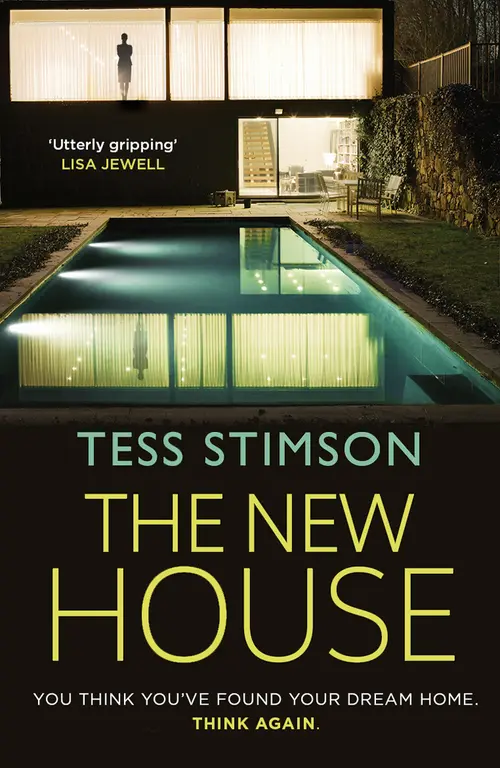
The New House
Cover
Praise for Tess Stimson
‘Dark. Twisty. Addictive. I couldn’t put it down’
Lisa Jewell
‘More chilling than Gone Girl and twistier than The Girl on the Train, this emotional, raw, dark family drama keeps you guessing until the end’
Jane Green
‘Truly gripping: the opening is heart-breaking and it never lets up, all the way to a genuinely shocking denouement’
Alex Lake
‘Well-drawn characters, believably complex relationships and relentlessly twisting plot keep the reader guessing. Plus, Tess Stimson writes beautifully’
Debbie Howells
‘Tense, twisty, and that ending – wow!’
Jackie Kabler
‘Such a gripping, fast-paced book. I just couldn’t put it down and read it within a day!’
Short Book and Scribes
Dedication
For my mother,
Jane, my father Michael,
my sweet sister Philippa
and beloved brother Charles.
Holding you all in my heart until we’re together again.
part one
chapter 01
millie
The silence of a house that’s been broken into is unlike any other. It’s as if you’ve flipped up its skirts and made it gasp, taking all the air with it.
Those first few stolen seconds of stillness are like a drug to me. I could spend a lifetime in this moment, at peace.
But it doesn’t last long.
It’s broken by the soft patter of feline paws running down the hallway. A grey cat slinks into the laundry room, ignoring me completely as she heads to her bowl. She isn’t the least bit interested in me, or what I’m doing in her house.
Cats have refined survival of the species to an efficient minimalism. Even the most self-absorbed cat will nurture her own kittens. But by the time they’re eight weeks old, the mother, having accomplished the important work of teaching them independence, is done with them. She’ll still intervene if they’re in trouble or get too rough in play, but she won’t interact with them on a regular basis. She’ll swat a youngster who disturbs her rest. And once they reach adolescence, at around twelve weeks, it’s every cat for herself. The mother will hiss if they come near her food. She won’t grieve when they disappear from the home. In fact, she’ll be relieved.
We don’t blame a cat for being a cat.
You knew what you were getting into, Tom says. You’re an intelligent woman. You knew what having children would mean.
The cat twines herself in a figure-eight around my legs, seeking more food. I pick her up, stroking the back of her head, enjoying the sensual pleasure of her fur beneath my fingers as I wander into the kitchen.
I had high hopes for this property, but it looked a lot better on Rightmove than it does in person. The pictures were clearly taken with a wide-angle lens, and then Photoshopped. The kitchen has very little natural light, and even on a bright morning like this, it feels dingy.
The owners obviously renovated before putting the house on the market – the house smells of paint – but they’ve made the same mistake most people do when they remodel a kitchen: they’ve upgraded the cabinets and appliances, but kept the same inefficient, dated layout.
It’s nicely done, with granite countertops and interesting stainless-steel backsplashes, but the way people live has changed a lot in the last few decades: a kitchen isn’t just where you cook any more, but where you live. They should’ve taken down that wall to the dining room – who actually uses a dining room these days? – and created one large, open-plan space. It would’ve given them a lot of natural light, too, from the west-facing front of the house, and they could’ve put in some French doors at the back to get that indoor/outdoor feel.
I check out the cupboards. Emma Bridgewater crockery, yawn. Expensive Le Creuset saucepans but cheap knives, which tells me everything I need to know about the people who own this house.
Upstairs is equally disappointing. A cramped fifth bedroom that should’ve been used to expand the master bathroom, or, better yet, create a decent walk-in wardrobe. Original features no one’s had the courage to either eliminate completely, or assimilate into the new design.
None of the beds are made. The cupboard doors in the master bedroom are flung wide, as if they’ve left in a hurry. Her sweaters are neatly folded in colour-coded stacks, but his side of the wardrobe is a tangled mess, with ties dribbling down the shelves, and balled-up socks on the floor. In my experience, incompatibility in a wardrobe is a more reliable indicator of divorce than infidelity.
I open the cabinet in their ensuite bathroom, scrutinising the prescription labels.
She’s had two bouts of cystitis recently. He’s got bad haemorrhoids. She’s missed a couple of her contraceptive pills this month. I wonder if her husband knows that.
Bored suddenly, I go back downstairs and scan the knick-knacks on the bookshelves in the sitting room, looking for a souvenir before I leave.
I never take anything valuable, or clearly sentimental. A fridge magnet. A bulldog clip. Nothing that will be missed.
There was a time I broke into houses on a weekly basis. Whenever life got too complicated, I’d slip away and disappear into the silence of a house that wasn’t mine. I’d spend hours in other people’s homes, perusing their wardrobes, reading their books. I find it profoundly soothing to exist in a world where I’m not supposed to be, for reasons I’ve never been able to explain.
It’s been months since I allowed my darker self to call the shots, but I’m tense and exhausted. Some people drink or take drugs to relax. This is my addiction.
I know what I’m doing is wrong: I’m violating someone’s private sanctuary. But I only visit houses that have been put up for sale, whose owners are inviting scrutiny. I’m careful never to leave a trace of my presence. I made a promise, and I never break my word.
First do no harm.
For a moment, I consider taking one of the photographs. Mr and Mrs Unmade Bed, with their two children, Boy and Girl. Here they are on their ski break in Zermatt. Oh, look! Boy and Girl have a new puppy, Dog! Look, Dog! Look!
They make family life seem so easy.
In the end I slip one of a pair of dice into my pocket, and go back through the kitchen, leaving via the same back door in the laundry room as I came in.
I even lock it behind me, which is more than the owners remembered to do.
SETtalks | psychologies series
Science ♦ Entertainment ♦ Technology
Inside the mind of a psychopath | Original Air Date 9 July
The transcript below has been lightly edited for length and clarity.
I appreciate the introduction, Ken, but I’m guessing you all know who I am, or you wouldn’t be here.
[Laughter]
I know you’re all desperate to get to the juicy stuff, the Glass House Murders, and we will soon, I promise.
But this talk is supposed to be educational, so let’s kick off with a statistic: one in a hundred normal people – and I’m putting normal in inverted commas here – is a psychopath.
I can see you all doing the maths, so let me save you the trouble. There’s about a thousand of you in this room.
So that means roughly ten of you are psychopaths. But since the stat I just gave you rises to one in twenty-five when we’re talking about business leaders and CEOs, we’ve probably got about forty psychos in here this evening. It could be carnage by the end of the night.
[Laughter]
But let’s get serious for a minute. It’s essential you approach this subject with something other than a pop-culture understanding of psychopathy.
Think of it as Psycho 101. I’ll do my best to make it as painless as possible.
Thanks to Hollywood, when you hear the term psychopath you imagine a knife-wielding maniac with crazy eyes. Jack Nicholson in The Shining, Hannibal Lecter in The Silence of the Lambs, Norman Bates in Psycho. Well, I guess the clue’s in the name with that last one.
[Laughter]
But what about this young lady who looks like Sandra Bullock sitting here in the front row? If you could just stand up – thank you. Lovely sweater, by the way. Looks like butter wouldn’t melt, doesn’t she? The archetypal girl-next-door. But trust me, she’s the one you need to be scared of.
[Laughter]
Well, not literally. Thank you, Ms Bullock, you can sit down now. My point is, not all psychopaths are wild-eyed serial killers. It’s a spectrum disorder, like autism. At one end, you’ve got Ted Bundy and Charles Manson and Jack the Ripper, Hollywood’s bloodthirsty predators.
And at the other you’ve got the brain surgeons and TV presenters and tech moguls and corporate business leaders. The people everyone needs to be ruthless and focused and unemotional in a crisis.
People like me.
When I tell people I’m a psychopath, their response is usually a mix of horror and fascination. I mean, who admits to being ‘deceptive, callous, manipulative, reckless, superficial, predatory’, right?
[Laughter]
And I’m not going to lie to you: I’m all of those things.
You’d think it’d put people off me, but no. You might be nervous, but you’re riveted and excited, too, aren’t you?
And why wouldn’t you be? I’m extremely charming when I want to be. I’m well-liked. I have lots of friends. Functionally, I’m a good person. I’m one of the ‘safe’ ones. I love to cook, and I’ve got a dark sense of humour. I often make people laugh. People come to me with their troubles.
So what makes me so different from most of you?
Well, I’m not going to bore you with lots of science about the amygdala and the orbital frontal cortex, but the bottom line is, psychopaths like me are biologically incapable of empathy.
A dozen scientific studies have confirmed it: we literally can’t feel your pain. We don’t experience fear or remorse. So we don’t care about blending into society. We’re not bothered by punishment or disapproval.
It’s a miracle more of us aren’t serial killers, to be honest.
We’ll lie and cheat to get what we want, but we don’t make moral choices; we make pragmatic ones. Usually we’re not out to get you. We’re like water: we’ll always find the quickest and easiest route to where we want to be, and if you get in our way, you’ll be washed away.
But we’re as capable of love and nurturing as we are indifference and destruction. Most of us aren’t a threat; remorse and empathy may not come naturally to us, but we can learn to care. It takes practice: it’s like learning a different language, and it’s exhausting. But we want to fit in, we want to be good people, and so we work at it.
Like I said, usually we’re not out to get you.
Usually.
A small minority of psychopaths have a predisposition to calculated violence; violence that’s cold-blooded and planned, and scary as hell.
I’m as terrified of people like that as you are. It’s not like psychos give each other a hall pass.
I’m often asked how something as ordinary as moving house descended into such chaos and bloodshed, and the truth is, I honestly don’t know. Hindsight is a wonderful thing, and, with retrospect, the signs were there. You’d think someone like me would have been able to spot them.
But at the time we had no reason to suspect anything.
We just wanted to sell our house.
chapter 02
millie
By the time I get back home, Tom is in the kitchen, organising breakfast, packed lunches, the day, our lives.
‘How was your run?’ he asks me.
‘Good. Just what I needed.’
Tom and I have been married for nineteen years. He knows it’s not the run that’s rejuvenated me, and put a spring in my step.
I left a bouquet of pink roses on the doorstep of the house I borrowed to say thank you to the owners, with a cryptic note: Pay it forward. They’ll be confused, but I hope the flowers will make them as happy as the house made me.
I hand Tom the dice I stole earlier as he puts two slices of wholewheat bread into the toaster. I don’t permit white bread in the house, or sugar, crisps, fizzy drinks. No screens at the table, or in bed.
Tom pockets the dice without comment. Later, he’ll add it to the other mementos of my extracurricular activities that he keeps in a drawer beneath his desk. I’m like a cat, bringing home a mouse as proof of my hunting skills.
Proof I still have my darker impulses in check.
The kids tumble down the stairs, already bickering and shoving at each other as they tussle for stools at the breakfast bar.
Medusa, our daughter, is thirteen, clear-eyed and knowing. She’s inherited Tom’s Black Irish hair and blue eyes, but in every other respect she takes after me. Sometimes this makes me sad; sometimes not. Naming her was my privilege, part of the deal Tom and I struck when we decided to have a child. I’d planned to call her Artemis, after the Greek goddess of the hunt, but that was before I endured a thirty-hour labour that ended in a forceps delivery and fourteen stitches.
Our son, Peter, named by Tom, is soft. Clay to her marble. He inherited my honeyed colouring, but people always say he takes after his dad. Amenable, sunny, accommodating. Ten years old, but he seems younger. He’s cerebral and dreamy; he gets bullied at school, and frequently comes home without the new computer game or collectible for which he’s saved for months.
I try not to play favourites, but if we were animals in the wild, Peter would be first to be picked off from the herd. He needs me in a way Meddie never has.
Peter sits down at the breakfast bar now and fills his bowl with plain yoghurt and granola. He reaches for the last banana in the fruit bowl to slice on top. His sister doesn’t like bananas, but now that Peter’s taken the last one, she wants it. She snatches his bowl away, and he sighs, but doesn’t object.
‘Give that back,’ Tom says.
Our daughter regards him, flat-eyed, and spoons a mouthful of granola and yoghurt between her lips.
‘Give the bowl back to your brother,’ I say.
Medusa shrugs and sends it skittering across the counter towards him. ‘I don’t want it, anyway. The granola’s got mouse droppings in it.’
Peter yelps and shoves the bowl back. ‘Ewww!’
‘Enough,’ I say, in a tone of voice that silences the pair of them. ‘I need to shower and change for work. You’d both better be ready to go when I come back downstairs. Your father doesn’t have time to take you to school today, so I’m dropping you off.’
This is a rare event. Part of our deal when we decided to have a child was that Tom would assume the lion’s share of hands-on parenting. We both knew that however good my intentions I’d quickly lose interest in the repetitive routines of childcare, perhaps with disastrous consequences.
I was quite clear when Tom asked me to marry him: I had no desire to replicate myself, no romantic longing to blend our genes. Frankly, given my childhood, I was a rotten proposition as a wife all round, but Tom was touchingly undeterred.
Perhaps it’s because we grew up together. He was, quite literally, the boy-next-door. Our parents owned adjoining semis on Kennedy Road, a cul-de-sac in what an estate agent would no doubt call a ‘leafy’ part of West Sussex. My parents bought Number 17 when my mother was newly pregnant with me. Three months later, Tom’s parents moved into Number 19.
My mother wasn’t sick then. There are photographs of her and Tom’s mother showing off their baby bumps together in the back garden. In some of them, my mother’s even smiling.
We were born two weeks apart in June 1982, just as the Falklands War was coming to an end. We went to the same nursery school and we were inseparable. Even when we moved up to primary school, and Tom made friends with other boys, he stayed loyal to me.
I spent more time in his house than mine; his mother, Amy, showed me more love and care than my own indifferent, sometimes hysterical, mother ever did. Amy fed me when my parents neglected to, and gave me a lift home from school when my father was drunk and my mother had taken to her bed with ‘nerves’.
Our bedrooms were separated by a thin partition wall, through which I’d hear Tom playing retro hits by Blondie and The Cure well into the small hours. Sometimes I’d touch my palm to the wall and almost feel him breathing in the bed on the other side.
I wasn’t like other teenage girls. I didn’t care about the things they cared about: boys, clothes, approval. I couldn’t afford to let myself care about anything. If I allowed myself to feel, the emotion uppermost would be rage.
Rage at my father, a violent narcissist who took pleasure in reducing my mother to a cowering wreck with his fist and his words. Rage at my mother, for letting herself be used as a punchbag and coming back for more again and again.
Rage at my own powerlessness.
In the absence of feeling, I’d do almost anything to force a jolt of emotion. I climbed higher up the chestnut tree to shake down conkers than any of the boys. I scaled a mobile phone mast for a dare. When I was thirteen, I sneaked out of the house in the middle of the night to climb the fence into a nearby railway yard, so that I could run the roofs of the trains parked in the sidings just for the hell of it; a fall into the gaps between carriages would have broken my neck. I hung onto the rear bumpers of passing cars on my skateboard to get a lift up the hill to our road. I was fearless, a daredevil, the leader of the pack. And Tom was my wingman.
Then – and now.
He never asked what I used to get up to when I disappeared, sometimes for days at a time, in the early years of our marriage.
We called these absences my ‘prison breaks’. Afterwards, when I returned to him, the restlessness that fuelled me would be sated for a while. Without me ever having to discuss it with him, Tom understood.
Six years into our marriage, I was the one who put motherhood back on the table, because I wanted to please him.
And I was curious. A child was the ultimate challenge.
Tom’s only condition was that my prison breaks must stop. As a mother, I couldn’t disappear for days on end. If I was to teach discipline, I must practise it.
We agreed that when the need became too strong, when the stresses and frustrations of ordinary life drove me to act out, I would limit myself to day trips and ensure I was back by nightfall. And I would tell him afterwards. Not in so many words, but with my mementos. He knows he can trust me. And so I never stray too far outside the lines.
The key to our marriage has always been honesty. My loyalty to the truth is the bedrock of our relationship. If he ever asks what I do when I’m not with him, I will tell him.
He never has.
chapter 03
tom
My wife’s very much an acquired taste. Even people who like Marmite rarely eat it out of the jar. She’s very … intense. Very focused. She likes to think she lives in the shades of grey between right and wrong, but the truth is, her moral world is very black and white.
You’re either with her or against her.
She’s not the psychopath she thinks she is. She loves fiercely and furiously, but she doesn’t wear her heart on her sleeve. She’s had to fight for everything she’s achieved: the child of an abusive drunk doesn’t easily climb out of the pit. Her fists are still raised against a world that tended to hit first. She doesn’t always follow the rules – or even the law – but she has her own personal code of honour, and she sticks to it. She never lies. And she’s loyal to a fault. If she decides to fight your corner, she’s all in – whether that’s what you want or not.
To be honest, a little of Millie goes a long way. But she’s a taste I’ve been hooked on for forty years. Back in the day, Victorians used to take arsenic regularly, using it as a tonic and an aphrodisiac. Who knows: maybe my addiction will kill me in the end.
I watch her now as she gets ready for bed, smoothing some kind of goo onto her flawless skin with deft upward strokes. Millie Downton is the woman I should not have been able to get: a nine to my four. Her thick gold hair is twisted up into a loose knot, and she’s wearing a plain white T-shirt and white cotton underwear. The soft glow from the bathroom light makes her look seventeen again. We’re the same age, forty, but she looks a decade younger than me. She’s in excellent shape, thanks to daily cardio and strength-training. She has an orthodontically perfect smile, a full mouth, and wide eyes that shift in shade between dark honey and black coffee, depending on her mood. If you were casting her in a movie, Rosamund Pike would be a good choice.
She catches my eye in the mirror as she snaps the lid of her lotion bottle closed. ‘Did you have fun this afternoon?’ she asks.
I took our son to visit the Holocaust Exhibition at the Imperial War Museum. It’s not recommended for children under fourteen, but Peter said his class is doing a block on it later this term. ‘Fun isn’t the word I’d use,’ I say.
‘I’m sure Peter enjoyed it.’
The Story Continues on BooksBarbecue!
Enjoyed this preview? ❤️ Do not stop here!
Read the complete book free online → 🔗
Continue reading now on BooksBarbecue and discover every page!
Love reading? Bookmark BooksBarbecue.com for more amazing books!
Happy Reading!