The Morbids
COVER PAGE
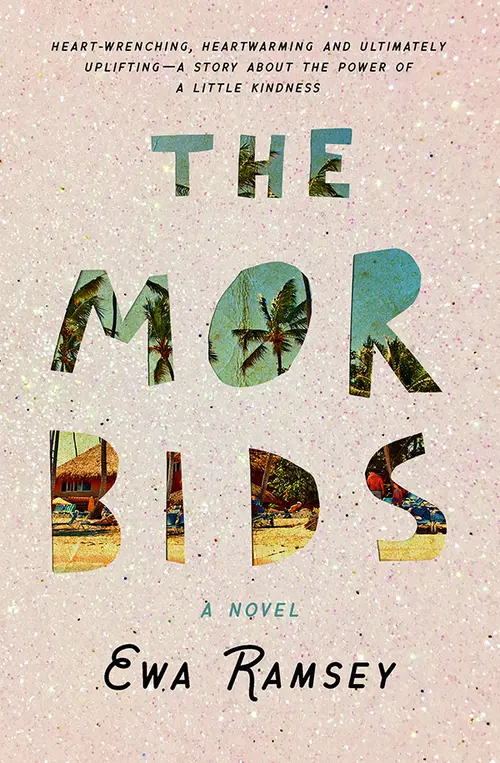
Ewa Ramsey is an emerging writer and arts administrator based in Newcastle, New South Wales. She has presented short fiction at the National Young Writers’ Festival, won a commendation in the Newcastle Short Story Award and been a finalist in the Newcastle Herald Short Story Competition. Ewa has also written for PC&Tech Authority and worked as an editorial assistant and pop-culture writer and reviewer for Atomic magazine. She is currently Operations Manager for the Newcastle Writers Festival and on the board of the National Young Writers’ Festival.
DEDICATION
For all the real-life Morbids, everywhere
AUGUST, ONCE
AUGUST, ONCE
There was glitter in my hair. When I moved it sparkled, fell, onto my hands, my lap. Stung.
There was glitter and silence—so loud it hurt my ears. And a smell I knew but couldn’t place. Hot. Rusty. Sour.
‘Hey,’ I said. ‘Are you okay?’
Nobody answered.
I looked down. My neck hurt and at the corner of my eye, I saw my hair. Pink, like fairy floss, full of glitter.
‘Hey,’ I said again, louder. Still, nobody answered.
There was just silence. And glitter.
So much glitter.
So bloody quiet.
1 TUESDAY, APRIL
1
TUESDAY, APRIL
‘It’s been three years,’ Donna finished in a shaky voice. ‘And I still wake up every morning wondering if today’s the day.’
Donna was new. Under the fluorescent lights of a nondescript community room in Surry Hills, above a health food co-op and across the corridor from a tax accountant, she looked beige. Her beige-blonde hair hung over her chest, ends crunchy with frizz and bleach, and she wore a beige-blue cardigan, skinny beige hands poking out the ends, fingers curled around each other in her lap, fading into her beige-brown pants.
Like all of us, Donna thought she was going to die. She had woken up one day, three years ago, convinced that the train she caught to work every day was going to derail and she’d be decapitated by a dislodged green leather seat. She was so convinced, she stayed home from work. The next day her fear of trains had passed, somewhat, but there was a strange pain in her calf that Google told her might be deep vein thrombosis. It wasn’t, of course, but it could have been. The day after that, she had a headache that could have been a brain tumour, and that fear of train derailment was back, even stronger.
And so here she was.
Geoff sat opposite me. He’d been coming for longer than I had—as long as the group had been going. When Donna said the thing about the train seat, his eyes had widened, and he’d turned to Frannie next to him and said, ‘God, I never thought of that. What a way to go.’ His voice was full of fear, but also wonder at this new toy to store in his brain box, ready to pull out when his favourite—domestic accident, the more unlikely the better—got boring.
We all had our favourites.
Frannie’s was cancer, Carlos’s vehicular. Louise had only been coming for a couple of months but it was obvious she was expecting something violent yet premeditated—a stalker or an ex-partner or her childhood enemy.
Mine was mugging gone wrong. Wrong place, wrong time type stuff, killed in a moment of panic or by accident—sexual violence of varying degrees optional, currently waning in frequency.
Some of us had more than one, a primary and a secondary. Louise’s secondary was cancer; Geoff’s was bad flu. He got his flu shot every year but that only protected you from last year’s strains, he told us, over and over.
My secondary was freak accident, not domestic: a shop awning collapsing, unsecured load flying off a truck, lighting rig coming loose from a nightclub ceiling. The kind of thing that would make the news not because it was tragic, but because it was so unexpected, the kind of thing the rest of us would watch on TV and think, Ooooh … good one.
The primary was the one you thought about all the time, that you’d almost accepted as inevitable. The secondary was more an uncomfortable niggle, a reason to cross the road but not to stay home.
‘My shoulder’s been sore for a couple of days,’ Frannie was saying. ‘I did help Owen move the fridge on Saturday, but I don’t think it’s that. I think it’s my lymph nodes.’
‘Ohhhh, that’s pretty advanced then. Sorry, hon.’ Donna’s eyes were damp, though it was hard to tell if she was worried for Frannie or herself.
Sometimes people came and they thought we were freaks, that we delighted and revelled in this. Some days I wondered if they were right. I looked at the beige faces, beige hands around their lukewarm cups, and I thought terrible uncharitable thoughts. But then I remembered the first time I’d felt it, walking through the park to my old house in Glebe, glitter in my hair and a horrible sound ringing in my ears. The way my heart had shifted in my chest and I’d felt it so strongly, like a friend walking next to me, arm around my shoulders—heavy and hot and smelling of rot, impossible to ignore. Not a friend at all.
I didn’t want to die. I hadn’t wanted it then and I didn’t want it now—none of us did. I just knew I would. I wasn’t as sure of anything as I was of the fact that I was going to die, that it should have happened already and it was only a matter of time.
We were all so sure.
Except we were so rarely right.
Frannie didn’t have cancer. She might develop it from the sheer number of scans she got, but so far she was clear. Carlos didn’t even have a driver’s licence. When Paulie died of a massive heart attack just before Christmas we were all shocked, much more shocked than we probably should have been. He was overweight, smoked a pack a day and his cholesterol was through the roof, but he’d been waiting for an industrial accident (he worked for a printer—in sales, but still).
And yet, we watched and we waited and we ran over our lives with a fine-tooth comb, confused and frustrated and anxious. Trying to outwit it, whatever it was, before it could kill us.
Pretend I didn’t say this, Paulie said once, only weeks before his myocardial infarction, but I reckon I’m safer for having spent all this time thinking about it. I’ve imagined sticking my hand in a trimmer so many times that when I’m near one I’m the most careful bloke in the room. The guys who are going to do it are the guys who don’t think about it, don’t see it coming.
And we all nodded and promptly pretended he hadn’t said it, because then it wouldn’t work.

We finished up a little earlier than usual, and I was grateful to escape. I had a headache—the same one I’d had for months, probably a tumour—and I couldn’t seem to catch my breath.
‘You’re quiet today, Caitlin,’ Geoff said, when my eyes hadn’t lit up at Louise’s story about being followed out of a bottle shop the weekend before.
Geoff was our unofficial leader. Officially, we were part of a ‘unique first-step program for treatment of anxiety, specifically as related to death and dying, led by a team of qualified mental health professionals’, but over the years, long before my time, those mental health professionals had been downgraded from psychiatrists to psychologists to counsellors, and then we’d been palmed off onto a series of nurses, most of whom started off with dreams of fixing us but left within months, defeated and disappointed.
According to Patrick, our last nurse who’d only made it to the six-week mark and left just after New Year, we were exhausting and ghoulish. Fiona had been with us ever since, but she spent more and more time doodling at the corners of her notepad, letting us talk among ourselves and nodding at appropriate intervals. I liked Fiona—not that it mattered; I’d liked Bernie, the first one I’d had, too, and Kim and Chris—all of them. They showed up and we let them think they were in charge, but really it was Geoff who led the sessions and asked the questions.
All of this mattered more to Geoff than it did to any of the rest of us. I wasn’t sure why.
And, truthfully, I thought Louise was probably reaching. I knew the bottle shop she was talking about. It was long and narrow and only had one door, so there was no way to leave except to follow someone else. And it was cheap, for Pyrmont, so there was always a steady stream of wine snobs and drunks coming in and out, even on a weekday morning.
Not that I ever bought wine on a weekday morning.
Not often, anyway.
I was standing on the street about to roll a cigarette when Donna came out. In the acid-washed streetlights she looked less beige. Her cardigan was teal and her trousers grey, hair blonde, still crunchy. Inside, I’d thought she was about twenty years older than me, but on the street it was more like ten. She looked like the older sisters of the girls I went to school with—cheap bottle blondes with too-long fingernails painted too-bright colours, breasts tucked into too-small bras and then too-small tops, gold bangles on their wrists and gold hoops in their ears. Multiple. Donna looked like one of them, but camouflaged and corporatised. I could see pinpricks along the curves of her ears where she’d taken out a row of earrings.
‘Want a tailor?’ she asked, holding out her pack.
‘I’m good,’ I said, finding a filter and touching it to my lip twice before letting it rest there as I filled a paper with tobacco. ‘I don’t really like the taste.’
I slipped the filter into the end of the paper, licked the edge and rolled it closed, tapping the end with my index finger, quietly proud of how perfectly cylindrical it was.
She lit her cigarette. I could tell she wanted to say something else but she wasn’t sure where to start, and when Geoff and Carlos pushed through the door she sighed, a mixture of disappointment and relief.
‘Want a lift, Cait?’ Geoff asked, like he did every week.
‘I’m fine,’ I said, like I did every week, putting the rollie between my lips and lighting it. A single strand of tobacco poked out past the filter, and I pinched it out with my fingernails.
‘Worth a shot,’ Geoff said, patting my arm as he and Carlos walked past. ‘See you ladies next week, yeah?’
‘Yeah,’ I said, smiling, forgetting they were there before they’d even turned away.
‘Do you live far?’ Donna asked. ‘I’m driving.’
‘Not far.’ I took a proper drag, looking down at my boots, scuffed at the toe. ‘Thanks, but I’m okay.’
Her lips came apart like she was going to say whatever it was she’d wanted to say before, but she thought better of it and put her cigarette in her mouth instead.
‘How long have you been coming here?’
‘About a year,’ I said, shrugging, trying not to think about it.
‘Does it help?’
I nodded, but didn’t answer, wasn’t sure how. ‘Are you coming back?’ I asked.
She paused for a second. ‘Yeah. I think so.’
‘Good.’
I wasn’t sure it was good that she hadn’t found us ghoulish or exhausting and run off into the night, never to be seen again. I didn’t know what it said about her, or me, but I was glad for it anyway. I put the rollie back in my mouth and hitched my bag further onto my shoulder. ‘See you next week,’ I said.
She nodded, and as I turned I forgot she was there too.
Carlos didn’t have his licence. Frannie didn’t smoke, didn’t drink, didn’t eat bacon or ham or salami and wore sunscreen religiously. Glenn, who wasn’t there tonight but who was waiting for a tsunami, hadn’t been east of Paddington in seven years. I didn’t know, but I was willing to bet Donna didn’t get on a train unless she absolutely had to.
I walked home by myself, every night.
Late at night, early in the morning, I walked everywhere. Over the past year or so—maybe longer—I’d mapped out the entire city, walked down every darkened lane and crossed every dodgy park and taken every dodgier shortcut, my skin crawling with goosebumps so permanent they may as well have been tattoos. I walked quickly, always vigilant, hyper-aware, scanning for threats and listening for footsteps or car engines, keys jammed between my fingers the whole way, like I’d been taught in one of the dozens of self-defence talks we were given at school. As though they’d help, as though I’d know exactly where to aim my key-fist when somebody grabbed me from behind and pulled me into a waiting car.
As though I could be bothered.
Tonight, I was skittish and restless and still cold, despite wrapping my hoodie tight around myself. It was cheap and thin, the fabric no match for the wind, which seemed to have picked up since I started walking. I took a right off Crown Street and headed past the towers on Belvoir, smoking my rollie and letting gravity pull me down the hill to Central Station. I crossed Prince Alfred Park and Cleveland Street as it arched over the railway lines, and turned into the back streets of Darlington, cutting through the uni and out onto King Street.
It was early enough that I still had to dodge the odd pedestrian as I walked, hope nobody pushed me out in front of a car or grabbed me and pulled me into an alley, but nobody did, and nobody would have noticed if they had. Shadows danced around street corners and doorways and telegraph poles, reminding me that this was a stupid, silly, terrible idea; a stupid, silly, terrible thing to do. But I did it anyway, waiting for my luck to run out. Ready.
I walked faster and faster until I was at my front door; navy blue and opening right on to King Street, almost invisible between a second-hand bookshop and a convenience store, with a small chrome plate displaying a street number, and an ancient intercom that was more for show than anything. The lock was sticky and only opened if you turned the key in the exact right way, and sometimes it took a few tries and that was when I felt it the most: the presence, eyes on me, creeping up behind me, waiting until that last moment, that last second before safety.
This time it gave first go, and I let myself in, falling back against the door as it shut, as I did every night, my heart pounding so hard I thought my ribs might break.
Alive, still.
Somehow.
It was called the cat-piss house because it smelled like cat piss. According to Marnie, my flatmate, it had been called that for years and years, the name passed down through its tenants along with a threadbare couch and a rusty breadmaker nobody was brave enough to use. Still, not long after I moved in, I hired a machine from the supermarket and cleaned and cleaned, and for weeks after all I could smell was perc and I was sure I was going to end up with brain tumours, but I hadn’t—so far—and when the headaches went away the cat piss came back. Marnie just shrugged and told me I’d get used to it.
The cat-piss house wasn’t a house. It was a flat over the secondhand bookshop, which, as far as shops to live above went, was relatively pleasant, except some nights when I’d lie in bed, too awake, and I’d swear I could smell smoke and I’d think of the back wall of the shop, lined with layers and layers of browning paperbacks, and I’d wonder how long it would take to go up if someone tossed a cigarette butt into the bin out the back or left one smouldering in an ashtray, and I’d have to get up and make sure nobody had—three, sometimes four times.
Still, it was cheap and close to the city and it overlooked King Street, and when I’d answered the ad Marnie hadn’t asked any questions or pretended we’d become best friends, which made it easier to ignore the masking tape holding the windows together and the peeling paint, hanging from the ceiling in sheets.
And I did get used to the smell. Sometimes I barely noticed it.
I walked up the narrow flight of stairs, my pulse slowing, unlit cigarette still between my lips, the end gone damp and cold, cat piss and stale smoke mixing with a new perfume of pad Thai and red wine as I dropped my bag on the kitchen bench. I could see a stack of greasy takeaway containers and two burgundy-stained glasses by the sink, a pile of mail by the toaster, a bright pink catalogue and an envelope from the gas company, and a postcard on top at an angle, tossed there as an afterthought.
Welcome to Bali! it sang in yellow, over a blue sky, bluer water, pale-gold sand, a pink and green beach umbrella over two empty pink and green sun loungers.
Nothing remarkable.
Nothing exciting.
But I stopped anyway, cold, my heart speeding up, strange and uneven and hard against my ribs.
I blinked, looking through the kitchen into the silent, empty lounge room. The glare of a streetlight right outside the window cast a phosphorescent glow over the few bits of mismatched furniture we had, and a flashing mobile phone sat plugged into a charger by the television, which meant Marnie had been here and wasn’t far away—probably at the Townie or the Courty, huddled at a table with ten of her closest friends, sharing bottles of pink wine and telling the kind of jokes that weren’t really jokes so much as secret handshakes. We weren’t those kind of flatmates—sometimes we didn’t see each other for weeks—but we could have been, if I made an effort, if I played along. I could have ignored the postcard, wandered down to the pub and found her, sipped pink wine, laughed at her jokes, been that kind of flatmate. I almost wanted to, but something stopped me.
I glanced at it again.
It could be from anyone, I told myself, pulling a beer out of the fridge and making toast for dinner. It could be to anyone. Marnie. A past tenant. The postal equivalent of a wrong number.
The smell of Thai food lingered and made my stomach rumble, but the toast was hard to chew so I threw most of it out and finished my beer, waiting for my bones to soften and my brain to slow down. I thought about Donna and that steady, rhythmic chugging of the train, so familiar and yet so strange. I thought about my best friend Lina and me, years ago, slumped low in those hard, uncomfortable fake-leather seats, not talking, just staring out the window at the blur of graffiti-covered fences that lined the tracks. We’d wasted hours that way, probably whole days, pretending we were going somewhere but not going anywhere.
We were teenagers then. Lina was still my best friend, maybe, but I never caught the train anymore, and I hadn’t spoken to her in weeks—longer. Months. Too long. She’d been calling me. Texting. A lot. Wanting to talk, to catch up. Leaving voicemails she had to know I wouldn’t listen to. I’d been meaning to get back to her, to find time, to do the things I knew I had to do, but I hadn’t.
I didn’t know how long it had been, and now there was a blue and gold postcard on my kitchen bench, watching me, waiting.
When I finally picked it up, after finishing another beer, going downstairs to check the locks on the door, checking the ashtrays and the stove and sniffing for smoke, I expected it to burn, to shock, to be heavy and hard and big and breathe fire, but it was just a rectangle of cardboard, slightly bent and too easy to tuck into mypocket, light enough that I could almost forget it was there, could still walk across the flat and into my room without collapsing under its weight.
I opened my window and looked down at the rusty awning beneath, full of so much bird poo and diesel dust and cigarette ash I didn’t know how it was still hanging. I wasn’t sure it would hold me if I fell onto it, but I leaned out anyway, feeling the cold air on my face.
I smoked a cigarette. Two. Listened.
The Story Continues on BooksBarbecue!
Enjoyed this preview? ❤️ Do not stop here!
Read the complete book free online → 🔗
Continue reading now on BooksBarbecue and discover every page!
Love reading? Bookmark BooksBarbecue.com for more amazing books!
Happy Reading!