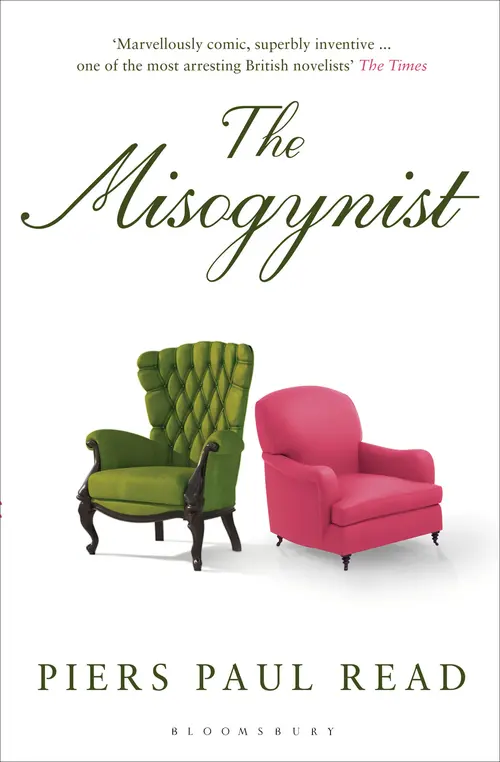
The Misogynist
Cover
PART ONE
PART ONE
Chapter 1
Chapter 1
Jomier broods. He broods about the present. He broods about the past. He types his gloomy thoughts on to his computer screen – a digital journal. At one time his journal was handwritten in notebooks with canvas covers. Now, when he has nothing more to say about the present, he returns to the past, copying the entries from the old notebooks on to the hard disk of his computer. There remain ten years still to go but one day the transcribed entries will link up with the new digital entries and his entire life will be contained in a single document. It will join digital inventories of his letters, books, CDs, DVDs, furniture and objets d’art. Everything there is to know about Jomier will be contained on a single CD, or a memory stick the size of his thumb.
Jomier does not envisage publication, despite the felicitous alliteration in the title: The Journals of Geoffrey Jomier. The project is to fill the empty days of his retirement; to create order out of disorder; and perhaps reach some understanding about what went wrong. Were his journals to be published, others might benefit from his experience and avoid making the same mistakes; but Jomier does not care enough about others to expose himself in print. To risk rejection. To admit to the banality of taking up writing in retirement. Jomier has half a dozen friends who are writing books. It is a rite of passage for men of his age. But no one wants to publish books by old men because no one wants to read them. Not, at any rate, if they are white and middle class and live in London. They want books by Asians and Africans. Or by women. By women, for women. Chick lit. Aga sagas. Women are inexhaustibly interested in themselves. Men are more wary of letting an author into their head.
There is an article in the morning paper: ‘When Can Grown Men Cry?’ It is by a woman, in the section that caters for women. Jomier does not read it but thinks back to the three occasions when he has wept as a grown man – his father’s death, his mother’s death, and when he discovered that Tilly was sleeping with Max. He sometimes rereads the entries in his journal that describe these events. Or he goes back further in his life to read the letters that Tilly wrote when she loved him. After the divorce, when she no longer loved him, they would communicate by fax. The faxes are in the box with the letters, but have faded into blank yellow scrolls. This will not affect the integrity of Jomier’s archive: the faxes are mostly matter-of-fact statements about the comings and goings of the children which are recorded in his appointment diaries. Jomier has kept all his appointment diaries as well as his letters, journals and printouts of significant emails. They are in an Office World cardboard box.
In other Office World boxes are the letters from other women whom Jomier has loved or thought that he loved; women who loved him or thought they loved him. Or pretended they loved him. Jomier remains tormented by the idea of love. He still yearns to love and be loved by a woman and despises himself for this yearning. Why will not his psyche face the facts? Si jeunesse savait, si vieillesse pouvait. Every morning mocking emails break through his spam filter on to the screen of his computer to offer drugs that will restore his potency, enlarge his penis, drive women wild. Why him? How do they know? Was his penis too small – too short or too thin? Was that what Max had over him? He had asked Tilly. A bigger penis? A better technique? A more mature ejaculation? She would not answer. ‘C’est privé.’ She was English and so talked about sex in French. Frottage. Soixante-neuf. Ooh la la!
When Jomier was young, in the years between the loss of his virginity and going steady with Tilly, he would attempt to have sex with any girl he fancied. It was less easy then than it is now. Girls were afraid they would get pregnant. The pill had been invented but doctors would not prescribe it for unmarried women. Married women could get Dutch caps and IUDs – intrauterine devices – from their doctors. French letters could be bought from seedy barbers’ shops but Jomier, like most of his friends, was too embarrassed to ask. It was up to the girl to take precautions. And there was abortion – illegal, but discreetly available for those who could pay.
Trawling through his archive, Jomier compiles a list of women he has desired, women he has propositioned, and women with whom he went to bed. He calculates that around 63 per cent of the women he propositioned said yes and 37 per cent said no. But these statistics are misleading. Eighty per cent of the 63 per cent who said yes did so either before he was married or after he had divorced. After his divorce, his success rate was high but the sample was small. The second largest category consists of those women whom he fancied while he was married but did not proposition. Because he was married. Or because they were married. He would like to have slept with them, and perhaps they would liked to have slept with him, but neither wanted to jeopardise their own or the other’s marriage. And the unmarried women on the whole did not want to waste emotional resources on a man who clearly would never leave his wife.
It has also to be said – by Jomier, as he studies his list – that there is no one whom he wishes he was married to now. This is why Jomier is so exasperated by his yearning for a woman’s love. It is generic. Invariably the specific disappoints. From behind, in the street, a tall swaying figure, long fair hair – the promise of love. He walks past and looks back. A face. Dull, arrogant, stupid, common, vain. The face of a person. Jomier is not looking for another person. Persons have moods, needs, appetites, aspirations, irritating habits. Jomier’s ideal is blank beauty – eyes, nose, mouth, ears, chin that express no personality; no character; no thoughts or feelings. Such women do exist – models on billboards or actresses on the screen. Other men search for women without qualities. Jomier is not alone.
Every now and then, Jomier sees such a blank beauty in the street. She scowls. Women take great trouble to be noticed. They think about eyeshadow and shampoo and tights and skirts and tops. But they want to be noticed only by good-looking young men. Or by other women. They are angry if these fail to notice them, but they are also angry if they are noticed by older men. Men like Jomier. Hence the scowl. Pretty girls – the blank beauties – scowl because they are so often noticed by the wrong people. Jomier can read the thought behind the scowl. ‘Fuck off!’ ‘Leave me alone!’ ‘Piss off, grandad!’ Jomier accepts that his glance is, in a sense, an invasion of privacy. Professors at American colleges are told not to make eye contact with their students. Seminarians are taught ‘custody of the eyes’. Jomier is not a seminarian or an American professor, so he looks, admires and suffers to think that he will never hold that girl in his arms.
These anguished passions are less frequent now than they were before. This is not because Jomier is older and wiser but because he has moved from Kensington to Hammersmith, a borough where there are fewer attractive women. Jomier ascribes this to natural selection. Rich and successful men live in Kensington and they choose beautiful women as their brides. Pretty girls know this. They flock to London to find rich husbands. It used to be said that the most beautiful women in England lived in Nottingham. No longer. The pretty girls from Nottingham have gone to London to work in the City. They are there to attract and breed with young bankers or hedge-funders. Their plain sisters remain behind in Nottingham, or Manchester or Stoke. Or they are already in London but live outside the pale, south of the river or, like Jomier, west of Shepherd’s Bush, that bucolically named transport hub with its litter-strewn triangle of tired grass and queues of misérables waiting for buses – asylum seekers from the White City estates, schizophrenics from the halfway houses, the homeless from the bed and breakfast hotels, the long-term unemployed, the chronically sick, the clinically depressed, wearing dirty jeans and synthetic anoraks or hooded tracksuit tops, eking out their disability benefit or jobseeker’s allowance, living off TFC chicken (‘Tantalising Fried Chicken’) or doner kebabs – dour, defeated, a few white – some Poles and Slovaks and Lithuanians here to make a quick buck before they retire to a wooden chalet on the Masurian Lakes – but mostly black – Ethiopians, Nigerians, Zimbabweans, Somalis, Egyptians, the detritus from the blighted continent of Africa who will never go home.
Jomier studies them from the top of the 94 bus. They file into the Shepherd’s Bush market to buy mangos and bananas. Arabs sell falafels, Parsees kebabs, from plywood stalls. The shops on the north side of Shepherd’s Bush Green could be in Delhi or Accra. Who needs to travel to the Third World when it is here in London – the Bangladeshis in Brick Lane, the sheikhs in Mayfair, the Turks in Haringey, Hasidic Jews in Tottenham, and a mix-and-match here in Hammersmith, fifty different nationalities milling around in the street with no apparent purpose? Fire practice at the Tower of Babel!
Jomier’s eye on the upper deck of the 94 bus is on the level of the windows above the shops. Plants grow in rotting sills and clogged gutters. He can alight here to go underground to catch a Central Line train but prefers to stay on the bus for another three stops to the station at Holland Park. He passes from the Third World into the First. On Holland Park Avenue, a butcher’s shop displays its cuts like jewellery in the window of Cartier’s; a French patisserie glitters with Tiffany-like confections; a bookshop offers novels up for literary prizes; a brightly lit chemist’s sells expensive elixirs for eternal youth; and there is a coffee shop where long-legged young women in designer jeans and preppy young men in chinos sit reading the Herald Tribune or Prospect or Foreign Affairs.
Jomier alights at Holland Park Tube station. There is a risk that in the lift going down to the Central Line Jomier will meet a former neighbour and have to make cheery conversation. At one time he might have run into Tilly or the children. Not now. Tilly lives with Max on the other side of Campden Hill. The children are grown up and gone. And Tilly never takes public transport. She either drives herself in her Prius or summons a minicab from Addison Lee.
Jomier moved to Hammersmith after his divorce. And because of his divorce. It was a ‘no-fault’ divorce. The Family Court had no interest whatsoever in adultery, the breaking of vows. It required only for one party, Tilly, to decide that the marriage had ‘irretrievably broken down’. The vehicle was a write-off. It could be disposed of as scrap. The function of the Family Court was not to dispense justice but ensure the well-being of the children. The mother was their default carer; the father the default provider. The children’s way of life and standard of living must change as little as possible. The Family Court ruled that the house in Blenheim Crescent should be sold and the proceeds divided – one-third to Jomier, two-thirds to Tilly. Jomier was to continue to pay the mortgage on Tilly’s new house on Princedale Road and a monthly sum for each child until they reached the age of eighteen. His disposable income was suddenly a quarter of what it had been before.
Jomier’s one-third share of the proceeds of the sale of his house in Notting Hill has enabled him to buy a terraced cottage in one of the streets between the Goldhawk and Uxbridge Roads west of Shepherd’s Bush. It had been built for a Victorian artisan. There is the usual double room on the ground floor running from front to back, and a small kitchen on the extension built into the garden. There are three bedrooms. The first has a wide bed; the second two bunk beds in which the children slept when they came to stay. Now they are too old for the bunk beds and they never come to stay. They have their own houses and, even when young, they preferred the comfort of their mother’s home in Kensington. Jomier knows that he should get rid of the bunk beds but does not.
The third bedroom is Jomier’s study, with his desk, his filing cabinets, his reference books, his computer. Jomier’s study is very tidy: everything has its place. So too the living room where the books and CDs are arranged neatly on shelves. Jomier has a Brazilian cleaner but she has little to do but wash and iron his clothes. The house is spick and span. So too the garden. No weed survives for more than a day after rising from the earth towards the sun. A leaf from his apple tree no sooner falls to the ground than it is put in a bag made of white flimsy biodegradable plastic stamped with the logo of the Hammersmith & Fulham Council. There are also orange bags for paper, plastic, bottles and tins – detritus that can be recycled – and black bags for real rubbish – vegetable peelings, broken light bulbs, soiled tissues, fish-skins. Jomier has his doubts about whether the contents of the orange bags are really recycled; he has been told that the black, orange and white bags all end up in the same landfill, or are dropped into the North Sea from the same barge. Even if this were proved to be true, Jomier would still sift and sort his rubbish. It satisfies his love of order. It gives him something to do.
Much that goes into the orange bag is junk mail. Among the cards from minicab companies and flyers from take-away Indian restaurants, there are thick glossy magazines with page upon page advertising houses for sale. Jomier’s spirits rise when he sees a house similar to his offered for sale at twice the sum he paid for it; but they sink when he sees that houses in Notting Hill comparable to the one he lived in with Tilly going for ten times more. If they had remained married, Jomier would be a property millionaire.
Tilly is now married to Max and lives with him in a large house on Phillimore Gardens. Max’s first wife, Jane, has returned to live in New York with her two children, Hayden and Chuck. The house on Princedale Road that Tilly bought after the divorce is let to an American banker. The rent is her pin money. Or perhaps she is building up a fund – a safety net – in case she and Max split up. Or perhaps she plans to use it to pay her grandchildren’s school fees. Jomier does not know about Tilly’s finances. She and Max live in a different world. The disposable income of Tilly’s Filipina housekeeper is larger than Jomier’s. When they were married Tilly showed no interest in where money came from or where it went. She always assumed it would be there. She took it for granted that providence would provide her with the means to lead the English upper-middle-class life to which she was accustomed. Jomier succeeded Tilly’s father as the agent of providence and whenever he failed to provide she became annoyed. She was not extravagant. She was not frugal. She spent money reasonably and thought it unreasonable if Jomier complained that she spent too much. The early years of their married life were punctuated by quarrels about money.
The divorce made her astute. At the time there was no talk of her marrying Max. Max had a wife already – Jane. Jane was American and was also rich. As rich as Max. During the bust-up, Jomier used to meet Jane for lunch to talk about Max and Tilly. At first Jomier looked forward to these lunches: there was much to discuss. Jomier was obsessed with his suffering. He was an Ancient Mariner. His friends had grown bored. Jane was an interested party. And then Jane too grew bored. Or perhaps she had never been particularly interested in what had gone wrong. Jane had always been hard to read. All those holidays they had taken à quatre; the trips to the movies; the dinners in one another’s houses; the weekends in the country; the children’s birthdays.
Why had they become friends? What was the trade? For Max and Jane, recently relocated from New York, the Jomiers were a couple who knew the ropes in London – who could advise them on where to buy a house, where to shop, where to eat out, where to send their children to school. For Jomier and Tilly, the Stutzels brought a touch of cosmopolitan glamour into their life: Max, a child of globalisation – a home on the shores of Lac Léman, the International School in Geneva, a degree in Economics from Stanford University, an MBA from Harvard Business School; Jane, a stylish East Coast Wasp, raised in Connecticut, a family house on Cape Cod. She was out of an ad in the New Yorker – clipped, slim, casually elegant – a little too tall, perhaps, so those of median height saw more of her nostrils than her nose. She had a degree in English Literature from Radcliffe but, for reasons no doubt rooted in her childhood, lacked confidence in her own opinions. She deferred to Max on the big issues, and relied on Tilly to teach her the subtleties of British upper-middle-class life – to steer her away from the crude esteem for titles and landed estates that is sometimes found in expatriate Americans; to interpret English irony and self-deprecation; to distinguish between the culture of north and west London, and warn her – in the nick of time – against living in Islington. Tilly helped Jane find a house in Kensington and pulled a few strings to get Chuck and Hayden into Norland Place.
The vexed question of what to do with young children at weekends in London brought the Jomiers and the Stutzels together. They would have Sunday lunch in one another’s houses, then take the children to the playground in Kensington Gardens or Holland Park. Or they would go to Ladbroke Square Gardens: Tilly had a key and was a member of the tennis club – both privileges that money could not buy. In summer they would have picnics on the large lawns behind the high railings that kept poor people out, and Max and Tilly would play singles at tennis while Jomier and Jane stayed with the children.
Sometimes, if there was a third party to watch the children, they would play doubles. Jomier disliked ball games and had to be cajoled on to the court to partner Jane. Max was a better player than Jomier. Tilly was a better player than Jane. The balance made for uncertain outcomes when the Jomiers played the Stutzels which in one sense was welcome; but Jomier felt unmanned by his dependence upon Tilly to take the points. Max was competitive: a triumphant gleam came into his eye when he thwacked the tennis ball at Jomier. Jomier understood that testosterone-fuelled competitiveness was a necessary quality for a successful banker, but he did not see why a languid barrister should have to play the same game.
The Story Continues on BooksBarbecue!
Enjoyed this preview? ❤️ Do not stop here!
Read the complete book free online → 🔗
Continue reading now on BooksBarbecue and discover every page!
Love reading? Bookmark BooksBarbecue.com for more amazing books!
Happy Reading!