Chapters (45)
- Cover
- The Meaning of India
- Introduction to the New Edition
- Select Further Reading on Raja Rao
- Preface
- Part I
- 1
- 2
- 3
- 4
- 5
- 6
- 7
- 8
- 9
- 10
- Part II
- 11
- 12
- 13
- 14
- 15
- 16
- 17
- Appendix
- Footnotes
- 1. The Meaning of India
- 2. India—A Fable
- 3. My First Meeting with Pandit Jawaharlal
- 4. When Malraux Meets Jawaharlal Nehru
- 5. Mahatma Gandhi: Saint or Politician
- 6. The Silence of Mahatma Gandhi
- 7. Wisdom and Power: A Marriage of Necessity
- 9. The Kumkum Mark
- 10. André Malraux among the Gods of India
- 11. On Understanding
- 12. In Search of—My Bride
- 13. The Shy Bride
- 15. Words of Acceptance
- 16. The Ultimate Word
- 17. Look, the Universe is Burning!
- Appendix : Foreword to Kanthapura
- Notes
- Endnotes
- THE BEGINNING
The word is alive. It is alive in the sense in which a caterpillar, a starling, a hippopotamus is, or like vriksha (tree), spanda (pulsation), ishvara (god) are. The word has membranes. It is palpitant, breathful. The word has self-existence. For, each word has, first, a noumenal, then a cosmological, and finally, a phonemological reality.
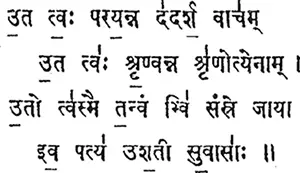
Many a man who sees does not discover the word.
And many a man who hears does not hear it.
Yet for another it reveals itself like
A radiant bride to her husband.
But, misunderstood, a word may sometime rise to unconvinced, but convincing, heights, like the word neat in America today, signifying the clever, the extraordinary—such words decay too—and is termed ultimately obsolete. The dictionary in that context is, partially, also a burial ground. Further, some words historically, humanly conditioned—having no primary-sound roots—become enfeebled like poisoned cockroaches. A certain number are just killed, squashed under, with a weight of journalistic, marketplace usage. A few words too are outcasts, like tiffin or bund in Indian English. And some are absurd misshapen monstrosities, such as OK. History will, I hope, hang it.
The writer is one who lives with these live creatures, like a shepherd with his sheep, or a Bantu, a Gond, with his fellow creatures of the vast, wild spaces. Sometimes they come to him, like a lion does, a peacock, a doe, maybe to be recognized, caressed. Others, you have to maybe seek, each one with green grass (or a chip of buffalo or goat) in hand, for him to be drawn closer—then you put a noose around his neck and make him your own, like one does a zebra, a wild horse. Some, however, when you are engulfed within yourself, and reach your Manasa-Gangotri, a Muchalinda might appear from nowhere and, spreading his seven hoods above your head, protect you from sun and rain: then a word, a sentence will upsurge. These words become mantras. Hence the word kavi in Sanskrit means a rishi, sage. The poet is then the sage. The emergent word thus having come in, the quiet helper, then, the noble mistress, finally, becomes his wife.
She becomes He, and is impregnated.
The poem becomes the poet. The meaning becomes the word. Parvathi becomes Shiva. Vak-artha, etc., etc.