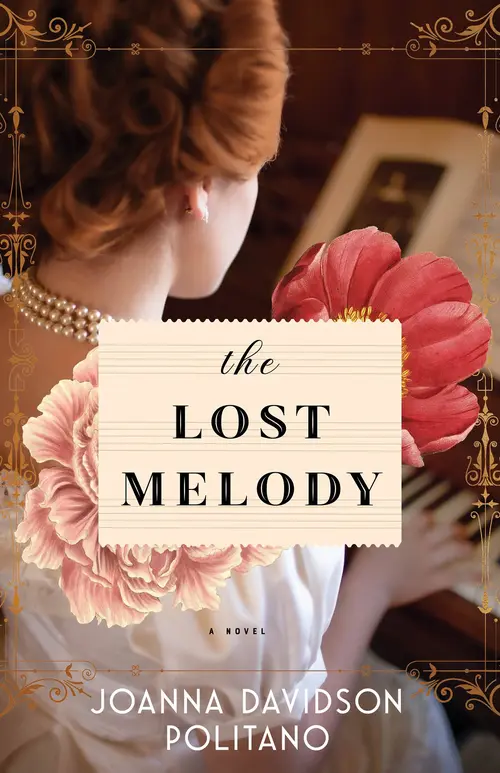
The Lost Melody
Cover
Endorsements
“Haunting. Riveting. Filled with hope. The Lost Melody is all these things and more. Author Joanna Davidson Politano delves into the dark world of Victorian mental health, and it’s the reader who comes out the winner after being enchanted by this tale of identity lost. After you read the last page, the characters will live on in your mind. Truly a fantastic read!”
Michelle Griep, author of Lost in Darkness
“Joanna Davidson Politano’s stories go on my bookshelf as a favorite! The stories she pens entice my Gothic-loving senses, thrill my literary soul, and inspire the dark romantic inside my spirit. I cannot emphasize enough how strongly I adore each story from this vivid and insightful author, and how badly I wish for all readers to experience her tales!”
Jaime Jo Wright, author of The Souls of Lost Lake and Christy Award–winning The House on Foster Hill
Praise for A Midnight Dance
“Politano writes beautifully, evoking the magic of ballet and the theater from the opening turns to the final curtain, leaving readers applauding for an encore.”
Booklist
“If you’re looking for mesmerizing historical romance, you need to read this book.”
Interviews & Reviews
“Politano’s latest novel, A Midnight Dance, is a true work of art that encapsulates ballet in the Victorian era.”
Box Office Revolution
“With an ability to create characters who pirouette right into our hearts, Politano has written a story that is at once deeply atmospheric, yet grounded in the universal ache to belong and be loved. A gently charming romance seamlessly weaves through Ella’s quest to unravel the mystery of her past.”
Kimberly Duffy, author of A Mosaic of Wings and A Tapestry of Light
Half Title Page
Books by Joanna Davidson Politano
Lady Jayne Disappears
A Rumored Fortune
Finding Lady Enderly
The Love Note
A Midnight Dance
The Lost Melody
Title Page
Copyright Page
© 2022 by Joanna Davidson Politano
Published by Revell
a division of Baker Publishing Group
PO Box 6287, Grand Rapids, MI 49516-6287
Ebook edition created 2022
All rights reserved. No part of this publication may be reproduced, stored in a retrieval system, or transmitted in any form or by any means—for example, electronic, photocopy, recording—without the prior written permission of the publisher. The only exception is brief quotations in printed reviews.
Library of Congress Cataloging-in-Publication Data is on file at the Library of Congress, Washington, DC.
ISBN 978-1-4934-3874-7
This book is a work of fiction. Names, characters, places, and incidents are the product of the author’s imagination or are used fictitiously. Any resemblance to actual events, locales, or persons, living or dead, is coincidental.
Most Scripture used in this book, whether quoted or paraphrased by the characters, is taken from the King James Version of the Bible.
Scripture marked NIV is taken from THE HOLY BIBLE, NEW INTERNATIONAL VERSION®, NIV® Copyright © 1973, 1978, 1984, 2011 by Biblica, Inc.® Used by permission. All rights reserved worldwide.
Baker Publishing Group publications use paper produced from sustainable forestry practices and post-consumer waste whenever possible.
Epigraph
The light shines in the darkness,
and the darkness has not overcome it.
John 1:5 NIV
Dedication

This story is for my wonderful grandfather,
the musician who “saw” everyone and loved them well.
Miss you, Grandpa.
First Movement

And those who were seen dancing were thought to be insane by those who did not hear the music.
~Friedrich Nietzsche
HURSTWELL ASYLUM
One day in late May of the year 1886, I found myself imprisoned in the Hurstwell Pauper Lunatic Asylum. This was unconscionable—I had never been a pauper.
I woke in a damp little room, and the music of the place was entirely wrong. I’d fallen asleep in a Beethoven sonata, white and airy, wrapped up with silky delight, and woken in the dark heart of Berlioz’s eerie Symphonie Fantastique, my head thudding with deep bassoon, the echoing rhythm of rain hitting stone. As my mind surfaced, I scrambled to collect the memories of the place, the bassoon solidified into a voice—one quite near the foot of my bed. I did not open my eyes to check.
“Don’t go too near. She’s moving.”
“Waking?”
“Not for several hours. Involuntary muscle spasms, most likely.”
Indeed. They’d overestimated whatever drug they’d injected into me. Or they had, as people often did, underestimated me. An odd thing happened when one carried a giant weight of troubles all her life—she built up a great deal of strength.
“Will we keep her?” A light timpani voice contrasted with the first.
“I’m not certain yet. It’s a rather odd case, and she’s already proved volatile. We cannot let her go free.”
I had fought, hadn’t I? My mind swirled with memories—an urgent need to escape. The failure to do so. Yes, I remembered. This is what came of trusting one’s best friend. I may not even marry him now.
“Has she a name?”
“Cora . . . Cora something.”
No. No, that wasn’t right. I wasn’t Cora.
“I’ve forgotten. Her last name is of no consequence. She doesn’t belong to anyone.”
Ouch. A pin into a live pincushion.
Scribbles on paper. “What is her condition?”
“Delusions,” came the deeper voice. The bassoon. “She hears music.”
“Rather a nice malady to have, isn’t it? Hearing music?”
“Not when there isn’t any.”
“Right, of course. Any other details?”
“We’ve only to decide if she’s acute or chronic—and that depends on her.”
“Well, her committal was . . . oh.”
“Yes. Oh.”
What? “Oh” what? my mind cried out. I recalled my childhood, my father, my home. Pianofortes. Performances. But the recent events, the details of this place, eluded me. Shrouded in the thick mist of the moors.
“Well, well. Look at this,” said the lighter voice.
Papers rustled. I wanted to snatch them and see for myself.
A frantic rapping just outside interrupted the meeting, and the door squeaked open. A breathy female voice inserted itself. “Pardon, Doctor. It’s the man in the male long-stay ward—he’s suffered another attack.”
“Very well.” After a blustery exhale, footsteps shuffled, then the door slammed shut.
But it did not lock.
Did not lock.
My heart pounded, three beats for every second that swept on silently, drawing those men and their footfalls farther from my cell and its unlocked door. My skin grew clammy, a line of moisture gathering along my legs where they lay cemented together. No one came.
I slowly activated my stiff muscles and pushed up on the bed, swinging my heavy limbs down and feeling about the cold floor for shoes as I fought the oddest sense of imbalance and heaviness. I could feel the blood recirculating, as if I’d lain comatose for a week.
Maybe I had.
Whiteness closed in around the edges of my vision as I lifted my head a bit too quickly. I saw two of everything, then four, then two, then back to one again, and the air felt thick. I forced myself to stand, holding out my arms for balance.
I could do this. I could. The woman who played an entire piano concerto without a scrap of music, who drew more listeners than her male counterparts, who survived a man like my father, could certainly stand up and walk out the front door of this rotten place. Especially since no one had a valid reason to keep me here.
They didn’t.
Stretching my neck, my legs, I eased myself up, preparing for whatever would come.
“You’re getting on quite well.” A voice to my right slid under my skin and chilled my bones.
I turned on wooden legs to see the bassoon-voiced doctor, who had apparently sent his partner on, remaining to observe me from against the door.
Thornhill. This was Thornhill, the superintendent, and a shadowy fear began to overtake me. Why, though? I couldn’t remember the details. The gears of my mind groaned into movement. Such fog, clouding what I needed to remember. “Where . . . Who . . . ?” I worked my mouth, but there wasn’t enough voice to come out. My throat was dry. A cotton-lined tube.
“Hurstwell Asylum, and your father.”
“My . . . father?” I clutched the back of a wooden chair. I began to shake. Impossible. Impossible.
Now I knew for certain this was all a catastrophic mistake. He couldn’t do this to me—not anymore.
1
I carry a deep sadness of the heart which must now and then break out in sound.
~Frantz Lizst
THREE MONTHS EARLIER, MANCHESTER
I was playing a piece by Berlioz the night my father died, the second movement of Symphonie Fantastique with arpeggios smooth as a horse’s gallop. Footsteps stopped and a figure hovered in the doorway, and I knew what was coming before our maid even spoke the jarring words. “He’s gone, Miss Vivienne.”
“I see.” I did not smile, for that would have been wicked, but I did relax, more than I had allowed myself to in many years.
Her steady footsteps crossed the carpeted room past where I sat, and she threw open the drapes on every long window—drapes that had remained drawn for years to keep my father’s headaches, and his resulting temper, at bay.
It was dark outside, still very early morning, but so many hours had passed in the waiting. The maid turned, those wise old eyes cast my direction. “Night is passing, and day is soon to come for you, Miss Vivienne.”
We shared a solemn smile. Then she gave a brief curtsy and left me.
A breezy emptiness infilled my soul at the sudden silence, a sense of unfettered spring air blowing through hollow places. Gone were Father’s company and his uncanny business sense, but so were the sting of fresh lashes across my fingers as I practiced, that voice bellowing through the halls, the silent fight always knotted up in my belly with nowhere to go. Suddenly, it had all gone slack. It was over, and I was alone in the world.
I grieved the man, but I couldn’t say I was unhappy. I looked over the vast spread of pianofortes that awaited restoration laid out before me with a new sense of ownership, of delight. It was my repair shop now, and darkness would have no place here anymore. God, you are the master of this house now. The master of me. No one else shall ever be. I felt his heady presence with the coming dawn and I welcomed it.
After several deep breaths to acknowledge the passing of a soul, I lifted my fingers to the ivories in the flickering candlelight and began the piece again from the beginning. The song was the perfect end to our tumultuous years together, powerful dissonance brimming with deeply textured tones that climbed to a rich climax as the dawn crested, colorful light brimming through the room, then simply stopped at the obvious point of conclusion, and the room was empty. Quiet and peaceful in morning’s rosy glow.
Within the hour, familiar footsteps—masculine ones—sounded somewhere in the foyer, and my breath caught. I kept my fingertips poised on the ivories, feeling the oddness of Richard’s presence in this house. Things were shifting already.
I continued playing as his footfall entered the room and crossed to me. He stopped at the pianoforte and sat beside me, the bench creaking under his weight. The slight bump of Richard’s shoulder as he slid close was all that passed between us, but it was plenty. I paused, for I suddenly couldn’t remember what came next in the piece.
Oh, how Father would hate this.
I almost began to play again, but Richard’s arm came around me, solid but cautious. I felt every inch of its gentle weight. We’d known each other all my life, and this was the first time he’d ever dared. I looked up into his face, and he smiled down at me—a solemn, affectionate look that expressed every word he didn’t need to say. The regret for my loss, the relief at my freedom, the uncertain hope of what was to come between us.
I played on for several minutes, and he listened without a word, as he always did. The song came to a gentle conclusion and I sat motionless, fingers still perched on the keys. The enormity of his masculine presence nearly undid my calm. What would happen now? Father was gone. There was nothing stopping Richard from . . . well, anything. I could feel his keen scrutiny on me. Deciding.
I looked up at him, and he leaned nearer, those familiar crescent-shaped eyes and clean-shaven chin, and laid his forehead on mine.
I ran my tongue over my lips that had gone dry and met his gaze. “So, now what?”
His hand lifted to my cheek and stroked it. “Everything’s different now, isn’t it?” A gentle smile. “What will you do with your life?”
I closed my eyes. “Oh, I have a few ideas.”
His finger came down the side of my face and teased my lips. “Anything that includes me?”
“Perhaps.” I looked up. “How are you at handling horses? I’ve been meaning to hire a driver.”
His look was amused and sympathetic all at once. Oh, how I adored this man. “Better than handling certain redheads.”
I smacked his arm, and somehow it relieved the night’s tension. Filled the cracks with a bit of joy.
“I bet I can guess your plans.” He leaned back. “After your mourning period, you’ll go out and continue to perform, maybe even better than before, and with a newfound joy that no one will truly understand. You’ll appear in concert hall after concert hall all over the Continent and amaze your audiences . . . then come home to a quiet house and live the simple, uncomplicated life you were always meant to have. One you fully deserve.”
I gave a polite smile but said nothing to contradict him. I’d known for years what I’d do with myself when I finally possessed freedom, but I dared not shock Richard with it. Not yet. I’d at least let him kiss me first.
“You’ll have your pianoforte shop, perhaps a few students, and your friends. Modest and simple and delightfully musical, a life of high quality is what fits you best.”
Few people actually knew me, as it turned out. I was a Chopin nocturne—surprising, complex, and impossible to master.
Many tried. I’m happy to report that they had all failed.
Well, nearly.
2
They probably think because I am so small and young, nothing of greatness and class can come out of me; but they shall soon find out.
~Wolfgang Amadeus Mozart
HURSTWELL ASYLUM
I stared at the asylum doctor who stood between me and freedom, listening to my explanation. My mind swam in the medicinal pea soup the longer I sat upright, but it latched on to one fact. “So you see, it wasn’t my father who brought me here. It couldn’t be.”
“I suppose not, if he’s dead.” The doctor, a bulldog of a man with a heavy face resting upon the cushion of his broad shoulders, availed himself of my vacated bed, perching on the edge and sinking it quite low. “Well, then. Perhaps it was another man who signed for you.” He lifted page after page on his clipboard, scanning the lines. “I just assumed. I was not here to meet him, of course. It was late when the papers were signed. Rather an emergency situation, you understand.”
“Who did sign me over to this place then?”
He scribbled on his paper, not even allowing me the dignity of eye contact, then came the instruments from his brown leather satchel. First, the listening device, its cold metal horn shoved down the top of my oversized asylum gown. “Hold still.”
I shook my head, trying to clear the remaining fog. “You will release me, won’t you? Once you’ve examined me and I’m proved fit?”
“I’m afraid not.” The cold metal found a new spot. “Wouldn’t you like to be well again? To stop hearing music and be like everyone else?”
I pinched my lips and looked down. “If I stop hearing music, you’ll let me out?”
He blinked, as if the notion of my leaving had never occurred to him. “Perhaps.” His calm smile had a numbing effect. Not the disarming sort, but the way one’s leg feels after its owner has been lost in a book too long and forgotten it was tucked under the body. “We’ll just wait and see, shall we? Now, Miss Fletcher, we’ll start with the routine information and get you admitted.”
“Fletcher?”
“Do you prefer Cora?”
I frowned. Cora Fletcher. Who was she? Not me, that was for certain. I wasn’t sure if it would help my case to mention it or merely solidify my diagnosis.
The doctor worked through a series of questions—address, sex, age, hair color—as if I’d be an inmate here long enough to need a record.
“Living conditions?”
I glanced about the place with a grimace. My head ached. “Deplorable.”
“At home, that is.”
“Lovely.” My voice took on a tone as distant as my normal life.
“Parents’ mental state?”
“Quite at peace in their graves.”
His lips twitched beneath his beard. “I meant, when they lived. Siblings similarly afflicted with—?”
“None.”
“Other relatives?”
“Deceased.”
He jotted. It didn’t take long, for the entirety of my family could be summed up in one word: dead.
“If you would only let me send word to—”
“Your condition is of no concern to anyone outside the asylum. It is a private matter.”
Chills climbed my spine, although I couldn’t say exactly why. “Allow me to send for my manager. He’ll—”
“Out of the question. We don’t allow contact with friends or relations—it’s bound to excite, and we can’t have that, can we?”
The chill deepened. No letters. No contact. He scribbled a bit more as I began to sense the quicksand into which I’d fallen, drawing me into a pit I would not escape without a fight.
Very well, then. I knew how to do battle.
“Occupation—none, I assume?”
“I am a concert pianist. And my name is not Cora Fletcher, it’s Vivienne Mourdant.” I edged my chin up. “You’ll find my name on the local playbills.”
He sat back with a steady gaze upon me. “I’ll warn you, we don’t indulge delusions at this institution.”
“I’m not delusional.” I looked him in the eye.
“I’ve heard witness from several people here at Hurstwell that you hear music playing at night. Nocturnal hallucinations are, in fact, delusions.”
“My life is full of music because I’m a concert pianist. I’m surrounded by it all the time, and it has become part of my subconscious.”
“I see.” His look of pity soured my belly. “Now then, let’s talk about your true occupation, shall we?”
“How, pray, can you possibly know that I’m not what I say?”
“Because you are Cora Fletcher. Many people know you as such. A great many more than you can find to say you are someone else.” He lifted my hand and I snatched it back, holding it close.
“I don’t believe you.”
He said nothing of my being in a madhouse, my logic being unreliable. With a firm look my direction, he took my hand back, guiding it toward him with gentle tugs and turning it, palm up, to touch indents on my fingertips. “Callouses. Signs of hard, physical work. Not signs of a concert pianist. If I were to guess, I’d say you are employed at a loom. I’ve seen similar indentations on other patients. And there has been a girl missing from the looms over Menston way.” The doctor set my limp hand back on my thigh and his face folded in gentle pity. “We’re here to help you, Miss Fletcher. Institutions aren’t what they used to be, and I’m not your enemy. Just remember that.”
I tucked my cold hand against my body. The gentle pity—it was anything but comforting.
He peered into my eyes with another tool, his fingers so close I caught the scent of lye and talcum, but his touch was not harsh. “Well, now that you’ve given up your hope of leaving . . .”
Had I? Would I ever?
“I’ll have a nurse show you to the wards.”
As he ushered me into the hall, my lungs filling with fresh air, my reason returned in cool waves, and the details of recent days—the ones at Hurstwell—began to take shape. Most of them, anyway. The long stone corridor glowing with oddly distorting gaslights . . . this was familiar. I’d walked here, had conversations here, felt frustration and ire in these shadowy halls.
But Cora. Cora Fletcher. Where did that name—
Oh. Yes. With a shock of awareness, I recalled why I was actually here, how I’d come . . . and who, of all people, had been behind it all.
It had been me.
3
Music is like a dream. One that I cannot hear.
~Ludwig van Beethoven
THREE MONTHS EARLIER, MANCHESTER
Richard remained all day on that first morning without Father, and I had not rushed him out. Especially since he still had not kissed me.
After the undertaker had come and gone, we sat side by side on the rickety bench of an old pianoforte I was restoring for a client, my fingers tripping lightly over the keys along with our conversation. The door opened and we jumped apart, an instinct born of many years.
“Pardon, miss, but your father’s solicitor is here to see you.” Sarah, our upstairs maid, stood in the doorway, her cool face surveying the scene.
“So soon? Can he not wait a few days?”
“He was quite insistent you meet with him today, so I’ve put him in the study.” She offered a quick curtsy and left.
I rose and excused myself, going to meet the man.
The Story Continues on BooksBarbecue!
Enjoyed this preview? ❤️ Do not stop here!
Read the complete book free online → 🔗
Continue reading now on BooksBarbecue and discover every page!
Love reading? Bookmark BooksBarbecue.com for more amazing books!
Happy Reading!