The Lollipop Shoes
Cover
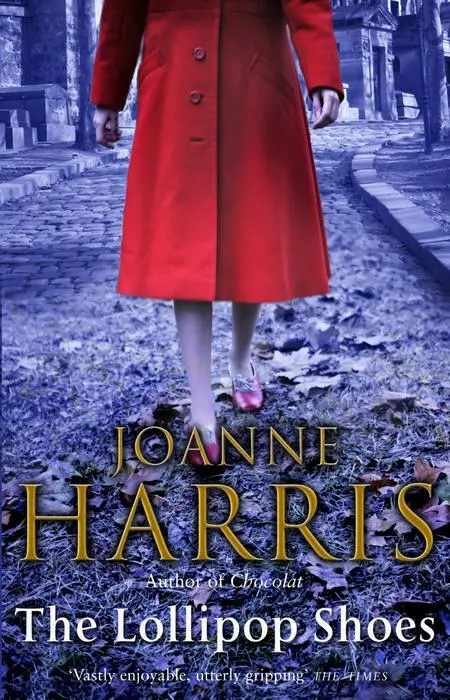
About the Book
About the Book
‘Who died?’ I said. ‘Or is it a secret?’
‘My mother, Vianne Rocher.’
Seeking refuge and anonymity in the cobbled streets of Montmartre, Yanne and her two daughters live peacefully, if not happily, above their little chocolate shop. Nothing unusual marks them out; no red sachets hang by the door. The wind has stopped – at least for a while. Then into their lives blows Zozie de l’Alba, the lady with the lollipop shoes, ruthless, devious and seductive.
With everything she loves at stake, Yanne must face a difficult choice; to flee, as she has done so many times before, or to confront her most dangerous enemy . . .
Herself.
The Lollipop Shoes
Joanne Harris
Dedication
To A. F. H.
ACKNOWLEDGEMENTS
Once again, heartfelt thanks to everyone who helped guide this book from babysteps to walking in heels. To Serafina Clarke, Jennifer Luithlen, Brie Burkeman and Peter Robinson; to my fabulous editor Francesca Liversidge; to Claire Ward for her wonderful cover design; to my terrific publicist Louise Page-Lund and to all my friends at Transworld, London. Many thanks also to Laura Grandi in Milan and to Jennifer Brehl, Lisa Gallagher and everyone at HarperCollins, New York. Thanks too to my PA, Anne Riley; to Mark Richards, for running the website; to Kevin, for running everything else; to Anouchka, for enchiladas and Kill Bill; to Joolz, Anouchka’s evil aunt, and to Christopher, Our Man in London. Special thanks go to Martin Myers, super-rep, who saved my sanity this Christmas, as well as to all the loyal reps, booksellers, librarians and readers who ensure that my books are still kept on the shelves.
PART ONE
Death
1

Wednesday, 31st October
Día de los Muertos
IT IS A relatively little-known fact that, over the course of a single year, about twenty million letters are delivered to the dead. People forget to stop the mail – those grieving widows and prospective heirs – and so magazine subscriptions remain uncancelled; distant friends unnotified; library fines unpaid. That’s twenty million circulars, bank statements, credit cards, love letters, junk mail, greetings, gossip and bills, dropping daily on to doormats or parquet floors, thrust casually through railings, wedged into letter-boxes, accumulating in stairwells, left unwanted on porches and steps, never to reach their addressee. The dead don’t care. More importantly, neither do the living. The living just follow their petty concerns, quite unaware that very close by, a miracle is taking place. The dead are coming back to life.
It doesn’t take much to raise the dead. A couple of bills; a name; a postcode; nothing that can’t be found in any old domestic bin-bag, torn apart (perhaps by foxes) and left on the doorstep like a gift. You can learn a lot from abandoned mail: names, bank details, passwords, e-mail addresses, security codes. With the right combination of personal details you can open up a bank account; hire a car; even apply for a new passport. The dead don’t need such things any more. A gift, as I said, just waiting for collection.
Sometimes Fate even delivers in person, and it always pays to be alert. Carpe diem, and devil take the hindmost. Which is why I always read the obituaries, sometimes managing to acquire the identity even before the funeral has taken place. And which is why, when I saw the sign, and beneath it the post-box with its packet of letters, I accepted the gift with a gracious smile.
Of course, it wasn’t my post-box. The postal service here is better than most, and letters are rarely misdelivered. It’s one more reason I prefer Paris; that and the food, the wine, the theatres, the shops and the virtually unlimited opportunities. But Paris costs – the overheads are extraordinary – and besides, I’d been itching for some time to reinvent myself again. I’d been playing it safe for nearly two months, teaching in a lycée in the 11th arrondissement, but in the wake of the recent troubles there I’d decided at last to make a clean break (taking with me twenty-five thousand euros’ worth of departmental funds, to be delivered into an account opened in the name of an ex-colleague and to be removed discreetly, over a couple of weeks), and had a look at apartments to rent.
First, I tried the Left Bank. The properties there were out of my league; but the girl from the agency didn’t know that. So, with an English accent and going by the name of Emma Windsor, with my Mulberry handbag tucked negligently into the crook of my arm and the delicious whisper of Prada around my silk-stockinged calves, I was able to spend a pleasant morning window-shopping.
I’d asked to view only empty properties. There were several along the Left Bank: deep-roomed apartments overlooking the river; mansion flats with roof gardens; penthouses with parquet floors.
With some regret, I rejected them all, though I couldn’t resist picking up a couple of useful items on the way. A magazine, still in its wrapper, containing the customer number of its intended recipient; several circulars; and at one place, gold: a banker’s card in the name of Amélie Deauxville, which needs nothing but a phone call for me to activate.
I left the girl my mobile number. The phone account belongs to Noëlle Marcelin, whose identity I acquired some months ago. Her payments are quite up to date – the poor woman died last year, aged ninety-four – but it means that anyone tracing my calls will have some difficulty finding me. My internet account, too, is in her name, and remains fully paid-up. Noëlle is too precious for me to lose. But she will never be my main identity. For a start, I don’t want to be ninety-four. And I’m tired of getting all those advertisements for stair-lifts.
My last public persona was Françoise Lavery, a teacher of English at the Lycée Rousseau in the 11th. Age thirty-two; born in Nantes; married and widowed in the same year to Raoul Lavery, killed in a car crash on the eve of the anniversary – a rather romantic touch, I thought, that explained her faint air of melancholy. A strict vegetarian, rather shy, diligent, but not talented enough to be a threat. All in all, a nice girl – which just goes to show you should never judge by appearances.
Today, however, I’m someone else. Twenty-five thousand euros is no small sum, and there’s always the chance that someone will begin to suspect the truth. Most people don’t – most people wouldn’t notice a crime if it was going on right in front of them – but I haven’t got this far by taking risks, and I’ve found that it’s safer to stay on the move.
So I travel light – a battered leather case and a Sony laptop containing the makings of over a hundred possible identities – and I can be packed, cleaned out, all traces gone in rather less than an afternoon.
That’s how Françoise disappeared. I burnt her papers, correspondence, bank details, notes. I closed all accounts in her name. Books, clothes, furniture and the rest, I gave to the Croix Rouge. It never pays to gather moss.
After that I needed to find myself anew. I booked into a cheap hotel, paid on Amélie’s credit card, changed out of Emma’s clothes and went shopping.
Françoise was a dowdy type; sensible heels and neat chignons. My new persona, however, has a different style. Zozie de l’Alba is her name – she is vaguely foreign, though you might be hard pressed to tell her country of origin. She’s as flamboyant as Françoise was not – wears costume jewellery in her hair; loves bright colours and frivolous shapes; favours bazaars and vintage shops, and would never be seen dead in sensible shoes.
The change was neatly executed. I entered a shop as Françoise Lavery, in a grey twinset and a string of fake pearls. Ten minutes later, I left as someone else.
The problem remains: where to go? The Left Bank, though tempting, is out of the question, though I believe Amélie Deauxville may be good for a few thousand more before I have to ditch her. I have other sources, too, of course, not including my most recent – Madame Beauchamp, the secretary in charge of departmental finances at my erstwhile place of work.
It’s so easy to open a credit account. A couple of spent utility bills; even an old driving licence can be enough. And with the rise of online purchasing, the possibilities are expanding on a daily basis.
But my needs extend to far, far more than a source of income. Boredom appals me. I need more. Scope for my abilities, adventure, a challenge, a change.
A life.
And that’s what Fate delivered to me, as if by accident this windy late-October morning in Montmartre, as I glanced into a shop window and saw the neat little sign taped to the door:
Fermé pour cause de décès.
It’s been some time since I last came here. I’d forgotten how much I enjoyed it. Montmartre is the last village in Paris, they say, and this part of the Butte is almost a parody of rural France, with its cafés and little crêperies; its houses painted pink or pistachio, fake shutters at the windows, and geraniums on every window-ledge; all very consciously picturesque, a movie-set miniature of counterfeit charm that barely hides its heart of stone.
Perhaps that’s why I like it so much. It’s a perfect setting for Zozie de l’Alba. And I found myself there almost by chance; stopped in a square behind the Sacré-Coeur; bought a café-croissant at a bar called Le P’tit Pinson and sat down at a table on the street.
A blue tin plate high up on the corner gave the name of the square as Place des Faux-Monnayeurs. A tight little square like a neatly made bed. A café, a crêperie, a couple of shops. Nothing more. Not even a tree to soften those edges. But then for some reason, a shop caught my eye – some kind of a chichi confiserie, I thought, though the sign above the door was blank. The blind was half-drawn, but from where I was sitting I could just see the display in the window, and the bright-blue door like a panel of sky. A small, repetitive sound crossed the square; a bundle of wind-chimes hanging above the door, sending out little random notes like signals in the air.
Why did it draw me? I couldn’t say. There are so many of these little shops along the warren of streets leading up the Butte de Montmartre, slouching on the cobbled corners like weary penitents. Narrow-fronted and crook-backed, they are often damp at street level, cost a fortune to rent and rely mainly on the stupidity of tourists for their continued existence.
The rooms above them are rarely any better. Small, sparse and inconvenient; noisy at night, when the city below comes to life; cold in winter, and most likely unbearable in summer, when the sun presses down on the heavy stone slates and the only window, a skylight not eight inches wide, lets in nothing but the stifling heat.
And yet – something there had caught my interest. Perhaps the letters, poking out from the metal jaws of the post-box like a sly tongue. Perhaps the fugitive scent of nutmeg and vanilla (or was that just the damp?) that filtered from beneath the sky-blue door. Perhaps the wind, flirting with the hem of my skirt, teasing the chimes above the door. Or perhaps the notice – neat, hand-lettered – with its unspoken, tantalizing potential.
Closed due to bereavement.
I’d finished my coffee and croissant by then. I paid, stood up and went in for a closer look. The shop was a chocolaterie; the tiny display window crammed with boxes and tins, and behind them in the semi-darkness I could see trays and pyramids of chocolates, each one under a round glass cloche like wedding bouquets from a century ago.
Behind me, at the bar of Le P’tit Pinson, two old men were eating boiled eggs and long slices of buttered bread while the aproned patron held forth at some volume about someone called Paupaul, who owed him money.
Beyond that the square was still almost deserted, but for a woman sweeping the pavement and a couple of artists with easels under their arms, on their way to the Place du Tertre.
One of them, a young man, caught my eye. ‘Hey! It’s you!’
The hunting call of the portrait artist. I know it well – I’ve been there myself – and I know that look of pleased recognition, implying that he has found his muse; that his search has taken many years; and that however much he charges me for the extortionate result, the price can in no way do justice to the perfection of his oeuvre.
‘No, it’s not,’ I told him drily. ‘Find someone else to immortalize.’
He gave me a shrug, pulled a face, then slouched off to rejoin his friend. The chocolaterie was all mine.
I glanced at the letters, still poking impudently from the letter-box. There was no real reason to take the risk. But the simple fact was, the little shop drew me, like a shining something glimpsed between the cobbles, that might turn out to be a coin, a ring or just a piece of tinfoil as it catches the light. And there was a whisper of promise in the air, and besides, it was Hallowe’en, the Día de los Muertos, always a lucky day for me, a day of endings and beginnings, of ill winds and sly favours and fires that burn at night. A time of secrets; of wonders – and, of course, the dead.
I took a last quick glance around. No one was watching. I was sure no one saw as, with a swift movement, I pocketed the letters.
The autumn wind was gusting hard, dancing the dust around the square. It smelt of smoke – not Paris smoke, but the smoke of my childhood, not often remembered – a scent of incense and frangipani and fallen leaves. There are no trees on the Butte de Montmartre. It’s just a rock, its wedding-cake icing barely concealing its essential lack of flavour. But the sky was a brittle, eggshell colour, marked with a complex pattern of vapour-trails, like mystic symbols on the blue.
Among them I saw the Ear of Maize, the sign of the Flayed One – an offering, a gift.
I smiled. Could it be a coincidence?
Death, and a gift – all in one day?
Once, when I was very young, my mother took me to Mexico City, to see the Aztec ruins and to celebrate the Day of the Dead. I loved the drama of it all: the flowers and the pan de muerto and the singing and the sugar skulls. But my favourite was the piñata, a painted papier-mâché animal figure, hung all over with firecrackers and filled with sweets, coins and small, wrapped presents.
The object of the game was to hang up the piñata over a doorway and to throw sticks and stones at it until it split open, releasing the presents inside.
Death, and a gift – all in one.
It couldn’t be a coincidence. This day, this shop, this sign in the sky – it was as if Mictecacihuatl herself had put them in my path. My very own piñata—
I turned away, smiling, and noticed someone watching me. There was a child standing very still about a dozen feet away: a girl aged eleven or twelve, in a bright red coat, with slightly scuffed brown school shoes and flossy black hair like that of a Byzantine icon. She looked at me without expression, head cocked slightly to one side.
For a moment I wondered if she’d seen me take the letters. Impossible to know for sure how long she’d been standing there; so I just gave her my most appealing smile and pushed the bundle of letters deeper into my coat pocket.
‘Hello,’ I said. ‘What’s your name?’
‘Annie,’ said the girl, without smiling back. Her eyes were a curious blue-green-grey; her mouth so red it looked painted. Striking in the cool morning light; and as I watched, her eyes seemed to brighten still further, to take on the shades of the autumn sky.
‘You’re not from here, are you, Annie?’
She blinked at that; puzzled, perhaps, at how I knew. Paris children never talk to strangers; suspicion is hard-wired into their circuitry. This girl was different – wary, perhaps, but not unwilling – and far from impervious to charm.
‘How do you know?’ she said at last.
Strike one. I grinned. ‘I can tell from your voice. What is it? The Midi?’
‘Not quite,’ she said. But now she was smiling.
You can learn a lot from talking to children. Names, professions, the small details that give an impersonation that invaluable authentic touch. Most internet passwords consist of some child’s name, a spouse’s, even a pet’s.
‘Annie, shouldn’t you be at school?’
‘Not today. It’s a holiday. Besides . . .’ She looked at the door with its hand-lettered notice.
‘Closed due to bereavement,’ I said.
She nodded.
‘Who died?’ That bright-red coat seemed less than funereal, and there was nothing in her face that suggested grief.
Annie said nothing for a moment, but I caught the gleam in her blue-grey eyes, their expression slightly haughty now, as if debating whether my question might be impertinent or genuinely sympathetic.
I let her stare. I’m used to being stared at. It happens, sometimes, even in Paris, where beautiful women are more than plentiful. I say beautiful – but that’s an illusion, the very simplest of glamours, barely magic at all. A tilt of the head, a certain walk, clothes befitting the moment, and anyone can do the same.
Well, almost anyone.
I fixed the girl with my brightest smile, sweet and cocky and slightly rueful, becoming for a second the tousled elder sister she has never had, the glamorous rebel, Gauloise in hand, who wears tight skirts and neon colours and in whose impractical shoes I know she secretly longs to be.
‘Don’t you want to tell me?’ I said.
She looked at me for a second more. An elder child, if I ever saw one; tired, so tired of having to be good, and perilously close to the age of revolt. Her colours were unusually clear; in them I read some wilfulness, some sadness, a touch of anger and a bright thread of something that I could not quite identify.
‘Come on, Annie. Tell me. Who died?’
‘My mother,’ she said. ‘Vianne Rocher.’
2

Wednesday, 31st October
VIANNE ROCHER. IT’S been a long time since I wore that name. Like a coat, well-loved but long since put away, I’d almost forgotten how good it felt, how very warm and comfortable. I’ve changed my name so many times – both our names, changing from village to village as we followed the wind – that I should have outgrown this wish by now. Vianne Rocher is long dead. And yet—
And yet I enjoyed being Vianne Rocher. I liked the shape of the word in their mouths. Vianne, like a smile. Like a word of welcome.
I have a new name now, of course, not so different from the old. I have a life; a better life, some might say. But it’s not the same. Because of Rosette; because of Anouk; because of everything we left behind in Lansquenet-sous-Tannes, that Easter when the wind changed.
That wind. I see it’s blowing now. Furtive but commanding, it has dictated every move we’ve ever made. My mother felt it, and so do I – even here, even now – as it sweeps us like leaves into this backstreet corner, dancing us to shreds against the stones.
V’là l’bon vent, v’là l’joli vent
I thought we’d silenced it for good. But the smallest thing can wake the wind: a word, a sign, even a death. There’s no such thing as a trivial thing. Everything costs; it all adds up until finally the balance shifts and we’re gone again, back on the road, telling ourselves – well maybe next time—
Well this time, there will be no next time. This time, I’m not running away. I don’t want to have to start anew, as we have done so many times, before and since Lansquenet. This time, we stay. Whatever it takes. Whatever it costs us, we stay.
We stopped in the first village that didn’t have a church. We stayed six weeks, and then moved on. Three months, then a week, a month, another week, changing our names as we went, until the baby began to show.
Anouk was nearly seven by then. Excited at the thought of a baby sister; but I was so tired, so tired of those interminable villages with the river and the little houses and the geraniums in the window-boxes and the way people looked at us – at her especially – and asked their questions, always the same.
Have you come far? Will you be staying with relatives here? Will Monsieur Rocher be joining you?
And when we answered, there’d be that look, that measuring look, taking in our worn clothes and our single case and that fugitive air that speaks of too many railway stations and passing-places and hotel-rooms left neat and bare.
And oh – how I longed to be free at last. Free as we had never been; free to stay in a single spot; to feel the wind and ignore its call.
But however hard we tried, rumour followed us. Some kind of scandal, the whispers said. Some priest was involved, so someone had heard. And the woman? A gypsy; in with the river people; claimed to be a healer; dabbled in herbs. And someone had died, the rumours said – poisoned, perhaps, or simply unlucky.
In any case, it didn’t matter. The rumours spread like dogwort in summer, tumbling us, harrying us, snapping at our heels; and slowly, I began to understand.
Something had happened along our road. Something that had altered us. Perhaps we’d stayed a day – a week – too long in one of those villages. Something was different. The shadows had lengthened. We were running.
The Story Continues on BooksBarbecue!
Enjoyed this preview? ❤️ Do not stop here!
Read the complete book free online → 🔗
Continue reading now on BooksBarbecue and discover every page!
Love reading? Bookmark BooksBarbecue.com for more amazing books!
Happy Reading!