Chapters (18)
- Cover
- Foreword
- Introduction
- Chapter One - Christianity Is Under Attack
- Chapter Two - Evolution Is Religion
- Chapter Three - Creation Is Religion
- Chapter Four - The Root of the Problem
- Chapter Five - Crumbling Foundations
- Chapter Six - Genesis Does Matter
- Chapter Seven - Death: A Curse and a Blessing
- Chapter Eight - The Evils of Evolution
- Chapter Nine - Evangelism is a Pagan World
- Chapter Ten - Wake Up, Shepherds!
- Chapter Eleven - Creation, Flood, and Coming Fire
- Appendix 1 - 20 Reasons Why Genesis and Evolution Don't Mix
- Appendix 2 - Why Did God Take Six Days?
- Endnotes
- Resources
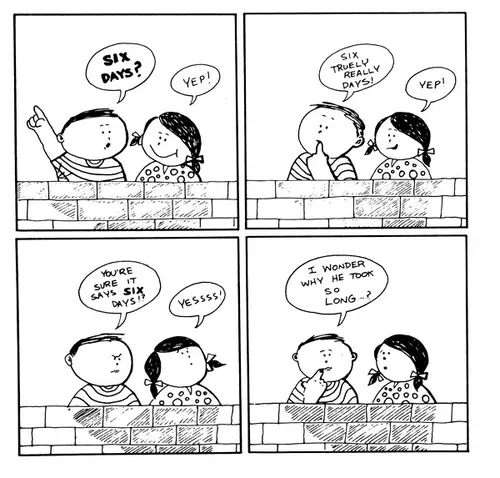
God is an infinite being. He has infinite power, infinite knowledge, infinite wisdom. Obviously, God could then make anything He desired. He could have created the whole universe, the earth and all it contains in no time at all. Perhaps the question we should be asking is why did God take as long as six days? After all, six days is a peculiar period for an infinite being to make anything. The answer can be found in Exodus 20:11. Exodus 20 contains the Ten Commandments, and it should be remembered that these commandments were written on stone by the very "finger of God." In Exodus we read: "And he gave unto Moses, when he had made an end of communing with him upon mount Sinai, two tables of testimony, tables of stone, written with the finger of God" (Exod. 31:18). The fourth commandment, in verse 9 of chapter 20, tells us that we are to work for six days and rest for one. The justification for this is given in verse 11: "For in six days the Lord made heaven and earth, the sea, and all that in them is, and rested the seventh day; wherefore the Lord blessed the sabbath day, and hallowed it." This is a direct reference to Gods creation week in Genesis 1. To be consistent (and we must be), whatever is used as the meaning of the word "day" in Genesis 1 must also be used here. If you are going to say the word "day" means a long period of time in Genesis, then it has been already shown that the only way this can be is in the sense of the "day" being an indefinite or indeterminate period of time, not a definite period of time. Thus, the sense of Exodus 20:9–11 would have to be "six indefinite periods shalt thou labor and rest a seventh indefinite period." This, however, makes no sense at all. By accepting the days as ordinary days, we understand that God is telling us He worked for six ordinary days and rested one ordinary day to set a pattern for man the pattern of our seven-day week which we still have today.
 |
DAY-AGE INCONSISTENCIES
There are many inconsistencies in accepting the days in Genesis as long periods of time. For instance, we are told in Genesis 1:26–28 that God made the first man (Adam) on the sixth day. Adam lived through the rest of the sixth day and through the seventh day. We are told in Genesis 5:5 that he died when he was 930 years old. (We are not still in the seventh day as some people misconstrue, for Genesis 2:2 tells us God "rested" from His work of creation, not that He is resting from His work of creation.) If each day was, for example, a million years, then there are real problems. In fact, if each day were only a thousand years long, this still makes no sense of Adams age at death either.