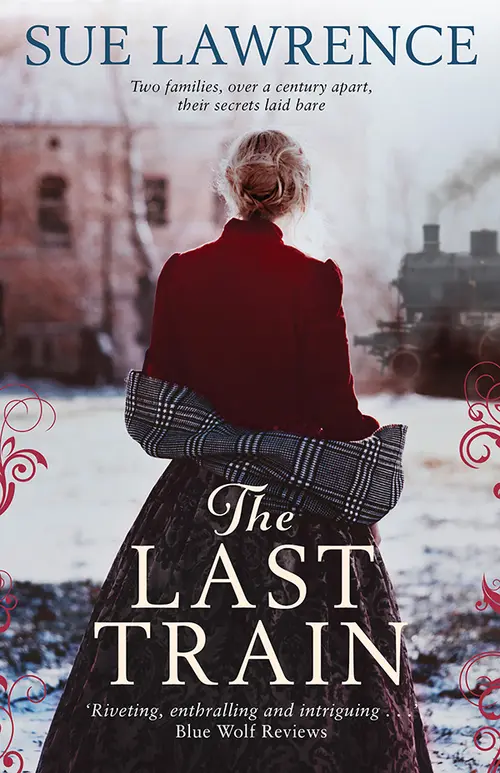
The Last Train
COVER PAGE
PRAISE
Praise for The Last Train
‘Steeped in Scottish history and atmosphere, with twin mysteries as a hook for portraits of two women coping with sudden loss.’
Sydney Morning Herald
‘Riveting, enthralling and intriguing, this is a corker of a read, one that is vivid, real and created with skill and a flair for historic fiction. Fabulous!’
Blue Wolf Reviews
‘An enticing historical fiction novel tinged with two mysteries that allow secrets to be revealed and families to become close … A well-rounded novel for fans of historical fiction and mysteries.’
The Book Muse
‘An enthralling read and beautifully written.’
Brisbanista
‘A great book to read on a train journey’
Midwest Book Reviews
‘I couldn’t put this down … [The Last Train] will hook you from the outset and keep you turning the pages late into the night.’
Theresa Smith Writes
‘Lawrence’s parallel plotlines advance in lock-step with each other … with spooky similarities but also crucial differences, until they’re entwined to great effect towards the end.’
Sunday Herald
‘A gripping tale.’
Daily Record
ABOUT THE AUTHOR
Sue Lawrence was born in Dundee but lived and went to school in Edinburgh, before returning to Dundee to study French at university. She then trained as a journalist with DC Thomson.
Having taken time off her career when her three children were small, she took up writing again after winning BBC Masterchef in 1991. She was cookery columnist for the Sunday Times then Scotland on Sunday and also wrote for several magazines and appeared regularly on TV and radio.
She won a Glenfiddich Food and Drink Award in 2003 and two Guild of Food Writers Awards, in 1998 and 2001. She was President of the Guild of Food Writers from 2004–2008.
She is author of 15 cook books, including Sue Lawrence’s Book of Baking, Scots Cooking and A Cook’s Tour of Scotland.
DEDICATION
In loving memory of my father, Robert Anderson, ever proud of his home city of Dundee.
CHAPTER 1
Chapter 1
Sunday 28 December 1879
7 p.m.
The storm raged on. In the pitch black, the thunder cracked as a roaring gale whipped through the narrow wynds and filthy closes of Dundee’s tenements. The wind ripped trees from their roots as it continued east, howling round the dingy buildings as slates and chimney pots crashed to the ground. Roofs from the bathing huts along the shore flew off as the wind rushed along the River Tay. The deep, tormented waters heaved upwards and crashed into foam-crested waves.
Above the maelstrom on the river, and far from the squalid homes of the poor, a large stone house was feeling the blast. Though neighbouring houses were gothic in style, this was classical, with pediment and pillars. The wind battered against the windows, rattling the casements. A flash of lightning forked through the bleak sky as a figure appeared upstairs at a window. The woman pulled the curtains open and placed the lamp on the table behind her. She beckoned to the children by the fire, their eyes wide with terror.
‘Come over here, my dears. There is nothing to fear. The storm sounds dreadful but it is simply the noise of the wind.’
As she spoke there was a crash as a slate smashed onto the cobbled path beneath. She took a deep breath and put her arms round her son and daughter, who had scuttled over to join her.
‘Shall we see Pappa’s train?’ James tipped his chin up in an attempt to see more clearly through the window.
‘Will the train blow over in the big wind, Mamma?’
‘No, Lizzie, it will not. Pappa shall be here as usual for your bedtime prayers.’ Ann lifted up her eight-year-old daughter and stood her on the window seat, adjusting the girl’s long nightgown as she did so. She tried to help her son but he clambered up onto the plump cushions himself. ‘I am ten years old now, I don’t need help,’ he muttered.
They gazed out through the whirling wind at the heaving waters beyond. The full moon was obscured by dark, scudding clouds.
‘There, see. Lights!’ said James, pointing across the river, towards Fife.
Ann turned to check the longcase clock behind the lamp; it was nearly quarter past seven. ‘It’s a little late, I do hope it won’t speed.’
She watched the lights of the train as it rounded the curve at Wormit and straightened up onto the bridge. ‘It has passed the signal box now,’ Ann whispered.
‘Pappa says it must slow down over the bridge.’
As they watched the train continue at full speed, Ann clenched her hands tightly together. The train entered the high girders and she held her breath.
‘Look, more lightning, Mamma!’ Lizzie cried, cowering into her mother, whose mouth opened wide. For Ann saw not lightning, but a brilliant sheet of flame from the iron girders and a comet-like burst of fiery sparks from the engine. In one long trail, the streak of lights and fire plummeted downwards. And then, nothing. All was dark on the river.
There was a sudden hush in the room while the rain continued to pelt against the window and the wind howled and swirled.
‘Stay here,’ said Ann, coming to her senses. ‘Do not move. I shall fetch Mrs Baxter.’
She fled from the room and ran downstairs to the kitchen, flinging open the door. ‘Go and sit with the children, I must go out at once. I fear the train is over the bridge!’
CHAPTER 2
Chapter 2
2015
‘Mum, it was really cool on the bus. We got juice and crisps and Jenny Baird was sick so the driver had to stop really fast, like a racing driver.’
Fiona looked round from the sink, drying her hands. ‘Sit down and tell me all about it,’ she said, flicking on the switch of the kettle. ‘Was it a good trip?’
‘Yeah, it was okay. It wasn’t the Peter Pan museum though, just the house where the man who wrote the book was born.’
‘J. M. Barrie. So what did you see there then?’
‘Stuff about when he was a child and things. And how they used to live in those days. Well, the teacher said it was a big house for rich people and that the ordinary folk wouldn’t even have had a toilet inside the house.’
Fiona made a pot of tea and opened the cake tin. ‘Bit of cake, Jamie?’
He nodded and rushed over to the kitchen dresser, peeling off his school sweatshirt as he went. He opened the drawer and pulled out a pad of paper and a box of coloured pencils.
‘I’ll draw you a picture of the statue they had in Kirriemuir. It’s Peter Pan with his pipe or flute, can’t remember what Miss Robb called it.’ He began sketching then slurped some tea.
‘Don’t be so noisy, Jamie, where are your manners?’
‘That’s how Pete drinks his tea.’
‘Yes, well, some grown-ups think it’s okay to have bad table manners, but it’s not.’
Jamie glanced up at the clock. ‘When’s Pete home?’
‘Oh, yes, I meant to say, Pete won’t be home till later tonight so I’m cooking. You up for pizza?’
He looked up from his drawing and grinned. ‘Cool.’
She planted a kiss on his cheek as she headed for the door. He wiped it away with the back of his hand and leant over his piece of paper, pencil poised.
* * *
Later that evening, once her son was in bed, Fiona poured herself a glass of red wine and stood looking out the window. It was a beautiful May evening, the sun low in the sky and the top of the hill still bathed in bright light. She took a sip and wished Pete wasn’t working so late. She’d love to go and climb the hill, but didn’t like leaving Jamie alone. It was a small and friendly village where everyone left their doors unlocked all the time, and the neighbours said he’d be fine – some even suggested that she was being overprotective – but there was no way she would leave him by himself.
Her love of walking was new, developed since she and Jamie moved to Glenisla two years previously. When she arrived she had been a city slicker from Dundee who hadn’t donned hiking boots since school; now, though, she was hooked – and was even a member of the local hillwalking club. She’d been unsure when Pete had asked her to move with him to Glenisla, but Jamie soon loved living in the country and made friends easily at the village school.
She looked at her watch. Pete would have finished service by now; he must have become embroiled in the bar chatting to the locals. Fiona switched on her iPad and Googled J. M. Barrie. He had been born in nearby Kirriemuir but she knew very little else about him. Thank God for Wikipedia, she thought.
She put down her empty glass on the coaster, which read The Old Chain Pier, and smiled. This was the pub where she’d met Pete some three years before; she had been taken in not only by his looks but by his easy Antipodean manner. She hadn’t had much fun since Iain had died. It had taken her years to get over his death but now at last she felt secure and happy; and Jamie adored Pete, though he didn’t call him Dad.
* * *
Fiona was in bed by the time Pete got in, propped up against a pile of pillows with her iPad on her lap. She pushed her glasses up over her forehead.
‘You’re late. Busy night?’
Pete threw his jacket on the chair and sat on the bed to take off his trainers. ‘Yeah, and loads of bookings over the weekend.’ He leant over to give her a kiss. ‘What’re you looking at?’
‘J. M. Barrie. You know, the Peter Pan author? Jamie was on his school trip today to Kirriemuir today. He enjoyed it but the best thing seemed to be some little girl vomiting all over the bus on the way home!’
Pete smiled as he disappeared into the bathroom.
‘Oh,’ shouted Fiona. ‘Before I forget, there was a phone call a couple of hours ago. Someone called Cress – or was it Lettuce – anyway, a woman with a silly name. She was from The Scotsman, must’ve been that girl who was up a few weeks ago. She told me she couldn’t get through on the hotel phone. She said to let you know the restaurant review’s going in the paper tomorrow.’
Pete came back into the room, toothbrush in hand. ‘Did she say if it was any good?’
Fiona smiled. ‘I obviously tried to probe but got nothing. I’m sure it’ll be a rave review though.’
Pete returned to the bathroom and continued to brush his teeth.
Fiona leant forward so her voice would carry. ‘I was thinking how brilliant it is we’re all online now. Instead of having to post the newspaper cutting to your folks in Melbourne, you can just send them the link. I could do it tomorrow if you give me an email address.’
There was silence, followed by the noise of Pete spitting out his toothpaste. He wandered back into the bedroom and pulled off his T-shirt. Fiona noticed the rolls of fat around his midriff; too much tasting his good food.
‘I don’t know why you don’t tell me more about them. I mean, that’s three years we’ve been together and I’ve never even spoken to your parents on the phone.’ Fiona smiled. ‘Do they actually exist?’
Pete sat down on his side of the bed and slipped off his jeans. ‘What time does Doreen get the papers in on a Saturday?’
‘Well, the shop opens at eight, but the papers only come up from Alyth about half nine. If you’re desperate to see the review you could check it out online first thing.’ She put two pillows back to his side, popped a couple of pills in her mouth and swigged from her water bottle, then switched off her bedside lamp. ‘Anyway, come to bed. You’ll need a good night’s sleep – if it’s a five-star review, Michelin may well come calling!’
‘To the sleepiest village in Perthshire? Bloody doubt it.’ He slipped into bed, gave her a kiss and rolled onto his side. ‘Night.’
A couple of minutes later, he turned and whispered, ‘Fi, you know I love you, don’t you?’
‘Of course I do, darling.’
* * *
Next morning, Fiona woke up to the sound of the phone ringing. She looked at the clock: 08:30. How had she slept so long? She ran downstairs and grabbed the phone. It was Mrs Cumberland, the receptionist at Glenisla Hotel.
‘Is that you, Fiona?’
‘Yes, is everything okay?’
‘Well, no, not really. Sorry to bother you on a Saturday, and when he’s got a late night tonight too, but can you tell Pete to get over here as soon as he can? That new sous-chef can’t get the grill on and a guest’s wanting kippers. Pete’s always saying not to do them in a pan as they stink everything else out.’
‘Sorry, Mrs C, he’s not here,’ said Fiona, walking through the cottage. ‘No idea where he’s gone.’ She frowned; usually on a Saturday morning he loved long lies. ‘I’ll call you back.’
Fiona went back upstairs to the bedroom and pulled open the curtains to let the daylight in. As she looked around, she noticed that his drawers were pulled open and half-empty. She rushed to the wardrobe – an overnight bag had been taken. How could she not have heard him open the creaky wardrobe door? Then she remembered that she was taking antihistamines for her hay fever and had slept heavily, as if drugged. She glanced at the packet of Piriton on her bedside table and then noticed the envelope.
She eased herself onto the bed to sit down, put on her glasses and ripped it open.
Fi, like I said, I love you, always will. But I’ve got to move on. Give Jamie a hug and tell him to keep up the drawing. He’ll be an architect one day like his dad. xx
Fiona stared at the note, then pulled open Pete’s bedside table drawer. She rifled through letters and bills then let out a long breath. His passport was missing. She ran downstairs and opened the front door. His car was gone. Fiona staggered back inside to the kitchen table and sat down, her hands at her head. He’s bloody well done a runner, she thought, as she heard the noise of the toilet flushing next door. How the hell would she tell Jamie?
CHAPTER 3
Chapter 3
Sunday 28 December 1879
7.30 p.m.
Ann Craig yanked her cape from the coat stand and threw it over her lilac gown. With clumsy fingers, she buttoned it up in front of the mirror. Her face looked paler than usual, framed by her dark hair. Usually this was where she preened, tilting her head from right to left, pinching her cheeks to add colour; at this moment though, grooming was far from her mind. She fastened the hook at the collar and strode towards the door.
‘Wait, Mrs Craig,’ said Mrs Baxter, heaving her bulky frame as fast as she could along the corridor. ‘Donald will go with you.’
Donald Baxter emerged behind his wife. Normally smart with his hair neatly combed, tonight he looked windswept. He pulled his cap from his pocket and said, ‘I’ll come too, Mrs Craig. I’m just in. There’s a commotion down by the shore, no one’s sure what’s happened.’
Ann pulled her hat firmly onto her head and opened the door. As the wind whirled around them, her hat blew off and she ran to fetch it. It was caught in a rose bush so she ripped it from the thorns and rammed it once again onto her head, holding it in place with her hand.
‘Will you not let me go down myself, Mrs Craig, and find out what’s going on? This isn’t a night for a lady to be out.’
‘Don’t be ridiculous, Baxter. I am perfectly capable. Here, take my arm.’
He reached out his arm and together they battled against the lashing rain and blustery gale. As they headed for the river, they came across others, heads stooped low against the wind. They tumbled along together over Magdalen Green towards the signal box on the shore.
The wind continued to howl furiously as Ann and Baxter slithered down the slope towards the path. She lifted her head and stopped, peering ahead. She could see the huge signal post was bent over like a bowed willow branch. She pulled Baxter’s sleeve and shouted in his ear. ‘I shall remain by this lamppost. Go and ask at the signal box.’
Baxter cowered low and took careful steps across the Green.
‘Hurry!’ she shouted, wrapping her arms round the post. Shoulders stooped, she listened to the almighty roar as waves higher than houses crashed against the shore, throwing great sprays of water over the gathering crowd. It was impossible to see the bridge through the dark; Ann tried to put aside visions of the train plummeting into the murky, cold depths of the Tay.
Some ten minutes later, she looked up and saw a hunched figure approach, arms held out at either side for balance.
Baxter came right up to her and shouted, ‘A man climbed up to the signal box. Signalman told him he’d got the usual signal from the other side as the train entered the bridge. Since then, nothing. No more telegraphic communication, he said.’
Ann stared at him. ‘But what’s to be done?’
‘No one can do anything right now, Mrs Craig.’
She pulled back the hair that had blown over her face and yanked it behind her ears. ‘We shall continue at once to the station. They must know more there.’
Baxter began to protest about the gale, that a lady should not be out on a night like this, it was much too far to walk, but she struck out her elbow for him and said, ‘It’s barely a mile, Baxter.’ One glance at the resolute look on her face and he realised he had no choice. He took her arm and off they staggered through the howling gale towards Tay Bridge Station.
* * *
As they approached, Ann saw crowds of bedraggled people standing outside, huddled round the gates. Even over the moan of the wind she heard wails of anguish. Ann looked up at the large clock over the entrance: it was just before 8 p.m. and the train was well overdue. The crowds parted a little as she headed for the station gates, which were firmly shut and padlocked.
‘Come, let us continue,’ she hissed to Baxter.
She leant through the bars of the gate and rapped on the wooden door and some of the throng turned to her.
‘They’ve locked us out.’
‘Station’s closed.’
‘Flung us all out.’
Ignoring the pack, she whispered to Baxter, ‘Go round the back to the side stairs and then to the stationmaster’s office on platform two. Tell Mr Smith I wish to see him.’
‘But Mrs Craig, he will not…’
‘Go, Baxter. At once!’
Baxter shuffled away and headed round the back. Ann stood up straight and surveyed the crowd. She was used to being taller than most women but now she seemed to dominate everyone before her; the crowd was stooped, heads bowed as they huddled for shelter from the storm.
After what seemed an interminable time, Baxter appeared and whispered to her to follow. She set off behind him, head held high, pulling at her skirt which had become trapped under someone’s walking stick. She turned to check the crowds were not following then hurried down the side steps towards platform two and stationmaster Alec Smith’s office. At the foot she came to an abrupt stop as she noticed a glint at her feet: broken glass. She looked up and noticed that part of the glass roof had shattered. She lifted her skirt a little and continued, stepping with caution towards the office as Baxter swung the door wide for her to enter. Here was a strange sight. Two railway men, dishevelled and windswept, were staring silently at the inert telegraph machine as if willing it to stutter into life. A third man sat at the desk, his head in his hands, snivelling like a child.
‘Mr Smith, what news is there?’
He sprang to his feet, wiping his forearm across his flushed face. ‘Mrs Craig, I’m sorry you were barred from entry. I had to take the decision to close the station. I am unsure the rest of the roof will hold.’ He took a deep breath. ‘I’ve just been out to the signal box – there’s been no signal from the south box since the train left, only a few minutes late. Together with my engine-shed man I tried to get along the tracks, but the wind was too strong.’ He turned towards the men by the telegraph machine. ‘Jimmy, tell the lady what you saw.’
One of the men swivelled round and whipped off his cap. ‘Nothing, nothing but broken ends of the rails pointing down into the river.’
‘Mrs Craig,’ said Alec, now more composed. ‘I must go and speak to the provost. The bridge is down and the train with it.’ He turned to grab his coat from a hook on the wall then nodded as he passed her with the two men.
‘But, Mr Smith, can nothing be done? Surely a boat can be sent out? Passengers must be rescued?’
The stationmaster ushered Ann out and locked the door. ‘On a night like this, there’s nothing to be done. I fear they are all at the bottom of the Tay.’
The Story Continues on BooksBarbecue!
Enjoyed this preview? ❤️ Do not stop here!
Read the complete book free online → 🔗
Continue reading now on BooksBarbecue and discover every page!
Love reading? Bookmark BooksBarbecue.com for more amazing books!
Happy Reading!