The Last Commandment
Cover
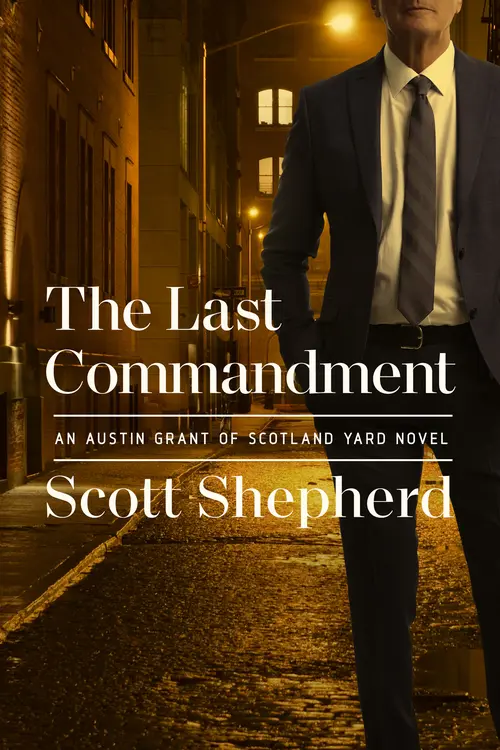
Title
The Last
Commandment
AN AUSTIN GRANT OF SCOTLAND YARD NOVEL
Scott Shepherd

For Holly,
because of you there is never
a Lonesome Day
Prologue: On Your Marks
PROLOGUE
On Your Marks
I
He fell in love at the exact same time every night.
Ten minutes before eleven o’clock.
That was when Billy Street, lead singer of the Blasphemers, launched into “Ain’t I Good Enough for You”—their only hit. The audience came out of its alcoholic daze and the chitchat faded as he prepared for his nightly lover’s leap.
He had played the song thousands of times and it almost never failed—there was always one lass who’d bump her way to the stage’s lip, plant herself beneath Billy’s leather-clad spread legs, and stare up at him with lustful adoration as he furiously strummed his Fender Telecaster.
This night’s lucky lovely wore snug diamond-patterned leggings and an even tighter AC/DC T-shirt that clung to her ample-sized chest. She knew all the words to every song in the group’s catalog, even the obscure and unreleased ones. Either she was a Super Groupie or just a sad girl with time on her hands to memorize the repertoire of a band that most of London (and alas, the record industry) had long cast aside.
Billy couldn’t give two shits. In that moment, he was playing only for her—his AC/DC girl, his devoted fan. He sang his hit, then launched into the covers the Blasphemers always ended their set with, all the while keeping his well-worn rock-and-roll eyes on that evening’s object of his brief desire.
II
“That’s it?”
AC/DC girl was disappointed.
Billy let out a final grunt; what did she expect? It wasn’t like they were going to spend a cozy weekend in Bath or end up in his dingy flat—there was barely enough room for him there. Plus, Billy knew if he woke up to googly-eyes and cooing sounds, he’d want to slit his wrists.
“Afraid so, sweetcakes,” Billy mumbled as he pushed her off him and squiggled in the driver’s seat to zip up his leather pants.
The restored MG convertible wasn’t ideal for a shag but the Wooten’s dressing room was the size of a dustman’s closet and his bandmates weren’t leaving anytime soon. So he’d ushered AC/DC girl out into the alley and the MG. He handed her the red-diamonded leggings she’d shed less than three minutes earlier.
“Off with you, now.”
Humiliated, AC/DC girl lowered her T-shirt so the band’s moniker spread over the pendulous breasts that had occupied Billy’s full attention until thirty seconds earlier. “I didn’t get to . . . you know . . . finish.”
Billy gave her a pat on the rump. “But it’ll give you a good story, won’t it?”
“That I dropped my knickers for some has-been who lasted twenty seconds?”
“Was it that long?” Billy cracked.
“You really are a fuckin’ bastard!” cried AC/DC girl. Mercifully, she crawled out of the car and hiked the leggings back up under the T-shirt.
“I’ve been called worse.”
Billy definitely had.
Not in the early days—back when the Blasphemers had gotten their first and only decent record deal. That debut album had sprouted “Ain’t I Good Enough for You,” an honest-to-God smash. That meant the next two albums sold well enough, even if the numbers were square roots of that maiden effort. Sub-mediocrity followed; the record company dropped them and there wasn’t a single label on the planet that would pick up the pieces.
Now, two decades later, the band was relegated to dives like the Wooten, which bordered a Piccadilly Circus alley where Billy was lucky to grab a groupie fuck.
Case in point—the disheveled and disillusioned AC/DC girl who had choked back a sob, flipped Billy off, then tromped down the alley, her heels clacking rhythmically on cobblestones as she disappeared into the misty London night.
Billy opened the glove compartment and dug around for a half-finished pint of Bushmills, uncapped it, and took a deep pull of amber-colored sustenance.
THUMP.
Something had just hit the back of the MG.
“Holy crap!” Whiskey spilled onto his multicolored silk shirt. His first thought was the girl.
“We’re all done here! Go home!”
The car jolted again.
Someone had opened the trunk.
Visions of scorned female rage raced through his head—tire irons on body parts, starting with private ones. Even worse—smashing his beloved Fender housed at the bottom of the boot. That got him scrambling out of the MG.
“Done means done, bitch! What don’t you get about that?!”
He got no response. Billy realized he hadn’t heard her high heels clip-clopping their way back on the cobblestones.
A figure flew out of the fog, swinging a familiar object.
The Fender Telecaster.
Pried from its case and suddenly used on its owner—a washed-up rocker who was soon bleeding out on the cobblestones of an alley in the heart of London.
His attacker hovered above, then straddled him—much like Billy did with his 10:50 women—wielding the Fender as a seductive scepter. For a moment, it seemed like he was going to tear into a searing solo of his own—instead, he ripped off one of the metal guitar strings with a savage jerk.
Within seconds, it was wrapped around Billy’s neck.
As he felt the life seeping out of him, Billy heard his killer softly begin to whistle “Ain’t I Good Enough for You.”
Billy really hated that song.
III
The Heath.
Austin Grant still strolled through it each Sunday after church, though he’d been doing it alone for over a year. Hampstead Heath had been their favorite spot on Earth, a gigantic park plopped atop a hill over London where he’d proposed to Allison over three decades ago.
They’d gotten married on a spectacular spring afternoon when the purple lilacs, pink hydrangeas, and blush roses were in full bloom. He’d been amazed she’d agreed to take him as her husband after a one-month courtship. Grant had been certain her late father wouldn’t hand his only daughter to a man with no prospects. Miraculously, Allison saw enough in Grant to accept his proposal and had subsequently cheered him on from a front-row seat through his entire career.
A career that was almost over.
Walking down the manicured path on this blustery December day, Grant kicked himself for not heeding Allison’s suggestions to pack it in five years earlier.
When had he finally let her show him the brochure? The month before she took ill? The small house in Todi—an hour’s drive northeast of Rome where vineyards flourished and life slowed down to a blessed crawl. “We’ll rent it for a summer,” Allison had said. “You’ll see if you can stand it. Reading a book, taking an afternoon nap; Lord knows—maybe even a drink before dinner.”
Grant had been dubious—he took his two weeks a year like clockwork and drove Allison crazy calling work every day while they were supposedly on holiday. More than once they had scrapped a trip altogether because he couldn’t tear himself away and would promise to make up for those lost days.
“Makeup” days gone forever when she had taken ill and never recovered.
Highgate Cemetery had been the obvious choice for Allison’s final resting place. It had broken his heart when she had told him that it would be a place she knew Grant wouldn’t mind visiting her until the time came for him to lie down beside her. Indeed, this was the only place where he could find peace, on the cast-iron bench that, just one year after Grant had donated it to honor Allison’s passing, already sported a coat of rust from the pervasive London dampness.
He placed a bouquet of her favorite blush roses on the plot, as he did every Sunday. Hard to find in the winter, Grant was determined his love would always have the same flowers that had surrounded them on their wedding day. He had an arrangement with a florist on the High Street; if the proprietor carried them year-round, Grant could arrange for the steep parking permit in front of the man’s shop to be waived. It was one of the few job perks left for Grant.
ALLISON REBECCA GRANT; Beloved Daughter, Wife, and Mother.
The simple tombstone inscription always turned Grant’s thoughts to Rachel. He wondered what she was up to, how things had gone so terribly wrong. He hadn’t seen their daughter since the funeral. Shortly after Allison had been diagnosed with lung cancer, Rachel had flown in from New York and holed up in the bedroom with her mother. She had left the house barely uttering a word to Grant. The one time he had tried to get his daughter to talk, Rachel had laid it out pure and simple.
“Mom is dying. There’s nothing more to say.”
Why she refused to ever have another conversation about it was a mystery to Grant. She’d stopped responding to his emails a while back and had even changed her cell number. If it weren’t for coming across an occasional feature piece she wrote in the New Yorker or the New York Times Magazine, he might think that Rachel had dropped off the face of the Earth.
He traced his fingers over the inscription, remembering those final days.
He was forever haunted by that last memory: seeing Allison carted off to hospital, unable to touch her, not realizing in that moment he would never see her again or even get a chance to say goodbye.
Grant sighed and glanced at his watch, the same Tag he’d been wearing for three decades, and spied the tiny window on its face with the date.
The eighth.
Twenty-three more days till year’s end. Three weeks and two more days until he didn’t have to get up and go anywhere. He certainly wasn’t going to rent a house in Todi. Not by himself.
He knew he would end up right here—on this bloody bench. At least he would be rid of his current troubles and wouldn’t have to deal with situations like the Fleming mess earlier in the year.
“Sir?”
For a second, Grant thought he’d drifted off and fallen asleep. He couldn’t come up with another reasonable explanation for hearing Hawley’s voice.
He turned around to see the man himself standing on a path among the graves. Hawley seemed nervous and a little jiggly, still carrying the extra weight Grant had urged him to lose for the job and his health.
“What are you doing here, Hawley?”
“You didn’t answer your mobile, sir.”
“That’s because it’s Sunday and I don’t have it on.”
“Well, I know you come up here every Sunday.”
“And how would you know that?”
Hawley hesitated before answering. Grant felt sorry for the man; he knew he still intimidated him, even though he’d been Hawley’s superior for over a decade.
“Because you told me this is where you go,” Hawley finally explained. “In case I really needed you—if something important came up.”
“Then I presume this must be very important.”
Hawley swayed back and forth. Waiting, as if for permission to speak—which Grant mercifully gave him. “Out with it, Sergeant.”
“There’s been another one.”
An icy chill ran the length of Grant’s spine. “A third?”
“In an alley behind a club in Piccadilly. Same mark as the others . . .”
“Except there were three lines instead of one or two.”
“Exactly, Commander.”
“Nice of the bloke to keep track for us,” Grant said grimly.
He turned for one last look at Allison’s grave, making a silent promise to see her the following Sunday. Then he told Hawley to lead the way. As they walked out of Highgate Cemetery, a thought that had recently become Grant’s mantra ran through his head.
I can’t wait until New Year’s Day, when I can leave Scotland Yard forever.
IV
Grant didn’t even know that the Wooten existed. There used to be underground clubs on practically every block in mid-London and Grant hadn’t frequented a single one. He’d definitely never heard of Billy Street or his band, the Blasphemers.
The crime team had been working the scene for over an hour by the time Grant arrived with Sergeant Hawley. The club’s adjacent alley was so tight between buildings that only a Smart car or the victim’s MG could navigate it without scraping paint. It was a space to toss trash, sneak out the back door for a smoke, or send an aging rocker off to meet his Maker. Being Sunday, Street’s body wasn’t discovered until a neighbor ducked into the alley to let his dog relieve itself. Street had been identified by the driver’s license in his pocket, allowing them to run his name through the system, which resulted in the knowledge that his band had played the Wooten the previous evening. As Grant approached the MG, Hawley was already on his mobile, rounding up the club owner and other Blasphemers to put together some semblance of a timeline.
Jeffries, the forensics medical examiner, was taking measurements and notes. Well into his forties but looking two decades older (Living with the dead will do that to you, thought Grant), he wore a bulky parka over jeans and a sweatshirt. Clearly his weekend had been interrupted just like Grant’s.
“Sorry to drag you out on a Sunday morning, Commander.”
“Not as sorry as I am,” Grant said. “Seeing how it looks like we have an even larger problem on our hands.”
“I’m afraid so,” agreed the FME.
Grant peered over Jeffries’s shoulder to stare down at the dead rocker. With rigor setting in, Billy Street looked paler than Marley’s ghost, but even more anguished. The metal guitar string wrapped around his bulging neck didn’t help. But it was the victim’s forehead that commanded Grant’s attention. Vertical cuts had been sliced directly above the victim’s dyed eyebrows.
“Sadly familiar?” asked Grant.
“Without being back at the morgue to compare, I’d say you’re looking at the same perpetrator,” answered Jeffries. “The marks are identical in width and length; a similar knife was used. The only difference being . . .”
“. . . the number of marks,” finished Grant. “Bastard must think we can’t keep count.”
“Any chance this leaked?”
“We’ve managed to keep it out of the papers and it hasn’t been on the telly.” The commander indicated the three marks. “We made sure to keep those to ourselves—especially after we got the second one.”
“How long do you think you’ll be able to keep it that way?”
“I need to figure that out. How soon can I get a full report?”
“End of the day? Good thing about it being Sunday—it’s quiet.”
“Not for long,” Grant said wearily. He wished he wasn’t so certain about that—but he could feel the storm rising.
Three murders in a week.
Each more horrific than the last.
V
The first body was discovered on the second of December.
It was an easy enough date for Grant to remember. It had been Allison’s birthday. So he was already in a glum mood to begin with.
A visiting Oxford professor of Greek mythology had not returned to the college after lecturing at the British Library the previous evening. When the Yard was alerted, a couple of constables were dispatched to the library, where a search located the dead man stuffed inside a WC off a back stairwell on the third floor.
After the lecture, Professor Lionel Frey had ducked inside the loo but had never exited the stall. His killer had turned out the lights and placed an “Out of Order” placard on the doorknob after carving a vertical line on Frey’s forehead to go with the deadly slash across the professor’s throat.
The sheer audacity of the murder had drawn Grant into the case.
Grant’s brother, Everett, a philosophy don at Oxford, had said someone had done a great service sending Frey to that big university in the sky. The mythology professor was a “pompous arse” who looked down on anyone who wasn’t taken with the Greek gods Frey had made his life’s work.
None of the other Oxford faculty were as overt as Everett, but Grant could tell that Lionel Frey wasn’t going to be missed by his colleagues. But none seemed to have an actual motive or interest in traveling down to London to sit through a two-hour lecture and then kill its orator in a tight-fitting WC stall either.
Grant’s thinking went to the obvious—a discarded mistress or some other affronted Londoner, but Frey’s schedule, credit cards, and wife’s statement showed he hadn’t set foot in the city for over six months. Any further theorizing was thrown to the wind when the second murder occurred.
Melanie Keaton.
A sculptor of some renown in the East End, she’d been found in her studio by Thomas Simmons, a prospective buyer, who’d arrived for a scheduled showing that morning. Simmons had sauntered inside the Whitechapel studio five days ago to discover Keaton on the floor with her throat slashed. Surrounding her body were the six figurines she had planned to show him with their wooden heads lopped off.
Grant was summoned to the East End by the constable, who had made a connection between the carefully carved marks (plural, yes, because there were now two, thank you very much) on Melanie Keaton’s forehead and the one found on the Oxford don who’d met his demise on the porcelain at the British Library.
When Grant arrived on the scene, he was immediately drawn to the beheaded figurines with black-feathered wings sprouting from their backs and faces an even darker shade of ebony. One of Keaton’s employees told him they were a series of archangels the sculptor had been working on. The studio was filled with a host of carvings in the same vein, causing the commander to wonder if he’d stumbled onto a black magic cult. Grant made a note to check if the murdered Oxford don had similar tastes, then began a round of questioning that proved no more successful than the inquiries days before at the British Library.
No one had seen Melanie Keaton since she’d locked up the previous evening. Grant asked Simmons if he was familiar with the library but it proved to be a tree not worth barking up; the man had just returned from a business trip in Poland where he’d been for the past month, dousing the idea he might have been on the third floor of the British Library on the first night of December.
Grant left the studio with no sort of connection between an Oxford professor of Greek mythology and a Whitechapel sculptor of archangels. Except for the carvings in their forehead; Melanie Keaton had twice the number of Lionel Frey. Grant felt no better when the FME concluded they’d been administered postmortem. It meant the killer was trying to make a point—as if purposely egging Grant and the Yard on.
Catch me if you can.
VI
The few hours after leaving Piccadilly brought no clarity. Nor did subsequent days.
An Oxford don, an East End artist, and a washed-up rocker—what did they have in common? It was one nasty riddle—and the only person who knew the answer wasn’t sharing.
It went further downhill once they rounded up Billy Street’s bandmates. They were fairly new additions to the Blasphemers; the original members had fallen to the wayside due to excessive alcohol and lack of gigs. None of the current trio held any enmity toward the lead singer. It was Billy’s band—they were just playing in it. With his passing, they were talking of forming a tribute group, but were unsure if it was a good idea because there was just one song to pay homage to.
The next dead end was Lisa Gosden. Jeffries had found trace evidence in the MG that Street had been with a woman the night he was killed and it didn’t take long for Grant’s team to run down the Gosden girl. She’d attended Billy’s swan song and reluctantly admitted to leaving the club with him that night.
Grant found it hard to believe she could have wrapped an E string around the musician’s neck as well as dispatched an Oxford don and sculptor all within a week. She fumbled through the details of her rendezvous with Billy—expressing frustration at his lack of prowess as a lover (more information than Grant needed). And she hadn’t been aware of being watched by anyone in the MG or during her “walk of shame” out to Charles Street.
By Thursday night, when he headed up to Hampstead for his weekly dinner and chess match with Everett, Grant felt further astray than ever on the case. The Thursday dinners had started, at Everett’s insistence, at his brother’s house shortly after Allison’s passing. Grant appreciated Everett taking it upon himself to look after his older brother.
“I won’t have you wasting away,” Everett had told him the night of the wake. “I can’t tell you how many geezers at the university I’ve seen go belly up right after their loved ones passed. They just seem to give up on living.”
Everett said he would miss Allison as well. He’d actually known her longer than Grant. Everett had introduced them during his last year as a student at Oxford when he’d come home to Liverpool for the holidays. Everett and Allison had briefly gone out but her heart quickly went to Grant. She’d jokingly say she hadn’t felt smart enough for Everett, a brilliant budding theologian. This made Grant feel slightly inferior, to which Allison would say “Nonsense.” At least the two of them could talk about normal things and affairs of the heart.
The Story Continues on BooksBarbecue!
Enjoyed this preview? ❤️ Do not stop here!
Read the complete book free online → 🔗
Continue reading now on BooksBarbecue and discover every page!
Love reading? Bookmark BooksBarbecue.com for more amazing books!
Happy Reading!