The Lady or the Lion
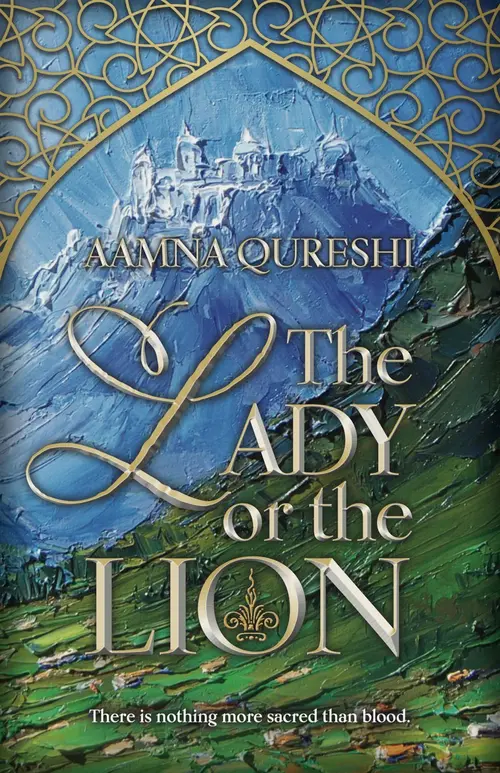
Cover
Dedication
For Mama and Baba,
Jazakullah Khair for everything.
Epigraph
“In the very olden time, there lived a semi-barbaric king . . .”
This is not his story.
The Trial
The appointed hour arrived.
From across the mountain, the people gathered into the galleries of the arena. Though considered a barbaric custom in the nineteenth century, the trial by tribunal was tradition. It was with sick fascination that the villagers filled the seats, the overflowing crowds amassing themselves outside the amphitheater walls.
The sky was a murky grey above them; summer was over. A breeze travelled through the air, and the villagers shivered, clutching their shawls and their children close.
The chatter and clamor ebbed to hushed whispers as the Badshah entered the arena at its height, where his ornate throne awaited him. His bearded face was stoic and severe: his lips pressed into a thin line, his eyes sharp.
The onlookers lowered their heads in respect as he took his seat. His wife, the Wali, sat beside him. A low murmur pulsed through the crowd as one more took her seat beside the Badshah.
It was the Shehzadi.
The low chum-chum of chudiyan echoed through the arena as she moved toward her throne, her blood-red gharara trailing behind her. Her golden crown glistened, bright and shining as her blue-green eyes.
She held her chin high, proud as ever, as she took her seat. The villagers had not expected her to come. How she could stomach such an affair was beyond them! To see one’s lover torn to shreds or thrust to another was no easy sight.
Yet, there she sat, directly beside her grandfather. They sat directly opposite the two doors, those fateful portals, so hideous in their sameness.
All was ready.
The signal was given.
At the base of the arena, a door opened to reveal the lover of the Shehzadi. Tall, beautiful, strong: his appearance elicited a low hum of admiration and anxiety from the audience.
The young man advanced into the arena, his back straight. As he approached the doors, the crowds silenced. A crow cried in the distance, and the lover turned.
He bowed to the king, as was custom, but his gaze was fixed entirely upon the Shehzadi. The sight of him seared through her.
He reached for her, she reached for him, but their hands did not touch: they were tangled in the stars between them, destiny keeping them apart.
From the instant the decree had gone forth to seize her lover to trial, she hadn’t spent a second thinking of anything else. And thus she had done what no other had done—she had possessed herself of the secret of the doors.
Now, the decision was hers to make.
Should she send him to the lady? So that he may live his days with another, leaving the Shehzadi to her envy and her grief? Or should he be sent to the lion? Who would surely tear him to shreds before she had a moment to regret her decision?
Either way, they could never be together.
Then, his quick glance asked the question: “Which?”
There was not an instant to be lost. The question was asked in a flash; it had to be answered in another.
It was time to seal both his fate and hers.
Chapter One
Durkhanai Miangul heard the bell echoing throughout the mountains.
Her hand lay atop her grandmother’s, the Wali of S’vat, whose hand lay atop her grandfather’s, the Badshah of Marghazar. Together, they three had rung the bell to alert the tribespeople of foreign entrance into their land.
For the first time in centuries, the capital city of Safed-Mahal was opening its doors to foreigners, those from their neighboring districts.
Coming to harm her family.
The sound resonated through the mountains, in cacophony with crows crying. It was said that crows brought visitors with them, and as a child, Durkhanai was always excited to see who would visit her castle in the clouds.
But today, she knew the visitors would bring turmoil. While entrance throughout Marghazar was permissible, sparingly, for trade, entrance into the capital Safed-Mahal had been forbidden for centuries.
Until now.
“It is done,” Agha-Jaan said, his old face flushed florid from the wind.
“Yes, janaan,” Dhadi said somberly. “Now we prepare.”
Durkhanai was clad in a pistachio-green lengha choli, her ears and neck dripping emeralds and pearls encased in pure gold. The ensemble made her eyes more green than blue and her skin a soft brown. Beside her, her grandparents were dressed in bottle green: her grandfather in a sherwani, her grandmother in a silk sari.
Maroon red mehndi covered Durkhanai’s hands in flowery details of blooming roses. Her curly hair was swept up in an updo with ringlets framing her face in front of her dupatta, which sat atop her head and fell down one shoulder.
She was the essence of a princess, but she would need to be more to protect her people.
Wind slapped her cold on both cheeks, turning her nose numb: up in the bell tower, there was no spring. It was the beginning of April, when the world cracked open its shell to let greens and pinks begin to spool out. The weather was softer, warmer.
From here, she saw the great expanse of lands she was heir to, the jewels of the earth. The palace was on the side of the mountain, with views of both the empty valleys and the populated ones.
On one populated mountain, she saw two waterfalls, and while ordinarily the glittering water brought her peace, today the two holes punctured in the mountain flowed water like eyes flowing with tears. In the distance of the unpopulated lands, she could almost see the blue green S’vat river, which protected them in the north from the Kebzu Kingdom.
Now, for the first time, they would need protection from those within their lands.
Ya Khuda, protect us, she prayed.
They waited for the bell to quiet, the valley to turn silent. Then, hand in hand, her grandparents made their way to the door, to head back down to the palace below.
“Come,” Agha-Jaan motioned for her to come.
“Just a moment longer,” she responded. “I want to make dua.”
Her grandfather nodded, allowing her solace, and she was alone.
“Ya Allah,” she prayed. “You are the Protector of all people, so please, protect my people. Bless us, forgive us, let no harm come to us. Ameen.”
She blew onto all her lands, the homes that dotted the mountains, praying her people and her country would stay safe from those who were coming.
“I will protect you,” she promised her people. It was her sacred duty to protect this land. With a final glance, she went back down to her palace, to prepare.
A banquet had been arranged for the ambassadors, and Durkhanai had to change to get ready for it. The defenses were up, but their greatest defense was their behavior: they had to act absolutely unbothered by any of this and entirely innocent—which they were.
They were to be kind—but with an undercurrent of cruelty.
As Durkhanai walked to her rooms, she noticed a man walking alone in her hall, his fingers dancing along the windowsill. She paused, blinking.
Who was he? More importantly, what was he doing here?
Durkhanai approached until she stood beside him. Noting her presence, he turned and smiled at her, his black eyes molten and warm, hiding a thousand emotions and layers.
“And you are?” she prompted.
He smiled an easy smile.
“Ambassador Asfandyar of the Afridi tribe of Jardum,” he said. His deep voice was stone: ragged and solid. “Pleased to meet you.”
He lowered his head with respect, but a smirk tugged at his lips. Durkhanai frowned.
From what she knew, the Jardum people were courageous and rebellious. They were good fighters who were pragmatic in picking their battles and making alliances.
She didn’t even know him, but she knew he would be trouble.
Sudden anger flashed through her: she had known the foreigners were coming, but now that they were here, in her home, the irritation was thrice folded. And in her halls!
This would not do.
“How pleasing indeed for you, ambassador,” she said, voice clipped, “that such an egregious occasion has arisen to force Marghazar’s hand into welcoming your sorry hides into our pure lands.”
He met her glare with an easy half-smile, nearly laughing.
“Forced your hand?” he drawled. “And here we were under the assumption the mighty Marghazari couldn’t be forced to anything.”
Her breath caught. She had slipped.
She had let her temper get the better of her, when she knew she was supposed to be fawning over the ambassadors with sweetness to prove her grandfather’s innocence. Her cheeks burned.
Worse still, he had twisted her words and was looking at her like she was as non-threatening as a child. It tore at the insecurity deep within her that told her she would only be a pretty little fool: beloved, yet useless.
Decorum be damned. In that moment, she felt less the sweet rose petals, and more the deadly thorns.
“Haven’t you any manners?” she asked, a bite to the words. She had never been anything but loved and adored, and the way he looked at her made her heart freeze over. “You will speak to your princess with respect, ambassador, lest I have to cut off your tongue.”
“Princess?”
He raised a brow, mock surprised. He cocked his head to the side, looking at her intently. She wanted to point out that she was, in fact, dressed as one, and how daft he must truly be to not realize, but she refrained from doing so. Instead, she lifted her chin.
She felt small, somehow, even though she was far from it: with her tall stature, she was used to commanding the space around her. But somehow, this man was looking at her as if she was as clear and thin as water.
One look at her was proof enough that she was born of the mountains and the rivers: eyes blue-green, her hair as wild as the rustling trees. Soft brown skin like golden earth, she was solid like a tree, but she had the silken stream of the river and the contours of the valleys.
She knew she was beautiful; she twisted her lips.
“Be careful where those eyes travel, ambassador,” she said, saying ambassador like an insult. “People have been blinded for less.”
“You may blind me, but the truth we shall still see,” he said. Whatever humor he had granted her before was gone. Now his voice was somber. Durkhanai furrowed her brows. This was usually the part where people lowered their heads, excusing themselves. No one liked to be on the receiving end of the Shehzadi’s temper.
Yet Asfandydar took a step closer, meeting her gaze head on with a blazing one of his own.
“What, precisely, is that supposed to mean?” she snapped.
“I was at the summit,” he said, face hard.
So it was a threat.
Durkhanai did not even bother to check for a nearby guard; she knew no one would have the audacity to hurt her in her own palace.
The summit had been organized by the Wali of Teerza, who had invited the walis and advisors of the other four zillas—or districts—of the mountains to discuss a treaty of unification: to join the tribespeople of all five zillas into one united nation.
The Badshah was adamantly against the idea. Independence was integral to their culture. The other zillas believed in this as well, but with increasing pressure from the Lugham Empire in the east and south, the Wali of Teerza had managed to get four of the five zillas to agree to at least begin negotiation of unification.
That is, until the explosion.
And seeing as Marghazar was the only zilla absent, all fingers were pointed to her home.
“I witnessed the explosion, heard the screams,” Asfandyar continued. “I saw the blood and the bones: those leaders were not merely your so-called enemies, but my colleagues. Moreover, they were mothers and fathers, wives and husbands. They were close confidantes and friends. They were people. And if Marghazar truly was responsible for such carnage—well, then the butchery will be repaid in kind.”
“Was that a threat? Don’t forget your place, ambassador.”
He smiled that easy smile again.
“I assure you, Shehzadi,” he said, turning her title of princess into the insult. “I know my place quite well.”
“Then you know this is my palace and my land and I can have you killed in a variety of ways without having even a single strand of hair coming undone.”
Unfazed, he tsked. “That’s thrice you’ve threatened me. Where is your hospitality?”
She pressed her teeth together and said nothing. He drew closer.
“Anyhow, your threats are empty,” he said, close enough to touch. “For if you kill me, you will have the war you so delicately prevented. I assure you my life is very dear to the Wali of Jardum.”
It was true: the only reason the ambassadors from the other zillas were even invited to Marghazar was to buy the Badshah time to prove his innocence so that war could be avoided. It was a gesture of good faith.
Her threats were empty. But something turned in Durkhanai’s mind as she recalled. The Wali of Jardum was Shirin of Afridi, a young Wali who had inherited the zilla when her mother was killed at the summit attack.
She looked at Asfandyar, then, how handsome and young he himself was, not yet twenty. Her smile was sugar honey sweet but laced with poison.
“I didn’t realize they were sending the Wali’s whores as ambassadors now,” she said matter of factly, more than a little bit proud of herself.
Asfandyar offered her a smile just as sweet.
“Of course that’s why they sent me,” he responded coolly. “We had heard whores were the only company you kept.”
Durkhanai couldn’t help her mouth from falling open.
Her entire face scrunched with anger, but before she could react further, he tapped her forehead lightly, where her eyebrows were pinched together.
“I wouldn’t hold that face for long,” he laughed. “It might get stuck that way—and what a shame it would be to ruin such lovely features, princess.”
Her fingers curled into little fists, her long nails piercing skin. She didn’t know what to say, but before she could, a boyish grin split his face, setting dimples deep into his cheeks.
How could he turn from grief-stricken and furious to nonchalant and amused so quickly? Surely there was something curious about such control over one’s emotions.
“Excuse me, but I have important matters to attend to,” he said, bowing his head with respect and walking away, shoulders relaxed, chin high.
She watched him go, wanting to throw a dagger into his broad back. He must have sensed her watching, for he looked over his shoulder and winked.
Unbelievable!
It was only when her servants surfaced in the hallway that Durkhanai was swept back to reality.
“Shehzadi,” one of her maids called. “Your bath has been prepared.”
Releasing a measured breath, Durkhanai entered her bathing room, where the tub was filled with warm honeyed milk. Her maids undressed her, then scrubbed her skin with milk-cream until she was soft and smooth. Then she transferred to a second tub filled with rose water. All the while, Asfandyar’s face lingered in her mind, his words playing over and over: They were people.
Surely, such a loss was tragic, but it was not her grandfather’s fault. Her family was innocent, and she would prove as much.
After she was clean, she went to her dressing room to see an elaborate, draping suit.
The folds of the brocade lengha were thick with embroidery, crystal stones, emeralds, and cutwork. The peplum top held the same heavy work, as did the dupatta. It was more ostentatious than anything she had ever worn. Spread beside it were what must be half her weight in jewels and gold: twenty-four chudiyan for each arm, rings for almost each finger, dripping earrings, a wide necklace, thick anklets.
It was florid and ornate, and while she and her grandfather usually adored the extravagant, this was excessive to make a point: it showed the wealth of the capital Safed-Mahal, the zilla S’vat, to foreigners. The power of the Ranizais tribe and the Miangul family.
The might of the Badshah of Marghazar and his crown princess.
Durkhanai straightened her back and raised her chin. She was the daughter of the mountains and river S’vat. She was a princess to this valley and the purest tribe.
She would not let a lowly ambassador faze her.
Chapter Two
Durkhanai stood by her grandfather’s throne, waiting to greet the ambassadors.
Beside him, her grandmother the Wali sat on her own throne. Already feeling tense, Durkhanai turned to her grandfather. He met her gaze with a warm smile.
“Don’t worry, meri jaan,” he whispered, squeezing her hand. With his other, he reached for his wife’s hand. “The Wali and the Shehzadi by my side—together, there is nothing we cannot conquer.”
She knew she was his beloved beyond anything in the world. She was her grandfather’s jaan, his very soul. She was loved by him above all humanity. And he was loved by her.
Durkhanai would never let anyone hurt him. Never let harm come to anyone she loved.
The door swung open with a solid thud as the ambassadors passed from the receiving room into the throne room. There were four ambassadors, each accompanied by one servant. There had been requests to bring their own security; those had been denied. There had been requests to bring along spouses; those had been denied. Eight foreigners were already eight too many.
The ambassadors from the four zillas—B’rung, Teerza, Jardum, and Kurra—came close, spreading out until they stood before the Badshah. Three ladies and one man. Durkhanai’s eyes immediately went to Asfandyar.
He wore a more formal black sherwani atop his black shalwar kameez. It looked simple, but when she looked closer, it had fine black embroidery woven into the material.
Subtle, but fine.
He looked sharp. When he caught her staring, he smirked. Pressing her teeth together, she turned her gaze to the others.
She would not lose her composure as she had in the hall. She knew her orders: she was to be the sweet and beloved princess, to treat her guests with kindness and respect. She would prove her grandfather’s innocence.
The ambassadors all bowed before the royal family. When they rose, the Badshah’s eyes narrowed when they fell upon Asfandyar.
“Come, now, this won’t do,” the Badshah tsked. “The Jardum send their servants to represent them?”
Durkhanai bristled at the cruelty in her king’s voice; his barbarism was bleeding through. It was evident Asfandyar wasn’t a servant—did her grandfather mean to humiliate him?
Asfandyar was unfazed.
“No, Your Excellency, Badshah of Marghazar,” he responded coolly. “My name is Asfandyar of the Afridi tribe, ambassador from Jardum, here to represent Wali Shirin.”
The Badshah was unimpressed.
“A Jardumi?” he asked. “One so Black?”
“My mother was from Dunas,” Asfandyar responded. He hadn’t lost an ounce of composure, but she noted his jaw clenched as the Badshah laughed.
His eyes flicked to the Wali for an instant, almost unintentionally, then his focus was back on the Badshah. It seemed like he recognized the Wali somehow.
“Very well, son of a Black woman, we accept you in this court,” he said. “As charity was beloved of the Prophet.”
Asfandyar bristled but kept his smile, showing no reaction to the king’s cruelty.
Unease needled through Durkhanai. She had no misgivings about punishing him for crimes against her people, but the color of his skin was no affront. This was not the first time she’d been jarred by her grandfather’s beliefs. She’d spent the first portion of her life somewhere else, apart from her grandparents. Their gap in age did not help to assuage such chasms.
Asfandyar retained his aplomb, but she could see his smile like a cracked egg: jagged and crooked, hiding everything soft inside. Asfandyar wasn’t even that dark. Some Teerzais were much darker—but it was the build and the features.
Asfandyar was Black, no doubt about it. Everything sculpted and textured and built differently—and being different made you dangerous.
“We accept you all into this court, into Safed-Mahal, the jewel of S’vat and Marghazar,” the Badshah proclaimed. “My sincerest condolences for those who suffered in the abhorrent attack on the summit held in Teerza. I promise you, on Allah and his Messenger, Marghazar had nothing to do with such a horrid act, and we will all strive together to uncover who the guilty party is. Punishment will be swift and severe, I assure you.
“You are here in my court as a sign of solidarity and comfort, my brothers and sisters. Stay in our court, eat our food, speak with our people, and learn that the Marghazari are enemies to no one, that we are all brothers and sisters serving one Allah, following one divine message. I extend asylum to you all.”
Everyone was smiling, acting like her grandfather’s words were sincere, as though they truly were brothers and sisters when in truth Durkhanai was in a den of snakes, all with fangs poised to attack her family. She would not let that happen. She swore to it.
“You are my honored guests here, in my court,” the Badshah declared. “You will be safe and cared for and honored. Protected by the mountains and by my warriors. We are not enemies. We are family.”
But Durkhanai heard the threat underneath, as did the ambassadors: that they would be safe so long as they did nothing out of turn, and if they did, the mountains would suffocate them, barring exit, and his warriors would kill them.
“Now,” her grandmother said cheerfully, “let’s all retreat to the banquet hall for a feast!”
Durkhanai followed her grandparents into the ornately decorated ballroom. There, her extended family and the other nobles were waiting for them, smoking shisha and making light conversation.
The men were dressed in crisp white shalwar kameez and black or gray waistcoats, their heads topped with wool pakols. The women donned clothing heavy in floral embroidery on smooth silk or soft lawn cotton. Thin chiffon dupattas covered their hair, and warm wool or velvet chaadars covered their shoulders from the chilly mountain night. Their hands, necks and ears were covered in shining gold, their lips coated pink or red.
The Story Continues on BooksBarbecue!
Enjoyed this preview? ❤️ Do not stop here!
Read the complete book free online → 🔗
Continue reading now on BooksBarbecue and discover every page!
Love reading? Bookmark BooksBarbecue.com for more amazing books!
Happy Reading!