The Importance of Being Seven
Alexander McCall Smith is the author of over sixty books on a wide array of subjects. For many years he was Professor of Medical Law at the University of Edinburgh and served on national and international bioethics bodies. Then in 1999 he achieved global recognition for his award-winning series The No.1 Ladies’ Detective Agency, and thereafter has devoted his time to the writing of fiction, including the 44 Scotland Street and Corduroy Mansions series. His books have been translated into forty-five languages. He lives in Edinburgh with his wife, Elizabeth, a doctor.
Praise for the 44 Scotland Street novels:
‘Perfect escapist fiction’
The Times
‘Simple, elegantly written and gently insightful’
Good Book Guide
‘A joyous, charming portrait of city life and human foibles, which moves beyond its setting to deal with deep moral issues and love, desire and friendship’
Sunday Express
‘Does for Edinburgh what Armistead Maupin did for San Francisco: seeks to capture the city’s rhythms by focusing on a small, emblematic corner… A light-hearted, genial soap opera’
Financial Times Magazine
Also by Alexander McCall Smith
THE NO.1 LADIES’ DETECTIVE AGENCY SERIES
The No.1 Ladies’ Detective Agency
Tears of the Giraffe
Morality for Beautiful Girls
The Kalahari Typing School for Men
The Full Cupboard of Life
In the Company of Cheerful Ladies
Blue Shoes and Happiness
The Good Husband of Zebra Drive
The Miracle at Speedy Motors
Tea Time for the Traditionally Built
The Double Comfort Safari Club
The Saturday Big Tent Wedding Party
THE SUNDAY PHILOSOPHY CLUB SERIES
The Sunday Philosophy Club
Friends, Lovers, Chocolate
The Right Attitude to Rain
The Careful Use of Compliments
The Comfort of Saturdays
The Lost Art of Gratitude
The Charming Quirks of Others
THE 44 SCOTLAND STREET SERIES
44 Scotland Street
Espresso Tales
Love Over Scotland
The World According to Bertie
The Unbearable Lightness of Scones
THE CORDUROY MANSIONS SERIES
Corduroy Mansions
The Dog Who Came in from the Cold
The 2½ Pillars of Wisdom
La’s Orchestra Saves the World
COPYRIGHT
Published by Hachette Digital
ISBN: 978-0-748-11887-8
All characters and events in this publication, other than those clearly in the public
domain, are fictitious and any resemblance to real persons, living or dead, is purely
coincidental.
Copyright © 2010 Alexander McCall Smith
Illustrations © Iain McIntosh 2010
All rights reserved. No part of this publication may be reproduced, stored in a
retrieval system, or transmitted, in any form or by any means, without the prior
permission in writing of the publisher.
Hachette Digital
Little, Brown Book Group
100 Victoria Embankment
London, EC4Y 0DY
Contents
Also by Alexander McCall Smith
Copyright
Preface
1. Nothing But Tenderness
2. A Very Considerate Husband
3. At Big Lou’s
4. Auden and Burns, and Bertie
5. Pre-Natal Classroom – for Babies
6. The Ways of Ulysses
7. Anthropological Issues
8. Domenica Has Coffee With Dilly
9. The Grosseto Road
10. The Return of Pat Macgregor
11. Pat’s Flat
12. The Green Hotel
13. On the 23 Bus
14. Regurgitation Issues
15. Edinburgh People
16. For Love or Money
17. The News from Arbroath
18. Ten Years with the Pygmies
19. The Question of Cosmetic Surgery
20. The Aphrodite of Dundas Street
21. Impressionists and Post-Impressionists
22. More About Baden-Powell
23. The Insouciance of Tofu
24. Some Sophisticated Colours
25. 100 Things for a Boy to Do: Part 1
26. 100 Things for a Boy to Do: Part 2
27. Forgery Exposed
28. A Game of Bridge
29. Underneath the Lamplight
30. Trust and Revelation
31. Pregnancy Plans
32. Dramatic, Life-Enhancing News
33. The Implications of Boys
34. Carnoustie Shortbread
35. Édouard Vuillard and the Interior Vision
36. Fear a’ Bhata
37. Political Crisis
38. Show and Tell
39. Which World Am I Living In?
40. A Moment on Queen Street
41. Psychotherapeutic Matters
42. Life and Chance
43. A Scotsman, His Life and Marriage
44. A Move to Moray Place
45. In Moray Place
46. What We Really Are
47. The Symbolism of Birds
48. The Breaking of the Heart
49. Chinoiserie
50. Matthew is Decisive
51. A Letter of Comfort
52. The Meaning of Always
53. An Offer is Made
54. The Therapeutic Hour
55. Men Can Cry
56. From Scotland With Love
57. Bonnie Irene’s Noo Awa
58. Painful Questions
59. Regret on Corstorphine Road
60. The Comfort of Friends
61. Big Lou on Art and Fashion
62. Unwelcome Thoughts
63. Italy At Last
64. Services to the Republic
65. The Impact of Italy
66. Pacta Sunt Servanda
67. An Outing Begins
68. The Need for Evidence
69. On Subsidence
70. Supporting Walls
71. Arrival at the Villa
72. Mistah Kurtz, He Dead
73. The Possibilities of Florence
74. In Proper Boots
75. The Haar Rolls In
76. A Real Boy’s Room
77. Bertie’s Dream
78. An Incident in a Café
79. Unbearable Beauty
80. Antonia’s Condition Explained
81. A Terrible Mistake
82. Shocking Developments
83. A Hinterland of Regret
84. Icarus, Cyril, a Ducati
85. The Timetable of Happiness
This book is for
James Naughtie
Preface
I started writing the 44 Scotland Street series without any idea that it would turn into something of a saga. Now here we are six volumes later, returning to the world of that motley collection of people who live in the Edinburgh New Town and whose lives I have recorded in daily episodes in the Scotsman newspaper. I am very pleased to be back among these characters, and do not intend this to be my last visit to them. Domenica Macdonald, Angus Lordie and all the others have somehow become part of my world, just as I believe they have become part of the world of quite a number of readers in many countries. That, incidentally, gives me the greatest possible pleasure – the knowledge that we are all linked by our friendship with a group of fictional people. What a pleasant club of which to be a member!
I am often asked at events whether I have a favourite fictional character. I find that a difficult question to answer, but it is certainly the case that Bertie, the six-year-old boy in these novels, is somebody for whom I have particular affection. It will not have escaped the attention of readers that Bertie started as a five-year-old five volumes ago and has not really progressed very far. In fact, Bertie is still awaiting his seventh birthday, although it does not actually happen in this book. Why has time stood still for Bertie? The main reason for this, I think, is that Bertie at six is absolutely perfect, and I have no wish for him to grow up. He is at that wonderful stage where he understands the world, but not quite; when his mother is still in complete control of his life; when he has yet to learn how to lie and dissemble, or indeed to be cruel, in the way in which adults seem to find so easy. His world is an attractive one – a sort of Eden – from which we know we are excluded by the loss of our own innocence.
I have lost count of the number of times I have met people on my book tours who say to me that Bertie is a special character for them. This happens throughout the world. Earlier this year I was in India, at the Jaipur Literary Festival, and I met numerous Bertie fans there. The same was true in Australia, Singapore, Dubai and Hong Kong – places that I went to after my Indian trip. The question I was asked most frequently in each of these places was the same: when will things get better for Bertie? And in each of these places there was a great groundswell of support for this poor little boy, egging him on, wishing him freedom from the regime of improvement planned for him by his mother, Irene, and siding with him against the dreadful Olive and the appalling Tofu. I wish I could have said that things were soon to change, but, alas, that would have been untruthful. Bertie’s situation is as difficult as ever; his is a hearth from which freedom seems for ever excluded. And that, alas, is true for so many of us. How many of us are really free of our past, of the things we have to do that we do not want to do, of the furniture of our life that is never really in quite the right place? Perhaps that is why Bertie is so popular. He reminds us of a yearning that many of us instinctively recognise within ourselves: the yearning to be seven – really seven.
I have dedicated this book to one of our greatest broadcasters, James Naughtie. James is a central pillar of the national conversation that we have with each other in Britain. I can imagine him engaging with any of the characters in this book – interviewing Angus Lordie, perhaps, on some artistic project, talking to Domenica Macdonald about her latest anthropological essay, or simply chatting to Big Lou about Arbroath and her years in Aberdeen. But he could also talk to Bertie, I think, and Bertie would be comforted by the conversation. James would make Bertie feel seven, even if he is still six, and that, I think, is a great art. Thank you, James, for everything you have done for me, for the cause of rational debate, and for the millions of people to whom you have brought enlightenment, amusement and comfort.
Alexander McCall Smith
Edinburgh, 2010
1. Nothing But Tenderness
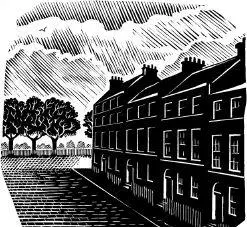
If there was one thing about marriage that surprised Matthew, it was just how quickly he became accustomed to it. There is always the danger that a single person becomes so used to the bachelor or spinster routine that a sudden change in circumstances proves difficult to accommodate. Or so the folk wisdom goes. There is a similar piece of folk wisdom that claims that parents, on launching the last of their children, feel the loss acutely, rapidly declining into the empty nest syndrome. Both these beliefs are largely false. Married couples – or those choosing to live together as bidies-in (and there is no more appropriate term to express that notion than this couthy Scots expression) – both adjust remarkably quickly to the sharing of bed and board. Indeed, after a few days, in many cases, a previous life is more or less entirely forgotten, and each person believes that he and she, or he and he, or she and she, have lived together for a very long time. In this way Daphnis and Chloë, or Romeo and Juliet, can only too quickly become Darby and Joan, Mr and Mrs Bennet, or any other famous domestic couple.
As for the received view about the so-called empty nest syndrome, like many syndromes it barely exists. In most cases, parents do feel a slight pang on the leaving of home by their children, but this pang tends to occur before the offspring go, and it is largely a dread of the syndrome itself rather than concern over the actual departure. In this way it is similar to many of the moral panics that afflict an imaginative society from time to time: the fear of what might happen in the future is almost always worse than the future that eventually arrives. So when the child finally goes off to university, or takes a gap year, or moves out to live with coevals, the parents might find themselves feeling strange for a day or two, but often find themselves exhilarated by their new freedom. Very soon it feels entirely normal to have the house to yourself, such is the rapidity with which most people can adjust to new circumstances. And of course if the child has been reluctant to leave home and has remained there until his late twenties, or even beyond, how much more grateful is the parent for this change. Empty nest syndrome, then, might be redefined altogether, to refer to the feeling of anticipation and longing which affects those whose nest is not emptying quickly enough.
For Matthew and his wife, Elspeth Harmony, the adjustment to married life was both rapid and thoroughly pleasant. Neither had the slightest doubt that the right choice had been made – not only in respect of deciding to get married at all, but also in their choice of partner. Matthew loved Elspeth Harmony – he loved her to the extent that everything that was associated with her, her possessions, her sayings, her friends and connections, were all endowed with a quality of specialness that attached to nothing else. The mug from which she drank her morning coffee was special because her lips had touched it; the tortoiseshell comb that she kept on top of the dressing table was special because it had belonged to Elspeth’s grandmother rather than to any other grandmother; the shopping list that she wrote out to take with her to Valvona & Crolla was special because it was in her handwriting. His affection for her was total, and touching.
For her part, Elspeth could not believe the sheer good fortune that had brought them together. She had always wanted to get married, from her university days onwards, but as the years passed – and she was only twenty-eight at the time of Matthew’s proposal – she had become increasingly concerned that nobody would ask her. There had been one or two boyfriends, but they had not been serious, and her intuitive understanding of this had meant that the relationships had been brief. She saw no point, really, in persisting with a man who would not be with her in a year or two’s time. Why invest emotional energy in something that was not expected to last? In her view that led to disappointment and loss, and this could be avoided by simply not taking up with the man in the first place.
Then Matthew came into her life, and everything changed. It was at such a difficult time, too, very close to that traumatic incident when she had succumbed to her irritation over Olive’s mistreatment of Bertie – Olive had used her junior nurse’s kit to diagnose Bertie as suffering from leprosy – and had pinched Olive’s ear quite hard, something she had wanted to do for some time but which she had refrained from doing because to do so would be contrary to every principle of education and child care she had been taught. The fact that Olive richly deserved this pinch, and indeed might benefit from such a sharp reminder of moral cause and effect, was not a mitigating factor, and she had been obliged to resign from her position at the school. Matthew had been there to save her from the consequences of all this. While other boyfriends might have expressed regret over what she had done, and questioned its wisdom, Matthew sided with her completely and unequivocally, making it clear that he believed that the act of pinching Olive’s ear was a blow for pedagogic sanity.
‘There are many children who would be improved by such a pinch,’ he observed.
Elspeth thought about this. In normal circumstances she would follow the party line and say that one should never raise a hand to a child or indeed pinch any of its extremities, but mulling over Matthew’s pronouncement she came to the conclusion that she could think of quite a number of children who would benefit from a short, sharp pinch. Tofu, in particular, might be improved by a small amount of judiciously administered physical violence, even if only to stop him spitting at the other children. Perhaps if teachers spat at him he would get the message, but modern educational theory definitely frowned on teachers who spat at their pupils. That was the world in which we lived.
And now all that was behind her. Matthew had rescued her from professional ignominy and given her a new purpose in life. He had showered her with love, and she felt nothing but tenderness for this kind and gentle man, who had given her his name, his home, his fortune, and himself.
2. A Very Considerate Husband
For Matthew’s part, the nicest thing about marriage was the opportunity that it presented to do something for another person. By nature he was a generous man, but had been inhibited in the practice of this generosity because of emotional insecurity. When he had been with Pat, in that curious on-off relationship, he had wanted to do things for her but had felt unable to do very much because of fears that she would reject what he did. With Elspeth it was completely different. He felt quite confident in giving her presents, because she received them with such evident pleasure. And anything he did – from dealing with the washing-up in the kitchen to buying her an Art Nouveau gold bracelet at a Lyon & Turnbull auction – had been received by Elspeth with both grace and gratitude.
Inspired by this, Matthew took every opportunity he could to do things for her.
‘Please let me’ was one of the most common phrases to be heard in their household. And ‘No, you’ve done enough, it really is my turn’ had become one of the most common responses.
The whole process started at the beginning of each day when Matthew got out of bed and went through to the kitchen to put on the kettle for a morning cup of tea. Elspeth loved drinking tea in bed, as many people do, and he would take her a piping hot cup of Earl Grey/Assam mixture before turning on the bedside lamp and opening the shutters.
From the comfort of the matrimonial bed, Elspeth would look up at her husband in his tartan dressing gown and smile. She knew that he would now go into the bathroom, shower, dress and then make breakfast for the two of them. By the time that she emerged, the breakfast table in the kitchen would be laid, the muesli jar would be in position, and a pan of water would be boiling on the Aga, ready for a free-range egg. The Aga, a rich red, had been a wedding present from Matthew’s father, along with a matching Aga fridge and freezer.
‘Couples with an Aga stay together,’ her new father-in-law had observed, jokingly, she thought. But he was serious.
‘How do people know that?’ she asked.
‘They just do. It’s the attitude that does it. A person who buys an Aga is going to be … how should one put it, solid. They want a solid and reliable cooker because they are solid and reliable themselves.’ He paused. ‘Do you get flashy types buying Agas? How many flashy types do you know who have an Aga?’
She thought for a moment. Did she know any flashy types? Did she know anybody who had an Aga? Her own parents might have liked one but could not have afforded it, she thought. Agas were expensive, and even an Aga fridge cost about £5,000 or, if one chose the option with the built-in freezer compartment, £7,000. So none of her colleagues had an Aga, and indeed neither did any of her friends, or even acquaintances.
‘Do you know anybody who has an Aga?’ she had asked Matthew after that conversation with his father.
‘Hundreds,’ said Matthew. ‘Why?’
Elspeth frowned. ‘Do you really know hundreds of people who have one?’
Matthew nodded. ‘Yes. I thought they were pretty common. They’re very nice things, you know. They make for a lovely warm place. You can put your wet washing on the rail, socks, underpants, the works. They get dry in no time.’
Elspeth looked thoughtful. Matthew’s comment – made so innocently – spoke to the very different circumstances in which they had been brought up. Elspeth’s father, Jim Harmony, had been a good provider, but had never been able to provide an Aga. She had been brought up in circles where people had modest means; where the overseas holiday was a treat rather than an expectation; where money was tight, as it is for the overwhelming majority of people. Now she found herself married to a man who had a considerable amount of money, and was used to moving in circles where that was the norm. Not that Matthew was any sort of snob – quite the opposite, in fact, as he seemed completely indifferent to wealth or position in others. That was an endearing quality, and she could not have been happy with a man who thought the value of others was determined by their means. But Matthew’s world was certainly different.
So it was upon an Aga that Elspeth’s breakfast egg was cooked. And once again, Matthew took great pains to make sure that he did everything he could to please her. When she had told him that she was quite happy to have her boiled egg ‘as it comes’, he had insisted on having a trial boiling of four eggs for different periods and then asking her to state a preference. She had chosen an egg in which the white was solid, rather than hard, and in which the yolk had at least some motility. Thereafter every egg he boiled her was done for that exact length of time; and every bath, which he ran for her while she ate her perfectly timed egg, was brought to just the right temperature. That temperature had been ascertained by the running of a trial bath in which she had lain while Matthew had gradually brought the temperature up, stirring the water with a large wooden spoon from the kitchen to ensure even distribution of the heat.
The Story Continues on BooksBarbecue!
Enjoyed this preview? ❤️ Do not stop here!
Read the complete book free online → 🔗
Continue reading now on BooksBarbecue and discover every page!
Love reading? Bookmark BooksBarbecue.com for more amazing books!
Happy Reading!