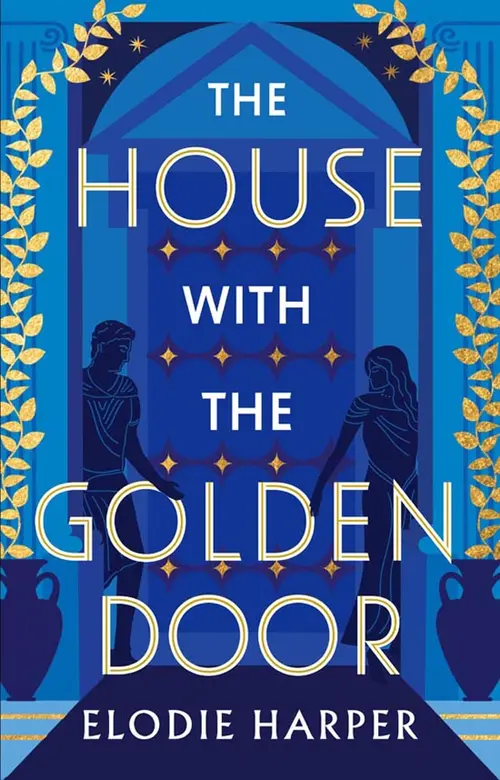
The House with the Golden Door
Cover
PRAISE FOR
THE HOUSE WITH THE GOLDEN DOOR
“One of my standout novels in recent years. . . . Harper is unflinching in her description of the lives of courtesans, and the hypocrisies of the men who use them. . . . As vivid, unsentimental and compelling as The Wolf Den.”
—The London Times
“Elodie Harper’s The Wolf Den was one of last year’s most vivid and transporting books, telling the story of sex workers in a Pompeii brothel in fascinating detail. Its gripping sequel leaves the down-market milieu of the fleshpots to depict its protagonist Amara’s new and luxurious life as a courtesan. But selling one’s body is a transaction in which the man holds all the cards, as Amara seeks revenge on her former owner and, even more dangerously, falls in love. Harper’s recreation of this ancient world continues to thrill.”
—The Guardian
“A beautiful, heartbreaking story of a woman who would do anything for the people she loves, and for her own survival; The House with the Golden Door is absolutely stunning, and kept me glued to the pages until I was done.”
—Hannah Whitten, New York Times bestselling author of For the Wolf
“Beautiful, moving, captivating. The House with the Golden Door is a brilliant sequel to The Wolf Den.”
—Jennifer Saint, bestselling author of Ariadne
“Beautifully written with great heart. . . . Addictive reading.”
—NB Magazine
“Richly evocative, and reeling with drama and the determined passion and conflicts of its unforgettable heroine, this is historical fiction at its most thrillingly entertaining.”
—LoveReading
“A spell-binding novel that brings Pompeii back to life and explores enslavement in all its forms.”
—Anna Mazzola, author of The Clockwork Girl
“Absolutely stunning and utterly gripping!”
—Buki Papillon, author of An Ordinary Wonder
PRAISE FOR
THE WOLF DEN
“Vivid, wise and unflinching, this is a triumph.”
—The London Times, Book of the Month May 2021, #1 bestseller
“A gripping historical story.”
—The Independent
“The Wolf Den is an enthralling, exhilarating read from its first page to its last. . . . Both a fascinating tale in its own right and an important reclaiming of the sorts of stories from history we far too rarely get to hear. . . . Like almost nothing else that exists in this genre at present, carefully drawing contemporary parallels that will feel deeply familiar in a world where modern women still must fight far too hard for autonomy, equality, and the right to feel both safe in and in charge of their own bodies.”
—Paste Magazine
“This powerful . . . trilogy opener beautifully walks the line between gutting and hopeful.”
—BuzzFeed, Best Books of March 2022
“A one-of-a-kind historical novel. . . . This is a mesmerizing, richly detailed tale of sisterhood and courage that fans of Circe will love.”
—Red Magazine, Best Books to Read this May
“There’s nothing like being transported to a different place and time and wholeheartedly believing you are there. . . . A compelling story of survival, friendship, and courage. Amara and her fellow she-wolves are vividly drawn in a fascinating depiction of women at the time. Utterly spellbinding.”
—Woman & Home, Best Books 2021
Dedication
To my dearest son Jonathon—I love you with all of my heart
75 CE
PARENTALIA
1
“Man alone of living creatures has been given grief . . . and likewise ambition, greed and a boundless lust for living.”
—Pliny the Elder, Natural History
The painter stands balanced on a wooden platform, his brushstrokes hidden from sight as he brings the goddess to life. Amara watches him. The rest of the fresco is complete, a hunting scene encircling her small garden. Only Diana’s face is unfinished. She breathes in deeply, enjoying the scents of spring. Narcissi lie scattered at her feet like white stars, and the air is sweet with them.
“Nobody could do justice to her beauty,” the painter remarks, standing back briefly from his work to scrutinize it, before busying himself with the brush again.
Amara knows he does not mean the goddess Diana. She could have hired anyone to paint a god, but she chose this man, Priscus, because he was once the lover of her friend Dido and the only artist capable of drawing her likeness. “I know that you will,” she replies. Or she certainly hopes so. The rest of the painting has been done by his craftsmen at a far cheaper rate. It cost ten times as much to hire Priscus, the master of the firm, to immortalize her friend.
“She was the most exquisite woman,” Priscus says. “There was a lightness to her unlike anyone else. I can still remember the way she sang.”
Dido has barely been dead three months and Amara feels tears prick her eyes. She blinks, not wanting Priscus to notice. It is strange to have him in her home. The last time they had met, she and Dido were enslaved. Priscus had been a regular customer, paying their pimp to spend the night with Dido, while his friend Salvius paid for Amara’s company in the bedroom next door. Now she is a freedwoman paying for his services. She suspects neither of them quite knows how to treat the other after this change in fortune.
He stands back from the wall again, looking over his work. “I believe it is finished.”
Amara steps forward. “May I see?”
“Of course,” Priscus climbs down from the platform, finally leaving his painting in view.
Dido is standing with one hand to her heart, the other pointing across the garden. Amara gazes at her dead friend. Priscus has captured the perfect symmetry of her face, the softness of her mouth and, most of all, her eyes, dark with a sadness she could never hide. Grief hits Amara then, and she turns away. Priscus reaches out before dropping his hand, perhaps afraid his touch will offend her. It is a while before she trusts herself to speak. “I can never thank you enough for this.”
“It has been my pleasure,” he says. “It gives me some comfort to think her beauty is not entirely lost.” Priscus stands next to Amara, leaving enough space between them to show his respect. “But can I ask you something? Why did you choose to remember her like this?”
He gestures at the walls surrounding them, and Amara takes in the scene, so different from the woman he has just painted. A stag with a human face is being ripped apart by hunting dogs, their muzzles slick with blood, teeth sharp in wide open mouths. Through the stag’s mangled body, white ribs are poking, showing the red of his heart. It is Acteon, transformed into a stag by the goddess Diana, only to be torn to pieces by his own hounds. The price he paid for seeing the goddess naked. Diana points at him as he dies, turning Dido’s melancholy into a mark of cruel indifference.
“She had the purest heart,” Amara replies. “Who else could Dido be but the virgin goddess?”
They both know she has avoided his question. Priscus bows his head in agreement, too polite to press further. “Of course.”
Amara waits while he collects his paints, packing them carefully into a box, his apprentice taking apart the platform to carry it back to the workshop. Afterward she walks them both across the atrium to the door. There is no need to hand over the money now. Rufus, her patron and lover, can be relied upon to pay an account at his own leisure. At the doorway, Priscus hesitates. “I hope you will not mind if . . .” He trails off, then collects himself. “Salvius asked me to pass on his good wishes for your health, and his heartfelt thanks to the gods for your good fortune. He holds you in great esteem.”
Amara’s face betrays no sign of the turmoil she feels at this reminder of her old life. She is conscious of Juventus, the porter, no doubt listening to every word, even as he stands silent at his post. “That is kind of your friend. Please pass on my thanks and good wishes for his own health.” She nods, polite but distant, and walks away before Priscus can say anything more. The mention of Salvius has flooded her mind with unwanted memories. His hands on her body, his nakedness, the weight of him, and then worse, not Salvius, but the fear and darkness of her old cell at the brothel, the violence and the pain. Her past is the whirlpool Charybdis, pulling her down under the waves where she cannot breathe.
Amara walks swiftly up the stairs to her private study, trying not to run, and shuts the door. Her legs are trembling. She sits down at the desk, hands flat on its wooden surface, trying to crush the rising panic. Her mind is playing tricks on her again, giving her the sense that she is not here, where her eyes tell her she is sitting, but back there, in Felix’s Wolf Den. Blood thuds in her ears as she searches in the drawer for the box that always calms her. It is heavy in her hands. She sets it down and opens the lid. Inside is all the money she has earned since she came to live here, a mixture of loans she has collected and the generous allowance Rufus gives her. She runs her fingers through the coins, feeling their reassuring weight, listening to the sound of them drop, like the gentle patter of rain.
She arranged this room to be as unlike Felix’s study as possible, placing the furniture at unfamiliar angles, making everything look different. The walls are white, not red; small cupids balance gracefully at intervals along the walls, one with a harp, another with a bow. Every small, pale figure, each careful brushstroke on their bodies, is more finely drawn than anything in the Wolf Den, yet somehow, the images are less vivid than the bulls’ skulls and black plinths she remembers. If she closes her eyes, Amara knows she will see them. There is something about sitting behind a desk that always makes her think of her old master. Even in her dreams, this is how she remembers him. The sharp lines of his body bent over the books, the tilt of his head glancing up, the strength in his hands.
A knock at the door startles her back into the present. “Who is it?”
Martha enters. Amara smiles, but her maid only looks at the floor. “Shall I get you ready to see Drusilla, mistress?” Martha’s accent is so strong Amara sometimes struggles to understand her.
Martha’s shoulders are rounded, her whole posture hunched. At first Amara had thought the girl was shy, but now she recognizes it as the deliberate withdrawal of the unwilling slave. She herself used that same reticence against Felix. Amara has to stifle her irritation. The girl does not know how lucky she is to be here in this beautiful house, not there, in the brothel.
Martha is Hebrew, captured in Rome’s recent offensive against Masada—or so Philos, the household steward, told Amara. It was Philos who chose which other two slaves should join him here on behalf of his master. Rufus, who owns Martha, has not said anything about her. Slaves are not people to him. He “loaned” all the servants to Amara along with the furniture, and it would no more occur to him to explain their different personalities than he would waste his time describing a history of the tables or lampstands. Amara only hopes Rufus never slept with Martha, although the girl is pretty enough. It might explain why she is so unfriendly.
“Thank you,” Amara says, rising from the desk. “You are good to remind me.”
They walk downstairs to the first of Amara’s private rooms off the atrium. Martha has already set out the dressing table. It is impossible for Amara not to think about her friend and fellow she-wolf Victoria when she takes her place in front of all the perfumes and cosmetics. She remembers all the cheap bottles Victoria used to line up so carefully on her windowsill at the brothel, the pains she always took to look her best. Victoria is so vivid in Amara’s memory, the tumble of black curls over her shoulders, her husky laugh and the drawl of her sarcastic remarks, that it seems impossible she will not walk into the room, demanding her own turn at the table. Martha starts to comb out her mistress’s hair. Amara picks up a delicate glass jar, shaped like a flower, unstoppers it and holds it to her nose. Jasmine. It is the only scent Rufus likes her to wear. Martha huffs as Amara puts it down again, and the maid pulls at the comb. All this movement is ruining her attempts to style her mistress’s ringlets.
When she has finished, Martha holds out the silver mirror. Amara always prefers to do her own makeup. She takes the kohl, redoes her eyes where it has smudged, but doesn’t smear any paste on her skin. It was unaffordable while she worked at the brothel, and now Rufus is used to seeing her barefaced. The only time she painted herself for him, he had hated it. All the words he uses to describe her—lovely, delicate, naive—she takes as instructions rather than compliments. It doesn’t matter that she worked in a brothel, that she outwitted the most violent pimp in Pompeii, or that she could move mountains with her rage. This is not what her lover wants to see, so she hides it all.
“Thank you,” Amara says. “You can start work in the kitchen now.”
“But don’t you need me to come with you?” Martha looks nervous. “Master said it’s better you don’t walk out alone.”
It is one thing having to put up with a discontented maid, Amara does not want a spy as well. “The streets do not frighten me,” she replies, with a cold smile, knowing the girl will understand her. “I am quite used to walking them.”
Martha bows her head, cheeks flushing, no doubt cursing the day the Romans dragged her from her homeland to serve a whore. Amara leaves her and walks across the atrium to the huge wooden door. Juventus hesitates a moment before letting her out unaccompanied, glancing round to see if Philos, the steward, is there to grant permission. “Philos is with the master today,” Amara says impatiently. “Perhaps you will let me out to attend the harp lesson Rufus has paid for?”
“Of course, mistress,” Juventus says, stepping aside.
It’s a quieter street than the one she used to live on—the brothel stood at a fork in the road, facing one bar and a stone’s throw from another—but even so, stepping out onto the pavement always makes Amara feel like she has slipped from a still pond into a fast-moving stream. She weaves her way past the billowing cloths that flank her doorway, strips of red, yellow and orange fabric flapping in the breeze. The house Rufus rents for her is fronted by a clothes store, one of several on the street. The shopkeeper, Virgula, nods as she passes, unperturbed at having a concubine for a neighbor. After all, they both share the same landlord—a friend of Rufus who Amara is yet to meet.
The road is narrow, but Amara owns her space on the pavement, her gaze cutting through to the middle distance, forcing others to let her pass. A man weighed down with an armful of leather goods huffs but stands aside. Amara does not acknowledge him. The days when she had to meet any man’s eye on the street are over.
It’s not long before she reaches Drusilla’s house. Pompeii’s most desirable courtesan does not live far away—her road runs parallel to Amara’s. It’s why she knows Rufus will tolerate her making the journey alone. This house is not rented; Drusilla owns it outright, and the beautiful glass workshop that fronts it is also hers. Amara lingers, looking in. The glassware becomes increasingly intricate the further inside you venture. Plain cups and scent bottles stacked on the counter give way to jugs shaped like fishes and an urn dripping in green grapes, a pair of nymphs acting as the vessel’s arms. Amara’s eyes are always drawn to the same place. A shelf carrying small statuettes of the gods. She thinks of the beautiful glass Pallas Athene from her parent’s house, wonders who owns it now.
Amara feels her heart lift as she steps across the threshold into Drusilla’s atrium. The porter inclines his head as she enters—she is always welcome here.
“There you are!” Drusilla calls down, leaning over the indoor balcony, her face dimpled in a smile. Amara beams back. Drusilla is—bar Dido—the most beautiful woman she has ever known. The pale yellow linen tunic she is wearing brings out the warmth of her skin, and her black hair frames her face like a laurel wreath. She could be Hesperia, Amara thinks, goddess of the setting sun.
Amara hurries up the stairs. She always enjoys Drusilla’s company, even more so when they meet without their lovers present, when she knows everything her friend says is genuine. They embrace on the balcony, admiring one another’s outfits, then head to Drusilla’s bedroom where she keeps her harp.
“When is he going to buy you your own?” Drusilla asks, as they sit down together, Amara positioned to play the instrument, Drusilla close beside her to instruct.
“Today, if I let him,” she replies, with a sigh. “But I’m not good enough yet; I don’t want him to hear me.”
“But you could practice every day with your own. You would improve more quickly.”
Amara knows it is true. She is finding the harp harder to master than she anticipated. Every time she plays the lyre for Rufus, however beautifully or skilfully, all he wants to know is when she will entertain him with the harp. There’s no malice in the way he asks; it’s all eagerness like a child, but his insistence makes her feel insecure. She wishes he could enjoy the instrument she already plays. “I’m not sure why he’s so set on this,” she says, patting the strings.
Drusilla strokes her lightly on the back, brushing her hair over one shoulder. “I think it’s an encouraging sign,” she says. “He’s making his mark. Turning you into the perfect concubine to suit his tastes. If he invests enough money in you, he won’t look elsewhere.”
Amara feels a flicker of anxiety. It’s a constant shadow, the worry of losing her patron’s interest. “Let’s try Sappho again,” she says. “I nearly had it last time.”
They play for an hour or more. Amara is a dedicated pupil, never complaining when Drusilla gets her to practice the same chords over and over. For her part, Drusilla is an exacting teacher, not only passing on her musical knowledge, but also her advice on how Amara should hold herself to look as attractive as possible when she plays.
“I think that’s enough for now,” Drusilla says, running her hand along Amara’s arm. “You are getting tense. I was serious earlier. Let Rufus buy you your own instrument. You will learn faster.”
Amara follows Drusilla to the couch. The maid, Thalia, has left them some wine and pastries. “All this effort,” Amara remarks, helping herself to a bun, telling herself she will eat less later. “Can you imagine Rufus and Quintus spending their afternoons deciding how to please us?”
“Not Quintus, certainly,” Drusilla says with a frown.
“But he adores you.”
Drusilla shakes her head. “A man like Quintus will inevitably want the excitement of something new, sooner or later. And I worry it might be sooner.” She toys with her wine glass. It is blue, no doubt bought from the shop she rents out, the red of the wine shining purple through the glaze. “I’m not in love with him, as you know, but a new man is always a disruption. I’m used to Quintus now.”
Amara is not entirely sure she believes Drusilla when she says she does not love Quintus. It’s hard to dedicate so much attention to pleasing a man without ending up feeling some affection for him. “I keep having to remind myself to ration out the tricks I learned at the brothel,” Amara says, raising an eyebrow. “Leave Rufus a few surprises.”
Drusilla snorts. “That one maneuver you told me about! I think even Quintus was shocked when I tried it.”
They both laugh. Amara settles back onto the cushions, enjoying the freedom of friendship, the license to say what she likes. Her apprenticeship at the brothel was brutal—everything Felix forced her to learn coming at the highest possible cost—but now that she has escaped, it can almost seem worth the pain. “Priscus finished the painting today,” she says.
“How do you think Rufus will react? When he realizes it’s Dido?”
“Philos says he won’t even notice,” Amara shrugs. “She was just a slave to him.”
“You discuss Rufus with Philos?” Drusilla’s voice is sharp. “Is that wise?”
“Philos was my friend before, when we were both . . .” Amara hesitates, not wanting to say the word. “When we were both enslaved.”
“But now you are not, and he still is. Philos belongs to your lover. Be careful what you say. He might feel bound to repeat it to his master.”
The Story Continues on BooksBarbecue!
Enjoyed this preview? ❤️ Do not stop here!
Read the complete book free online → 🔗
Continue reading now on BooksBarbecue and discover every page!
Love reading? Bookmark BooksBarbecue.com for more amazing books!
Happy Reading!