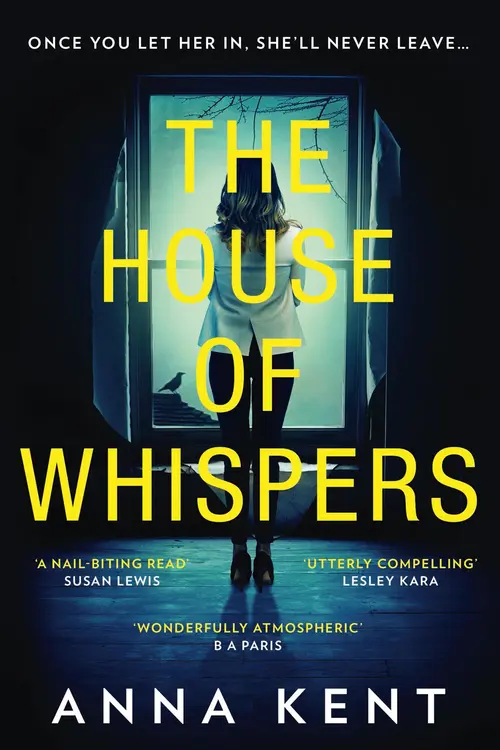
The House of Whispers
Cover
Praise for The House of Whispers
‘I thought this was a nail-biting read that absolutely gripped me. A real page-turner!’
Sunday Times bestselling author Susan Lewis
‘Haunting, dark and wonderfully atmospheric, The House of Whispers will quickly have you under its spell.’
Sunday Times bestselling author B A Paris
‘Beautifully written… a dark and inventive tale. Utterly compelling.’
Sunday Times bestselling author Lesley Kara
‘Unsettling and creepy, The House of Whispers is a gothic yet very modern tale of a descent into madness… Anna Kent kept me guessing at every turn, right up until the last shocking page.’
Alice Clark-Platts, author of The Flower Girls
‘So, so good! A brilliant tale of artistic temperament and toxic friendship but so much more than that too. Just fabulous.’
Catherine Cooper, author of Sunday Times bestseller The Chalet
‘Dark, creepy and atmospheric. I loved it.’
Melanie Golding, author of Little Darlings
‘With excellent characterisation, pitch-perfect prose and heart-wrenching detail, this is a fresh new psychological thriller that – like Grace – completely got its hooks into me!’
Philippa East, author of Little White Lies
‘A chilling and original take on toxic friendship, with a proper gasp-inducing ending.’
Roz Watkins, author of Cut to the Bone
ANNA KENT has worked as a journalist, magazine editor and book editor as well as enjoying a stint as a radio producer. She’s written for numerous publications at home and abroad, including the Daily Telegraph, where she was a contributor for six years. Brought up in the South East, she loves to travel while maintaining a base in Gloucestershire. She’s married with two children.
Title Page

Note to Readers
This ebook contains the following accessibility features which, if supported by your device, can be accessed via your ereader/accessibility settings:
- Change of font size and line height
- Change of background and font colours
- Change of font
- Change justification
- Text to speech
- Page numbers taken from the following print edition: ISBN 9780008238735
Transcript of interview with Mr Rohan Allerton, husband of Abigail Allerton: 20 December 2019
‘So, let’s rewind right to the beginning. When was it that you first suspected that something might be wrong?’
‘It’s really hard to say. Abi’s always been a bit of an oddball. It’s what I love about her. She has what I call… “quirks”, but I put that down to her being so talented. You know she’s an artist? Her work is sublime, and I always think that, with such talent, comes a degree of… [cough] “individuality”? “Uniqueness”? [pause] I guess what I’m saying is that it’s hard to tell where that ended and… Look: I thought things were pretty normal, given that one of us was an artist. I wasn’t looking for signs. I wasn’t on high alert.’
‘But if you had to pin it down? How long ago are we talking?’
‘I guess last summer. Do you remember how hot it was? God. Our house is old. It traps the heat. It rises, right up to the attic where she works. Maybe that had something to do with it. Stuck up there all day, stewing in the heat. I don’t know. Even my mum said she wasn’t herself.’
‘And did she have any ideas on what might be the root of the problem?’
[Laughs] ‘Let’s not go there! But, yeah, I suppose it was the summer when I knew something was up with Abi. I felt she might be hiding something from me… To be honest, I thought she might be pregnant.’
‘And would that be a problem? Something you would describe as “wrong”?’
‘Oh God, no. Not at all. It would be right. All right. We’ve been trying for over a year.’
‘I see. But she wasn’t pregnant?’
‘No. She wasn’t pregnant.’
One
I didn’t tell Rohan straight away that Grace was coming back. The morning that I got her email, I started to tell him, but then I held the thought inside me, like a breath. Inviting her to stay with us was a huge decision. I knew it would change everything.
It was 7.30 a.m. and already the air in the kitchen was stifling; residual heat from the long days of the heatwave was an unwelcome guest trapped in the ceilings and walls of the house, like a ghost. London was suffocating.
‘Darling,’ I’d begun, thinking at that point that I would tell him – not just about Grace, but everything – the whole story. Ridiculous, really, but it was honestly what I was thinking that sweltering morning. We were sitting at the small table in the kitchen, and the back door was propped open to suck in what reluctant breeze there might be. I was nursing a coffee and my husband, ready in his work shirt, his silk tie slung over his shoulder, was eating scrambled eggs on toast. Already I could see the fabric of his shirt darkening under his arms.
But he hadn’t heard me. Maybe I hadn’t said it loud enough; maybe I hadn’t said it out loud at all – I don’t like to think he ignored me. The unresolved issue of what we were going to do about New York hung in the air between us, crackling like an electrical charge. I was still upset with him and he knew it. The fine hairs on my forearms tickled under a sheen of sweat. A fly, gleaming metallic blue, circled lazily over the fruit bowl. The coffee made me sweat more; I pushed it away.
‘So, what are you up to today?’ Rohan said. ‘More pets?’ He shook his head and tutted, but he was smiling. ‘I don’t know why you do it. You should be focusing on your real work: going to galleries, looking at books – I don’t know. Nobody ever got inspired painting dogs. And no gallery ever bought Rufus – the Series.’ He laughed.
I closed my eyes as I let out an imperceptible sigh. We’d been here before. ‘As Picasso said,’ I told him, ‘“inspiration exists – but it has to find us working.”’
Rohan moved his head in time with the words; he’d heard that before, too.
‘I’m doing a home visit today,’ I said.
His eyebrows shot up. ‘A home visit?’
‘Yep.’
Rohan looked at me then, his head tilted; the ghost of a frown lining his forehead. ‘I thought they were supposed to upload photos. Wasn’t that the whole point of the website?’ He shook his head and smiled indulgently. ‘You’re too soft.’
I went over to him and put my hands on his shoulders, feeling the heat of his skin under his shirt as I gave him a little massage.
‘It’s a one-off.’
Rohan leaned back into my hands. ‘Yeah, that’s good. Right there.’ He groaned as my fingers released the tension in his muscles and I realized that, with one thing or another, we hadn’t touched properly for a day or two. That was unusual for us; New York really was taking a toll.
‘Look,’ Rohan said, ‘you’re the best judge, of course, but I really think you need to focus on your next collection and stop messing about. You’ve exhibited in London, hon. It was a sell-out! You can do it again!’ His voice softened. ‘You’re good.’ He reached up and squeezed my hands. ‘I hate it when you sell yourself short.’
He stood up and touched his lips to mine. The tension went out of me as I relaxed into the kiss and, for a few moments, there was no New York, no Grace, no house, no masterpiece waiting to be painted – just the feel of my husband’s mouth on mine and the familiar smell of his skin. But then he pulled away reluctantly, stroking a finger across my cheek as he did so.
‘Hold that feeling, gorgeous. Save it for tonight.’ His hand slid down my body, round my waist and across my bum. ‘I’ve got to run.’
He winked as he looked around for his keys and his briefcase, and that was it: the moment to bring up the topic of Grace was lost. But what I didn’t realize then was that the longer I held the information inside me, secret and burning, the harder it would be to tell him. Rohan didn’t know Grace, or the effect she had on me, but I did.
I’d lived with her before.
Two
Rohan closed the front door with a bang, leaving a shocked silence that reverberated through the house. I sat for a moment, with my head in my hands and my eyes half closed, and let my mind wander. Under my eyelids, I could see the kitchen as it used to be – before we coated its walls with glossy units and smothered the old lino floor with laminate; before we fitted the built-in appliances and the gleaming new oven.
It was all there: the foundations of the old Victorian house, as well as the transient energy of those who’d occupied it throughout the past century. If I concentrated hard enough, I could sometimes catch echoes of them; a snatch of the adults who’d lived and loved within these four walls; of the children who’d grown up here. Their breaths had brushed this very ceiling; had become a part of the fabric of the house. Their thoughts and emotions had impregnated the walls. To my mind, these people still existed, trapped in layers, like coats of paint, behind the cabinets and the shiny glass tiles.
In the hall, the grandfather clock we’d inherited with the house ticked off the seconds, each tick a textured drop of sound that swelled and burst, adding its own shape to the canvas of the house. My breathing slowed and, between my half-closed lids, I pictured the girl who’d lived here before slip into the kitchen, her hair in a ponytail, clean uniform on, ready for school. I watched as she poured cereal into a bowl, added milk, taking care not to spill it, closed the old pine-fronted fridge, and sat at the table to eat her breakfast. She was sweet, and I could tell by the pride she’d taken in her uniform that she was conscientious, too. She read while she ate: one of the thicker Harry Potter tomes. It was advanced for her age, which I took to be seven or eight today, and I smiled my admiration, proud like a mother – not that she’d see me, of course.
But this was no time for daydreaming. I pushed my chair out from under me with a scrape and stood, bringing our new kitchen back into focus. The heat was still stifling; the clock still ticked its metronomic beat; that lazy fly still circled. I picked up the fly swat that had taken up residence on the kitchen table since the heatwave began and gently swooshed until I could edge the fly back out to the garden and off away over the hedge. As my second coffee ran through the machine, I leaned on the counter and reopened the email on my phone. Not that I needed to read it again; already I knew it by heart.
Hi Abi, how are you? I know – long time! How have you been? How’s the art coming along? Have you exhibited again?
I’ve had a blast in Australia. I’ve moved around a bit and seen some different places but my last job came to a natural end and, after lots of soul-searching, I think it’s time to come home. You can only wander for so long, right? I’ve decided to look for a job in London, maybe do some volunteering or something where I can make a real difference. Are you still in London? It’d be great to hook up and, if you have any leads on places to stay, that’d be great. I’m back next month. Cheers, Grace
Grace. Grace, Grace, Grace.
She’d been the first person I’d met at university. It had been my very first afternoon and I’d sensed her before I’d seen her, as if her presence had charged the air itself. Dad had dropped me and my suitcases at the Halls and left, muttering about parking meters and rush-hour traffic, and I’d found my room, unlocked it and heaved my stuff inside. It wasn’t anything much: the scuffed grey paintwork was the colour of rain clouds and, without any personal stuff, it was as bare as a prison cell. I could still give you an inventory of what was there when I arrived: bed, desk, desk chair, easy chair, wardrobe. I added the contents of two suitcases and, later, an easel, canvases, paintbrushes, turpentine. Two dinner plates, two side plates, two bowls, two mugs, two glasses, two sets of cutlery.
‘What if you have friends over to eat?’ Dad had asked.
‘I won’t have friends over,’ I’d said. I don’t have friends.
I’d lain on the bed that first afternoon, staring at the pages of a book, my eyes scratchy with unshed tears; my ears unable to drum out the unaccustomed roar of the London traffic and the sounds of London life: engines revving, sporadic shouts, sudden bursts of police sirens that left my heart thudding. I felt naked – more than naked; I felt as if my skin had been torn off, leaving me red raw and vulnerable; my sense of self as warped as a Picasso. I’d lain on the bed and tried to picture a force field around my body – a buzzing line of light that would keep the world, with its horrors, away from me. I hadn’t learned, then, about PTSD. I hadn’t learned how to deal with it.
From inside the building I could hear voices: my fellow students. They were in the corridor, talking and bonding, flirting, getting to know each other; chatting about where to go for dinner. Vacuous. No cares in the world. I pictured them leaning casually against the walls, dirty shoes marking the paintwork; someone’s door open, music coming from inside, and I longed to be with them; one of them. There was the occasional voice raised in mock offence, and too much laughing. Something deep inside my head had thrummed and then, when I heard the rap of knuckles on my door and the excited voices stopped outside my room, I’d held myself statue-still, not breathing. Even the earring I liked to twist between my fingers fell still.
‘Is she in?’
‘I thought she was.’
‘I didn’t hear her go out.’
‘Maybe she popped out for something to eat?’
‘Knock again.’
I visualized the force field, crackling and electric outside my door; a barrier of energy to repel them and, after a few interminable moments, I heard the shuffling of feet retreating.
‘We tried.’
‘Never mind. Another time.’
I’d slumped back on the pillow, the corridor once more silent. My window was open to the warm September evening but then, right outside my room, the air was rent with the sudden and hostile blare of a car horn that sent my heart scudding. When it had calmed, I’d turned my attention back to the book I was trying to read, my eyes going over the same paragraph I’d read ten minutes previously, and then the hairs on the back of my neck prickled. I froze.
Someone was outside my room; I felt it. I waited, motionless, for the knock but, as the pause extended, I slid silently off the bed and crept towards the door. I’d held my breath, waiting for the person outside to make a move, and I’d stood there for almost a minute, then, when nothing happened, I’d ripped opened the door and there – looking as surprised to see me as I was to see her – was a student about five feet six tall, with shiny, dark hair, tortoiseshell glasses, pale skin and freckles. I still remember what she was wearing: grey skinny jeans, a white T-shirt with a scarf knotted artfully around her neck and the same scuffed white Adidas we were all wearing in those days. Over her shoulder she’d slung a stylish leather bucket bag, which had made me instantly rethink the backpack I carried everywhere.
We’d stared at each other for a moment, then she’d said, simply, ‘Hi, I’m Grace. Can I come in?’ and the force field had really failed me there because I’d stepped back and let her walk right into my life.
And, to be fair, they’d been happy days, just the two of us hanging out. Sure, to begin with, I’d had to back away when her boyfriend, Alex, came up to visit, but I was her North Star – ‘the fridge to her magnet’, as she used to say – the one thing she’d always come back to with a knock on the door and a smile. She’d slink into my room in her lounge pants and her glasses with neither apology nor explanation, and there we’d be again, just the two of us.
Grace and Abs. Abs and Grace.
It soon became apparent that Grace was popular. And why wouldn’t she be? A keen and brilliant medical student, she had everything going for her – brains, beauty, emotional intelligence by the bucketload. Her dimpled smile won everyone over, from professors and students to grannies on the bus. She was the type of girl who’d dance or sing with buskers in the stuffy tunnels of the Underground before blowing a kiss and giving them her last fiver; she was on first-name terms with all the Big Issue sellers we ever passed; and she shouted ‘thank you’ to bus drivers. She gave off an aura of loveliness in which everyone wanted to bask – yet she chose to attach herself to me.
‘Go out with your friends,’ I’d tell her. ‘I’m fine on my own’ – and that was the stupid thing in all this: I really was. I was happy to be alone, to lie in my filth and revel in my misery, but she’d roll her eyes and punch my arm, and joke that I was stuck with her now. If Alex wasn’t coming up to stay, she’d bound into my room on weekend mornings, tearing open my curtains and say, ‘Come on! Get up! Let’s go on an adventure!’ She’d suggest ice-skating, tap-dancing, going out to dance Zumba, or taking the train down to the Kentish coast to eat ice cream with Flakes down by the sea.
She told me everything – all the details of her life, even her love life, assuming, incorrectly, that I, too, was no virgin, and I’d look at the floor and flush as she told me about this position and that position and how she liked it best. The intimacy was unnerving. Overwhelming. All-consuming. Flattering. We were chalk and cheese but, somehow, it worked.
For a while.
The coffee machine beeped, startling me from my thoughts and I stared at the email, still not believing that Grace had written to me; not believing that she was coming back. It had been four years since she’d left, just before my gallery show – just before I’d met Rohan. By then I’d lived with her for five years, through university and beyond, until she’d disappeared – pouf! – like a pantomime genie, off to Australia with her latest boyfriend.
I should invite her to stay with us, of course. That’s what she wanted – that’s what was expected, but then… I stared into space as I weighed up the dilemma. I was older now. Stronger. Married. Living in a lovely home. Although she was as familiar to me as a favourite old shoe, there was no space for Grace in my life. I picked up my phone and clicked ‘reply’.
Dear Grace, I wrote, thumbing the words before I lost my resolve.
Lovely to hear from you! Sounds like you had a wonderful time in Australia, and how exciting to be moving back to London. Yes, I live in North London now, with my husband. I’m very busy with work but I’d be very happy to help you find somewhere to stay – if you give me an idea of budget and the sort of area you want to be in, maybe I could see what’s available. When are you planning to arrive? Cheers, Abi
Upstairs, a door slammed, and the noise ripped through the house like a gunshot. I jumped in my seat and Alfie, our cat, shot into the room, his claws skittering on the hard floor.
‘You got a shock, too?’ I said and he prowled, his tail fluffed up like a squirrel’s. Outside, the trees rustled, the first wind we’d had in days – weeks, it seemed. ‘It was just the wind,’ I said. ‘Nothing to be scared of, you wuss.’
I turned back to my phone and read the email again to myself, as pleased with myself as an alcoholic pushing away a drink, then I put the message into the ‘drafts’ folder – it was time to visit Mrs Keyson. Her husband was one of my patients at the hospice: a sparky, ex-fighter pilot, he was one of my favourites, but he didn’t have long left, and he missed his dog, Bruce. It was way beyond my remit as a volunteer, but I was going to paint a portrait for him to keep by his bedside.
Three
It was midday by the time I’d finished photographing the dog at Mrs Keyson’s and got off the bus at the High Street. I was sweating, my T-shirt damp against my back; the music in my AirPods drowning out the sound of whatever birds might have been singing. Summer was never easy for me; things that other people loved – the scent of a flower, or the slant of light at sunset – had the potential to tip me into a full-blown panic attack. I knew that now. I dealt with it.
The Story Continues on BooksBarbecue!
Enjoyed this preview? ❤️ Do not stop here!
Read the complete book free online → 🔗
Continue reading now on BooksBarbecue and discover every page!
Love reading? Bookmark BooksBarbecue.com for more amazing books!
Happy Reading!