The Hornet's Nest
Cover
Thank you for downloading this Simon & Schuster eBook.
Join our mailing list and get updates on new releases, deals, bonus content and other great books from Simon & Schuster.
CLICK HERE TO SIGN UP
or visit us online to sign up at
eBookNews.SimonandSchuster.com
Contents
Acknowledgments
Principal Characters
BOOK I: 1763–1773
CHAPTER 1. The Philadelphia Cordwainers
CHAPTER 2. Sons of Liberty in Norfolk
CHAPTER 3. A Corrupt Royal Government
CHAPTER 4. The Regulators
CHAPTER 5. The Regulator Revolt
CHAPTER 6. Quakers Move to Georgia
CHAPTER 7. The Battle at Alamance
CHAPTER 8. Trial and Execution
CHAPTER 9. The Pratts Move to Georgia
CHAPTER 10. Life on the Frontier
CHAPTER 11. The Pratts and the Morrises
CHAPTER 12. The Neighboring Indians
CHAPTER 13. William Bartram Visits Georgia
BOOK II: 1774–1777
CHAPTER 14. Stirrings of a Conflict
CHAPTER 15. A Special Colony
CHAPTER 16. Massacre of the Indians
CHAPTER 17. Clarke Organizes a Militia
CHAPTER 18. Peace in Georgia, Fighting in the North
CHAPTER 19. The Georgia Navy Strikes
CHAPTER 20. Does God Approve Revolution?
CHAPTER 21. Thomas Brown, British Spy
CHAPTER 22. Tar and Feathers
CHAPTER 23. A Rebirth at St. Augustine
CHAPTER 24. The Florida Rangers
CHAPTER 25. “Common Sense”
CHAPTER 26. Georgians Expel the British Governor
CHAPTER 27. The Struggle for Indian Allegiance
CHAPTER 28. Florida Rangers Versus Georgia Militia
CHAPTER 29. Georgia Remains Independent
CHAPTER 30. A Deadly Duel
BOOK III: 1778–1785
CHAPTER 31. The British Southern Strategy
CHAPTER 32. Last Invasion of Florida
CHAPTER 33. Quash Dolly, Slave Woman
CHAPTER 34. The British Take Savannah
CHAPTER 35. The Hornet’s Nest
CHAPTER 36. “Take No Prisoners!”
CHAPTER 37. Ethan Pratt Goes to War
CHAPTER 38. The British Take Georgia
CHAPTER 39. The Americans and d’Estaing Attack Savannah
CHAPTER 40. New York to Savannah
CHAPTER 41. Brown Returns to Augusta
CHAPTER 42. The Fall of Charles Town
CHAPTER 43. Cornwallis Triumphant
CHAPTER 44. Georgia Militia to Carolina
CHAPTER 45. Attack on Augusta
CHAPTER 46. Four Hundred to the Watauga Valley
CHAPTER 47. The Over Mountain Men
CHAPTER 48. Ethan at King’s Mountain
CHAPTER 49. General Nathanael Greene
CHAPTER 50. Georgians Turn to Combat at Home
CHAPTER 51. A Victory at Augusta
CHAPTER 52. Ethan and Mavis
CHAPTER 53. Cornwallis Moves North
CHAPTER 54. Mavis Goes North
CHAPTER 55. Georgia Finally Secured
CHAPTER 56. Ethan Returns to Augusta
Epilogue
About Jimmy Carter
Dedication
In memory of my parents, Earl and Lillian, my brother, Billy, and my sisters, Gloria and Ruth
Acknowledgments
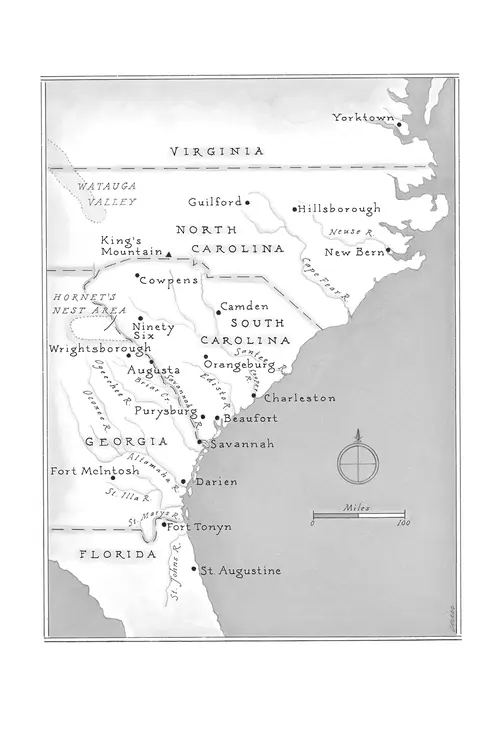
This novel was begun more than seven years ago and, while writing three other books, I turned constantly to it with new ideas and information about my own ancestors and others who played a crucial role in achieving our nation’s independence. Most Americans know very little about major events of the war in Florida, Georgia, and the Carolinas, and I wanted to present as accurate an account as possible of the complex and crucial interrelationships among colonists, British officials, and the Indian tribes during the twenty years that led to the war’s successful end in 1783.
I would like to thank the librarians at Emory University and others in Georgia and North Carolina for providing me with maps and more than two dozen history texts and biographies, written by both English and American authors. They also helped me understand how people traveled, fought battles, grew crops, made shoes, and what words were used during the eighteenth century.
My wife, Rosalynn, was my earliest editor, and her questions about the interrelationship of characters, both historical and fictional, were incisive and helpful.
The strong influence of Michael Korda and Alice Mayhew, editors at Simon & Schuster, provided the necessary incentive for me to arrange the text in a more logical fashion and, with some pain and reluctance, to reduce its original length.
As with all my other books, Faye Perdue provided easy and pleasant communication with the editors and librarians and handled the myriad details of a book’s being born.
Principal Characters
Ethan Pratt (wife, Epsey): frontiersman, later Georgia militiaman
Henry Pratt (wife, Sophronia): Ethan’s brother, member of North Carolina Regulators
Joseph Maddock: Quaker leader
Kindred Morris (wife, Mavis): naturalist, neighbor of Ethan Pratt
Newota: young Indian, neighbor of the Pratts and Morrises
Elijah Clarke (wife, Hannah): organizer and leader of Georgia militia
Aaron Hart: aide to Elijah Clarke
Lachlan McIntosh: Georgia military commander
Button Gwinnett: Georgia political leader
Thomas Brown: organizer and leader of Florida Rangers
Quash Dolly: slave woman
OTHERS
Georgia militia leaders: James Jackson, John Dooly, William Few
South Carolina militia leaders: Andrew Pickens, Francis Marion, Francis Sumter
Continental military commanders: George Washington, Charles Lee, Benjamin Lincoln, Robert Howe, John Ashe, Horatio Gates, Nathanael Greene, Daniel Morgan, “Lighthorse Harry” Lee, “Mad Anthony” Wayne
British military commanders: Thomas Gage, William Howe, Henry Clinton, Charles Cornwallis, Augustine Prevost, Alured Clarke, Banastre Tarleton, Patrick Ferguson
Royal governors: William Tryon, North Carolina; James Wright, Georgia; William Campbell, South Carolina; Earl Dunmore, Virginia
Georgia’s elected leaders: Council of Safety President Archibald Bulloch, Governors John Adam Treutlen and John Houstoun
Aides to Thomas Brown: Alonzo Baker, Chief Sunoma, Daniel McGirth, James Grierson
Chesley Bostick: a Son of Liberty, Brown’s persecutor
Emistisiguo: distinguished Indian chief
Herman Husband: leader of North Carolina Regulators
John Stuart: Royal Indian superintendent
William Bartram: naturalist, explorer
William Henry Drayton: South Carolina firebrand patriot
Count d’Estaing: French naval commander
BOOK I
1763–1773
CHAPTER 1
The Philadelphia Cordwainers
1763
The young girl stood quiet and unseen behind the trunk of a large walnut tree, its leaves and branches scarred on one side by a recent fire. Her demeanor and even her clothing would have indicated to a careful observer that she led a relatively protected life in a family of modest means. Although concealed, she didn’t appear to be ill at ease, but quite sure of herself. Her high-topped shoes were polished but plain, like new ones designed for a long life, and her black dress was of good quality but without frills of any kind. She wore a bonnet that only partially concealed her thick and somewhat unruly hair, most of it twisted into a tight bun on the back of her head. Hers was almost but not quite the same as clothing worn by the many Quaker families in Philadelphia.
From her vantage point on the edge of a side street among modest houses and shops, she could survey most of a small vacant lot—or one that was almost empty. There were the remnants of a burned house, its outline delineated by a rim of scorched weeds and grass. The lone chimney was standing and some of the foundation pillars were still visible, flat rocks only partially held together by blackened mortar. When the unoccupied house had burned the previous month, the neighbors had been successful in limiting the blaze to the one structure, largely because the nearest home was twenty feet away.
There was a boy working just beyond where the house had stood. She knew his name was Ethan, and that his father was Samuel Pratt, the neighborhood shoemaker. Recently she had volunteered to carry her father’s shoes to be repaired and was disappointed when only Mr. Pratt had been in the shop. This was the third time she had come to watch Ethan, and she felt somewhat guilty. Her parents would have been surprised to see her doing anything devious or surreptitious. She was not afraid or embarrassed, but only reluctant to confront another person her age, and especially the boy she was watching.
On previous days she had seen him use a pinch bar to remove the few remaining cut nails from charred boards and timbers, and carefully straighten each nail with a hammer and put it into an old bucket. Then he had gathered the wood debris against a leather apron that extended from his upper chest down to his thighs, and laboriously arranged the pieces in neat piles on the ground, each parallel to the others. Only after the ground within the foundation was cleared and swept smooth had the boy prepared his garden plot in what had been the backyard. He had cut down the weeds with a scythe, broken the ground with a pick and mattock, raked it level, and laid off rows with a hoe. He used two stakes and a taut string to make each furrow perfectly straight before moving to the next one. Now he was planting small pieces of white potato from a bucket in regularly spaced hills almost exactly a foot apart. The girl was fascinated by the care, persistence, and precision with which he labored, totally absorbed in his work. She noticed that there were no wasted movements of his agile hands.
Now she made a deliberate decision to move a few inches out into the open, and the boy looked up and saw her, she presumed for the first time. For a few seconds, they both seemed uncomfortable, not knowing what to say. She finally made a remark that she had carefully rehearsed: “It’s interesting that those potatoes are akin to tomatoes.”
Ethan, somewhat aggravated to be observed without knowing it, replied, “That’s foolish. A potato grows under the ground, and tomatoes on a bush.”
The girl thought for a while and said, “Then maybe my father’s book is wrong.”
“What kind of book?”
“It describes the different food plants produced in Europe.”
Ethan was intrigued, but reluctant to continue talking with a stranger. He said, with something of a smile, “Well, you’d better take another look.”
He turned to continue his work, and when he glanced up again, the girl was gone. This was one of the few times in his life that he had spoken directly with any girl other than his two sisters. He figured that she was probably about his age, since she was larger than his sisters. She was not unattractive, but dark eyebrows gave her face a somewhat brooding appearance. He was pleased that he had been able to correct her mistake, hoped that he had not hurt her feelings, and then forgot about her completely. He had no premonition that they would spend a good portion of their lives together.
Late the next afternoon he was watering some new onion plants and saw the girl approaching from across the nearby street. She had a book in her hand and walked directly toward the garden plot, without hesitation. When she arrived at the edge of the lot, she waited for him to speak first.
“Well, what did you find about the vegetables?”
Trying not to sound superior in any way, she glanced in the book and said, “Tomatoes and potatoes are both in the nightshade family, with a Latin name spelled s-o-l-a-n-a-c-e-a-e. They came from South America. My father has a special interest in the names and origins of plants.” She paused for a few seconds and added, “And so do I.”
She turned the book around and held it out to Ethan as he approached her, and without touching the pages, he read the text. Then he wiped his hands on his trousers, took the book, and thumbed through its pages, stopping to read a few sentences about corn, peas, okra, carrots, sweet potatoes, and other plants that he knew.
She said, “I told my father about your garden, and he said you could borrow the book if you wish.”
When Ethan nodded and kept the book, the girl turned and began to walk away. He called after her, “I’m grateful. What is your name?”
“Epsey Nischman.” She hesitated a few moments and then added, “My father is a Moravian minister, who teaches in our church’s boarding school. We live about two hundred yards from here, and I have seen you working in the garden. My grandparents used to live in Savannah, Georgia, and my grandmother lives with us now.”
They exchanged a little more information about each other, with Epsey describing a house “full of books” and parents interested in helping Indian tribes improve their lives with religious instruction and better farming practices. Epsey soon knew that Ethan was eighteen years old and he found out Epsey was two years younger.
Ethan said, “I’ve had a very small garden plot for several years just behind our house, but it’s mostly in the shade. Only last weekend Mr. Parvey came in our shop to get his shoes repaired, saw me working in the backyard, and said if I would clean up this lot I could plant a garden. I’m to save the boards and nails for him and give him a third of the vegetables I grow.”
“Why didn’t you plant in the clean place where the house stood?”
“Because my father said that a hot fire would kill the ground for a year or two, so things won’t grow on it.”
Epsey offered to help him with his work, but he declined politely. She told him where she lived, and he promised to return the book the next Saturday morning.
As night approached, Ethan walked down a path behind the shops and small houses to the back door of the Pratts’ home and entered the kitchen. His father and sisters were at the table, and his mother was preparing to serve supper.
“You’re late again,” she said. “We were just getting ready to eat.”
“I’ve been in the new garden. I only have a couple of hours each day after the shop closes to work in it.”
His father said, “You’re not like Henry was. He always wanted to stay in the shop as long as he could.”
Ethan decided not to reply.
The shop was not an unpleasant place. There were four workbenches in the center of the main room, spaced evenly around a lighting source that supplemented what came in through the windows and doors. A single high-quality candle burned in the center of four small globes filled with water, each the size of a large man’s fist. Each created a prism that focused the candle’s light in a small spot, and the shoemakers shifted their work to be in the brightest place. The soft leather for the upper shoe was stretched into proper shape, holes were punched with an awl, and strong linen or flax thread was used for sewing. Although steel needles were available, everyone preferred to use stiff hog bristles, which were enmeshed in the end of the thread and guided the fibers through the holes. The thick soles were often attached with small maple pegs. All the toes were square, and the shoes could be worn on either foot.
Samuel Pratt was from a Scotch-Irish Presbyterian family and had come from Ulster to Philadelphia as a young man. Most of his earlier friends had moved on into western Pennsylvania, but he had stayed in the city to ply his trade. He was a member of the Guild of Cordwainers, the older name for their craft. Mr. Pratt was proud of his shop and his trade, commenting often about its value to the community, the breadth of its contact with even the most elite members of Philadelphia society, and the fact that the Worshipful Company of Cordwainers had helped to finance Captain John Smith’s first expedition to America in 1607, long before the Pilgrims came to Massachusetts.
The family lived in the heart of Philadelphia, where Mr. Pratt earned enough to support his wife and four children, somewhat crowded into two rooms above the shop. In the larger room upstairs, two old blankets hung from a length of rope, with a bed on each side. The boys used the space nearest the door and the girls enjoyed a window that looked out on the street. On the ground floor, a narrow room extended all the way across the house behind the shoemaker shop, with a long table surrounded by two benches and two chairs occupying much of the floor space. The fireplace at one end provided warmth and a place for cooking, and supplies of leather goods were stored in shelves along the walls. Mr. Pratt sometimes worried about the future, but the other members of the family took it for granted that they would never lack anything they really needed.
Although Henry was the one who seemed to be interested in his father’s trade and loved to be at the shoemaker’s bench, the making and repairing of shoes and other leather goods just made possible the camaraderie and political discussions with customers and loungers that he really loved. He was small for his age, loved to be with people, and had many boyhood friends. Even when quite young, Henry joined in the discussions about the exciting political life of Philadelphia and its cultural and economic affairs. He worked rapidly and with great skill but despised taking orders and keeping records. Competition from other shoemakers in the city was intense and his father showed no inclination to retire and permit either of his sons to run the shop, so from an early age Henry’s ambition was to move away from home, own his own place, and live an independent life. Influenced by some broadsheets distributed by the Guild of Cordwainers, Henry planned to travel to Norfolk, Virginia, and later to settle in western North Carolina, where he’d read that a number of Quakers had established new homes. He was never insubordinate to his parents and didn’t want to cause them concern, so he shared his plans only with Ethan.
Ethan was the youngest child, born in 1745, two years later than his brother. He had little love for either the work or the talk of the shoemaker’s shop. He was interested in tools, machines, and how things worked, but was even more fascinated with plants and how to grow them. Even as a small child, Ethan had felt closed in and restricted, and wanted mostly to be alone. He had always been quiet and aloof, disappointing his older sisters when he rejected their efforts to cuddle and care for him. Ethan was now tall, thin, blond, and handsome in a rough way. There had been a time when Henry was dominant, but Ethan was larger even before they became teenagers, and after their first bodily contest they had learned to respect each other as physical equals. As soon as he could obtain his mother’s permission, Ethan had begun moving his bedroll downstairs to a corner of the shop, but only for privacy during the night and not because he was attracted to the place during the working day.
He watched Henry with interest and sometimes embarrassment during busy hours in the shop. The conversations were often lively, and Henry would make loud, confrontational statements about political affairs, and was sometimes personally critical of prominent people in the city, including Benjamin Franklin and some of the more influential Quakers. The age or substantiality of other men in the shop never dampened his provocative opinions. Ethan soon realized that his brother would take diametrically opposite positions in subsequent discussions, obviously just to engender lively exchanges. Their father rarely commented except on matters that involved his own profession, and seemed to realize that part of his business was due to Henry’s helping to provide a forum for the exchange of ideas.
Ethan realized that when his brother left home, he would be expected to become his father’s apprentice, customarily a commitment of six or seven years. He was always uncomfortable around other people and, taking advantage of Henry’s presence, he escaped whenever possible to visit a nearby blacksmith or a cabinetmaker, where he volunteered to help them and carefully observed them at their craft. Without explaining or really expecting to have a place to use them, he asked Henry to help him acquire tools of his own with which he could work with wood. Henry found a small collection for sale at a low price in the estate of an older friend of their father. For years, Ethan had enjoyed working behind their shop in a small garden plot, only about twice the size of their kitchen table. He had experimented with various kinds of seeds and cultivation practices, and was proud when his vegetables helped supplement the family’s diet. During the growing season he had tended the garden while the shop was closed or without customers, and considered it a source of pride to be called “farmer” by the other children.
The Story Continues on BooksBarbecue!
Enjoyed this preview? ❤️ Do not stop here!
Read the complete book free online → 🔗
Continue reading now on BooksBarbecue and discover every page!
Love reading? Bookmark BooksBarbecue.com for more amazing books!
Happy Reading!