Chapters (42)
- Title Page
- Tor Copyright Notice
- Thrall
- Chapter One - NORTHEAST COAST OF ENGLAND, A.D. 865
- Chapter Two
- Chapter Three
- Chapter Four
- Chapter Five
- Chapter Six
- Chapter Seven
- Chapter Eight
- Chapter Nine
- Chapter Ten
- Chapter Eleven
- Carl
- Chapter One
- Chapter Two
- Chapter Three
- Chapter Four
- Chapter Five
- Chapter Six
- Chapter Seven
- Chapter Eight
- Chapter Nine
- Chapter Ten
- Chapter Eleven
- Jarl
- Chapter One
- Chapter Two
- Chapter Three
- Chapter Four
- Chapter Five
- Chapter Six
- Chapter Seven
- Chapter Eight
- Chapter Nine
- Chapter Ten
- Chapter Eleven
- Chapter Twelve
- Also by Harry Harrison
- PRAISE FOR - THE HAMMER AND THE CROSS
- Copyright Page
“And there is another strange thing about him. Who is his father? Sigvarth Jarl thinks he is. But for that we have only his mother’s word. It comes to me that perhaps this boy is the beginning of the great change, the center of the circle, though no one could have guessed it. And so I have to ask his friends and those who know him a question:
“Is the boy mad?”
Slowly, eyes turned to Ingulf. He raised his eyebrows.
“Mad? That is not a word to be used by a leech. But since you put it to me in that way, I will tell you. Yes, of course the boy Shef is mad. Consider …”
Hund found his friend, as he had known he would, standing amid a litter of charred wood and iron at the northeast tower, above the Aldwark, surrounded by a knot of interested pendant-wearers. He slipped between them like an eel.
“Have you worked it out yet?” he asked.
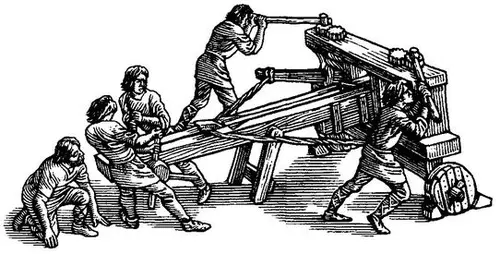
Shef looked up. “I think I have the answer now. There was a monk with each machine, whose duty was to see it destroyed instead of captured. They started the job, then scuttled back to the Minster. The men they left behind had no great desire to see the burning finished. This slave was captured,” he nodded at a collared Englishman inside the ring of Vikings. “He told me how it worked. I haven’t tried to rebuild the machine, but I understand it now.”
He indicated the pile of charred timbers and iron devices.
“This is the machine that fires the bolts.”
Shef pointed. “See, the spring is not in the wood, it is in the rope. Twisted rope. This axle is turned and twists the rope which puts more and more force on each bow-arm and the bowstring. Then, at the right moment, you release the bowstring …”
“Wham,” said one of the Vikings. “And there goes old Tonni.”
A grunt of laughter. Shef pointed at the toothed wheels on the frame. “See the rust on them? They are as old as time. I do not know how long it is since the Rome-folk left, or if these things have been lying round in some armory ever since. But anyway, they were not made by the minster-folk. It is all they can do to use them.”
“What of the great boulder-machine?”
“They burnt that better. But I already knew how they were made before we got over the wall. The minster-folk had all that in a book, and the parts of the machine also, left over from olden times, so the slave says. I am sorry they burnt it all, for that alone. And I should like to see the book that tells how to build machines. That and the book of numbercraft!”
“Erkenbert has the numbercraft,” said the slave suddenly, catching the Norse word in Shef’s still faintly English pronunciation. “He is the arithmeticus.”
Several Vikings clutched their pendants protectively. Shef laughed.