The Growing Season
Cover
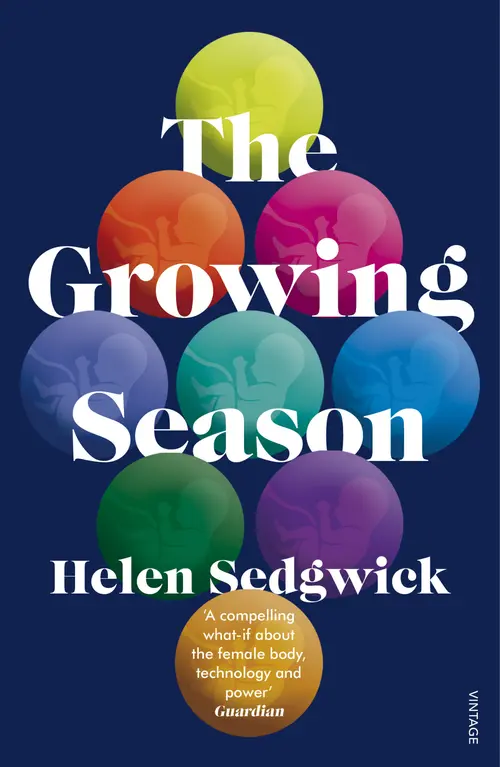

About the Book
Now anyone can have a baby.
With FullLife’s safe and affordable healthcare plan, why risk a natural birth?
Just choose the colour of your pouch and its accessories.
Without the pouch, Eva might not have been born. And yet she has sacrificed her career, and maybe even her relationship, campaigning against FullLife’s biotech baby pouches. Despite her efforts, everyone prefers a world where women are liberated from danger and constraint and all can share the joy of childbearing. Perhaps FullLife has helped transform society for the better? But just as Eva accepts this, she discovers that something strange is happening at FullLife.
Piotr hasn’t seen Eva in years. Not since their life together dissolved in tragedy. But Piotr’s a journalist who has also uncovered something sinister about FullLife. What drove him and Eva apart may just bring them back together, as they search for the truth behind FullLife’s closed doors, and face a truth of their own.
A beautiful story about family, loss and what our future might hold, The Growing Season is an original and powerful novel by a rising talent.
About the Author
Helen Sedgwick was a research scientist working in the field of biophysics before writing her debut novel, The Comet Seekers. She has an MLitt in Creative Writing from Glasgow University and a PhD in Physics from Edinburgh University, and has received a Scottish Book Trust New Writers Award. Having grown up in London, she now lives in the Scottish Highlands. The Growing Season is her second novel.
Also by Helen Sedgwick
The Comet Seekers
Dedication
For Michael
Audio log
7 Feb 2016 18:32
This will be my last audio log. I’ve been thinking about how to explain, though perhaps it doesn’t matter now anyway – you didn’t come, and it is too late to make a difference. So I think I might end with the story of the indigo hamlets. You remember – those luminous tropical fish I used to talk about? For ten years I’ve kept them in my aquarium in the outhouse. When I stand between those four walls of Caribbean Sea I can imagine myself in a coral reef with no glass keeping me separate. I suppose they’ll be dead by the time you hear this, but that’s probably for the best. Fish should not be kept in a tank any more than animals housed in a cage or humans confined to a role. We all of us need our freedom, sooner or later. Don’t you think?
I went out to the rocks this morning, before sunrise. It is not as dark as you might imagine, when your eyes are accustomed and the moon is past waxing gibbous. But I do realise that a fall could kill me and I am not ready to die, not just yet, so I wore my head torch and carried a hand-held beam strapped tight to my wrist. The path out to the black coast is muddied and frozen this time of year. Covered in thin sheets of ice that crack under my feet and puddles that trap my ankles, sinking me shin-deep into half-hearted bog.
I call it the black coast for the rocks, fractured and pitted as they are. Deep like charcoal but sharp as etched glass. Sheets of them stretch out when the sea is away, lives upon lives of sediment. This morning, though, the sea was close in, and the waves were thrashing against the dark sandstone. I wondered if they were trying to claw their way right up into my lighthouse.
I feel alive, standing at the coast, my feet planted – like this – on the rock and my body braced against the wind. It believes I am not a challenge, that wind. It sees only an old woman but it has not blown me over yet. It stings my eyes with grit-salt until they’re raw in the corners and weeping but it does not blow me over. It is hard to imagine anywhere else when you’re facing those waves, standing on those rocks. But even there – even now – there are times when I am in two places at once. When I am living in two times. I am an old woman standing alone with her scowl and I am a young woman sitting among the dark wood and towering bookshelves of that basement room in King’s. The feel of all that cold stone underfoot, the echo of it, the smell of the professor’s tobacco mixing with a hint of stale chlorine that could have come from the lab or from the clean floor in the corridor. That room is as still and timeless, in its way, as the ever-changing black rocks of the peninsula.
‘You can have the post,’ he says to me. His beard doesn’t move as he talks and it obscures his lips – I only see the flash of teeth. ‘Fixed term,’ he says. ‘Three years. You will be expected to publish.’
‘Of course,’ I say, not wanting my excitement to show.
‘I see you have a reference from our Dark Lady.’
He chuckles. His eyes are amused. He seems to find himself amusing.
‘Though Rosy’s not working on cell fertilisation, is she?’
I give a clipped smile as my excitement changes into something vaguely sickening. These are the names they call her, behind her back. The Dark Lady. ‘Rosy’. I’ve heard them before – everyone has – and we all understand the implied insults, too. What an affront, to be a woman. To be that type of woman. I chose to use her reference for a good reason.
He leans across the desk with a reassuring expression, like you would give to a child.
‘Well, let’s see what you’re made of, eh?’
I think he might be about to pat my hand, so before he can I snatch it away and push my chair further back from the desk. It scrapes, nail-like, along the floor. I can hear the screech even now.
I meet his gaze.
‘Thank you,’ I say, standing up, keeping my back rigid and my expression professional. I want to get away from this man, who makes me feel small even as he gives me what I came here for. But if I am to work here, I know that I must be able to work with him.
He stands too. Towers over me. Holds out his hand, expecting me to shake it. I haven’t accepted his job offer, though he assumes that I have.
I am hesitating.
The world spins. The bookshelves grow until they meet in an oppressive arc over my head. I’m trapped in a labyrinth of dark wood and pristine white, of labs and stone and chemicals, and I know, with my arm half raised to take his hand, that my decision in that instant will be the decision that makes the difference. But the flagstones are turning to sharp black rocks that glisten in the sun and my fingernails are aching in the cold. Way out to sea, far beyond the rocks and the whites of the waves, I can see dense storm clouds gathering. I am an old woman again and I start to make my way home, thinking about the indigo hamlets.
I wish I’d told you more about them when you were young. You would have listened then – remember how you used to listen to me, as though my ideas could change the world?
Truth is, it’s been a long time now since I spoke to anyone. I am alone here, quite completely. I’ve made sure of that. The storm has been threatening all day and the lamp glasses are rattling in their frames – perhaps there is an earthquake shaking the foundations of my lighthouse. But I’m going to imagine instead a sea so warm it caresses my toes, a landscape of gently ribboned anemones and shoals of lilac-moon jellyfish, a glowing world of multicoloured coral where I wouldn’t have had to fight in the first place. That is where the indigo hamlets live. And now I’m going to finish where I started, with their story. Close your eyes, just for a moment. Forget how angry you are.
They leave their home ranges before sunset to search for a mate in the warm saltwater reefs of the western Caribbean. When they find a partner – and they find true partners – they wrap their transparent tails around each other and use their blue-white fins to swirl themselves through the sea. They turn together so close that their love dance spins the water into a vortex. It’s beautiful to watch: an extraordinary combining of colour and soft threads of DNA in the sheltered valleys between tall mountains of snowflake coral. They share, the indigo hamlets. They take turns. That is what makes them so special. They release alternating sets of gametes, male one moment and female the next, and it seems to me that they whisper the truth of how it can be. I want to join them but I can’t because suddenly I am back, transported against my will, standing in that room surrounded by the smell of stale chlorine. I have a choice and I must make it. I can walk away to live my life elsewhere. Or I can stay, and become a scientist. This is where the path splits. The world changes.
But now I hear the wind shaking the window glass and feel the air thickening around me. It is no use. The dense purple clouds have reached the black rocks and I made my choice a long time ago and I understand that the storm has finally—
Chapter 1
EVA OFTEN FELT that the entrance should be dilapidated in some way – paint chipped off, perhaps, windows in need of a clean. Nothing too dramatic, just a hint of changing circumstances. They had a local community group, though, like most neighbourhoods, and it was very well funded – her windows were cleaned regularly, fresh paint applied each year at the start of spring. Apparently it was more important to make sure the building looked good than to fund the work being carried on inside. It wasn’t even the government she was most angry with.
The winter sun made the window glass shine, glint gold as she glanced up. One of the shelter vans drove past behind her; there must have been a report of someone sleeping rough last night. No sign of them now though – the street appeared flawless. She unlocked the front door, which was painted a deep olive green, and collected her post at the reception. There were flowers on the desk, luminous oranges and purples with each petal larger than the head of a rose. The heating was on full blast. Eva reluctantly smiled at another smiling woman and headed for the stairs. Sometimes she felt like something had gone very wrong with the world.
Her mum had told the tale of how she started the group so many times it had become a sort of genesis story, to their family at least, to their supporters. Women, it always began. We are women. Eva held on to the banister as she climbed, almost pulling herself up the stairs. She felt tired. Was tired. And frustrated, and more beyond that. The staircase was so familiar she could have walked it with her eyes closed, though what she did instead was stare at the small square patches of light that came in from the windows at either end of the stairwell. The beams of sun were strong, low-angled, bright enough to catch the tips of her eyelashes when she blinked. As she reached her floor she noticed, with relief, that the air was colder there – the landing window was open, letting in a breath of December. She felt it cooling her neck, straightened her back then checked with an open palm that her hair was suitably spiky today.
Once inside the office, Eva dropped her bag on the floor by the desk and took a seat. It was a large, light-filled room that ran the length of one side of the building. Large, and empty. Recently she’d repositioned the desk and chair so she could look out – different to how her mother had it arranged, with multicoloured furniture and throws and cushions, scarlet and purple and turquoise, every seat facing inwards, a welcoming circle. No, Eva wanted to look out, to be able to stare out at the world and watch what was happening face-on.
The windows overlooked a small park, though park was probably too grand a name for it – every spare space in London had been turned green over the last few years. So much planting had been done, so many new patches of grass sown, and all those bulbs resting quietly under the ground, waiting for spring. She thought the office had once had a view over a car park, but she couldn’t quite remember. Perhaps it had just been a bit of street where cars had parked. Now it was an elongated triangle of grass with chestnut and cherry trees along the sides and neat wooden benches in between. People went there for picnics, in the summer, parents and children. Today there was just a couple walking their dog. She looked to see if they were carrying anything, but saw to her relief that they weren’t.
She began with the slim white envelope, slid her finger along the seam and pulled out the contents. Next she did the same with the handwritten one, and then the brown envelope with the pristine address label on front – she didn’t bother to read the words, just placed the bill and another two letters of disagreement on her desk and clicked on the screen. Her long coat was starting to feel heavy on her shoulders and she could feel a trickle of sweat running down her spine, but she wouldn’t take it off. It had belonged to her mother, and perhaps her mother’s mother before that. The screen lit up, but didn’t show the login box. It was an old computer. Probably needed an upgrade it would never get. She pummelled the enter key, even though it was useless. Then stopped.
Leaning back in the chair, which adjusted for her comfort, she allowed her eyes to linger on the factory-set pale blue screen of her computer. There had been a photo there once. She closed her eyes, just for a second. There was no point in feeling sorry for herself, but she wanted to take a moment to listen. She listened to the soft pad of footsteps walking across the shared office space upstairs, to the drone of traffic outside, the murmur of indistinct voices from the start-up across the hall, the whisper of warm water flowing through cold pipes. And her own breath, the only sound coming from her office as she drew air into her lungs and held it there, imagining the oxygen passing into her capillaries, travelling, eventually, to the left side of her heart.
Enough.
She pulled open the empty bag that she’d carried from home and stood up, shrugging the coat from her shoulders. Walking around the edges of the room she ripped the last of the brightly coloured posters off the cream walls. It didn’t take long.
Eva could remember coming into the headquarters with her mother when she was a child, how full of people it had always seemed. There were several desks in the room back then, though people rarely sat at them, preferring the comfy chairs and low sofas arranged all around for volunteers and visitors. They came to help with campaigns, sometimes, to raise awareness. They came because they needed to talk or because they were unsure, because the facts seemed to say one thing while their instincts were saying another. They came with ideas and with doubts and her mother offered a place where they could be shared, and where they would be welcomed. Where had they all gone, those people?
We are women, her mother would always begin.
And then, four years ago today, her mother had died.
An old-fashioned stapler. A note pad, phone recharger, pens, some letters of support from years ago, all went into the bag along with today’s post and her favourite chipped coffee mug with the half-handle that no one else could hold. She checked her email, though she didn’t know why she was bothering. Clicked through to watch the latest vlog from FullLife: another beaming couple, another newborn. The comments had been disabled. Below that, an interview with the FullLife director calmly reassuring everyone that nothing had been stolen during the break-in last week. Eva stared at her face. At her smiling, lying face. They had probably been going for the newly released covers. The ones that everyone wanted, and some could not afford.
She imagined the laptop making a sigh as it shut down, though it was perfectly silent. She slipped it into her bag. There was hardly any furniture left. The single empty desk and chair she would leave for whomever it was that came next. They would know nothing about her. Or her mother.
She stood up and pulled the bag onto her back.
How easy it was, to bring something to an end.
As she walked to the station, no idea what she was going to do next, Eva found herself standing underneath the railway bridge, looking up.
One hundred thousand lemmings can’t be wrong.
That’s what it had said – Eva remembered it from when she was a child, though she hadn’t heard the phrase for years. How had they done it, she’d wanted to know, how had they hung one-armed off a bridge and maintained stability enough to write? Such determination to break the law must come from somewhere. And now, standing under the same bridge, painted a soothing pale green – it was the most relaxing colour to view, and so it had become a very popular colour to use – her eyes searched under the layers of paint, under the years, the decades, for that same scrawl.
It was gone, of course.
A couple walked past, the man’s hand cupped affectionately – though not protectively – around the curve of their unborn child. Five months, Eva thought, perhaps six. Enough that the pouch looked full but still comfortable. Very comfortable, she knew. They had chosen a winter cover of fluffy red fleece. Christmassy. Festive. The last few years had been all about the accessories.
They saw her staring.
‘Are you OK?’
They asked kindly. So kindly her reply came out more wistful than angry, though she wasn’t wistful, and she was angry.
‘No one makes graffiti any more,’ she said.
The man looked up at the bridge then over to the woman beside him, questioning, and she explained.
‘She’s talking about vandalism.’
He looked a little shocked, though he hid it well. Eva could imagine his thoughts: Perhaps she was a historian. Perhaps she was writing a book – doing research.
She adjusted the bag on her back. It was larger than she’d needed, and awkward on her shoulders. Beams of light shot through the gaps in the bridge’s security barriers.
‘Why would anyone want to vandalise anything?’ he asked.
Eva didn’t reply. She didn’t think she had the fight left in her.
The man stood still, an uncomfortable smile on his lips. She knew that he didn’t need to adjust the straps of what he was carrying.
She had tried one on once, years ago, when she was young and would happily have argued with any stranger in the street. She’d wanted to understand – what it felt like to wear one, but more than that as well. The appeal of it. It was before all the different textures were available, though there was a range of colours. Bright yellow, she’d requested, fluorescent, like one of those tropical fish.
‘This is the equivalent of six months,’ they’d told her, as they let her strap it on over her T-shirt. In the early days the FullLife doctors had helped people position it, over the shoulders, snug on the belly, but they realised it was making people nervous – much better to do it yourself, they decided, then you can see how easy it is. How versatile. How safe.
The Story Continues on BooksBarbecue!
Enjoyed this preview? ❤️ Do not stop here!
Read the complete book free online → 🔗
Continue reading now on BooksBarbecue and discover every page!
Love reading? Bookmark BooksBarbecue.com for more amazing books!
Happy Reading!