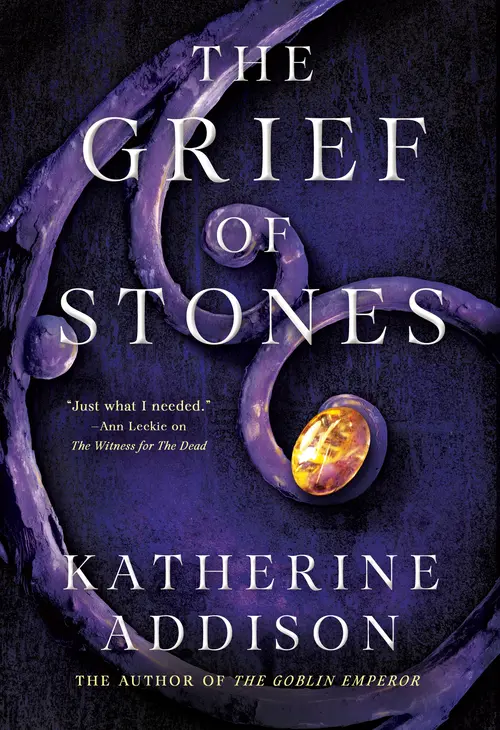
The Grief of Stones
Copyright Notice
The author and publisher have provided this e-book to you without Digital Rights Management software (DRM) applied so that you can enjoy reading it on your personal devices. This e-book is for your personal use only. You may not print or post this e-book, or make this e-book publicly available in any way. You may not copy, reproduce, or upload this e-book, other than to read it on one of your personal devices.
Copyright infringement is against the law. If you believe the copy of this e-book you are reading infringes on the author’s copyright, please notify the publisher at: us.macmillanusa.com/piracy.
Dedication
to my parents-in-law,
Bill & Elizabeth,
with much love
and many thanks
Begin Reading
On a cloudy autumn day, I attended the execution of Broset Sheveldar.
Anora tried to talk me out of it. He said, “Thou’rt punishing thyself, and it is pointless.”
“It’s not a punishment,” I said. “I don’t feel guilty about it. I feel responsible.”
“Thou art splitting hairs,” Anora said. “Well, if thou’rt going to insist, dost thou want company?”
“No,” I said. “I thank thee, for it is a most kind thought. But I have no qualms about going alone.”
“That’s not what I asked,” Anora said.
“What I don’t want is to make thee attend this execution.”
“I’ve attended my fair share,” Anora said. “Another will not harm me.”
“I know that. But…”
Anora looked at me over his spectacles. “Truly, thou wishest to go alone?”
“Truly,” I said.
“Then I must let thee go,” he said, although his ears said he would have preferred to keep arguing.
“I thank thee,” I said.
Executions in the city of Amalo took place on the broad plaza in front of the Ulistheileian. They had switched from hanging to beheading in the reign of Prince Orchenis’s father, Prince Orchena. Beheading was fast and could be expected to go right the first time, neither of which had been reliably true of hangings, even when the executioner was both competent and sober.
There was always a crowd for a beheading—in this way Amalo was like every other city I had ever lived in. People seemed to emerge from the flagstones to surround the dais, men and women, elves and goblins, manufactory workers and shop clerks and the idle sons of burghers and nobility, and the vendors, every dozen feet or so, of quickly printed pamphlets about the murderer and his victims and whether or not he had repented of his crimes. Another prelate of Ulis was unremarkable in the crowd, which suited me very well.
They brought him out at noon, the traditional hour for executions. They had cropped his hair and tied his hands behind his back, and the two big goblins from the Vigilant Brotherhood made Sheveldar look almost delicate, breakable. I reminded myself of the women he had murdered, after seducing each one into believing he loved her. There was nothing delicate about Broset Sheveldar.
He stumbled on the steps up to the dais, but the goblins, not breaking stride, kept him upright until he reached the reveth-atha, where they let him fall to his knees.
The executioner was waiting. He didn’t give Sheveldar time to think of resisting, whatever resistance he might have been able to make, but shoved his head forward and dropped the stock across the back of his neck. The crowd made a low noise, a sort of moan, and I flinched.
Thou didst choose to come, I reminded myself grimly, and then the blade came shining down with a thwack!, and the crowd’s noise was more of a roar. Sheveldar’s head fell into the basket, and that was it. He was dead.
Maybe now I could stop dreaming of his wives.
It was a few days after Sheveldar’s execution that I received a letter asking me to come speak to the Marquess Ulzhavel as soon as was convenient. I gave my black silk coat of office a close scrutiny for frays or dangling threads or other signs of wear, resolutely ignoring how faded it was, for about that I could do nothing. I braided and pinned my hair carefully, and went to visit the marquess that afternoon.
The Marquess Ulzhavel was legendary in Amalo for his stubbornness, he and his father before him. When all the other noble elven families had left the city for their country estates, the Ulzhavada had stayed put. Their property had become a slowly shrinking island amid the Airmen’s Quarter and was now down to the original compound walls, which were mortared stone like the walls of the Veren’malo.
There was a liveried servant on duty at the gatehouse, a middle-aged elven man who watched my approach with frank curiosity.
I said, “We are Thara Celehar, a Witness for the Dead. The Marquess Ulzhavel has requested that we attend on him.”
“Of course,” he said and unlocked the gate.
He could not leave his station, but the way to the main house was unmistakable, broad and straight and lined with elesth trees that had probably been planted when the compound wall was being built. There was a bell rope beside the front door. I pulled it and heard the bell’s muffled answer from inside.
It was a few minutes before anyone opened the door, another elven liveried servant, his hair very white and his eyes very pale against the plum-and-crimson-on-black livery of the Ulzhavada. I introduced myself, and he nodded. “The marquess is expecting you. Please come in.”
The house was dark inside, great somber brocade hangings on every wall, and the drapes all drawn closed. I followed the servant through a snarl of narrow passageways and small interconnected rooms, wondering if the house had ever been renovated since it was built. Given the candelabrum the servant was carrying, it seemed unlikely that they had gas lighting; if anything, the house was becoming darker as we went. On the other hand, the house did not smell musty at all, and I admired the housekeeper.
We came to a closed door. The servant knocked and called, “The Witness for the Dead is here.”
“Let him in,” replied a voice from inside the room.
“The Marquess Ulzhavel,” the servant said and swung the door open.
Inside, at least there was candlelight, showing a somewhat larger room, though with the same dark brocade hangings on the walls. Against the far wall was a desk, and behind it an old elven man, with a stony face and bright, pale, angry eyes. He was dressed in formal mourning, black-on-black brocade with black lacquer combs and onyx beads in his hair. The emperor’s court would call him old-fashioned, but in Amalo, this was no more than was expected.
“We are Thara Celehar,” I said. “A Witness for the Dead.”
“Yes,” said the marquess, in a voice as stony as his face. “We have been expecting you. Please take a seat if you wish.”
I sat down, though cautiously, for the chair looked none too sturdy. “How may we be of service, dach’osmer?”
“You come straight to the point. We shall be equally forthright. We wish you to witness for our wife, Tomilo Ulzhavel.”
I knew, of course, that the Marquise Ulzhavel was dead. It had been in all the newspapers. It had also been three months ago.
“We beg your pardon,” I said, my heart sinking, “but after so long, there is nothing we can do. There is nothing of the spirit left.”
“Not that,” said Ulzhavel. “We meant what we said. We want you to witness for her. For we have discovered evidence that she was murdered.”
“Murdered?”
“Here,” he said and tapped something lying on his desk. “We found it among her papers.”
I stood up and came closer. The anger in the marquess’s eyes did not become less discomfiting. The thing on his desk was a note, creased as if it had been folded and opened and refolded many times. Printed across the paper in bold letters was the message STOP INTERFERING OR WE WILL MAKE YOU STOP. “We” was plural.
After a dumbfounded pause, I said, “Do you know what this note is about?”
“No. We have no idea. She never mentioned it to us, and she was involved in a number of charitable undertakings that might be construed as ‘interfering.’”
That was alarming. I said, “Surely a judicial Witness—”
“No,” the marquess said flatly. “We want a proper Witness for the Dead for our wife.”
He was well within his rights to insist, though again old-fashioned. “Is there anyone in particular you think we should talk to?”
He shook his head with obvious regret. “We paid little heed to her activities.”
“Is there someone we might speak to who would know?”
He thought for a moment. “Her closest friend was Dach’osmerrem Cretheno Cambesharan. But Dach’osmerrem Cambesharan does not believe that our wife was murdered, so we do not know if she would speak to you. You can ask Osmin Tativin, our wife’s secretary. She kept track of the marquise’s engagements.”
“Where might we find Osmin Tativin?”
“She is still here. She is a cousin of the marquise, and she has nowhere else to go. We have told her she may stay until she secures another position. She is badly shaken by the marquise’s death.”
“How did the marquise die?”
“It was very sudden,” the marquess said bleakly. “A thunderclap coronary is what our cleric decided.”
“Had the marquise any history of heart weakness?”
“None,” said the marquess. “We should have been suspicious from the start—but we could not imagine anyone wishing to harm her.”
“She had no enemies?”
“None that we knew of. But she did not tell us everything.”
“She did not tell you about the note?”
“No. We found it entirely by accident.”
“Would she not have told you if she were afraid?”
“She would have told us. We can only conclude that she did not think it was serious, but we do not understand, in that case, why she kept it.”
“Sometimes people’s reasons are unknowable,” I said. That was cause to regret that no one had had suspicions at the time of the marquise’s death, for it was a question I might have been able to get an answer to. She might even have known from whom the note had come.
“Yes,” the marquess said. “There is much about our wife we do not know. But will you witness for her? Not knowing the truth about her death will drive us mad.”
“Yes,” I said. “We will witness for the Marquise Ulzhavel. Although we must warn you that we may not discover an answer.”
“We understand,” said the marquess. “Any effort is better than nothing at all. And we have heard of you, Othala Celehar. We think it more likely that you will discover an answer than that you will not.”
To which I could only bow and say, “Thank you, Dach’osmer Ulzhavel. We will make our best endeavor.”
I found Osmin Tativin where the marquess had predicted I would find her: in the late marquise’s solarium, which was possibly the only room in the house into which sunlight was allowed to come.
Osmin Tativin was a middle-aged elven lady, tall, thin, and ferret-faced; she was wearing onyx mourning beads in her hair and hanging from her ears. My knock on the open door startled her; she came bolt upright from where she had been leaning over a secretary-desk. “Oh! Oh, othala, how you frightened us!”
“We beg your pardon,” I said. “Are you Osmin Tativin?”
“Yes,” she said, frowning in puzzlement. “Were you looking for us?”
“We are Thara Celehar, a Witness for the Dead. The Marquess Ulzhavel has petitioned us to Witness for his wife, Tomilo Ulzhavel.”
The formal phrases seemed to alarm her further. “But what reason is there to petition a witness for the marquise? There is no question about how she died.”
“The marquess believes she was murdered.”
Her knees nearly buckled. I lunged across the room to steady her, but she braced herself on the secretary-desk and said, “We beg your pardon. But murder? Who would want to murder the marquise?”
“You don’t know of anyone?”
“She was kindness itself,” said Osmin Tativin.
“The marquess thinks she could have angered someone with her charitable work.”
Osmin Tativin frowned. “The marquess is angry over his wife’s death. He wishes there to be someone to blame, but there is not. She died of a coronary. Here in this room. We … we saw her die. How could she have been murdered?”
“We do not know,” I said, “but the marquess’s concerns seem reasonable to us. What charities was the marquise involved with?”
Osmin Tativin bit her lip, her ears dipping, then seemed to decide there was no harm in answering my question. “Education, mainly. She served on the boards of several schools for orphans and foundlings, and she helped start a school for airmen’s children. She was also interested in some of the efforts to improve conditions in places like the Marigold Rookeries. And she was very keen to start a school for girls—not a school. More of a university.”
“A university for girls?”
She bristled. “Do you disapprove?”
“No. We were just surprised that a lady of the marquise’s age would support such a thing.”
“She felt very strongly about education,” said Osmin Tativin. “Very strongly.”
“Do you know of anyone she might have angered?”
Osmin Tativin looked horrified. “You don’t think it’s true, do you?”
“We have been asked to witness for the marquise,” I said patiently. “This means we must explore the possibility.”
“We can think of no one.”
I was fairly sure she was lying. “How about disagreements?”
“Well, of course,” said Osmin Tativin, who was now wringing her hands. I was relieved that she was not hardening her stance and insisting that the marquise had never disagreed with anyone, either. “But we don’t want to accuse anyone of murder.”
“We certainly would not take any information you give us as an accusation.”
That seemed to reassure her. She said, “It is true that the marquise disagreed frequently with Osmer Vobora Bazhevar, and she left the board of the foundling school in Cemchelarna quite suddenly, although we never knew the reason.”
“Thank you, Osmin Tativin,” I said. “That is very helpful.”
“But we truly cannot imagine anyone murdering the marquise,” she said. “The marquess must be mistaken.”
“We will find out,” I said and departed.
I emerged from the confines of the Ulzhavadeise compound into the teeth of a bitter wind. I had purchased a shabby overcoat from Mer Estorezh, the secondhand clothes dealer, and I was grateful for it. I walked to the tram stop, debating whether I should try to see Osmer Bazhevar or Dach’osmerrem Cambesharan first. There was enough of the afternoon left for one, but not both—and that was assuming they both kept town residences. I decided as I took the tram north to the Veren’malo that I would try friend before foe.
Most of the city’s nobility who kept town residences lived in the neighborhood of the Princess Vodreän Square, where several luxurious blocks of flats had been built on the grounds of the old Brenenada compound. I knew another member of the Cambeshada lived in what had been the opulent main house, so it seemed reasonable to find out if his family was nearby.
On my third attempt, I was lucky. The half-goblin gatekeeper admitted that Dach’osmerrem Cambesharan kept an apartment there, and sent an elven page boy running to see if she was at home to visitors. I didn’t think my chances were very good, but the boy came back with an invitation to step inside.
I followed the boy through a tiled atrium and then up a wide spiral staircase with wrought-iron grilles at each landing. Dach’osmerrem Cambesharan lived on the third floor, where the grille was worked in an elaborate pattern of twining roses. The page boy produced a key and let me through the grille, carefully locking it again behind us.
The hallway curved clockwise around the counterclockwise spiral of the stairs until we came to a door with the Cambeshada’s crest on it. The boy knocked, and the door opened so quickly that I knew the person on the other side had been waiting for us. She was a skinny part-goblin girl in servant’s livery, her hair cropped close to her skull. She said, “This way, please,” and I followed her, leaving the page boy to return to his post.
Dach’osmerrem Cambesharan was waiting in her receiving room, which had a series of narrow, arched windows looking out over the building’s atrium. She was a diminutive elven woman, her white hair elaborately dressed with combs and tashin sticks and a strand of black pearls, in contrast to her clothes, which were of expensive materials, but very simple. Her eyes, cornflower blue, were full of lively curiosity, and she said, “We do not believe we have ever had a prelate call on us before. We are Cretheno Cambesharan. How do you do?”
“We are Thara Celehar, a Witness for the Dead. The Marquess Ulzhavel has asked us to witness for his wife.”
Her mouth tightened. “Is he still insisting on this mad idea that Tomilo was murdered? We grieve for her, too, but that does not mean her death was murder.”
I said, “We feel that the marquess’s concerns are justified. Did he tell you about the note?”
“What note?”
“He found a threatening, unsigned note among the marquise’s papers. Did she tell you about it?”
“A threatening note? Who in the world would want to threaten Tomilo?”
“That is what we are endeavoring to discover,” I said. “Do you know of anyone who was angry at her?”
“Well, there was the Cemchelarna disaster. But that was nothing worth committing murder over.”
“People will commit murder for surprisingly trivial reasons. What was the Cemchelarna disaster?”
“Tomilo had been on the board of a foundling school in Cemchelarna for years and years, and then they decided they wanted to economize by lowering the teachers’ wages. Tomilo was outraged. She argued and argued and finally resigned. She said it was unconscionable and would destroy the school, and two years later, it turned out she was right. The school had to close. Tomilo never forgave any of them.”
“Do you think any of them was angry at her?”
“We are sure they must have been, but we cannot imagine they were angry enough to kill. Tomilo did nothing to cause the school to close; she was merely correct that that was what was going to happen.”
“Some people cannot bear to be proven wrong.”
“We have known several such,” agreed Dach’osmerrem Cambesharan, “but we still think it an unlikely reason for murder.”
“Osmin Tativin mentioned an Osmer Vobora Bazhevar.”
“Him,” said Dach’osmerrem Cambesharan. “We would believe it of him, although you will still have to explain to us how he did it.”
“What did he disagree with the marquise about?”
“What didn’t he, is a better question. Tomilo used to say she was sure he meant well, but we are dubious even of that. He seems to be interested in pursuing only those matters which will allow him to be seen to be a great patron of charitable works—not those matters which would make a difference in the lives of the poor. He would rather tear a building down and build a new one than make simple and inexpensive repairs.”
“We understand. And the marquise did not agree?”
“Tomilo was a very practical person. She had no patience for Osmer Bazhevar’s posturing. And he in turn despised her.”
“Would he—did he—describe her as interfering? That is the word the note used.”
“We do not remember him ever using that specific word,” Dach’osmerrem Cambesharan said carefully, “but it is certainly not contrary to his sentiments.”
I would have to talk to Osmer Bazhevar, that much was plain. “Was there anyone else, to your knowledge?”
“No. Tomilo was not a contentious person, othala. She did not make enemies. We still think that Ulzhavel is letting his anger get the better of him. They had been married for fifty years, you know.”
“And there were no children?”
“No. Tomilo never conceived. But Ulzhavel refused flatly to divorce her.”
“Who is his heir?”
“His great-nephew, Otilis Ulzhavar. If Ulzhavel had been murdered, we would tell you to look no further. But Otilis was fond of Tomilo in his own way, and murdering her would avail him nothing.” Her ears twitched. “Gracious, how callous we sound.”
“You have been very helpful,” I said. “Do you remember the name of anyone on the Cemchelarna board?”
“We never served on that board ourself, but just a moment.” She crossed the room to where a secretary-desk stood against the wall. She rummaged through its pigeonholes and returned with a red octavo notebook, which she was paging through as she spoke. “We try to keep track of who serves on which educational committee or board. It saves a good deal of heartache when one is looking for someone to fill a seat—or attempting to start a new … Here we are!” She scanned the page she’d found. “Most of these people will not speak to you, but Hanaru might. Osmerrem Hanaru Ganatharan. She was not one of the people in favor of that idiotic policy.”
“Thank you, Dach’osmerrem Cambesharan,” I said.
“Well, if Tomilo was murdered, we certainly want you to find out who did it,” she said. “But we hope you are wrong.”
“So do we,” I said and bowed.
I took the tram south to the Ulvanensee stop and went to talk to Anora.
The Story Continues on BooksBarbecue!
Enjoyed this preview? ❤️ Do not stop here!
Read the complete book free online → 🔗
Continue reading now on BooksBarbecue and discover every page!
Love reading? Bookmark BooksBarbecue.com for more amazing books!
Happy Reading!