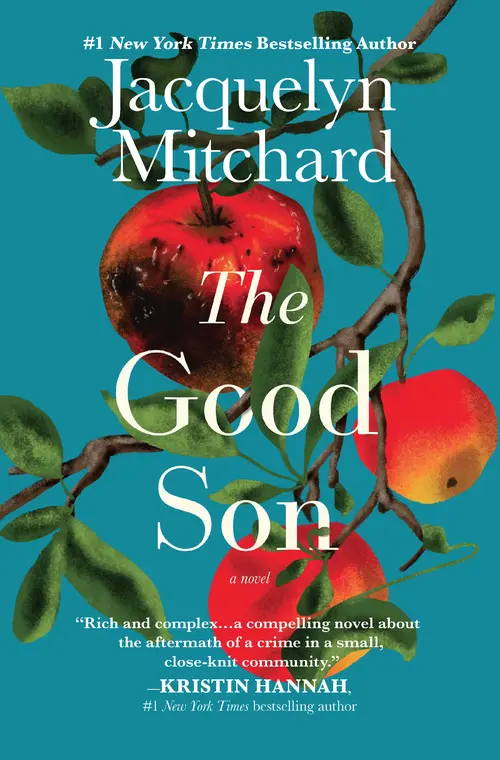
The Good Son
Cover
Praise
Praise for the novels of Jacquelyn Mitchard
The Deep End of the Ocean
“A wrenching first novel.... Wonderfully written.”
—New York Times Book Review
“Masterful... A big story about human connection and emotional survival.”
—Los Angeles Times
No Time to Wave Goodbye
“A bold, brilliant powerhouse of a novel. I read it in one sitting, unable to walk away until I’d come to the startling and unexpected end.”
—Kristin Hannah, #1 New York Times bestselling author
“Gripping, suspenseful and downright good; a beautiful reminder of why the world loves Jacquelyn Mitchard.”
—Karin Slaughter, New York Times bestselling author
Second Nature
“Timely...provocative.... [Mitchard’s] distinctive voice is strong throughout.... Her latest will not disappoint.”
—Washington Post Book World
“Mitchard’s latest ought to come with a warning: make no immediate plans, because this book will take over your life... A high-profile novel destined to galvanize fans and new readers alike.”
—Booklist, starred review
“A riveting tale.”
—Publishers Weekly
“There’s a newsy urgency to this story.”
—Chicago Tribune
Two If by Sea
“Suspenseful...nearly impossible to put down.”
—People
“Soulful and emotionally arresting... Mitchard masterfully mines the place where catastrophic loss meets near-impossible hope and healing... This book will open your mind and heart in equal measures.”
—Paula McLain, New York Times bestselling author of The Paris Wife
“A thoughtful, sweeping read.”
—Jodi Picoult, New York Times bestselling author of Leaving Time
“Mitchard returns with another heartbreaker.”
—Library Journal
“A troubled protagonist, beset by disaster and malefaction, is touched by magic.”
—Kirkus Reviews
Booklist
Also by Jacquelyn Mitchard
The Deep End of the Ocean
The Most Wanted
A Theory of Relativity
The Breakdown Lane
Still Summer
Cage of Stars
Twelve Times Blessed
Christmas Presents
No Time to Wave Goodbye
Second Nature
Two If by Sea
About the Author
Jacquelyn Mitchard is the award-winning, #1 New York Times bestselling author of twelve novels for adults, seven novels for teenagers and five children’s books, including The Deep End of the Ocean, the inaugural selection of Oprah’s Book Club. She is also a professor of creative writing whose short stories, articles, essays and book reviews have been widely published. A native of Chicago, she now lives on Cape Cod with her family.
Dedication
For Henry the First and all very good sons
Epigraph
“The dead cling to the land. The living cling
to a story that, like currency, changes hands.”
Laura Van Prooyen
“Now that my ladder’s gone,
I must lie down where all the ladders start
In the foul rag and bone shop of the heart.”
William Butler Yeats
BOOK ONE:
Release
1
I was picking my son up at the prison gates when I spotted the mother of the girl he had murdered.
Two independent clauses, ten words each, joined by an adverb, made up entirely of words that would once have been unimaginable to think, much less say.
She pulled in—not next to me, but four spaces over—in the half circle of fifteen-minute spots directly in front of the main building. It was not where Stefan would walk out. That would be over at the gatehouse. She got out of her car, and for a moment I thought she would come toward me. I wanted to talk to her, to offer something, to reach out and hold her, for we had not even been able to attend Belinda’s funeral. But what would I say? What would she? This was an unwonted crease in an already unaccustomed day. I slid deep into my down coat, and wished I could lock the car doors, although I feared that the sound would crack the predawn darkness like a rifle shot. All that Jill McCormack did, however, was shove her hands into the pockets of her jacket and lean against the back bumper of her car. She wore the heavy maroon leather varsity jacket that her daughter Belinda, captain of the high school cheer team in senior year, had given to her, to Stefan, and to me, with our names embroidered in gold on the back, just like hers.
I hadn’t seen Jill McCormack up close for years, though she lived literally around the corner. Once, I used to stop there to sit on her porch, but now I avoided even driving past the place.
Jill seemed smaller, diminished, the tumult of ash-blond hair I remembered cropped short and seemingly mostly white, though I knew she was young when Belinda was born, and now couldn’t be much past forty. Yet, even just to stand in the watery, slow-rising light in front of a prison, she was tossed together fashionably, in gold-colored jeans and boots, with a black turtleneck, a look I would have had to plan for days. She looked right at my car, but gave no sign that she recognized it, though she’d been in it dozens of times years ago. Once she had even changed her clothes in my car. I remember how I stood outside it holding a blanket up over the windows as she peeled off a soaking-wet, floor-length, jonquil-yellow crystal-beaded evening gown that must, at that point, have weighed about thirty pounds, then slipped into a clean football warm-up kit. After she changed, we linked arms with my husband and we all went to a ball.
But I would not think of that now.
I had spent years assiduously not thinking of any of that.
A friendship, like a crime, is not one thing, or even two people. It’s two people and their shared environs and their histories, their common memories, their words, their weaknesses and fears, their virtues and vanities, and sometimes their shame.
Jill was not my closest friend. Some craven times, I blessed myself with that—at least I was spared that. There had always been Julie, since fifth grade my heart, my sharer. But Jill was my good friend. We had been soccer moms together, and walking buddies, although Jill’s swift, balanced walk was my jog. I once kept Belinda at my house while Jill went to the bedside of her beloved father who’d suffered a stroke, just as she kept Stefan at her house with Belinda when they were seven and both had chicken pox, which somehow neither I nor my husband, Jep, ever caught. And on the hot night of that fundraising ball for the zoo, so long ago, she had saved Stefan’s life.
Since Jill was a widow when we first met, recently arrived in the Midwest from her native North Carolina, I was always talking her into coming to events with Jep and me, introducing her to single guys who immediately turned out to be hopeless. That hot evening, along with the babysitter, the two kids raced toward the new pool, wildly decorated with flashing green lights, vines and temporary waterfalls for a “night jungle swim.” Suddenly, the sitter screamed. When Jill was growing up, she had been state champion in the 200-meter backstroke before her devout parents implored her to switch to the more modest sport of golf, and Belinda, at five, was already a proficient swimmer. My Stefan, on the other hand, sank to the bottom like a rock and never came up. Jill didn’t stop to ask questions. Kicking off her gold sandals, in she went, an elegant flat race dive that barely creased the surface; seconds later she hauled up a gasping Stefan. Stefan owed his life to her as surely as Belinda owed her death to Stefan.
In seconds, life reverses.
Jill and I once talked every week. It even seemed we once might have been machatunim, as they say in Yiddish, parents joined by the marriage of their son and daughter. Now, the circumstances under which we might ever exchange a single word seemed as distant as the bony hood of moon above us in the melting darkness.
What did she want here now? Would she leave once Stefan came through the gates? In fact, she left before that. She got back into her car, and, looking straight ahead, drove off.
I watched until her car was out of sight.
Just after dawn, a guard walked Stefan to the edge of the enclosure. I looked up at the razor wire. Then, opening the window slightly, I heard the guard say, “Do good, kid. I hope I never see you again.” Stefan stepped out, and then put his palm up to a sky that had just begun to spit snow. He was twenty, and he had served two years, nine months and three days of a five-year sentence, one year of which the judge had suspended, noting Stefan’s unblemished record. Still, it seemed like a week; it seemed like my entire life; it seemed like a length of time too paltry for the monstrous thing he had done. I could not help but reckon it this way: For each of the sixty or seventy years Belinda would have had left to live, Stefan spent only a week behind bars, not even a season. No matter how much he despaired, he could always see the end. Was I grateful? Was I ashamed? I was both. Yet relief rippled through me like the sweet breeze that stirs the curtains on a summer night.
I got out and walked over to my son. I reached up and put my hand on his head. I said, “My kid.”
Stefan placed his huge warm palm on the top of my head. “My mom,” he said.
It was an old ritual, a thing I would not have dared to do in the prison visiting room. My eyes stung with curated tears. Then I glanced around me, furtively. Was I still permitted such tender old deeds? This new universe was not showing its hand.
“I can stand here as long as I want,” he said, shivering in wonderment. Then he said, “Where’s Dad?”
“He told you about it. He had to see that kid in Louisville one more time,” I told him reluctantly. “The running back with the very protective grandmother. He couldn’t get out of it. But he cut it short and he’ll be home when we get back, if he beats the weather out of Kentucky this morning, that is.” Jep was in only his second season as football coach at the University of Wisconsin–Whitewater, a Division II team with significant chops and national esteem. We didn’t really think he would get the job, given our troubles, but the athletic director had watched Jep’s career and believed deeply in his integrity. Now he was never at rest: His postseason recruiting trips webbed the country. Yet it was also true that while Stefan’s father longed equally for his son to be free, if Jep had been able to summon the words to tell the people who mattered that he wanted to skip this trip altogether, he would have. But he couldn’t quite bring himself to say it’s a big day, our son’s getting out of prison.
Now, it seemed important to hurry Stefan to the car, to get out of there before this new universe recanted. We had a long drive back from Black Creek, where the ironically named Belle Colline Correctional Facility squatted not far from the campus of the University of Wisconsin–Black Creek. Stefan’s terrible journey had taken him from college to prison, a distance of just two miles as the crow flies. I felt like the guard: I never wanted to see the place again. I had no time to think about Jill or anything else except the weather. We’d hoped that the early-daylight release would keep protestors away from the prison gates, and that seemed to have worked: Prisoners usually didn’t walk out until just before midday. There was not a single reporter here, which surprised me as Jill was tireless in keeping her daughter Belinda’s death a national story, a symbol for young women in abusive relationships. Many of the half dozen or so stalwarts who still picketed in front of our house nearly every day were local college and high-school girls, passionate about Jill’s work. As Stefan’s release grew near, their numbers rose, even as the outdoor temperatures fell. A few news organizations put in appearances again lately as well. I knew they would be on alert today and was hoping we could beat some of the attention by getting back home early. In the meantime, a snowstorm was in the forecast: I never minded driving in snow, but the air smelled of water running over iron ore—a smell that always portended worse weather.
Once outside the gates, we headed for the highway and a restroom where Stefan could change outfits.
He had asked me only one thing—to bring shoes and clothes and a coat. And I had. But although over the course of more than a hundred visits it should have been obvious to me, I had never fully realized until now how, when he went in, he was only a boy of seventeen, five-ten, a hundred and sixty pounds. And by now he had grown three inches taller. The flight parka that seemed so huge on him the last Christmas he spent at home wouldn’t even close over shoulders hardened by intervening years of obsessive solitary exercise. His feet were probably a size bigger, too. In my eagerness to bring Stefan things that were his own, familiar shirtsleeves I had rubbed between my hands when the days and nights were too long, I had not stopped to consider just how ruthlessly time had passed. Maybe I didn’t want to know that.
“It doesn’t matter,” he told me.
“Sure it does,” I said. “What else does?”
It seemed right to offer every teaspoon of conferred civility that I could. So I pulled off at a nearby Target, and apologized for this being the only choice for haberdashery. But Stefan loved Target, he always had; he thought of it as a bazaar of consumer delights. Target, not homemade dinners or a proper bed, was what always headed the list of things he missed. His excitement was poignant. He appeared in the dressing room door, posing in a striped pullover, then a bright Green Bay Packers hoodie. I thought helplessly of Stefan as a little boy, wearing matching shorts and sailor tops from The Children’s Place, so expensive and foppish that Jep complained his son looked like one of the dolls in a Victorian child’s bedroom on Masterpiece Theatre.
He was my only. What could I do? Then and now. It is far easier to hate yourself than to hate your own child.
We bought jeans and a sweatshirt, flannel shirts and Carhartt boots and a light down parka, and he threw out the stiff black prison-sewn shirts and the two pairs of mended chinos, as well as the coat that stank of sweat and cigarettes that had once belonged to some criminal—though, of course, Stefan was a criminal, too. The only thing he kept was the pale blue sweater he had knitted himself, just in the past year when he’d been trusted with plastic knitting needles. Cheerfully disdaining the new jacket, he wore the Green Bay Packers sweatshirt out of the store, the way a child would do. When he grinned and pointed to the gold Packers logo, I took a picture and messaged it to Jep, who texted back, Yes! He then texted me privately, Is he okay? And I answered, So far so good. Who would have imagined that this was how I would communicate that news? In this new universe, the most critical exchanges—between parents, between a long-married husband and wife, new sweethearts, or a stalker and his victim—were shared on a four-inch screen, with emojis of hearts and smiley faces. This was probably a metaphor for something but I could not fathom what.
Newly outfitted, Stefan and I headed back toward the highway.
We’d driven only a few miles when the blizzard leaped upon us. We edged our way into a hotel parking lot. I couldn’t even see the sky. A check of the local weather on my phone promised hours of possible whiteout conditions.
“Did you get a good night’s sleep?”
Why was I talking to Stefan as though he were my great-aunt?
“I never slept a whole night the entire time I was in there,” he said. “The last couple of nights, I didn’t go to sleep at all. I was afraid I’d die before I got out.”
I’d never been a good sleeper, but the previous weeks—enduring Christmas, the winter break at my college, New Year’s Eve with Jep, my best friend Julie and her husband, Hal, and a few other couples, all with my mind arrowed toward this moment—had been impossible.
“Let’s just stay here until the storm eases up,” I told Stefan. “I’ll get us hotel rooms. You can...relax, have a nap or watch a movie. Later on, we’ll get a fancy meal.”
I was, as always, too optimistic. I had in mind a steak house like Bee’s and B’s, the place I took him to for birthdays when he was a kid, with the whole family, grandparents and cousins and aunts and uncles and a couple of neighbors at a table nearly as big as the room. Who knew? Three solid college campuses and a sizable airport were within fifty miles. Maybe there would be at least one luxurious hotel, with flat-screens and plunge tubs and blackout shades and a pricey, chef-owned eatery on the first floor. As it turned out, our options were limited to Pizza Hut and Panera Bread. Apparently boutique hotels were scarce near a prison. How had I not known this before?
Well, for all my weekly visits, I had never spent an overnight in Black Creek. Nor had any of Stefan’s aunts or grandparents who visited. When I came alone, which was most often, I would hit the road again right after visiting hours, bombing my way home along the back roads in the summer, the highway in the winter. Then I would slam into the house straight upstairs to sit in a tub filled with scented oil and hot water for over an hour, adding more hot as needed, an almost holy observance after the stench of the place where Stefan lived. I would sit there and cry. I cried so hard each week it seemed impossible that I did not actually lose water weight.
We were already in the parking lot of a Residence Inn on the frontage road, so we followed a smudge of light that seemed to be the lobby and parked under the portico. I booked a two-bedroom suite, but that quickly seemed like an iffy idea so I changed it to a room for Stefan to give him privacy and one for me, not even on the same floor, because why would you want to share a suite with anyone, even your mother, especially your mother, on your first night out of jail? The rooms were generous vistas of downtrodden brown tweed carpet and the kind of overly pebbly white walls that could rip an elbow out of a sweater. Down the hall from Stefan was a woman herding three little girls and three miniature greyhounds, all of them yipping up a storm. A slight, pretty girl in a crop top and squeeze-tight leggings, her extensions coiled around her regal skull, gave us handfuls of emery boards and press-on nail kits as we passed her, sweetly sharing her fear that her home-salon event was going to be snowed out. I saw her heavily-kohled dark eyes sweep appreciatively over Stefan, saw him notice how she looked at him, and wondered if anything would have happened had I not been there. I almost regretted that I was.
Fluttering around Stefan’s room, I said, “This is awful.”
“Not to me,” Stefan said. “It’s heaven.”
The hotel had a sort of little convenience store in the lobby that carried a few things we would need to stay overnight, toothbrushes, bottles of water, the most cursory kinds of comfort food. Although it was only late morning, Stefan wanted the kind of meal he would have craved as a teenager. He flopped on the bed with a spoon and a carton of ice cream, Häagen-Dazs Rum Raisin, his favorite, which he had not tasted in years, and a microwave cheese pizza. As I sat across from him, drinking black coffee stirred up from the hot tap water and stingy little packets, he ate the whole pint of ice cream and three-quarters of the pizza and, and then, to his humiliation, threw it all up.
“I’ve been hungry for years,” he said. “I’m so sorry.”
He looked so young. I thought of him on his first day of preschool, when he gravely explained that he no longer wanted his fried eggs flipped over. When he finished breakfast that morning so long ago, he said to me, “You know what, Mom? You’re my sunny-up egg.”
Now he told me, “In AA, they say the whole thing is to trust the process. You just do one thing at a time.”
“You went to AA? But you had regular group counseling.”
He was silent. Then he said, “No.”
“What? Stefan!”
The Story Continues on BooksBarbecue!
Enjoyed this preview? ❤️ Do not stop here!
Read the complete book free online → 🔗
Continue reading now on BooksBarbecue and discover every page!
Love reading? Bookmark BooksBarbecue.com for more amazing books!
Happy Reading!