The French Lesson
Cover
About the Book
Paris, 1789
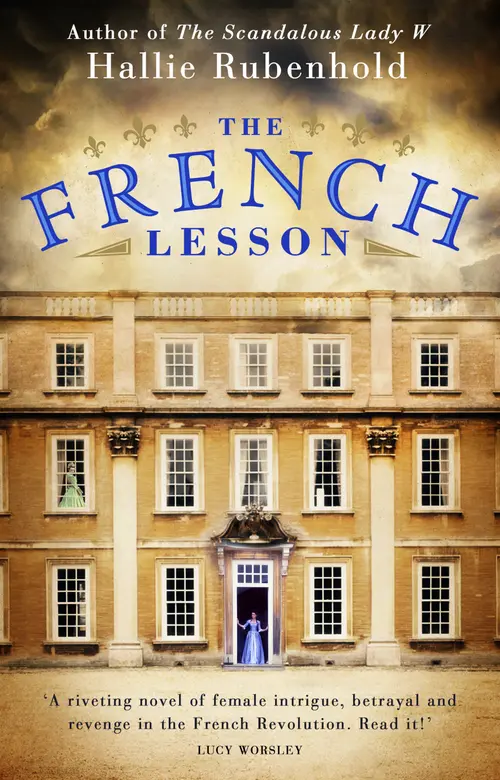
Henrietta Lightfoot, a young Englishwoman, trips on her silk gown as she runs for her life along the bloodstained streets of revolutionary Paris. She finds refuge in the opulent home of Grace Dalrymple Elliot, the city’s most celebrated courtesan. But heads are rolling, neighbours fear neighbours, and masters whisper before servants.
As the sound of the guillotine echoes outside, within the gilded salons of high society Henrietta becomes a pawn in a vicious power game.
Seductive and finely plotted, this tale of one woman’s flight through the bloodiest times in history resonates with a sense of modern revolution and tyranny.
Title Page

Dedication
To my father, Sydney
Foreword and Dedication
To the Right Honourable Marguerite, Countess of Blessington
Little more than a year has passed since I sat in the drawing room of Gore House as the guest of the lady to whom this work is dedicated. The hour was late and we found ourselves quite alone when she pressed my hand and spoke in a low voice.
‘I have often wished to enquire, my dear Mrs Lightfoot, how it was you came to make the acquaintance of Grace Dalrymple Elliot.’
At first her question startled me. I had not heard that name mentioned for some years and I wondered how it was she came to know of Mrs Elliot, or indeed my time in Paris during that period of revolution and bloodshed. Rarely did I mention either, and to no one but my most intimate of associates.
‘Is it true what they say of her?’ She raised an eyebrow into an inquisitive arch.
I folded my fan into my hands and smiled pleasantly in the manner I had learned to do when wishing to divulge nothing.
‘I am afraid I have very few stories to tell of Mrs Elliot,’ I said. ‘Our acquaintance was but a brief one.’
My hostess did not for a moment appear satisfied with my response.
‘Very well, my dear Mrs Lightfoot,’ said she in a teasing tone. ‘I know you well enough to understand your games. If you insist on refusing, I shall have to compel you to reveal your secrets.’
She then made me a very pretty little offer: in exchange for penning an account of my time in Paris during the French Revolution, she would settle upon me a tidy annuity of which, she claimed, she understood me to be in need. She then ventured to set forth her terms: I was to commit to paper a perfect record of all that befell me while I sojourned in that city. I was instructed to omit nothing, no matter how scandalous or indelicate. All my adventures, my opinions, all that I had witnessed or experienced, were to be laid plain so that at the conclusion of my memoir she would be in a fair position to judge for herself the truth of the rumours she had heard.
My conscience wrestled with her proposition for a good while before I saw fit to accept it.
And now, my dear Lady Blessington, I humbly submit to you in published form that story which you bid me to recount. I offer no apology for it, nor for the scenes in which I engaged, the philosophy I espoused, or the actions that my conscience urged me to take. As you and my devoted readers well know, I am blessed with numerous friends and champions, among which I have considered you for several years. Much to my detriment, I have also acquired an equal number of detractors, many of whom are my very own kinsmen. I bid you to peruse these pages carefully, for amongst the lines are the answers you seek. Only once you have discovered them will you be able to determine whether you wish to rank yourself amongst the former or the latter.
I am your eternally devoted servant,
H. Lightfoot
15th March 1837
Chapter 1
I SHOULD BEGIN by stating this: until I found myself at Mrs Elliot’s gate, I had no desire whatsoever to make her acquaintance. Only that afternoon I had endeavoured to prevent our introduction, and my scheme might very well have succeeded had I not suffered a terrible and sudden reverse. All at once, the lady I had sought most to avoid in Paris had become the nearest approximation of a friend that I possessed.
I cannot rightly say how it was I navigated a path to her home. I recall nothing beyond placing one foot before the other. At first I tripped and scurried, and then, once I had crossed the swirling Seine, my gait slowed into a heavy trudge. I believe it was Fortuna who, quite without warning, compelled me to draw to a halt. There, she caused me to lift my eyes to a sliver of light escaping from a shuttered window. It fell across a sign which read ‘Rue de Miromesnil’.
Her hôtel particulier was simple enough to find amid the row of similar high gates. A lantern hung upon a hook above the entry, illuminating her entwined initials: G and E. I lingered for a while, my eyes set upon the dancing, silent candle flame.
I was in no fit state to pay a call upon anyone, least of all a woman who was no better than a stranger to me. I wore no cloak or shawl or gloves. My head was uncovered, and my coiffure was as slack and sodden with rain as a wet dog’s pelt. My hem and stockings had been turned black from the streets. That city was slickened by a sludge worse than any you have ever had cause to see, and in wading through that gelatinous pudding of excrement and rotten matter I managed to tear right through my finest red satin slippers. However, my ruined attire was but the half of it. There was also the matter of the throbbing welt upon my cheek.
I breathed and exhaled in long vaporous clouds until at last I roused enough courage to pull upon the bell. I waited as the gate rattled and a porter lifted a light to my face.
I straightened my head and without so much as an ounce of hesitation announced myself as Lady Allenham, which of course was not my name at all.
He paused and examined me with a cautious squint. Once satisfied that my bearing spoke more of my breeding than did my wretched appearance, he showed me into the house and up the stairs. A pair of doors were opened on to a lime-green antechamber lined with gilt mirrors. Here he bid me wait and abandoned me with six reflections of myself. Briefly, I caught the eye of one of them before shame forced me to turn my gaze. I lowered my head and crept my hand along my injured cheek so as to hide it from the view of my hostess.
Within a moment there came the sound of frantic footfall from the adjoining room. The doors flew wide and with great alarm Mrs Elliot came towards me.
‘Oh, dear, dear Lady Allenham!’ she cried, aghast.
She stood before me, just as I had imagined her, just as she had been described to me by my friends in London, like some majestic rare bird of vast height. Her head of dark curls rose in a tower of blue and white ostrich feathers while a shimmering length of pale silk streamed from behind her. It spilled forth from her waist to the floor in a cascade of rippling fabric. She studied me down the bridge of her Roman nose, her rouged lips parted in horror.
‘Heavens, my lady, have you suffered some accident?’
I could not think of an appropriate response, for the awkwardness of my humble circumstances had silenced me. I nodded and then slowly removed my hand from my cheek.
‘Good Lord, madam!’ Her eyes widened. ‘Victoire!’ She called for one of her servants. ‘Victoire, you must make up a compress for this lady’s injury, and bring some hartshorn . . . and some brandy . . . at once!’ Her arms then flew about me, one around my waist and the other at my elbow. ‘There now, there now,’ she purred as she led me through to a sofa in her drawing room. Only two of the candles had been lit, which led me to conclude that she had been preparing to pass the evening elsewhere until I had intruded.
‘My dear, I do believe you have had a most frightful shock. Have you been robbed? Are you in need of a physician?’ She placed herself beside me and gathered my small hands into her elongated fingers. ‘Dear Lady Allenham, I implore you, you must inform me what has occurred . . .’
Had you seen her expression, you would have perceived beneath her paint and powder that she possessed the purest, most saintly countenance. Her gentle eyes beguiled me with their warmth. Such a look of kindness had not been directed at me for many weeks. I exhaled in a slow sigh and carefully met her gaze.
Chapter 2
IT WAS IN April of 1792 when I found myself in Paris. Of course those were the days before the gas lights arrived, before the tyrant Napoleon rose and fell. It was after the Bastille was stormed, after the constitution was drawn up, after the court was forced from Versailles and locked into the Tuileries Palace.
I need not recount to you the events of the French Revolution. I would wager you have read enough of that in newspapers and chronicles to know something of its horrors. The devil himself could not have devised the scenes of bloodshed and murder enacted upon the streets. There was such suspicion, such fear; neighbours betraying neighbours, servants betraying masters, all in the name of the Republic. The worst of it was the dreaded pounding at the door. It might arrive by day or by night. The guards would not scruple to turn over an entire house, rummage through every drawer, poke at every mattress had they reason to suspect conspiracy. The denounced were routinely pulled from their beds, husbands torn from their weeping wives, and mothers from their babes. They were marched away through the streets, more often than not to a certain death at the guillotine.
But that was when the flames of revolution burned at their highest; when I first passed through the barriers of that city they had only just begun to lap at the foundations. Nevertheless, to an Englishwoman, the alterations to life were most striking. I learned that the distinction of aristocracy had been abolished. No Frenchman or -woman of rank was permitted to be addressed as anything other than Madame or Monsieur. Coats of arms were removed from coach doors and from the architecture of great homes. Any display of wealth or hint of privilege was viewed as highly suspect. A life of moderation became de rigueur for all. Ladies fastened tricolour rosettes in place of jewelled buckles. Gentlemen abandoned their silk brocade coats for those of wool. It was considered prudent to speak in hushed tones when expressing a political opinion, and it now seemed every Frenchman and -woman was in possession of one of those. Few epithets were deemed more offensive than those of ‘enemy of the constitution’ or ‘aristocrat’, one who favoured the old regime. However, to be regarded as a ‘counter-revolutionary’ was worst of all. No one was to be trusted. Not a soul.
When I first landed upon that nation’s shores nothing was further from my mind than its troubles. As I was neither a Frenchwoman nor one of our country folk foolish enough to cross the Channel and play at patriot, I concluded that I was unlikely to be inconvenienced by political matters. This was not the first occasion upon which my judgement had deserted me. Indeed one might even suggest that it was on account of a similar miscalculation committed two years earlier that I landed at Mrs Elliot’s gate.
At the tender age of seventeen, I had fled the home of my father, the 4th Earl of Stavourley, and thrown myself under the protection of a gentleman. The fact that I had fallen in love with George William Allenham, the 4th Baron Allenham of Herberton, the man to whom my late half-sister had been betrothed, was not the error to which I refer. His affection for me was as true as mine was for him, and returned with as much devotion and ardour. In that regard we had sinned no more than had my father and my mother, Kitty Kennedy, a celebrated woman of the town. Our affaire de coeur was enacted with far more discretion than was theirs. For a time we lived privately in a cottage on Lord Allenham’s estate, and passed our days as simply as might plain country folk. No, my misstep was not that I ruined my character so that I might live as my heart dictated, but rather that I had abandoned Orchard Cottage and set out in search of Allenham when he vanished from it. I ought not to have taken my leave of it for London with scarcely a ha’penny to my name. While this sort of adventure generally ends well for young men, it rarely does for young ladies. I shall spare you the sorry tale of my descent into the demi-monde, but merely say that as the winds of dissipation and debauchery whirled about me, my heart remained fixed on Allenham alone. My constant thought was of locating him and, in time, fortune favoured me and directed me to sail for Calais.
Allenham was delighted at our reunion, but in the days that followed took pains to explain the circumstances of his absence to me. He informed me that he presently served as a secretary to Viscount Torrington, who was then His Majesty’s ambassador in Brussels. His duties necessitated that he undertake frequent travel and so he had found himself regularly in Paris, Coblenz, Spa, Geneva and Turin.
‘However,’ he explained, ‘my title is but a formality, for the role I am charged with is far more critical than this.’ He then hardened his blue-eyed gaze upon me. ‘You apprehend what has occurred in France? That a good many of the nobles, a good number of the court have abandoned their country since the fall of the Bastille?’
I nodded.
‘Among those who have fled their country are the King’s brothers: the Comte d’Artois and the Comte de Provence; and his cousin, the Prince de Condé. They have gone to Coblenz, in Prussia, where they live as émigrés. It is from Coblenz that they seek to further a counter-revolution by raising an army. It remains in the interests of our King that relations are maintained between Britain and the émigré court, and it is my duty to ensure this. I have been made the emissary between our King and the supporters of the French King.’
Allenham said that this was a mission which required the utmost discretion and when he had taken his leave of England he had not been at liberty to inform so much as a soul of his departure. The position had been granted to him through the influence of his friends in government, and rewarded him with an income of which they understood him to be in need.
‘I fear that my debts are vast,’ he whispered to me, his brow heavy with sadness. ‘Herberton and my lands have been mortgaged. The house in London has been let, and my resources are at present entirely spoken for.’ He slowly shook his head before continuing in a low, apologetic tone: ‘Henrietta, I have not the means to wed you, nor the means to support any children of our union. It is a predicament that has vexed me since the day we parted.’
I studied him, his dark hair and sharply formed features. His remorse was etched deeply into them. It was then I recognized from where his sorrow sprang and how I might soothe it.
‘My dear love,’ said I, ‘you believe I have pursued you to France in the hope of marriage? Why, you know well enough that I abandoned such notions upon the very day I surrendered myself to you. I have been long reconciled to a life as your mistress. I am not such a fool as to think that a gentleman of title with little income is any more at liberty to marry according to his tastes than is the friendless and illegitimate daughter of an earl.’
He raised his eyes and appeared somewhat surprised to find a gentle smile upon my lips.
‘I request no more of you than the constancy of your heart, which you have ever given to me freely,’ I affirmed. ‘It would be an honour if you would permit me to return to Brussels with you and there live quietly in some lodgings not far from your own.’
There was a moment of silence while he sat and contemplated my proposal. Then the corners of his mouth turned carefully upward, before he placed upon my lips the kiss that sealed his consent.
From that instant, I resolved to forsake all that I had become since venturing forth from Orchard Cottage. My finest watered silks, my tissues of gold thread and heavily plumed hats: those many articles of attire which served no purpose but to remind me of my bitter compromises were packed away. All of my banknotes, all of the riches I had received – the shoe buckles that glimmered with rubies and sapphires, the diamond eardrops and brooches, the collars of precious gems which formed the mainstay of my fortune – were consigned to a locked silver coffer within a sealed chest. So determined was I to rid myself of the souvenirs of my former existence that I even disposed of the silk-lined town coach in which I had made my escape from London. (That fetched me a handsome sum, to be sure.)
It was with the promise of a new life that Allenham and I proceeded to Brussels. There, he arranged for me a set of rooms upon the rue des Petits Carmes in the home of a widow by the name of Madame Vanderoi. Madame’s late husband had done well by the linen-draping profession and left his wife a genteelly appointed house in the upper town. I had at my disposal a comfortable bed hung with emerald damask, several finely made cabinets of mahogany and a snug dressing room, which was warmed in the winter months by a tall blue and white enamelled stove.
I had been introduced to my landlady as Mrs Lightfoot, a young English lady, not long married and recently widowed. Mr Allen, my only relation, had paid for my passage to the Austrian Netherlands where he resided and conducted his business as a lace merchant. A fine tale indeed, and one as embroidered and perforated with holes as any piece in which Mr Allen purported to trade. However, Madame Vanderoi appeared contented enough with this sham, and ventured to ask no questions of my concerned relation.
The Story Continues on BooksBarbecue!
Enjoyed this preview? ❤️ Do not stop here!
Read the complete book free online → 🔗
Continue reading now on BooksBarbecue and discover every page!
Love reading? Bookmark BooksBarbecue.com for more amazing books!
Happy Reading!