The Flanders Road
Cover
Biographical Notes
CLAUDE SIMON (1913–2005) was born in Madagascar and, after his father was killed in the First World War, raised by his mother in southwestern France. He briefly attended Oxford and Cambridge, studied painting under André Lhote in Paris, and traveled to Barcelona during the Spanish Revolution of 1936. When the Second World War broke out, he fought in the French cavalry, was taken prisoner by the Germans shortly after the Battle of Sedan, and later, back in France, joined the Resistance. These wartime experiences informed many of his novels, including The Acacia, The Georgics, and The Flanders Road. He was awarded the Nobel Prize in Literature in 1985.
RICHARD HOWARD is the author of eighteen volumes of poetry and has published more than one hundred fifty translations from the French, including, for New York Review Books, Marc Fumaroli’s When the World Spoke French, Honoré de Balzac’s Unknown Masterpiece, Julien Gracq’s Balcony in the Forest, and Guy de Maupassant’s Alien Hearts. A collection of his poems, Richard Howard Loves Henry James and Other American Writers, is published in the NYRB Poets Series. He has received a National Book Award for his translation of Les Fleurs du mal and a Pulitzer Prize for Untitled Subjects, a collection of poetry.
JERRY W. CARLSON is a professor of literature and film at The City College of New York and the CUNY Graduate Center. As an independent producer, he worked with Claude Simon on a proposed film version of The Flanders Road.
Title Page
THE FLANDERS ROAD
CLAUDE SIMON
Translated from the French by
RICHARD HOWARD
Introduction by
JERRY W. CARLSON
NEW YORK REVIEW BOOKS

New York
Copyright
THIS IS A NEW YORK REVIEW BOOK
PUBLISHED BY THE NEW YORK REVIEW OF BOOKS
435 Hudson Street, New York, NY 10014
Copyright © 1960 by Les Éditions de Minuit
Translation copyright © 1961, 1985 by George Braziller
Introduction copyright © 2022 by Jerry W. Carlson
First published in French as La Route des Flandres in 1960.
First published in Great Britain in 1962 by Jonathan Cape Limited.
First published as a New York Review Books Classic in 2022.
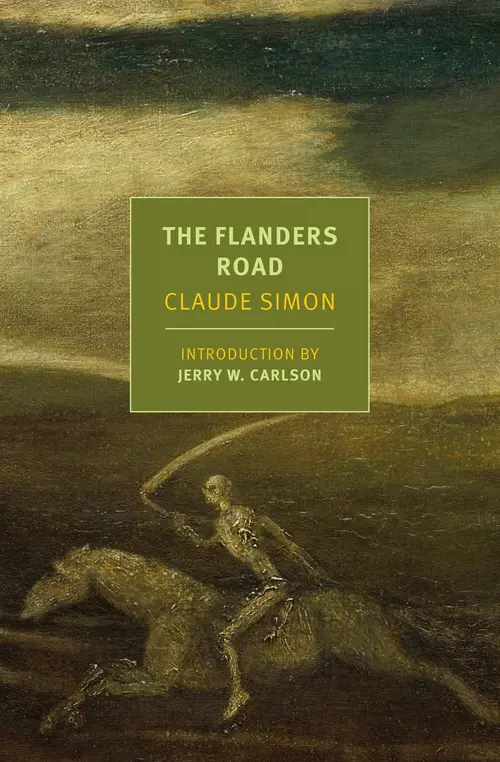
Cover image: Albert Pinkham Ryder, The Race Track (Death on a Pale Horse), c. 1896–1908; Cleveland Museum of Art
Cover design: Katy Homans
Library of Congress Cataloging-in-Publication Data
Names: Simon, Claude, author. | Howard, Richard, 1929– translator. | Carlson, Jerry W., writer of introduction.
Title: The Flanders road / by Claude Simon; translated by Richard Howard; introduction by Jerry Carlson.
Other titles: Route des Flandres. English
Description: New York: New York Review Books, [2021] | Series: New York Review Books classics
Identifiers: LCCN 2021000489 (print) | LCCN 2021000490 (ebook) | ISBN 9781681375953 (paperback) | ISBN 9781681375960 (ebook)
Classification: LCC PQ2637.I547 R613 2021 (print) | LCC PQ2637.I547 (ebook) | DDC 843/.914—dc23
ISBN 978-1-68137-596-0
v1.0
INTRODUCTION
World War Two began on September 1, 1939, as Germany surged with annihilating force into Poland. France and Great Britain declared war against Germany two days later, which was followed by eight months of light military action—the so-called Phoney War. Only on May 10, 1940, did the feared blitzkrieg of the German panzer divisions come. France and the Low Countries collapsed like tents in a hurricane. Paris, open and undefended, was occupied on June 14.
Among the French forces pitted against the German tanks at the Belgian border were troops of traditional cavalrymen, men on horses facing armored killing machines. Among those unfortunate French soldiers was Claude Simon, a twenty-six-year-old sometime painter and aspiring novelist, the son of an officer killed in the first days of World War One. Simon was one of only four members of his squadron to survive, after seeing his commanding officer cut down by a machine gun in an ambush. Captured by the Germans, he escaped and made his way back to his family home in the south of France. What he could not escape, however, were his memories of the violence and chaos and terror of combat and military collapse and of his wanderings afterward in search of what he would later call “the front that no longer existed.” These were experiences that he could not forget even as he felt they defied description. Fragmentary Description of a Disaster was the preliminary title of the novel drawing upon these experiences that in 1960 would be published to acclaim as The Flanders Road.
Fractured form and fragmentary memory both raise the problem of description. For Simon, the tool kit of the realist novel proved useless. In his skepticism about the epistemological claims of realism, he is frequently grouped with fellow French writers Michel Butor, Jean Ricardou, Alain Robbe-Grillet, and Nathalie Sarraute, among others, under the banner of the nouveau roman (new novel). As a grouping, it was more useful for marketing then than it is now for aesthetic accuracy. To be sure, Simon shares with these writers a distrust of engaged literature with “its realist alibi” and their embrace of the radical inadequacy of narrative and language for understanding human experience. Even so, Simon can never hide in formalism because he can never let go of the mystery of history and the problems of approaching what he calls the “magma” of experience. Explaining his boredom with the realist novel, he admits that his own work is “practically autobiographical” because “reality is far superior to fiction.” Simon’s affinities align with those of Marcel Proust and William Faulkner, the two modernist writers whom he saw as his masters, both of whom found infinite inspiration in their immediate environments. Their questions about time, history, narration, language, characterization, the status of the author, and the expressive powers of the nonliterary arts are his questions. Their baroque density of design and language is also his.
“Mine is quite the opposite of the attitude of the God-like novelist,” Simon remarks in a 1985 interview. “The novelist today tries to make his way through a kind of fog; it isn’t really a question of irony, but one of vertigo: he just doesn’t know the answers. You are faced, as always, with the unknown, the unknowable.” Simon may be frustrated by the inability to produce any definitive answer, but, rather than crushing his artistic will, the situation inspires him to keep “trying to make his way.” This restless energy and tireless search help to explain how story, style, character, and structure work in The Flanders Road.
In fact, the novel is neither plotless nor without human actors. Simon begins with ingredients of traditional stories but subjects them to the pressures of a repeated refrain: “How can you tell, how can you tell?” The central event of the novel is the death of the cavalry officer Captain de Reixach in an ambush as observed by his younger, distant cousin Georges, who by coincidence has been assigned to his relative’s squadron. Events before and after the ambush are spread across the novel as Georges tries to discover what brought his cousin to his death. Was it the bad luck of war or was it a disguised suicide with origins in his marriage and family history? Or, even, something yet unknown? A self-appointed detective, Georges gathers evidence from many sources. There is Iglésia, the captain’s groom who was also in his employ as a jockey before the war and may have been the lover of his young wife, Corinne. After the war Corinne becomes briefly Georges’s lover and has her own version of what happened. Blum, a fellow prisoner of war with Georges, doubles as a detective, helping Georges assemble stories and consider interpretations. Georges’s mother, Sabine, provides a longer-term view of the Reixach family dynasty and its history of ambiguous deaths, including another possible, yet unproven, suicide. Other informants and sources come and go wearing various credentials of reliability.
In its investigative premise, the novel evokes a classic detective story that moves forward and backward. Ideally, the search forward in the present eventuates in a reliable linear reconstruction of the past. Not so in The Flanders Road. Instead, Simon creates a world of fluid, multidimensional time. Time stops, starts, contracts, expands, repeats itself, multiplies strata, plunges into subjectivity, assumes mechanical chronometry, and more. As Georges observes, an instant in reality can be like “when you dream that so many things are happening and when you open your eyes again the clock’s hand has scarcely moved at all.” Temporal planes intersect in unexpected, involuntary ways. A prewar day at the racetrack overlaps with the memory of the ambush. As Georges makes love to Corinne his imagination returns to his chaotic battlefield escape. In the POW camp Georges warns his fellow interpreter Blum that he was “mixing it all up,” that he was confusing the life of an eighteenth-century Reixach with his great-grandson.
While the vertigo induced by the quest undermines traditional plotting, it also produces alternative forms of patterning that create the novel’s elegant, if elusive shape. As the nouveau roman theorist and an early advocate of the novel Ricardou observed in 1967, the work has a “hidden but nonetheless rigorous coherence.” In the broadest sense, it not only decomposes plot but “deploys a world in the process of complete disintegration.” This includes different regimes of order: military, social, mechanical, spatial, temporal, physical, physiological, and genealogical. It is all coming apart. If there is a single image in the novel that embodies the overall disintegration it is “what was not a rough mass of dried mud but . . . a horse, or rather what had been a horse.” The decomposing horse appears multiple times as Georges passes by it in his confused efforts to escape capture. Opposing the forces of decomposition are images, symbols, motifs of potential reintegration. Events yield to “radiating” clusters offering “semantic polyphony.” Simon offers an image of the overall structure: “I wanted to construct my book like a cloverleaf, with a center and three unequal loops. The dead horse is the center of the cloverleaf.” In writing the opening section of the novel, he used different-colored pens to track and visualize the tight weave of disparate materials he offers as an overture, a kind of reader’s manual for the rest of the novel. Narrative decomposition transmutes to poetic recomposition, if the reader accepts the offer.
Style, no less than character, event, and story, is subject to both decomposition and recomposition. Georges vacillates in his belief in the power of language to conjure reality. In a debate with his father just before he leaves for active service he blurts out “I just don’t want to go on putting words together and more words and still more words . . . Don’t you ever get tired of it yourself?” But, later, as he trades stories with Blum during their imprisonment, he reevaluates his father’s love of the written word. “And so after all words are at least good for something, so that in his summer house he can probably convince himself that by putting them together in every possible way you can at least sometimes manage with a little luck to tell the truth.” For Simon the sentence is not a stable mode of exposition but an agile tool of exploration. Assertions meet qualifications that generate more assertions that lead to more qualifications, etc. Here time, among its many properties, can advance “without progression.” Qualifiers abound: “or,” “perhaps,” “unless,” “although,” “except perhaps,” “that is to say,” “or better still.” Discovery takes place less by grammatical rule than by the semantic pressures of juxtaposition. Analogy challenges causality. In stunning passage after stunning passage Simon deploys the maximum force of the French language in shape, sound, and meaning. Here the English-language reader is fortunate to be in the hands of the master translator Richard Howard, who renders the full sensorial range of Simon’s style. Simon could have no better advocate in the language of Shakespeare.
Indeed, it is a mark of Simon’s importance that he has been translated into and remains in print in all major world languages and not a few minor ones. The republication of The Flanders Road gives the English-speaking reader an opportunity to discover anew a writer who faced the chaos of human experience with courage and indefatigable artistic resilience.
—JERRY W. CARLSON
THE FLANDERS ROAD
ONE
I thought I was learning how to live, I was learning how to die.
Leonardo da Vinci
He was holding a letter in his hand, he raised his eyes looked at me then the letter again then once more at me, behind him I could see the red mahogany ochre blurs of the horses being led to the watering trough, the mud was so deep you sank into it up to your ankles but I remember that during the night it had frozen suddenly and Wack came into the bedroom with the coffee saying The dogs ate up the mud, I had never heard the expression, I could almost see the dogs, some kind of infernal, legendary creatures their mouths pink-rimmed their wolf fangs cold and white chewing up the black mud in the night’s gloom, perhaps a recollection, the devouring dogs cleaning, clearing away: now the mud was grey and we twisted our ankles running, late as usual for morning call, almost tripping in the deep tracks left by the hoofs and frozen hard as stone, and a moment later he said Your mother’s written me. So she had done it in spite of the fact that I told her not to, I could tell I was blushing, he stopped and must have tried to smile but probably that was impossible, not being friendly (he certainly wanted to be friendly) but eliminating that remoteness: the effort merely stretched the hard little pepper-and-salt moustache somewhat, he had that tanned lustreless skin of people who live outdoors most of the time, something of the Arab in him, probably the traces of one Charles Martel had forgotten to kill, maybe he claimed descent not only from His Cousin the Virgin, like his neighbours the petty nobility of the Tarn, but even from Muhammad into the bargain, he said I think we’re cousins more or less, but in his mind I suppose that as far as I was concerned the word probably meant something more like mosquito insect midge, and I could feel myself blushing with fury again the way I had when I first saw that letter in his hand, recognized the stationery. I didn’t answer, he must have seen how furious I was, I wasn’t looking at him but at the letter, I wished I could snatch it away and tear it up, he gestured with the hand that was holding the letter folded, the corners fluttered like wings in the cold air, his dark eyes showing neither hostility nor contempt, cordial even but distant too: perhaps he was only as annoyed as I was, resenting my irritation while we went on with our little ceremony standing there in the frozen mud, both of us making that concession to custom to convention out of regard for a woman who unfortunately for me was my mother, and finally he must have understood for his little moustache moved again while he was saying Don’t hold it against her It’s only natural for a mother She was right Personally I’m delighted to have the chance If you ever need, and I Oh thank you Captain, and he If something goes wrong don’t hesitate to come and see, and I Yes Captain, he waved the letter again, it must have been around minus seven or minus ten degrees that early in the morning but he didn’t even seem to notice it. After they had drunk the horses trotted off again in pairs, the men running between swearing and hanging on to the bridles, you could hear the noise the hoofs made on the frozen mud, he repeating If something goes wrong I’ll be happy to do, then folding the letter putting it in his pocket looking at me again with an expression that in his mind must have been a smile and that merely pulled the pepper-and-salt moustache to one side again after which he turned on his heel and walked off. From then on I simply made sure I did even less than I was doing already, I had reduced things to essentials, unhooking the stirrups when I dismounted, unbuckling the harness after I had changed the water once or twice and then taking off the whole bridle, dipping it in the trough while the horse was still drinking, and then the horse went back to the stable by itself while I walked beside it ready to grab an ear, and after that all I had to do was wipe off the steel and now and then use sandpaper when it was really too rusty, but it didn’t matter much anyway since my reputation on that point had been established long since and no one bothered me about it any more and besides I suppose that as far as he was concerned he couldn’t have cared less and to pretend not to see me when he inspected the platoon was a favour he did my mother without too much bother, unless the polishing was also one of those futile and irreplaceable things for him, one of those reflexes and traditions so to speak ancestrally maintained at Saumur and then later reinforced, although according to what people said she (in other words the woman in other words the child he had married or rather who had married him) did everything she could in their four years of marriage to make him forget or in any case forswear most of these traditional traditions, whether he liked them or not, but even supposing he had given most of them up (and probably not so much because he loved her but because he had to or better still because he had to because he loved her) there are some things that the worst renunciations the worst capitulations can’t make you forget even if you want to and usually such things are the silliest or the most senseless ones the things you can’t reason about or have any control over, for instance his reaction of drawing his sabre when that burst of gunfire came from behind the hedge: there was a second when I could see him that way his arm raised brandishing that useless ridiculous weapon in the hereditary gesture of an equestrian statue which had probably been handed down to him by generations of swordsmen, a dim figure against the light so that it looked as if he and his horse had been cast together out of one and the same material, a grey metal, the sun glinting for a second on the naked blade then everything—man horse and sabre—collapsing together sideways like a lead soldier beginning to melt from the feet up and leaning slowly to one side then faster and faster, vanishing sabre still held outstretched behind the carcass of that burnt truck abandoned there, indecent as an animal, a pregnant bitch dragging her belly on the ground, the punctured tyres slowly rotting, giving off that smell of scorched rubber the sickening stink of war hanging in the brilliant spring afternoon, floating or rather stagnating, viscous and transparent but somehow visible like putrid water in which the red-brick houses the orchards the hedges had been standing: for an instant the sun’s dazzling reflection caught or rather condensed all the light and the glory on that virginal steel . . . Only, it was a long time since she had been a virgin, but I suppose that wasn’t what he asked, desired of her the day he had made up his mind to marry her, undoubtedly knowing perfectly well from that moment on what lay in store for him, having accepted in advance having assumed having so to speak consumed in advance that passion, with this difference that the site the centre the altar wasn’t a naked hill but that smooth and tender and hairy and secret crease in the flesh . . . Yeah: crucified, agonizing on the altar the mouth the cave of . . . But after all wasn’t there a whore at the other crucifixion too, presuming that whores are indispensable in such things, women in tears wringing their hands and penitent whores, supposing that he had ever asked her to repent or at least expected hoped that she would that she would become something else than what she had the reputation of being and so expected of this marriage something else than should logically follow from it, even foreseeing or at least having perhaps imagined as far as that final consequence or rather conclusion, that suicide which the war gave him the opportunity of perpetrating so elegantly that is not melodramatic spectacular and nasty like the housemaids who throw themselves under the Métro or the bankers who dirty their whole office but disguised as an accident if you can still consider being killed in the war an accident, somehow taking advantage with discretion and a sense of the opportune of the occasion provided in order to finish off what should never have begun four years before . . .
I understood that, I realized that all he wanted hoped for in that moment was to get himself killed and not only when I saw him there planted on his horse fixed clearly exposed right in the middle of the road without even bothering or seeming to bother to get his horse under an apple tree, that fool of a little second lieutenant thinking himself obliged to do the same thing, probably supposing that it was the last word the ne plus ultra of elegance and chic for a cavalry officer without suspecting for an instant the real reasons that impelled the other man to do it, in other words that it was a question neither of honour nor of courage and still less of elegance but a purely personal matter and not even between him and her but between him and himself. I could have told him, Iglésia could have told him even better than I. But what was the use. I suppose he must have been convinced that he was doing something absolutely sensational and besides why should we have disabused him since that way at least he would die content even ecstatic, dying beside and like a de Reixach, so it was better for him to believe it better for him to be a fool not to ask what was behind that face only slightly bored slightly impatient waiting making us or rather making the campaign service regulations and the orders in case of low-flying aircraft strafing the roads the concession of waiting until they were some distance away and we climbed out of the ditch, turning slightly on his saddle a little exasperated but obliging himself to be patient showing us that still impenetrable expressionless face merely waiting for us to get back on our horses again while they disappeared no larger than dots above the horizon now, then once we were mounted starting again, urging his horse forward with an imperceptible pressure of his legs, the horse apparently starting of its own accord and still at a walk naturally without haste yet not slowly either and not even casually: simply at a walk. I suppose he wouldn’t have started trotting for all the money in the world, that he wouldn’t have driven his spurs into the horse wouldn’t have moved faster if a gun had gone off in his ear and that’s exactly what happened there are expressions that are convenient: at a walk then, and that too must have been part of what he had started four years before and had decided, was in the process of ending or rather of trying to put an end to walking calmly, impassively (in the same way that, according to what Iglésia said, he had always pretended to notice nothing, had never betrayed the slightest emotion neither jealousy nor anger) along that road that was something like a death trap, not war but murder, a place where you were cut down before you had time to know it, the snipers sitting behind the hedge or some bush as though at a county-fair shooting gallery and taking all the time they needed to get you in their sights, in other words a massacre and for a moment I wondered if he didn’t want Iglésia to get his there too, if at the same time he was ending it all for himself he wasn’t also taking a longed-for revenge, but all things considered I don’t think so I imagine that by then everything had become indifferent to him supposing he had ever had anything against Iglésia since after all he had kept him in his service and now he bothered as much or rather as little about him as about me or about that fool of a second lieutenant, probably not feeling any further responsibility not so far as we were concerned personally but in regard to his role his function as an officer, probably thinking that what he could do or not do from that point of view no longer had any importance whatever at the stage we had reached: delivered then released relieved so to speak of his military obligations from the moment his squadron had been reduced to the four of us (his squadron itself being virtually all that had managed to survive of the whole regiment along with maybe a few other dismounted cavalrymen stranded here and there around the countryside) which still didn’t keep him from sitting as straight and stiff on his saddle as if he had been reviewing his men in the Fourteenth of July parade and not in full retreat or rather rout or rather disaster in the middle of this collapse of everything as if not an army but the world itself the whole world and not only in its physical reality but even in the representation the mind can make of it (but maybe it was the lack of sleep too, the fact that we had had almost no sleep at all in ten days except on horseback) was actually falling apart collapsing breaking up into pieces dissolving into water into nothing, and two or three times someone shouted at him not to go on (I don’t know how many, nor who they were: I suppose wounded men, or men hidden in houses or in the ditch, or maybe civilians who incomprehensibly kept wandering around dragging a broken suitcase or pushing those perambulators ahead of them loaded with some kind of luggage (and not even luggage: things, and probably useless: probably just so as not to be wandering around empty-handed, to have the impression the illusion of taking something of possessing something anything as long as there could be attached to it—the split pillow the umbrella or the coloured photograph of the grandparents—the arbitrary notion of price, of value) as if what counted was to be walking, whether in one direction or another: but I didn’t actually see them, all I could see, was still capable of recognizing, like a kind of target, a landmark, was that bony back thin stiff and very straight placed on the saddle, and the serge tunic slightly shinier over the symmetrical bulges of the shoulder blades, and I had long since stopped paying any attention -stopped being able to pay attention—to what could be happening along the roadside); voices, then, unreal and whining crying something (a warning, an alarm) and that reached me across the dazzling and opaque light of that spring day (as if the light itself were dirty, as if the invisible air kept in suspension, like contaminated water, that kind of dusty stinking filth of the war), and he (I could see his head move each time appearing in profile under the helmet, the dry hard outline of the forehead, the eyebrow, and underneath the notch of the eye socket then the firm dry immutable line falling straight from the cheekbone to the chin) looking at them, his expressionless incurious eyes resting for a moment (but apparently without seeing) on the man (or perhaps not even that: only on the place the point the voice came from) who had called to him, and not even reproving severe or annoyed, not even frowning: merely that lack of expression, of interest—at the most maybe astonishment: a little nonplussed, impatient, as though in a salon someone had suddenly spoken to him without having been introduced or had interrupted him in the middle of a sentence with one of those non sequiturs (for instance indicating that the ash of his cigar was about to fall off or that his coffee was getting cold) and perhaps making an effort, a show of goodwill of patience of courtesy to try to understand the reasons or the interest of the remark or if the latter could be related in some way or other to what he had been saying, then giving up any attempt to understand making up his mind without even a shrug of the shoulders probably deciding it is inevitable to meet everywhere always and in any circumstance—in salons or at war—stupid and ignorant people, and that done—in other words decided—forgetting the interrupter, effacing him, no longer seeing him even before looking away, then no longer looking at all at that place where there was nothing, raising his head again and resuming with that little second lieutenant his calm conversation of the sort two cavalrymen riding through the countryside might be having (in training or on manoeuvres) about fellow cavalrymen about promotion about hunting or about racing. And I felt as though I was there, saw it: the green shade with women in bright-coloured print dresses, standing or sitting on iron garden chairs, and men in pale riding breeches talking to them, leaning over them, tapping their boots with their Malacca riding crops, the silks of the horses and those of the women and the tawny leathers of the boots making brilliant spots (mahogany, mauve, pink, yellow) against the deep-green foliage, and the women of that particular class to which do not belong but which is constituted by (to the exclusion of all others) the daughters of colonels or of men with a particle in their name: rather insipid, rather insignificant and frail, keeping until late in life (even married, even after the second or third child) that virginal look, with their long delicate bare arms, their short white girlish gloves, their boarding-school dresses (until they turn suddenly—in the middle thirties—into something rather masculine, rather horsy (no, not mares, horses), smoking and discussing races or horse shows like men), and the faint hum of voices suspended beneath the heavy branches of the chestnut trees, the voices (women’s or men’s) capable of remaining decorous, even, and completely futile while speaking the coarsest or even the rawest remarks, discussing copulations (animal and human) money or first communions with the same inconsequent, agreeable and cavalier ease, the voices then melting into the constant and confused trampling of the boots and the high heels on the gravel, stagnating in the air, the iridescent and impalpable clouds of gilt dust suspended in the calm green afternoon smelling of flowers, dung and perfumes, and he . . .
“Oh yes!. . .” Blum said (now we were lying in the darkness in other words intertwined overlapping huddled together until we couldn’t move an arm or a leg without touching or shifting another arm or leg, stifling, the sweat streaming over our chests gasping for breath like stranded fish, the wagon stopping once again in the dark and no sound audible except for the noise of breathing the lungs desperately sucking in that thick clamminess that stench of bodies mingled as if we were already deader than the dead since we were capable of realizing it as if the darkness the night . . . And I could feel them sense them swarming slowly creeping over each other like reptiles in the suffocating odour of excrement and sweat, trying to remember how long we had been in that train a day and a night or a night and a day and a night but that didn’t have any meaning time doesn’t exist What time is it I said can you see the, What difference does it make to you he said What difference will it make when it’s morning Are you so eager to see our filthy prisoners’ faces Are you so eager to see my filthy Jew’s face they, Oh I said shut up shut up shut up), Blum repeating: “Yeah. And then he took that burst of machine-gun fire at point-blank range. Maybe it would have been smarter on his part if
The Story Continues on BooksBarbecue!
Enjoyed this preview? ❤️ Do not stop here!
Read the complete book free online → 🔗
Continue reading now on BooksBarbecue and discover every page!
Love reading? Bookmark BooksBarbecue.com for more amazing books!
Happy Reading!