The Fall of Dragons
Cover
Title Page
MILES CAMERON
GOLLANCZ
LONDON
Dedication
This book, and indeed the whole series, is dedicated to Joe Harley (Elves/Irks), Robert Sulentic and Jim Dundorf (the Empire), Rob Gallasch and Delos Wheeler and Stephen Callahan (Etrusca/City States), Greg Hauser (the Steppes/Horseclans), Jevon Garrett (Galle/Gargencel), as well as Chris Schulitz, Mark Stone, Doug Snyder, David Stier, Regina Harley, Frank Gilson, and all the other players in the endless RPG and war games campaign we all called “Alba.” In fact, this book is also dedicated to the men and women of the SGA, the GLA, and the Drama House, who played games for days, or taught all of us nerdy gamers how amazing role-playing could be with trained actors, or how much fun it was to game with people who’ d never tried a game, and how easily we could let pretend take over our lives if we were not careful. It was thirty years ago that I folded away the maps. I miss you all. And to Celia Friedman—that’s C. S. Friedman, if you read fantasy—who taught me to be a GM.
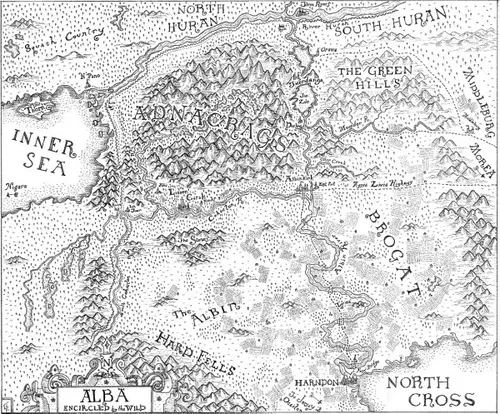
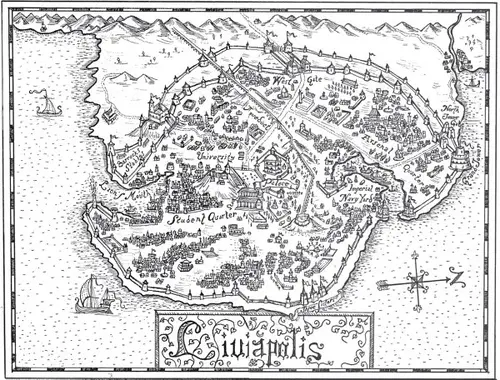
Map
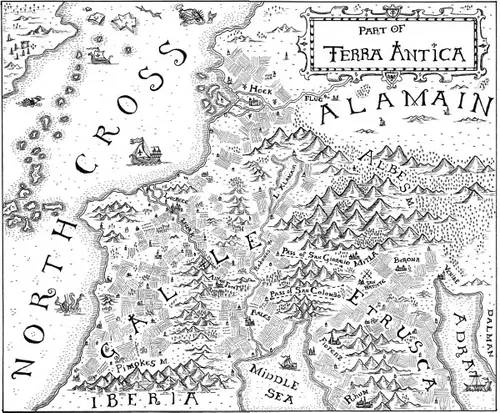
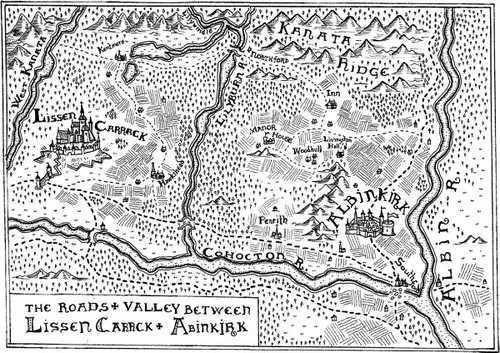
Map
Prologue
Prologue
Alba
The Vale of Dykesdale—Bill Redmede
The sun was setting in a sky of gold, and the bronze light suffused everything, gilding the endless forest, bronzing the stones left by ancient glaciers, and burning on the spear-tips of the retreating Army of the Alliance. The golden light set fire to the bright hair of the oldest irks and kindled the fur of the Golden Bears. It smoothed faces deeply creased by terror and fatigue.
Bill Redmede looked down the long column of weary men and a few women and then looked at the strange golden sky.
“Rain?” he asked John Clothyard, who was now, to all intents, his lieutenant. Nat Tyler had left him; killed the king, or so some men said. Ricar Fitzalan had gone east to serve with Aneas Muriens as battle comrades or lovers or both. The Jarsay-born Fitzalan had been a fine leader and the best second a commander could ask for, and Redmede missed him. He missed Tyler, too. Instead he had Grey Cat, who tended to wander off into the woods, and Clothyard, who was solid and dull.
Clothyard was a broad man of middle height, and his looks weren’t helped by a four-day growth of beard.
“Rain,” he responded.
Redmede was so far past exhaustion that he didn’t have to think much about his actions. He put a hand on the bow slung over his shoulder in a linen bag and trotted back along his Jacks. “Rain!” he yelled. “Put your bowstrings in your shirts.”
“Who the fuck are you? My father?” muttered one Jack. In a single summer of constant fighting, the Jacks had dispensed with camaraderie and turned instead to discipline. Some resented it.
“I never wanted to be a goddamned forester,” said another voice. This was directed at the grim reality that royal foresters, the king’s law in the woods, were the traditional enemies of the Jacks, broken men and outlaws, and now they marched together, the last Jack only two paces in front of the first forester. Not one forester or Jack was so dense as to miss the grim irony that in the eyes of the world’s powers, they were exactly the same: superb woodsmen and rangers. Ser Gavin, the army’s nominal commander, had put the two bands together with some hundreds of irk knights mounted on forest elk and irk ponies, an armoured cavalry that could glide through heavy woods with the agility of wild deer. Together, they were a match for almost any forest foe.
“Keep your bowstrings dry,” Redmede repeated as he trotted down the column. Not everyone was surly; Stern Rachel gave him half a grin, but she was mad as a felter and loved war; Garth No Toes hummed to himself as he flourished a little beeswaxed bag.
Most of these men and women had survived the rout after Lissen Carak; had fought at Gilson’s Hole; had marched west again to face Ash and his million monsters. They knew how to survive a little rain.
He told them anyway. Tired people make mistakes.
He forced himself up the rise he’d just descended, looking for the blank exhaustion that was like a sickness; looking for signs of people who hadn’t drunk enough water. His thighs burned, but it was these displays of routine prowess that marked him out, and he knew it.
He reached the top just as Long Peter and Gwillam Stare came over the crest, glanced back into the hell of Ash’s army, and shook their heads.
“We fightin’ agin?” Stare asked.
Redmede shrugged.
“Only have nine shafts,” Stare said.
Long Peter didn’t speak much at the best of times. He kept walking.
“I hear you,” Redmede said.
“Meaning we might fight,” Stare asked.
“Meaning I don’t know a goddamned thing,” Redmede said.
He could see his brother trudging up the hill. The same irony that made the two bodies of men and their decades of enmity irrelevant in the current crisis was sharpened by the two Redmede brothers: Bill, the leader of a rebellion against royal authority, and Harald, his older brother, who had risen to command the foresters. That maturity had brought each to a better understanding of the other’s position might have been the reason that the two bodies could cooperate at all.
“Harald?” Bill said.
“Bill.” Harald nodded. Both Redmedes were tall and ruddy-haired and rough-hewed; where Bill wore the stained, loose off-white wool cote of the Jacks, his brother wore a sharply tailored jupon in the forester’s forest green, although he carried his hat in one hand like a beggar. He stopped at the crest, and his weary men shuffled past; Bill was starting to know their names, and John Hand, tall and strong as an old oak, sporting a knightly beard and mustache, was Harald Redmede’s best officer. He grunted a greeting and kept going, glancing back at the rising tide of bogglins behind them as almost every man and woman did on reaching the crest.
“I heard a rumour we won a big fight in Etrusca,” Harald said. “Heard it this morning from Ser Gregario.”
“I heard that there’s a thousand dead of the plague in Harndon,” Bill said.
“Aye, or three times that.” Harald Redmede leaned on his bow staff.
The first drops of rain fell from the golden sky.
“We winning or losing?” Bill asked his brother.
“Losing,” Harald said. He held his hat—full of berries—out to his brother, who took a handful and ate them, seeds and all; black raspberries, fresh picked.
Bill nodded. “Well, that makes me feel better,” he said.
Both of them looked down the ridge they’d just abandoned without a fight to the enemy, who were already crowding the ground below them; a flood of bogglins, so many that the ground seemed to move with chitonous lava.
The irk knights were the last in the column. Even their magnificent animals seemed dejected; stags with racks of antlers that were themselves weapons walked with their heads down, and their riders walked beside them.
“We’re fucking doomed,” Harald muttered. “Sweet Jesu, I’ll end up being taken for a Jack if I keep on like this.”
Bill Redmede shrugged. “I trust Tapio,” he said. “He’ll see us right.” He didn’t say, The happiest hours of my life were spent in N’gara and I’ll fight for it. N’gara was just a few leagues away, and Ash’s entire autumn campaign seemed bent on taking it.
Harald smiled without mirth. “My brother the fuckin’ Jack believes an elf will save us, and I think that the queen’s commander is a lackwit. Well played, my brother. We can change off; I’ll take the Jacks, you take the foresters.”
Bill shrugged. “You always was contrary, Harald.” He looked at the looming sky. Thoughtfully he said, “We need shafts.”
“As do we. Best hope the mighty Ser Gavin knows it, too.” Harald shook his head. “If’n we stand and talk any longer, we’ll be eaten alive by bugs.”
The two men turned, and began to trot along to catch their people, who were retreating into the strange, wet, golden evening.
The Vale of Dykesdale—Ser Gavin Muriens
Ser Gavin Muriens sat heavily on his destrier, feet out of his stirrups to ease his back, great helm and gauntlets on his squire’s saddle-bow, idly picking something wet and grisly out of the spike of his little axe.
He was looking out over the valley that the irks called Dykesdale, watching his vanguard (in this case acting as his rear guard) toil down the far ridge like a line of ants slipping along to a food source.
At his feet, the Vale of Dykesdale stretched for some miles below a long ridge whose top was dominated by old maple and beech trees in the full colour of late summer growth. Many of them had lost their tops, as if a winter ice-storm had swept along the ridge, and there were gaps where men and irks had hewed away patches of wood.
Below, in Dykesdale itself, a crisscross of streams and beaver dams funneled all approaches to the ridge into two main routes: the Dyke, an ancient dam built by long-vanished Giant Beavers, and the Causeway, a stone and earth tribute to the Empress Livia’s failed attempt to wrest N’gara from the irks fifteen hundred years before.
Ser Gavin had chosen it as the ideal battlefield, with Tapio, the Faery Knight, and Mogon, Duchess of the West, and Kerak, her mage, after the two defeats farther west. They had stood here, on the same bare, round crest that the Outwallers called “The Serpent’s Rest,” and looked out over the magnificent country.
“It’s like an impregnable fortress, built by nature,” Gavin had said.
Tapio smiled so that his fangs showed. “It isss an impregnable fortress, oh man. But it wasss built by my kind, to defeat all comersss.”
And Mogon had lowered her great crested head. “Armies founder here, as the wardens know all too well. But our enemy comes in numbers that this place has never withstood.”
“Aye.” Tapio nodded.
Lord Kerak smiled. “You see only defeat. But we have discussed this, Lords of the East. We have slowed him, and made him show us his real warriors, his broken wardens, his hastenoch, his trolls. All I ask is that we make him use his power. Harmodius and Morgon and I have . . . a surprise.”
“Will it work?” Ser Gavin asked.
“That depends on the depth of his arrogance and some fortune,” the scholar-daemon said. His heavily inlaid beak opened to reveal the purple-pink tongue within—the Warden’s equivalent of a smile.
Gavin was still coming to grips with the idea that the battlefield had been built. “It is all apurpose?” he asked, somewhat awed.
“Every tree, every branch,” Tapio said. “We didn’t build the ssstone caussseway.” His fangs showed. “We jussst left it asss a monument to the ssstupidity of men.”
Tonight, with the sun setting in a ball of fire beyond Ash’s legions, Tapio’s confidence seemed empty vanity. So did Kerak’s.
“We can’t fight many more times, and lose, without the whole will of this army snapping,” he said. “We need a win, even if it is fleeting.”
Kerak shook his head. “In this war there will be no victory, short of a miracle. Tomorrow, if we make a stand here, I will invite the opportunity for a miracle, but that is all I promise.”
Why did I want this job? Gavin said, but only inside his head. He’d already learned the key role of a commander in an alliance is to show relentless good humour and confidence.
So instead of speaking, he looked back west into the setting sun. The light was turning bronze from gold, but the strange metallic quality of the light was unchanged.
As far as Gavin could see, a carpet of moving creatures covered the earth, so that instead of grass, shrubs, and marsh, he could see only a vast blanket of enemies stretching to the horizon.
At his elbow, Tamsin’s voice was soft. “He has emptied every nest along the banks of the West River. Every bogglin. He has stolen the wills of millions of beings and he will use them as fodder for his vanity. Oh, how I hate him.”
“Tomorrow, I will use that vanity against him,” Kerak said.
“From your beak to God’s ear,” Ser Gregario said with his usual humour. “Let’s sleep. Unless you think they will come at us in the darkness.”
Tapio was still watching the endless carpet of foes. “If we lose here, we lose N’gara,” he said.
Tamsin kissed him. “Yes,” she agreed. “I am ready to lose it. Are you, my love?”
Tapio looked at Gavin. “We are all sssupposed to trussst your brother. Perhapsss I do. But even sssuppose that in the end, we triumph. Will there be anything left of my world?”
Very softly, Tamsin said, “No, my love.”
They all looked at her, for she was renowned as an astrologer and prophetess.
She shrugged. “When the gates open, the world changes. It has always been so. I need no wizardry to predict this.”
Gavin shook his head. “Let’s get some sleep,” he said. Far off to his right, the last of the column of rangers arrived at the foot of the great ridge to find rough shelters built of bark, and hot food. And bundles of arrows. There was fodder for man and beast, and fresh water. Everything that the hand of man and irk could do had been done.
“Tomorrow,” Tapio said. “I can feel it. I think we can stop him. My people have never been beaten here.”
Kerak bowed. “Tomorrow,” he said.
Mogon laughed. “In my youth, when this tree was young, I tried to make it up this ridge against you, Prince of irks, and my nest died like bogglins,” she said. “It is really quite pleasant to be on this side.
Tomorrow we will win.”
Gavin nodded. “Tomorrow,” he said.
The sun rose somewhere, but over Dykesdale there was first fog, and then light rain, and the light grew very gradually.
Not a man or irk or bear or warden had slept damp, though, and every one had a hot breakfast. When Gavin had eaten his share of oatmeal porridge and bacon, he mounted a riding horse and rode the length of the ridge with Tapio and Ser Gregario. The highest summit, on the far right, was held by Mogon’s main battle; Exrech’s veteran bogglins, and Mogon’s hardened Saurian warriors, demons all, their inlaid beaks and engorged red-crests shining like myths come to life in the grey light of morning. In reserve, two hundred of the magnificent bears of the Adnacrags, the Long Dam Clan inured to war and many of their cousins and outbreeds, their golden fur darkened with damp. Many of them were sporting the heavy maille that the Harndon armourers had made for them over the summer, and almost every bear was wielding a heavy poleaxe as big as a barge pole in their paw-hands. A handful of Outwaller warriors stood with the bears; most of their kin were off in the east or fighting in the north against Orley, and the Sossag, once the mightiest of the Outwaller clans, were now protecting Mogon’s heartland from giant Rukh and yet more bogglins coming along the Inner Sea from the west.
In the center were the feudal hosts of Brogat and the northern Albin. There was Edward Daispainsay, Lord of Bain, commanding the dismounted knights in the center of the line although his wounds from Gilson’s Hole were not yet fully healed, and Lord Gregario with the mounted knights in reserve. The feudal levies were well armed with spears and armour; they had withstood days of attacks by bogglins without much loss, and they were more confident than most militia. They were beginning to be soldiers.
Tapio commanded the left of the line. There, the ridge was lowest and most vulnerable, and there were the Jacks and rangers; there also were the irk knights, and every irk regardless of gender who could be spared from N’gara. There, too, was Ser Ricar Fitzroy, with the knights of the northern Albin and Albinkirk, as well as fifty or so knights-errant from Jarsay, the Grand Seigneur Estaban du Born with another two hundred belted knights of Occitan, and there stood 1Exrech, his chitonous white armour spotless, at the head of his phalanx of spear-armed bogglins; they held the lowest ground, almost two thousand strong.
All told, they had almost eighteen thousand to face Ash’s million or so creatures. Or odds of roughly fifty to one. Gavin told his allies and his own more human officers that they were fighting for ancient N’gara, to show the irks that men and women could be trusted. But in his heart, Gavin was fighting because his brother had laid out a strategy and expected him to implement it, part of a plan so vast that Gavin could not imagine it would succeed. And yet, despite everything, he trusted his brother.
Gavin trotted his riding horse back up the central ride, the Serpent’s Hill, and dismounted. His page took his riding horse while his squire brought up his charger. A young man he’d never seen before handed him a cup of hippocras and he drank it while he considered the odds. They had to fight; that much had been made clear by his brother Gabriel all spring and summer. Every fight would bleed Ash, and only by fighting for every member of the alliance; the irks, the Jacks, the people of Alba and Morea; only by showing all of them that they could be defended would the alliance be preserved. This was not a war that could be won in an afternoon; Gilson’s Hole proved that. It was a war that might continue for generations.
In Gavin’s ear, Lord Kerak said, “Ready.”
While Gavin had reviewed his dispositions, the battle had begun. The tide of bogglins had rolled across the swamps and the dyke and causeway; had come forward like a seeping tide and splashed against the carefully sited earthen walls, the coppiced trees and “natural” stone features of the Dykesdale ridge.
The tide came in for an hour. Gavin watched, issuing no orders. There was nothing he could do but watch, but he stood as Ser Edward launched a counterattack that cleared the lower line of the center when the Brogat levies wavered. Tens of thousands of bogglins were used as filler by the creatures behind them, trampled to death and then walked over in the swamps.
The fog began to burn off. Off to the north, some low-level workings began to flay the waves of bogglins.
They broke. The tide flowed back; the waves receded into the swamps and ten thousand more bogglins drowned.
Gavin considered a second cup of hippocras and wondered what the hell his brother was doing, wherever he was.
Kerak spoke again from the aether. “Now he sets his will on the bogglins. Now they come again.”
This time the bogglins raced in, heedless of losses or terrain. They skittered over the carpet of their own dead and straight onto the spear points of the Brogat Levy. Below Gavin’s position, men and irks were dying again. His exhausted troops, manning the barriers and thickets, lofted clouds of arrows and stood their ground with sword and axe in hand. A hundred bogglins had fallen for every man; in some parts of the line, a thousand bogglins had fallen for every irk. But the second attack was pressed with more enthusiasm, and the drowned bodies in the swamp were now so thick that the next wave could cross dry-shod.
Off to the right, Mogon’s wardens and Golden Bears had lost less than a hand of their creatures, but even there every bear’s fur was matted and the wardens’ crests already deflated with fatigue. Along the first defence line on the ridge, the stacks of dead bogglins were already so high that the line had to be abandoned.
Out in the marshes, the dead were so thick that the course of the stream had been altered.
The Army of the Alliance was unrolling every scroll on war, and playing them out—ambushes, incendiaries, raids, dashing charges, destructive volleys.
Gavin looked out over the infinite fabric of his foes, and tried to wall off the rising tide of despair.
“Millions,” he said aloud. “But we are slaying mere thousands.”
Tapio smiled grimly, showing his fangs. “Millionsss are made of thousssandsss,” he said. “Hisss lossses are ssstaggering.”
Gavin shook his head. The tide had risen high; the sea of bogglins had swamped the first line entirely and were now facing the second, two hundred paces higher on the hillside. The sound was loud and constant; screams, war-cries, the despair of men wounded and eaten by bogglins, the equal despair of a bogglin whose carapace was penetrated; a week to die or a month, the creature was nonetheless already dead.
And then, like the changing of the light or the dissipating of the morning mist, the great assault failed. It did not fail suddenly; but inch by inch, bogglin by bogglin. Ash could take their minds and conquer their wills, but there came a point when flesh and blood conquered sorcery. Even bogglins had a scent sign for self-preservation.
The sky was turning blue overhead, and smell of bogglin blood was everywhere.
And so the tide went out for a second time.
“Blessed Saint Michael,” Gavin said. Across a nine-mile-wide battlefield, his people had held.
Far away to the west, almost lost in the mist, something rose into the air.
“Here he comesss,” Tapio said. “Pray to your godsss, or whatever else ssseemsss bessst to you, friendsss.” But Tapio was grinning. “We have hurt him.”
The Story Continues on BooksBarbecue!
Enjoyed this preview? ❤️ Do not stop here!
Read the complete book free online → 🔗
Continue reading now on BooksBarbecue and discover every page!
Love reading? Bookmark BooksBarbecue.com for more amazing books!
Happy Reading!