The Enigma Affair
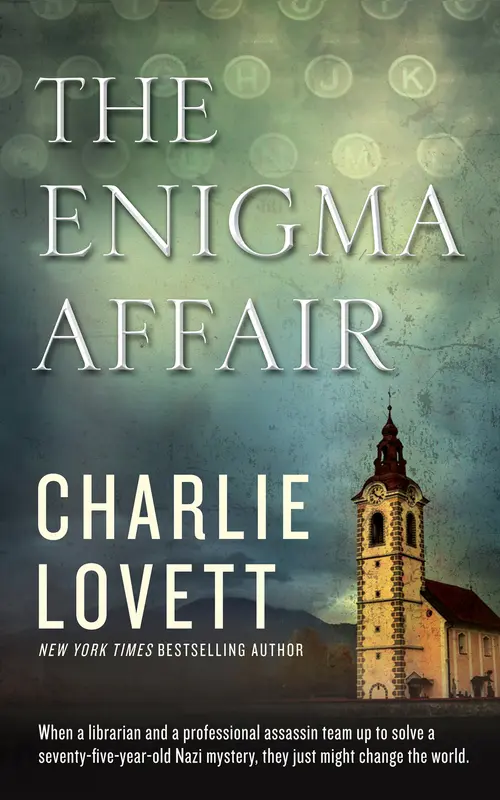
Praise for The Enigma Affair
“The latest from veteran literary mystery writer Charlie Lovett…This action-packed adventure gave me serious Raiders of the Lost Ark vibes.”
—Anne Bogel,
creator of Modern Mrs. Darcy and host of What Should I Read Next?
“With breathtaking, brisk prose that vaults you into the story at a torrid pace, Charlie Lovett’s The Enigma Affair throws two unlikely characters together…Immensely satisfying.”
—Rex Pickett,
critically acclaimed author of Sideways and The Archivist
“Rollicking…The pages fly by. This prose mash-up of National Treasure and Indiana Jones is fun escapist fare.”
—Publishers Weekly
“Wow! This is a roller coaster of a novel, and just like that ride, it delivers thrills and great heights before rolling to a satisfying conclusion. The Enigma Affair has it all…Smashing stuff!”
—James R. Benn,
author of From the Shadows and other Billy Boyle WWII novels
“A modern thriller with first-class historical credentials…Part Ken Folllett, part Raiders of the Lost Ark, and as clever as anything Lovett has written. A smart roller-coaster ride from start to finish.”
—M. L. Huie,
author of the Livy Nash historical mysteries
books by Charlie Lovett
The Engima Affair
Escaping Dreamland
The Lost Book of the Grail
The Further Adventures of Ebenezer Scrooge
First Impressions
The Bookman’s Tale

Copyright © 2022 by Charlie Lovett
E-book published in 2022 by Blackstone Publishing
Cover design by Gunjan Ahlawat
All rights reserved. This book or any portion thereof may not be reproduced
or used in any manner whatsoever without the express written permission of the
publisher except for the use of brief quotations in a book review.
The characters and events in this book are fictitious.
Any similarity to real persons, living or dead, is coincidental
and not intended by the author.
Trade e-book ISBN 978-1-6650-4709-8
Library e-book ISBN 978-1-6650-4708-1
Fiction / Thrillers / General
CIP data for this book is available from the Library of Congress
Blackstone Publishing
31 Mistletoe Rd.
Ashland, OR 97520
www.BlackstonePublishing.com
To the memory of
Mavis Batey (née Lever)
&
Betty Stockwell (née Swan)
SECTION ONE: ALTA VISTA
XJZSZ ELKQM NTTEZ KHPQJ BX
SECTION ONE:
ALTA VISTA
I
I
It wasn’t just the bullet passing by Patton’s left ear that concerned her. After all, she had sustained gunfire before, even been hit once—if you could call a graze on the forearm that barely left a scar a hit. No, what worried Patton was the sound this bullet made, or rather the sound this bullet didn’t make. Every bullet that had ever traveled near her had brought with it the distinctive crack of an object in supersonic motion. But this bullet merely hissed quietly as it crossed the kitchen before embedding itself in her refrigerator. This bullet was subsonic. This bullet didn’t come from a confused deer hunter or some nut whose idea of target practice was taking potshots at her fence posts. Such things did happen at the lonely end of Lone Pine Road just outside the town of Alta Vista. In her experience though, only one type of marksman went to the trouble of ensuring his rounds were subsonic and therefore nearly silent. This bullet had been fired by a professional assassin, and he was not likely to miss twice. Patton thought all this in the split second it took her to drop to the floor behind the kitchen island. The second round exploded the bag of flour on the counter, filling the air with white dust. The perfect cover, she thought.
Most women who suddenly came under fire in the middle of a Sunday morning bake would be terrified or panicked or at the very least shocked. A woman like Patton Harcourt, with her particular history, might also be laid low by anxiety or even kicked in the gut by a flashback. But Patton felt none of these things. Patton felt pissed. She had been making chocolate ganache–filled profiteroles like the ones she had seen on The Great British Baking Show last week, and if they turned out, she planned to take a batch to Jasper. Now she lay on the floor listening to the mixer overbeating her choux pastry and thinking of the ruined profiteroles and of Jasper waiting for her visit while she spent her day dealing with a fucking sniper.
She flipped onto her back for a moment, looking at the way the midmorning sun flickered through the cloud of flour. Even though it reminded her of the sunlight filtering through the dust on that day ten years ago, she felt no panic, no anxiety, only cool under fire as another round hit the fridge, no doubt burying itself in the leftover meatloaf. That was no great loss, but she had just spent twelve hundred dollars on the fridge, and she doubted that the warranty covered gunshot wounds.
She counted to sixty without hearing another bullet. That meant one of three things. He might know he had missed and be waiting for her to reappear. He might think she was hit, in which case, given that no one was around to see him, he would probably come to check that it had been a kill shot. Or . . . She pushed the third possibility out of her mind. This was no time for wishful thinking. Wishful thinking led to laziness and laziness got people killed.
She rolled back onto her stomach and shimmied across the floor and into the corridor that led to her bedroom. Luckily, she had not opened the blinds that morning, but she still kept low. She didn’t want to cast any shadows. She opened the closet door slowly, so the movement didn’t register through the translucent blinds. She was glad she had opted for a floor safe instead of one mounted on a shelf. That meant she could stay prone while she twirled the dial. She lifted out her passport and her Beretta M9, slipping the former into her jeans pocket and clicking a magazine into the latter. She turned over, slid up against the closet wall to a sitting position, lifted the gun steadily in front of her, flipped off the safety, and pointed it out the open door. She regulated her breathing, taking exactly fifteen breaths in the time it took her to count to sixty again. She heard nothing but the whirring of the mixer and the song of a towhee chirping in the edge of the woods out back. She knew better than to allow herself to become impatient, but honestly, she wished the guy would just show up in her bedroom so she could get this over with.
The one-stoplight town of Alta Vista is tucked into the mountainous folds of the northwest corner of North Carolina. But for the rugged ridges that rise behind three sides of the town, one could stroll into Virginia or Tennessee. Because no roads cross those ridges, Alta Vista is on the way to precisely nowhere. Too deep in the hills to attract many tourists, the economy depends on Christmas trees and a small community of retirees of modest wealth. Main Street is a mixture of deserted storefronts and art galleries interspersed with a café, an outfitter, and an organic grocery, all of which are, to their owners, hobbies rather than profitable businesses. Practical shopping happens at the Walmart twenty miles away in Greenfield. Most of the population ended up here because they couldn’t go any farther—the few old-timers left might call them hippies, but the truth is the majority of the people in Alta Vista are running from something, hiding from something, or trying to forget something. Patton was doing all three.
Like just about everyone in Alta Vista, Patton had a past she’d like to forget. But most people’s pasts didn’t show up on a Sunday morning and start shooting at their new refrigerator. From where she sat on the floor of the closet, she could see the clock radio on her bedside table. In an era of iPads and cell phones, Patton Harcourt still loved her clock radio. She liked to listen to classical music while falling asleep—or trying to fall asleep—and she preferred the tinny sound of the old radio tuned through the static to NPR to the crisp, clean sound of some streaming service. The clock radio also came in handy when you were holding a pistol in front of yourself and didn’t want to reach into your pocket for a cell phone but did want to know how much time had passed since the last bullet hit your fridge.
She watched the numbers turn over three times and as 10:31 a.m. rolled into 10:32 a.m., she heard the creak of her front door opening. She hadn’t locked it when she got back from her morning run, but she hadn’t sprayed any WD-40 on the hinge either, so the squeak served as an alarm. She decided to wait for a count of ten before yelling at the intruder.
Nemo’s morning was not going the way he expected, he thought as he stepped through a kitchen dusted with flour and noted the bullet hole in the fridge. This whole job wasn’t going the way he expected. It was supposed to be an easy job. Some jobs are complicated. They take months of planning and a deeply laid backstory. They involve extreme risk, great expense, and major resources. Afterward, Nemo can’t work for a few months or even a year—that is, he can’t take a new job. He’s always working. Living in the shadows, leaving no trail, staying invisible—that takes work. It takes work to be Nemo, to be no one. So he likes it when a job like this comes along. A couple of weeks’ surveillance, wide-open target, easy in, easy out. True, it only paid twenty-five grand, but that wasn’t bad for two weeks’ work.
The target’s movements were like clockwork. Up at seven, a walk to the Alta Vista library at nine. Lunch at the café on the corner of Main and Mountain Streets, then back to the library until closing time. A quick stop at the market on the way home, dinner, in bed with the lights out by nine thirty. Little social life, certainly no love life. Occasional visits with an acquaintance from the library, but no close friends; mail limited to bills and catalogs; phone calls limited to insurance scams and pollsters. No contact with family. Nemo couldn’t imagine why anyone would choose this target, but that didn’t concern him. After all, one of his professional rules was “Never know the client’s endgame.” So he watched and waited and enjoyed the mountain air.
He had been lodging in an abandoned motel on the edge of town, a relic from the days when travelers still ventured this far back in the hills to marvel at the autumn colors. The windows and doors had been boarded up years ago, the parking lot was just patches of weeds, the roof sagged in some places and had ceased to exist in others. But in Room 6, Nemo found a spot with no leaks in the roof and something still recognizable as a mattress in one corner.
Nemo had no qualms about living rough. He felt equally at home squatting in an abandoned motor lodge and posing as a wealthy businessman in a five-star hotel. Neither situation would last long, and after each he would shed his identity and begin again. He kept no phone or computer. When he needed to look for a new job, he simply lifted an iPad or laptop from a Starbucks, pitching it into the storm sewer when he’d finished with it. He had no permanent address, though he did rent seven safety deposit boxes in different cities, all under different names. He traveled with no more than he could carry, acquiring the tools for each job as the need arose. This time, he had stashed everything he might need in the trunk of his car—a used gray Ford Taurus he bought for cash a few weeks ago. He had already ground off the VIN number, and when he finished this job he would abandon it somewhere no one would notice. There are a surprising number of such places. His black backpack contained three identities, $15,000 in cash, a change of clothes, and a few toiletries.
Nemo was forty-seven, though the few people with whom he came face-to-face might easily be forgiven for thinking him in his sixties. They had not been easy years. While he had a ragged scar on his left forearm, a reminder of a job that had almost gone wrong, he wore his worst scarring on the inside, where it ached more than the freshest wound. If asked to describe him, even a careful observer would be unsure about his race—was he a white man who had lived his life outdoors? Italian or Middle Eastern? Perhaps mixed race? People tended to see what they expected. For this job he sported unkempt hair, a ragged growth of beard, worn jeans, rugged work boots, and a black T-shirt covered with an unbuttoned plaid flannel. In Alta Vista, he may as well have been invisible, and that was the point. Wherever he went, Nemo always remained one thing to those he passed in the streets—forgettable. Certainly no one who glanced at him as he walked by, hands in his pockets and eyes on the sidewalk, would guess that his net worth was just over $5 million, most of it in a Swiss bank account.
Nemo had settled on early Sunday morning for what he expected to be the easiest job of his career. He had long ago mastered the art of sleeping when the situation required it, so he went to bed in the midafternoon and woke up deep in the night. He made instant coffee with water warmed on the engine block of the car and ate some Cheerios from the box. He sat in the car for two hours, listening to gospel music on a radio station from Boone through a cloud of static, eyes closed, rehearsing each move of the job. At 6:00 a.m. he threw the car into gear and headed toward Lone Pine Road. If there were no surprises, he thought, he would be out of Alta Vista in less than an hour. But there had been surprises and now he was going to end up leaving flour footprints all over this damn house.
“You come one step closer and I’ll fucking waste you!” yelled Patton.
“If you’re talking to the guy who just put three rounds in your house I don’t blame you,” said Nemo. “But that’s not me.”
Patton did not recognize this voice, that was the first piece of good news. She knew three people who might want to ruin her morning baking with a little gunfire and this gravelly baritone didn’t belong to any of them. The sound of the mixer stopped, and the house fell silent for a second.
“Then who the hell are you?” said Patton.
“I’m the guy who neutralized your friend out there,” said Nemo. “I’m coming back.”
“Don’t you come near me,” said Patton in a calm but loud voice. “I’ve got a Beretta M9 with a full magazine and the safety is off. I know what I’m doing.”
“I’m sure you do,” said Nemo, taking a step into the hallway toward the open door the woman’s voice was coming from. “I don’t want to get into a shoot-out; I just want to talk to you.”
Patton waited another beat. “Are you armed?”
“Yes,” said Nemo, “but I have my safety on.” He didn’t.
“Judging from your sniper fire, I’d say you’re ex-military.”
“It wasn’t my fire,” said Nemo. “And I’m not ex-military. But I’m pretty sure your friend out there was.”
“Stop calling him my friend,” said Patton. “Whether it was you or someone else, it wasn’t any fucking friend of mine.”
“Just an expression,” said Nemo. Flattened against the wall of the corridor, he peered through the open door into a small bedroom. Above the bed was a large framed photograph of rhododendron on the Blue Ridge Parkway. In the glass, Nemo could just make out the reflection of a woman sitting in a closet across the room, pointing a gun at the door he had been about to enter.
“That’s a nice firing position you’ve got there,” said Nemo. “Maybe I should ask if you are ex-military.”
Patton looked at the picture above her bed and saw the man’s reflection. “If you can see me, I can see you.” The scruffy face Patton saw reflected in the glass did not belong to any of the three trained killers most likely to send shots into her kitchen on a Sunday morning. But if this guy wasn’t the shooter from outside, one of those three men might be out there right now.
“So this sniper out there,” said Patton. “This sniper who is not my friend. You just happened along and neutralized him?”
“Something like that. You want to put the gun down?”
“I don’t see you putting yours down.”
“Fine,” said Nemo. “We’ll talk like this. Do you know a man named Jasper Fleming?”
“You claim you just killed a man who was trying to kill me, and you want to know about Jasper Fleming?”
“I never said I killed him. You think I want Tommy Linton coming across an unidentified body and asking a bunch of questions?”
“How do you know Tommy Linton?” asked Patton.
“It’s a small town, and he’s the sheriff,” said Nemo.
“But you don’t live here,” said Patton.
“Nevertheless.”
“If you didn’t kill the sniper, what did you . . .”
“Tranquilizer dart,” said Nemo. “And then I locked him in your shed. Now about Jasper Fleming.”
“Why the hell do you just happen to be wandering my property with a tranquilizer gun on a Sunday morning? And how do I know you’re not the shooter?”
“You don’t,” said Nemo. “But right now, your choices are to trust me or to wait for the sniper fire to start again. The man who is not your friend had a partner watching the turnoff to your road—that’s what, maybe a mile and a half? And I figure we have three or four minutes before he realizes that radio silence means his buddy is down and he starts humping it up here to send some more rounds through your living room window. Takes him maybe fifteen minutes to get here if he’s smart enough not to risk driving. That gives us nineteen minutes at best and we’ve already used six of them. So do you want to ask me questions or do you want to give me answers? Do you know Jasper Fleming?”
“Throw your gun in here and I’ll tell you,” said Patton.
“Seriously?” said Nemo. “I don’t have time for this shit.”
“If you don’t have time, then you’ll throw your gun on the bed and you’ll walk in here where I can see you.”
“Where you can shoot me, you mean,” said Nemo.
“Clock’s ticking,” said Patton.
“Fine,” said Nemo. He clicked the safety on his own Beretta and tossed it through the door onto the bed.
“And keep your fucking hands where I can see them,” said Patton.
“Jesus, you are a piece of work,” said Nemo. “I guess no good deed goes unpunished.” He raised his hands and walked through the door, directly into the woman’s line of fire. She did not move. “Now can we talk?” he said.
“You want to know about Jasper Fleming?” said Patton. “Yeah, I know Jasper.”
“Does he have any property other than his home at 173 Lone Pine Road?”
“Not that I know of.”
“What about that you don’t know of? How would you find out?”
“I’d ask him,” said Patton.
“Let’s assume that’s not a possibility.”
“Did you do something to Jasper?” said Patton. “Did those . . . those guys out there hurt Jasper?”
“Try to focus here,” said Nemo. “We don’t have time for emotion. How could we find out if Jasper Fleming owned a place other than his house?”
Just as Nemo said this a flash of light flickered across the blinds covering the window to his left. Nemo pulled the blind slightly to the side and looked out to see a man dressed in black with a rifle slung over his arm maybe fifty yards away and walking toward the house. The idiot was wearing mirrored sunglasses which reflected the morning light against Patton’s window.
“Looks like our time’s run out,” said Nemo. “The backup man is walking up your driveway.”
“You think I’m going to fall for that trick?” said Patton.
The Story Continues on BooksBarbecue!
Enjoyed this preview? ❤️ Do not stop here!
Read the complete book free online → 🔗
Continue reading now on BooksBarbecue and discover every page!
Love reading? Bookmark BooksBarbecue.com for more amazing books!
Happy Reading!