The Door of No Return
COVER
DEDICATION
FOR MY MAAME, BARBARA ELAINE JOHNSON ALEXANDER, WHO TOLD THE BEST STORIES
EPIGRAPH
MY CHILDREN GLIDED ON THE GREAT RIVER
OVER THE DEPTHS OF DEATH…
THEN, ONE DAY, SILENCE…
—DAVID DIOP
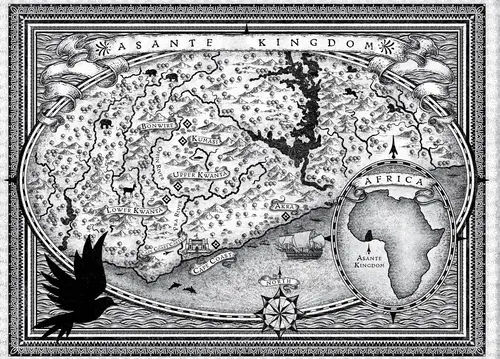
MAP
A NOTE FROM THE AUTHOR
This is historical fiction. It is a novel inspired by history, based on the real lives of the Asante (A·shan·ti) people, who are native to a region of West Africa now known as Ghana. It was a hard story to write, but it was one that needed to be told. I wrote it for the me nobody knows. For the you who is still becoming. For the possibility that is in us. The great poet, philosopher, and abolitionist Ralph Waldo Emerson said, Be an opener of doors. I’ve tried to be that here. Now you must walk through. With your eyes unshut. With your heart unlocked. And your mind as free as the mighty sea… Akwaaba!

ASANTE KINGDOM
SEPTEMBER 1860

CHAPTER ONE
THE STORY OF OFFIN
There was even a time… many seasons ago… when our people were the sole supplier of the purest and most valuable gold in the world… The river was bedded with enough gold to make a century of royal stools for the Asante kings… A thousand shiny bracelets for their wives… Then came the foreigners… Invaders disguised as friends… pretending to be students of our way… with only one lesson to learn… how to steal our fortunes… But we fought them off… protected our rich land, our river… the Offin River… It flows to the east, into the mighty Pra, which travels over one hundred and fifty miles down to the Coast, where it drains into a vast blue unknown that we call the Big Sea… On the rolling sides of Offin are deep forests and farmlands and villages and a boy of the same name… You see, on the morning of your birth, eleven years ago, your maame squatted at the edge of the water, and… Offin carried her fifth child on its shoulders at first breath… It is true, I was there, that you stopped crying as you floated off like a ship inching toward the horizon… The river Offin grabbed you with an invisible cord wrapped around each moment of your day… held you like a mother cradles a baby… pulled you like the moon does the earth… Ever since, you and the water have been bound… river and son, wave and flutter… That is how you got your name, my grandson…
THE STORYTELLER
There was even a time
is how my papa’s father,
Nana Mosi, the village storyteller,
begins most of his
fireside tales
always starting
in the middle
of a thought
like we were to know
what even came before
always speaking
in slow,
deliberate spurts
about the past
like it lives
in him,
like it still matters
always repeating some things
and pausing at other times,
with a toothy smile
that raises one eyebrow,
right before
the thing he knows
we cannot wait
to hear.
Though he is nearly eighty now
and seldom speaks,
when he does,
I hang on to all his words,
the lulls in between,
and I remember
the stories
like a pigeon remembers
its way home.
IN THE DREAM
I sprint across
the clearing,
past a leopard
teaching her cubs
how to count to ten.
After I grade them,
I dart between the maze
of forest trees
and discover a pot
of boiling plantains
by the river.
Picture me running
over rocks and grass
swept up in the cool breeze
rushing to the water
diving off the back
of a—
SCHOOLED
Offin, how old was
beloved Queen Victoria
when she became heir
to the throne? Mr. Goodluck Phillip, our teacher, asks,
startling me
out of my dream.
My cousin,
who thinks he is better
than me at everything,
giggles, then shoots
his hand up fast,
but Mr. Phillip is talking
to me, staring
at me, daring
me
to answer incorrectly.
I will like Kofi Offin
to answer the question, please, he says.
Dunwõtwe, I proudly answer,
standing among
my classmates, smiling
like I just bit into
the sweetest mango.
I do not see
the lightning
almost slice
the skin
from my palm,
but I do feel the scorch
of the rod
across my hand
and in my bones.
I even taste its sting
in my mouth.
Queen’s English, please, Mr. Phillip says,
as calm as rain, like
he did not just attack me
with his jagged cane.
Eighteen, I say quickly.
That is correct. The Queen was eighteen, he adds, looking at the whole class,
when her uncle died
of pneumonia,
making her the rightful heir.
I am not teaching you
to count in English for nothing.
Sorry, Mr. Goodluck Phillip, I say,
looking down at the purplish welt
burning my sable skin,
and trying not to cry
in front of everyone,
especially Ama,
and my cousin,
who now looks like
he is happily eating
my mango.
OUR TEACHER
Kwaku Ansah
was sent
many, many seasons ago
to Akra
to attend
The Queen’s Missionary School
at Osu for the Propagation
of Better Education
and Improved Language,
and when he returned
he had “improved” his name to
Goodluck Kwaku Phillip,
and insisted
to the Council of Elders
that we needed
to be propagated
as well.
ON A MISSION
Mr. Phillip seldom smiles,
is lanky and tall,
wears wire-rimmed glasses
and big-collared shirts
with strange bows
around his neck,
frowns when he speaks our Twi,
insists that we call him
by his new names,
does not like
riddles or bean stew
or most things
we are used to
in our village,
and swears
that he has been anointed
to rescue us
from our old selves
and help us discover
our true ones.
MY OLDER BROTHER
Kwasi once told me
that Mr. Phillip informed
his class that
English is regularly spoken
in Akra and on the Coast,
and if we want to become better,
learned men and women,
we must learn
to speak
this mother tongue,
and when a boy responded,
I do not know about your mother, sir,
but my maame speaks Twi
the entire class erupted
in laughter,
including the boy,
until Mr. Phillip’s cane
slashed his buttocks
so hard
he was unable to sit
for three days
and it left
a long, thin gruesome bruise
that swelled
across his buttocks,
making it look
like he was smiling
from behind.
LIGHT SENTENCE
The punishment
for my crime,
for answering
in my own Twi
instead of talking
in the stale, foreign language
that Mr. Goodluck Phillip
makes us speak
in school,
is to stay
after school
so that he can teach me
to read
from The Dramatic Works
of William Shakespeare,
which I enjoy—though
I cannot let him know—but
which I can barely focus on
because I want to be in the river
and my forearm is throbbing
and I cannot stop thinking
about the end of the day
when Ama came up to me
and whispered,
But you knew the correct answer, Kofi,
so do not feel so bad,
and her breath smelled
like honey
and pine
and possibility.
AMA
I have known her
since we were
giggling babies
swathed in cloth
on our maames’ backs
while they sold yams
and cassava
at the market.
We played together,
learned together,
swam together,
even dreamed together
about our futures
until hers was nearly ruined
when her parents died,
leaving her homeless
and alone.
So, now I mainly get
to see her in school,
since she spends
the rest of her time
cleaning
and being the house girl
for her uncle’s family
in exchange for food
and a roof.
AFTER SCHOOL
When we finish reading together,
Mr. Phillip makes me repeat
different English words,
praises my efforts, then says
that if I want to be
a young man of intellect
I should pay attention
to where my tongue lies
when I roll my Rs,
and even though
I hate the taste
of his alien words
on my tongue
I just nod
and say,
Thank you for
the instruction, sir.
WAITING FOR ME
outside
is Ebo,
my best mate,
leading a band
of youngsters
in search
of the few
gold specks
still swimming
in the streets
and ditches
after last night’s
heavy rainfall.
TAKEN
Ama walks
toward me,
carrying a large water pot
on her head,
a bundle of timber
in her arms,
and her baby cousin
draped across
her back.
It will not hurt long if you use this, she says,
placing the timber
on the ground and
taking my arm
in her hand.
She rubs my bruise
with a large, fuzzy, green leaf
and a flash of warmth
rushes through me
like a wave.
I do not feel
my eyes closing, but
I can feel every hair
on my body
jump at the sun.
Is that better, Kofi?
Yes. It. Is.
Now, do not swallow this or you will cough until you die, she says,
handing me the leaf. I cannot tell whether she is serious or not.
…
It is a joke. It is just a clove leaf, mainly used to make the pain of a bad tooth go away. You will be fine.
It has the smell of something in my maame’s stew… Thank you, Ama.
Are you and Ebo going to swim now?
If the river is you, I will swim… is what I wish I could say. Instead, I answer, No swimming today. It is too dark.
WHERE I GO
each day
after school
is both hideout
and oasis.
It is where I am student
and king.
A place that holds me
and my destiny safely
in its deep-blue arms.
The river
where I splash
and splish
and kick
into twilight
until the stars emerge
or Kwasi
comes growling
like a hippo.
KOFI, OUT OF THE WATER, NOW!
IT IS ALMOST DARK!
Sometimes
I pretend to not hear
him telling me
what to do
just because
he is older
and bigger,
but when it comes
to swimming,
I have to listen,
because all the elders
in my family
and mostly all
the old people
in our village
say that the river
is cursed
at nighttime.
CONVERSATION WITH EBO
CHALE! Ebo hollers, handing me a palm full of red berries.
Just in time—I can use a sweet snack.
Also, I collected these, he says, showing me a bag of kola nuts.
What, you are preparing our dinner now, chale? I say, laughing.
Oh, these are not for you to eat.
What are they for, then?
For you to present to Ama’s uncle when you ask to marry her, he adds, laughing.
You are a nut, yourself.
Your obsession is so obvious, Kofi.
I am not obsessed.
You are. And you are afraid to tell her.
I am not.
Then do it, big man, tell her how you feel, he says, peeling away the kola’s white skin.
How I feel? You sound like my sisters.
Ei! Your sisters are smart. And beautiful, he says, looking way too excited.
My sisters are married and their husbands will skin you for thinking those thoughts.
Only two are married. Esi is free, no? She is dark and comely. You think she will come to me? he says with a smirk.
Ebo, you are a fool.
So, tell me, what was Goodluck’s penalty? he says, chewing away at the kola seeds. Did he make you hold a stack of books over your head and say your numbers in English?
No, we just read.
Torture.
In truth, it does not bother me. I actually enjoy it.
A witch has cast a spell on you, chale.
To be, or not to be, I say in my best Mr. Phillip imitation.
Ei! Speak Twi! We are not in class.
Ebo, how much gold did you find?
I promise you, barely a crumb.
At this rate, you will be an old man with a cane and no hair before you collect even a Benda of gold, I say, laughing, then turning to leave.
Then I will die rich and happy with my one Benda, he says, laughing too. Ei! What about the river?
I cannot swim today. I must get home.
I will walk with you, then. In case your cousin and his herd are waiting.
And what will you do if they are?
I will run for assistance. HELP! HELP! I will scream, he says, laughing.
You are a true friend.
Seriously, do you think I have a chance with your sister?
Daabi, I tell him, shaking my head. Not in a hundred seasons.
TROUBLE
When I arrive
at our compound
Kwasi and Nana Mosi
are seated
on opposite sides
of an ivory game board,
playing Oware.
So focused
on winning, which
no one has ever done
against Nana Mosi,
Kwasi does not
even look up
when he tells me
that everyone
knows of my wrongdoing
because my cousin
came around earlier
singing
like a guinea fowl.
AFTER LOSING
three straight times to our
grandfather, Kwasi finds me
counting in English.
CONVERSATION WITH KWASI
Mr. Goodluck Phillip is still miseducating his students, ei?
He says he is on a mission to widen the sea of our intellect and understanding.
He is on a mission to capsize our culture, I promise you.
Nana Mosi beat you again?
Our grandfather has been playing Oware for nearly one hundred years. He is unbeatable. This I know.
He just needs better competition probably.
You are the one with jokes, he says, laughing. It appears that I am not the only one with an adversary.
Can you teach me to punch like you?
Fighting is not the answer.
That is easy to say for someone who fights as well as you do, Kwasi.
You have a sharp mind, little brother. Try using that. Outsmart him.
My thoughts are no match for his fast legs, or his powerful fists.
But there are things you have that are powerful. Use these.
What kind of things do you speak of?
Am I to come up with every answer to your problems? Figure it out.
…
You must face this, head high.
But what if I—
Ei! The bird who dares to fall is the bird who learns to fly!
What does that even mean?
It means that Maame is looking for you, and she is not pleased, he says, laughing, then tapping me on the head and walking away. You will be fine. With our cousin, I mean. Not with Maame. He laughs again.
…
PUNISHMENT
I am banished
to bed
for the night
without drink
without dinner
by my maame,
who is only silent now
because she plans to wait
to unleash her wrath
on me
when my father,
who is away
mining,
our business,
returns.
GOLD DIGGER
During the rainy season
Papa leaves
before the sun breaks
and works
two full days
panning
for gold
along the banks
of streams,
leading dives
into the rapid river,
and scooping up
shiny pebbles
and golden nuggets
with a shovel
that he invented.
WHEN I WAS SMALLER
before my schooling began,
he would take me
with him,
sit me on the riverbank
while the women
filled their large trays
with sand
and gravel,
and washed it
over and over
till all that was left
were shiny specks
of gold to be dried
in shallow calabash bowls
under the sun.
I would sit there,
captivated
by the sparkling dust,
watching him
paddle in boats
carved from tree trunks,
plunging
in and out
of the water,
swimming like a fish
in Offin.
I would sit there,
quietly staring
at the horizon
wondering
what lay beyond.
WHEN MY FATHER RETURNS
after the next sundown
both my parents scold me
in the worst way
with a never-ending lecture
on discipline
and responsibility
telling me,
It is when you climb
a good tree that we push you.
What does that even mean? I think,
and what does it have to do
with Mr. Goodluck Phillip caning me
for speaking Twi
instead of English?
So I just nod in agreement.
Papa shakes his head
and leaves.
My maame now smiles,
then hands me
an orange-and-red kente cloth.
I got it at market.
You will wear it
on the opening day
of the festival.
Thank you, Maame!
Ei! YOU WILL NOT SPEAK THAT FOREIGN LANGUAGE IN MY HOME.
Medase! I quickly say, showing my gratitude in our Twi, and thinking I cannot win for losing.
Come, I boiled fresh yam for you and Kwasi. You will eat, yes?
Yes, I answer, taking a bite,
looking grateful,
not wanting to hurt
her feelings.
WE PLANTED YAMS
in the dry season
and now the stems
are yellow,
which means
three things:
the yams are finally ripe,
we will celebrate
the harvest of the yams
at Bayere,
the annual Kings Festival,
and for the rest
of the rainy season
I will be eating yams
until I choke.
THE KINGS FESTIVAL
is eight days
of no school
of plays
about Anansi the trickster spider
of kente costumes
and plenty-plenty of tasty food
of loud drumming
and competitions
of lots of bowing
to the Kings
and the Paramount Chiefs
and all the other chiefs
of honoring
the departed
of prayers
for protection
and prosperity
of lengthy speeches
about our future
and the past
of remembering
the big war.

CHAPTER TWO
THE STORY OF THE BIG WAR
There was even a time… nearly two hundred seasons ago… when the villages of Upper and Lower Kwanta lived as one family… The land was vast… its crops, plenty… The water was wide enough for each of our people to wash, to drink, to swim… together… We shared the river… and the endless pieces of gold resting in the basin… until, one day, a week’s worth of mining went missing… Now, this is where the story gets complicated… It was suspected that two men from Lower Kwanta had stolen the gold and traded it with foreigners on the Coast… So, the King of Upper, Nana Manu Bambara II, went to see Nana Nii Boateng, the King of Lower, who was drinking and entertaining foreign guests… King Boateng, embarrassed in front of the foreigners, his “wonderfuls,” did not take kindly to being accused of harboring the criminals… An argument ensued… insults were thrown… and battle lines were drawn… It was a horrible war… many men were killed… homes were ruined… life was interrupted… until our King got very clever and blocked access to our land (as if land could be owned), to its rich soil, to the harvest, and, thus, to their food supply… which led to their hunger… a truce… and a treaty.
THE BAMBARA TREATY
In order to avert the horrors of war
this treaty is made
and entered into
between Upper Kwanta,
its dependencies, and heirs,
and Lower Kwanta,
its dependencies, and heirs.
1st There shall be perpetual peace
between both parties,
and neither party shall
have any claim
upon the other.
2nd Upper Kwanta shall have authority
over the river and its gold deposits,
to be stored in an undisclosed location,
but the King of Upper shall guarantee
a fair, annual distribution
of twenty-five Benda of gold
to Lower.
3rd The King of Upper agrees not to block
the harvest, and shall permit
Lower farmers to cultivate,
for the purpose of instituting
normal production of crops.
4th The Kings agree
that the villages shall convene,
befriend, compete, and feast
together at a Festival
to occur annually
in honor
of this peace treaty.
5th And finally, in the event any subject
of Upper or Lower does violate
this treaty by an act of disrespect
or any crime of magnitude,
a joint Council of Elders
reserves the right of punishment,
to be dealt with
according to the laws
of our people.
DISPUTE
They are the wretched of the earth.
They do not stand a chance
in the festival contests.
We will once again destroy
the lowest scum, my cousin hollers,
tossing a ball around
during our lunch break
in the courtyard.
They are us. They dream like we do. They wake like we do. They eat like we do. They are us. No more, no less, Ama interjects. You should really pay attention in class.
A crowd forms around them
as rain begins to dribble
from the grim sky.
They do not eat as well as we do,
and they never will, silly girl, he continues,
getting a few laughs. And I do listen
to the lessons.
Upper won the war.
Lower lost.
They are not us… THEY. ARE. YOU!
Our servants.
SHE IS RIGHT, THEY ARE US, I shout, before I realize what I have done. Ama smiles at me. My cousin scowls at me.
Do not butt in, little cousin, unless you want some of this wahala, he says, balling his fists.
I do not want any of this trouble, I think, as a classmate, thankfully, distracts him.
I have heard they are building a big wall. A fortress, in case there is another war, says the mate.
Do not be stupid. They are not that smart. But if they do come for us, my father has the big gun, remember, says my cousin, aiming his finger at me and Ama. Plus, we have all the gold, and he who owns the gold eats first, and eats best. That is the only lesson that matters.
Without hesitation, Ama shakes her head
like she feels sorry for him,
then fires back
with a might
that could lift a log.
The mind of a fool is like a broken pot. It holds nothing.
Everyone laughs
at her mocking
of him, loudly,
including me,
which pricks him so much
he comes over
and punches me
in the belly
so hard, my whole body collapses,
and I spew
my lunch.
Who is the fool now?
AMA JUMPS
in my cousin’s face
and calls him
the meanest thing
she can think of—ABOA!—which
really is not that bad,
because my cousin
probably believes
he actually is
an animal,
king of his own jungle,
always roaring
and wreaking havoc
on me.
He lifts her
off the ground
as she screams,
trying to break free, then
he
kisses
her.
He. Kisses. Ama.
You know you like that, little house girl, he says,
dropping her.
MY COUSIN
does not walk around,
he marches, thinks
he is a soldier,
is stronger
and taller than me
by two coconuts,
which I have seen him
nearly split open
with his hard head,
then offer to
whichever girl
he is fond of
at the time.
He outran me
last spring
from the village
to the river’s edge,
and is so big and tough
he is allowed
to chop timber
with the big men.
But none of that matters
right now, because
Ama has been disrespected,
her honor plunged
into the damp red clay,
and I think I understand
what Shakespeare meant
when he said,
Love never did run smooth.
Forget peace.
This means war.
THE BATTLE
I run into him
headfirst
with the force
of a million thunderstorms
and knock him down.
I do not need Kwasi
to train me, I think.
I am an able hawk
hunting my prey.
The thud
The Story Continues on BooksBarbecue!
Enjoyed this preview? ❤️ Do not stop here!
Read the complete book free online → 🔗
Continue reading now on BooksBarbecue and discover every page!
Love reading? Bookmark BooksBarbecue.com for more amazing books!
Happy Reading!