The Deep
Cover
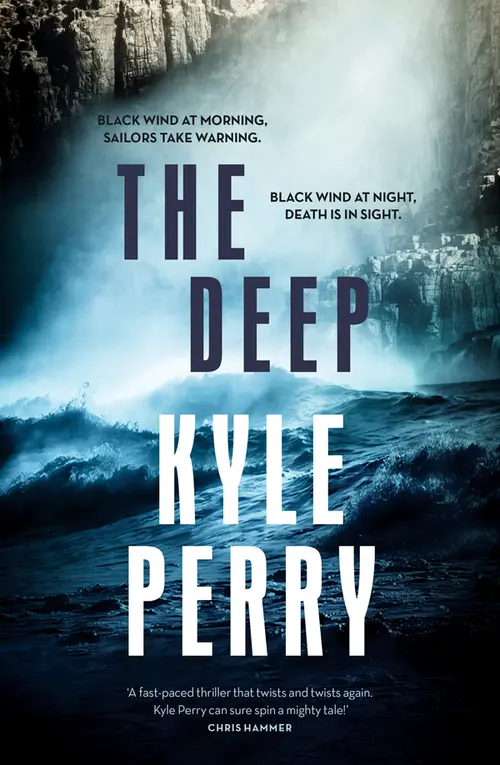
About the Book
IF YOU ENCOUNTER THE BLACK WIND WHILE OUT THERE AT SEA, ALL YOU CAN DO IS RACE BACK TO SHORE. THERE’S NO PREDICTING IT, NO SAILING IT, NO LIVING WITH IT. AND IF YOU’RE A DEMPSEY, IT CAN PLAY TRICKS ON YOUR MIND . . .
On the Tasman Peninsula, nestled amidst the largest sea-cliffs in the southern hemisphere, is Shacktown. Here the Dempsey family have run a drug ring for generations, using the fishing industry and the deadly Black Wind as cover. But when thirteen-year-old Forest Dempsey walks out of the ocean, bruised and branded, everything is at risk – because Forest has been presumed dead for the last seven years.
Mackerel Dempsey, out of jail on strict bail conditions, is trying to change his fate, doing his best to keep out of trouble. His cousin Ahab has renounced the family altogether, in favour of working to keep the town and its fragile tourism economy safe. But in their search for answers about Forest, both Mackerel and Ahab can’t help but be drawn back into the underworld. What happened to the boy all those years ago? And does it have anything to do with the infamous drug kingpin Blackbeard, who is rumoured to be moving in on Shacktown?
When secrets long thought buried at sea wash up on shore, generations of the Dempsey family must stand up for what they believe in, even if it means sacrificing everything. But in the gritty fight between right and wrong, blood isn’t always thicker than water, and everyone is at risk of being pulled under . . .
From the bestselling author of The Bluffs comes a heart-stopping new thriller set on the rugged coast of Tasmania about modern-day pirates, family bonds and betrayals, and the hidden dangers that lurk in the deep.

Dedication
Ryan Barber,
wouldn’t have made it without you.
I pay my respects to the traditional custodians of country, the Paredarerme, who are the custodians of Teralina and Turrakana – also known as Eaglehawk Neck and the Tasman Peninsula. I pay my respects to elders past, present and emerging.
I acknowledge today’s Aboriginal community on all Lutruwita, who are the custodians of this island, and I recognise their continuing connection to land, waters and culture.
Epigraph
Black Wind at morning, sailors take warning.
Black Wind at night, death is in sight.
Maritime saying of the Tasman Peninsula
The sirens of the Tasman Peninsula are known to be evil creatures who lure sailors to their deaths . . . Their songs were reported to be haunting and beautiful, sweeping many people into the deep . . .
From Folktales of Tasmania, by Cheryl Stirling
When first I heard the sirens’ song,
’twas out upon the sea.
Their gaze was hot, their hunger high.
A coward, I did flee –
terror, I flew, to my domain.
But she did follow me,
far from that misty bounding main,
the Black Wind of the sea.
Now ever I must flee,
there is no peace for me.
Dr William Ashbury, circa 1850s
PROLOGUE
Pirates Bay, Tasmania
The boy gasped for breath, hair in his mouth, before the next wave slammed him back against the bottom. He tumbled, the fizz of bubbles around him.
Back to the surface. Another desperate breath. Stinging eyes searching for land. In the pre-dawn light the ocean was a roiling grey, the dark gumtrees so close . . .
Knocked under by another wave, bull kelp tangling around his limbs. He clung to it as the current sucked him away from shore. His hands were so cold he couldn’t grip the kelp, but he wrapped slick loops of it around his wrists, adrenaline and fear giving him strength.
The water receded in a rush of whitewash and for a moment his head and torso were above the water.
‘Help!’ he called, voice raw.
A crash and he was under again. He held his breath, wrists locked in the kelp, until the rushing water had passed.
Above the sound of the wind and the waves, a dog barked.
The boy pulled himself forward. He could feel sand beneath his feet.
When the next wave came he let it carry him forward in the swirl of sand and silt. He spun, over and over. Arms tangled in kelp. Forehead scraping rock.
The water pulled away, but he rolled until he found a crevice in the coarse rocks on the shore. He gasped for salty air, the sound of breaking waves close by. He wasn’t out of danger yet. He dragged himself forward, grazing skin, all strength gone from his legs, the wind cold against his bare back.
A German shepherd splashed into the rockpool beside him, barked, nudged its nose under his arm.
The boy dug bleeding fingers into the rock as the waves surged over him again, the dog yelping.
Rough hands seized him under his armpits and picked him up.
‘I’ve got him!’ the man shouted. ‘Here, he’s still breathing!’
The dog shook its fur and licked the boy’s bleeding shins, its barks mixing with human voices. They were crowding him now, carrying him off the rocks, onto the sandy beach. The man laid him on his back, putting an ear to his chest.
The boy opened his eyes, crusted with silt and sand.
‘He’s alive,’ said a woman. ‘Thank God, he’s alive.’
She was right in his face and he pulled away, coughing, scrabbling on hands and knees, backing himself against the panting dog. The stink of wet fur and seaweed.
Still these people crowded around him. ‘Easy, mate, easy,’ said the man.
The boy’s grazes stung, his body ached. He shivered from the cold, his heart pounded. He needed to run . . .
The sight of the woman holding out a towel broke through his panic, and a new thought reached the surface of his mind.
These people have come to rescue you.
You need their help.
He forced his struggling breaths to slow.
‘Thank you,’ he croaked. His throat and nose burned raw from the salt water.
Then he turned and buried his face in the dog’s fur. ‘Thanks, Zeus,’ he whispered to his dog. ‘You did it.’
‘Bloody hell. Look at his tattoos,’ said the man.
The boy knew he was a desperate sight. Short, thin, shaggy blond hair. Covered in kelp and sand. He wore only a pair of boardshorts, the cuts and puckered scars all over his skin rising from goosebumped flesh.
‘No, it can’t be . . .’ gasped the woman. ‘After seven years?’
Tattooed across his scrawny shoulder blade, which dripped icy sea water, jagged words read:
THIS IS FOREST DEMPSEY
BE CAREFUL WHAT YOU WISH FOR
CHAPTER 1
AHAB
Ahab Stark burst out of the bay with a gulping breath, speargun in his hand, an underwater torch dangling from his wrist. He pulled his diving mask down to his neck, coughing. Cold water matted his grizzled beard, the salt water stinging ice-blue eyes long since used to its bite. He bared his teeth in a grin; he’d pushed that dive a little too far.
The sky still had a dusting of dawn stars – no clouds in sight – but under the surface of the water he had heard the vibration of the drone and felt the cross-current. It was easy to feel it here, around the isolated reefs that spired out of the bay, and he had seen a school of Australian salmon flee to deeper water.
The Black Wind was on its way.
He floated in the dangerous silence that preceded it. Of course, the ocean is never quiet, but to Ahab this was true silence. Natural sounds, constant movement around him, waiting with bated breath. He looked up at the lightening sky, content.
‘I’ll take my time,’ he told it.
Eventually, when the cold and the wind had seeped deeper into his blood, he kicked his matte-black fins, swimming over to his anchored rigid inflatable boat. He climbed up the ladder, naked skin dripping water. His fishing haul was in the catch bag attached to his waist – enough king flathead to offer a fish-of-the-day special at his pub. He dropped his mask and snorkel, speargun and torch, slid off his fins.
His diving partner, Ned, was floating on the other side of the boat. Ned wore a ripple-patterned wetsuit – even in the middle of summer, the younger man found the water too cold. ‘Fish have disappeared, Ahab,’ he called. ‘Reckon it’s coming? Black Wind?’
‘On its way,’ Ahab called back.
Ned hurriedly climbed into the boat himself, shivering as he peeled his wetsuit off his lanky frame. A boat was like a footy change room – no one cared if you were naked. Ned dried his mullet and checked it in his phone camera before he towelled the rest of himself dry.
‘Let’s get out of here,’ said Ahab, once they were both dressed.
‘Look,’ said Ned, zipping up his thick coat. ‘Another boat.’
It was visible – just – through the peaking waves.
‘They’ll be right,’ said Ahab. ‘They’ll see the signs.’
He glanced at the sky – still clear of clouds save for some high horsetail wisps, which caught the first blush of the sunrise. The truth was, there weren’t any signs, yet. Sometimes the Black Wind came with little warning. And there were always out-of-towners on these waters.
Ahab let out a sigh. ‘Better have a look.’
He fired up the engine and they headed towards the other boat, slicing through a sea of dark interlocking waves, tinges of the pink sunrise now catching in the liquid peaks.
As they drew closer, Ahab identified the other boat, and he backed off the throttle. It was the abalone motherboat, the Absconder, a 60-foot Westcoaster, with a flybridge and live abalone tanks, and a crane on the rear deck. It belonged to the head of Dempsey Abalone – Davey Dempsey, his cousin.
Ahab tied his RIB to the side of the Absconder.
‘I’ll stay here?’ said Ned.
‘Get ready to leave in a hurry,’ Ahab said softly, as he pulled himself up through the dive door and planted his feet on the deck.
Davey stood at the stern with his second-in-charge, Chips, and spun at the sound of someone coming aboard his vessel. He cut an impressive figure – a dark-haired, muscular man, in a business shirt but with his sleeves rolled back to show his distinctive tribal tattoo sleeves. He had a rugged face that was, as Ahab had heard Ned sulkily describe it, ‘unfairly good-looking’.
He smiled wryly at Ahab’s entrance. ‘Alright, cuz. Come right aboard.’
Chips wore warm hi-vis, for comfort not style, her sandy hair in a long ponytail under a blue baseball cap. She gave Ahab a deferential nod. A long time ago, when she’d dropped out of high school, Ahab had been the one who’d given her work, then put her name forward for the Business.
She had never forgotten it. Ahab wished he could take it back.
‘To what do we owe the pleasure?’ said Davey, leaning back on the rail. He was wary of Ahab, with good reason, but tried to hide it.
‘Black Wind is on the way,’ said Ahab.
Davey grimaced. ‘How long ’til it hits?’
‘An hour. Maybe two.’
Davey sucked his teeth, then turned and looked out over the water from the bow. Ahab followed his eyes. The aluminium tiller-steer boats were just in view. ‘An hour . . .’
Abalone fishing was a strange business. It required divers, who were down there under the water now, to hunt for what were technically sea snails. The thick inner layer of their spiral shells was a source of iridescent, colourful mother-of-pearl, but it was their flesh that was the prize – delicious raw or cooked, it sold like gold in Asia. Tasmania supplied about 25 per cent of the world’s yearly abalone harvest.
On those smaller boats all around the Absconder were deckhands, staying above wherever the diver was fishing below. The divers prised abalone from the rocks and sent them to the surface in catch bags, on shot lines with underwater parachutes filled with air from the divers’ regulators.
Catch bags full of abalone, but other things too, as Ahab well knew . . . things that were left out here, for Davey to pick up, bring back to shore, and sell on, right under the nose of the law.
‘It’ll still be there later,’ said Ahab.
‘Always plenty in the sea,’ agreed Davey. ‘But we’ve got a quota. Business stops for no one. I’ll signal the divers later.’
‘You really want to risk it?’ said Ahab.
Davey straightened. ‘Don’t forget who you’re talking to.’
‘I know exactly who I’m talking to.’
Chips shuffled her feet. She glanced between the two men, uneasy.
Davey laughed, breaking the tension. ‘Don’t worry, Chips. We respect the elders that have gone before.’
He might really have intended to be respectful, but all it did was wrench Ahab’s chest. There was no way to change the past . . .
Ahab gave a wordless salute as farewell and climbed back down to his boat. Ned turned the wheel, pushed down the throttle, and set them towards Shacktown.
One of these days, he would have to tell the police about the Business. But could he really do it? Ruin Davey’s life, Chips’s life, the lives of countless others . . .?
But what about the lives they ruined?
Angrily, he pushed the thought aside. As he’d done so many times before.
He couldn’t do anything – not yet. As much as it goaded him, sometimes to the edge of insanity, Ahab was a man of his word.
But his self-control had its limits. One day he would find a reason to break his promise.
As they neared the sea cliffs, mist from Devils Kitchen caught the pink dawn like smoke. Devils Kitchen: a huge, deep trench in the cliffs of Pirates Bay, where the water and wind had eroded a chasm, forming a dangerous swirl of waves and fury, turning the swells of the Great Southern Ocean into a boiling cauldron. It was gigantic, magnificent, and dangerous as hell. But that wasn’t where it got its name – early European settlers in the area had seen this mist rising and claimed it was the Devil, boiling his meat pot.
Now the buildings of Shacktown came into view, spreading across the wooded hills to the stark cliffs, spilling right down to the beaches. Ahab surveyed it all from his boat, the beach mansions and the holiday shacks and all those in between, waiting in the she-oaks and banksias and sands.
As they rounded the point, heading towards the huge maze of wooden piers that made up the marina, they saw red-and-blue pinpricks of ambulance lights and police cars, far in the distance, down on the northern beach.
‘What’s gone on there?’ called Ned over the sound of the engine.
‘We’ll find out soon enough,’ said Ahab.
Shacktown residents were notorious gossips, and even this early the marina was stirring.
Ned eased them into their berth, and Ahab left him to moor the boat, jumping onto the slick timber pier, catch bag in hand.
He approached a huddle of fishermen who were talking among themselves, dressed in thick waterproof gear.
‘Ho!’ called Ahab. ‘A no-go today, boys! Black Wind’s on its way . . .’
‘Ahab!’ said one of the men, as the others broke apart. ‘Have you heard?’
‘What’s happened?’
‘They found Forest. Forest Dempsey!’
Ahab dropped the catch bag.
The fishermen edged away from the look in his eyes.
CHAPTER 2
MACKEREL
Sucking on his vape, Mackerel Dempsey stood far away from the entrance to Shacktown Police Station, as was polite. The grape flavour of the vapour filled his mouth and burned his throat, tasting like Nerds lollies. The cloud hovered in front of him before slowly dissipating in the faintly menacing breeze. The station had been renovated to seem friendly and inviting, etchings of seabirds swirling along the windows to make tourists feel safe.
An early-morning tour bus rumbled by, a red double-decker, the top open to the elements. It was full of wide-brimmed hats and cameras. A sunburned woman waved at Mack, cheerful. The side of the bus read: SEE TASMANIA? SEA TASMANIA.
He waved back and took another puff. He always put off entering the cop station as long as he could.
A narrow isthmus of land, Eaglehawk Neck was 50 kilometres east of Hobart and halfway down the Tasman Peninsula. Swamping that land, engulfing it like umbrellas on a crowded beach, was Shacktown. The area offered stunning views, unique geology, the tallest sea cliffs in Australia and some of the largest sea caves ever explored – and plenty that were unexplored. There were green parks and white beaches, shops and cafés, danger and folklore. Shacktown had something for everyone. Worth the drive.
The Shacktown locals were a large part of the appeal, their attitude towards tourists one of fondness. They opened their homes as Airbnbs without qualms, invited strangers on the beach back to the cafés for lunch, forced travellers to sign their guestbooks, or, if they didn’t have them handy, gave out their address and insisted on postcards from their next destination or a Facebook friend request.
But underneath it all, unseen by most, was the influence of the Dempsey criminal dynasty. And Mackenzie – known by most people as Mackerel – its outcast. Crooked nose, tattoos. Large enough to be intimidating yet for some reason always the butt of people’s jokes. His father had once said it just oozed out of him – like he was asking to be bullied.
The automatic door to the police station opened and an old man in a ripped puffer jacket and stained trackpants walked out. He nodded to Mackerel, wandering over for a chat, already lighting his cigarette. ‘Hey, Mack. How’s the day looking?’
They saw each other every day – every damn day. They had the same daily sign-in conditions and they both chose to get it over with first thing in the morning. The old man stank of body odour, was always drunk, and no one ever stopped to chat with him – which was why Mackerel always went out of his way to do so.
‘Looking good, I reckon!’ said Mack. ‘Just heading out on the boat. First day’s work I’ve been able to land in a while. How about you?’
‘Sorry to break it to you, mate, but I heard in there that the Black Wind is on its way.’
‘No . . .’
Mackerel couldn’t afford another day without the meagre income he made from the only fisherman in town – his best mate – who still gave him work.
‘Just go home and get high,’ advised the old man, stretching his back. ‘Weird feeling in the station today. I think some kinda shit’s gone down. Hope you weren’t involved, mate.’ He took another puff and walked off with a lazy wave, the smoke caught in the breeze.
Out on the ocean, that breeze would soon become a droning wind. The Black Wind. Mackerel had been caught out in the Black Wind once, and it still gave him chills to remember it. It twisted and pulled at the waves like a cyclone. The rage of it, the chaos, the feeling that death was just a bee’s dick away and there was nothing you could do but hold on and pray . . .
Mackerel flicked the vape off – five quick taps of the trigger – and slipped it into his pocket. As he stepped into the foyer of Shacktown Police Station, his mind turned and turned. Subconsciously he made slight adjustments to his stance and walk, trying to appear as nonthreatening as possible. He had a fresh face and big blue eyes, and he’d been told he had a nice smile. A bit goofy, a bit endearing. These days, he needed every shred of endearing he could manage.
Even in the station, he had to keep on his toes. It was common knowledge that Mackerel had been run out of town five years ago – for very good reason – and should never have returned. But only those with ties to the local underworld knew what this ‘very good reason’ was . . .
‘Morning, Constable Linda . . .’
‘Yeah, morning, Mack,’ said Linda. She pulled out the bail sign-in registry, jotted down his name, the time and date, and spun the book around for him to sign. There was a briskness to it, and his heart sank. That usually meant it’d be an interrogation day.
How’s your health and temper?
How’s the job hunt going? How’s the psychologist going? Who have you been seeing? What have you been doing? Anything illegal? C’mon, Mackerel, tell me the truth . . . What have you been doing?
Anything you want to tell me now before I find out later?
This daily sign-in was a constant reminder of everything he’d lost. His dignity, the respect of everyone he knew, the ability to ever be more than twelve hours away from Shacktown, even just being able to work his old job. All Tasmanian fishermen have to be of good character and be a fit and proper person, so when he went to prison he’d lost his FLAD – Fishing Licence (Abalone Dive). That meant he couldn’t even dive for a living, the one thing he was good at.
Linda glanced up from the work she was doing on her computer, confused to still see Mack there. ‘I’m sure you have places to be?’
She seemed distracted. He noticed now the absence of other officers. Where were they all?
‘Yes, ma’am.’ Mackerel turned and walked out as quickly as possible.
No interrogation today!
That was a good sign.
Yet instantly his mind was back to his upcoming court case. His rehabilitation. What he could do to fix things.
I could go to church . . . No, too transparent. Maybe a religious girlfriend? That’d look good.
While prison loomed? Who’d possibly have a relationship with someone like that?
Someone looking to save a lost cause, that’s who.
He felt a pang of fear. If he went back to prison – which was the most likely outcome of his upcoming sentencing – he’d be alone again. He didn’t want to be alone again.
These were the unhappy thoughts in his head as he limped to the chemist, the gulls cawing overhead. There was the smell of roasting coffee from a van set up in a little park, and he could hear the shouts of children on the swings there. Sunshine beamed. You’d never know the Black Wind was on its way, except for those rippled clouds blowing in from the horizon.
A couple of local men saw Mack limping past and spat at their feet. This attitude was why no one else in town would give him a job. He tried not to mind. It was just lucky that he could work on Big Mane’s boat as a deckie, on the few occasions his best mate actually had the work for him.
The Story Continues on BooksBarbecue!
Enjoyed this preview? ❤️ Do not stop here!
Read the complete book free online → 🔗
Continue reading now on BooksBarbecue and discover every page!
Love reading? Bookmark BooksBarbecue.com for more amazing books!
Happy Reading!