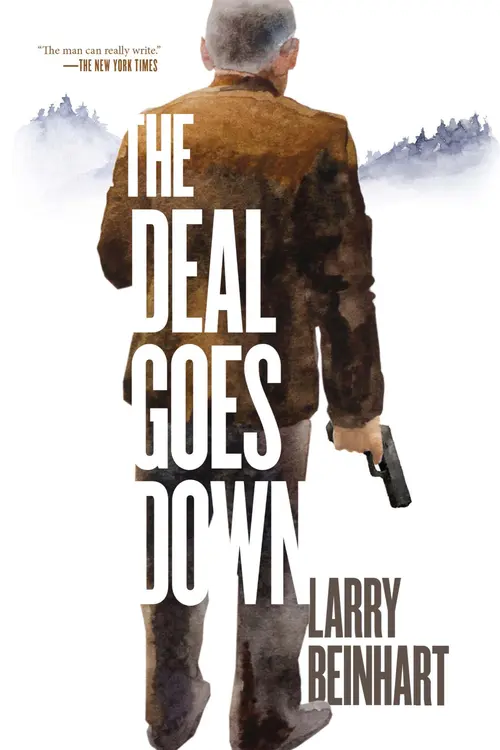
The Deal Goes Down
Cover
Other Titles
ALSO BY LARRY BEINHART
FICTION
Zombie Pharm
Salvation Boulevard
The Librarian
Wag the Dog
(originally published as American Hero)
THE CASSELLA BOOKS
Foreign Exchange
You Get What You Pay For
No One Rides for Free
WITH AND AS GILLIAN FARRELL
Murder and a Muse
Alibi for an Actress
Seven Stages of Deception
NONFICTION
Fog Facts: Searching for Truth in the Land of Spin
Dedication
Some show up in this book, real people strolling through fiction, as we all like to do. They’re not in the list below, not even the two who just lent their names to a pair of cats.
So, to Julie Beesmer, who runs Bread Alone the way a coffee shop should be run. Joe & Denise Clark at Bearsville Garage. Mikhail Slobodynak with the banya & frozen pond. Gioia Timpanelli, Sicilian-American storyteller & Ken Barricklo, architect. Graham Blackburn, expert in antique woodworking tools.
Dean Schambach, actor, bohemian, ski jumper; Rocky Rosario, person of interest; and Richard Segalman, artist; representing the deceased. But there are videos of them on YouTube, Dean’s under his own name, Rocky’s is Rocky Lama, and Richard’s simply and mysteriously called Winter.
Plus apologies to the rest of the people I play poker with, play tennis with, ski with, and otherwise know about town, who are not mentioned. How damn long can I make a list like this. All of us with our aspirations & disappointments, achievements & frustrations, what the ancient Greeks called the agon.
CHAPTER ONE
WOMAN ON A TRAIN
THE WOMAN ON THE TRAIN asked me to kill someone.
I liked the train. I didn’t especially like the woman. It was a real train, an Amtrak, not one of the commuter trains like Metro-North, which are more like buses that happen to be stuck on rails. We both got on at Rhinecliff.
The line is called Empire Service. It runs along the east bank of the Hudson River from Albany to New York City. There are about thirteen trains a day, weekdays. Each one has a cafe car. They’re the old types with tables that are simple rectangles with badly cushioned bench seats on both sides. You can really sit there and enjoy the ride. The new ones, like they have on the Acela Express, have uncomfortable stools at a counter too skinny for you to even read a newspaper with your coffee, making it clear that what they really want is for you not to be there. Take your sandwich, snack, and whatever you’re slurping on, and go back to your seat.
These sit four. Comfortably. In this case it was just the two of us. Me facing south, the direction we were headed, and her facing north, the places we were leaving behind. Our table was on the west side, our windows facing the marvelous and great river that looks different every season, every day, every time, no matter how many times you’ve seen it.
Some years ago, I don’t remember if it was a dozen or two decades by now, they stopped offering cafe service on the short hauls, the seven that originated or terminated in Albany. The other six include two for Niagara Falls, two for Rutland, Vermont, one for Toronto and one for Montreal. Those still have cafe service in the cafe cars. They’re also the most likely to run late, especially the two that cross the border because fear is mud and it makes for a slow slog.
We were on the Ethan Allen Express out of Rutland. We’d boarded at about 2:50 in the afternoon and it had left the station right on time at 2:54.
I was on my way to a funeral. I headed straight for the cafe car. What was there to do but look out the window, contemplate the river. You think of it as flowing south, water entering it from the mountains on either side, all going down to New York and then to the Atlantic. But actually the ocean pushes back. The whole river will flow north for a hundred and fifty something miles; you can’t really see it except in winter if it’s cold enough for ice to form and then break up and if you’re watching at the right time you see the white slabs moving the wrong way.
On my way to a funeral, another old friend gone. Sitting there, moving south, watching the water flow as it did before I came and will do after I’m gone, and the light and the hills, trying to come to terms with the rhythms of life and death.
I was happy to find an empty table.
She’d gone past me to the service counter. A couple of minutes after we got rolling, she swayed back down the aisle, came to where I sat, and slid in across from me as she was surely entitled to do. She had a cardboard tray with a miniature bottle of Tito’s Handmade Vodka, a can of Schweppes Ginger Ale, and a plastic railroad cup with ice. She opened the Tito’s, poured it all out into the cup, and then popped the tab on the can and added a measured amount of the Schweppes.
She didn’t start out asking me to kill someone.
She started with a simple, “Hi, Tony, how are you?”
We knew each other slightly, vaguely, from running into each other, up and around the Woodstock area, or maybe Saugerties or even Phoenicia or Shandanken. At that point, I couldn’t for the life of me remember her name. “Fine, fine,” I said. “And yourself?”
“I’m grand, just grand,” she said in a tone that said all things opposite, miserable, bitter, and disappointed in life. I tried my best to take her at her word and ignore her manner, because I had no desire to know.
“Good, good,” I mumbled and turned to watch the winds making small waves on the river and the illusion created by the turning of the Earth on which we ride that it’s the sun that’s moving, to the west and sinking, on its way to hiding below the horizon.
She was a reasonably attractive woman, as these things go, and had probably been an almost beautiful one ten or twenty years earlier. What the hell was her name? And where exactly did I know her from? I guessed her to be staring at forty and hoping it wasn’t staring back at her. Well dressed. Expensively dressed to the degree that I could judge. The manner with which she raised her glass and put her lips to it was trying very hard to say I’m just sipping at this for the flavor and because it’s refreshingly cool. She was good at it, having practiced it a lot I guessed, and it was convincing if you didn’t put an odometer on the speed with which it went down, which told another story, that her natural state was a place she wanted to leave behind and the 80 proof was rolling her away from it as surely as the steel wheels on the steel rails below us. She said this and that, I was listening just enough to make polite noises and I don’t recall what. If I’d had computer in front of me or even a bunch of paper or a serious looking book, I would have said “Pardon me, I don’t mean to be rude, I’d love to chat, but I have to get this done.” Instead I just hoped I could keep her nattering at a sufficient psychological distance that it wouldn’t build to the point where I blurted out a strident command to shut up.
Madelaine, that was her name. Maddie.
Right, right, she was going on about a son-of-a-bitch husband who was ruining her, cheating, of course, with secretaries and what not, of course, the nanny, that ex-nanny, two nannies back, maybe the housekeeper even if she had fat thighs, alienating her children from her, Leslie and Sandra.
They had a lot of money. Or he had a lot of money. Maybe not by New York City standards, hedge fund billions and such. Certainly, by upstate standards. Maybe millions? This was from vague, passing gossip, about people I barely knew, from people I slightly knew and didn’t listen to very much. There was money there and there was little or no money here—meaning with me—and I felt its tug. I don’t know when it happened or if it was always that way and I was just blind to it, money has gravitational force. The bigger the mass of it, the closer you get to it, the more it pulls you.
Maddie finished that drink and went back for another. I was grateful for the silence when she was gone. Then she was back. She poured again, mixed again, and drank again, faster this time. She said I was looking good, was I going into the city on business. I said no. She said, jacket and tie, fresh shave, being inquisitive, but friendly.
“A funeral,” I said.
“Oh, death,” she said. “I’m sorry. Were you close?”
None of your fucking business is what I wanted to say. “Close enough” is what I said. It didn’t quite shut her up. Of course not.
“You’re a detective,” she said.
I twisted my head, half a shake, half a denial. I raised one shoulder, shrugging it off.
“You used to be a detective,” she said.
I made one of those noises. Yes, it was true. I acknowledge it. Don’t have any interest in discussing it. She wanted to know if it was exciting. Did I do any famous cases? Did I carry a gun? Did I ever shoot anyone? Things like that. What kind of people did I work for? It was all long ago, and far away, is what I said, in several different ways. Retired now, living on social security and a little of this and a little of that.
Maddie said that I didn’t look that old. I’m vain enough to want that to be true. I still have hair on my head, I haven’t gone to fat, and I’m as fit for my age as I’m likely to be short of being fanatical, medicated, and on a regimen of human growth hormone.
We’d passed Croton-Harmon. That was her third drink. On the train. I expect she’d started before she’d boarded. She got the fourth just after Yonkers. We’d be seeing the Palisades across the river soon. The fragments in her mind were mixing and matching without the normal controls and separations of sobriety. “Millions,” she said. “The pig has millions. And he is a pig. He’s cruel and plotting and vicious and mean. I have bruises. I could show you bruises. Not to mention the emotional abuse. Plus, if Me Too catches up with him. The problem is everyone is scared of him. And his money, of course. I should have a big, big piece of that money. He wouldn’t have made it without me. Will I get it? No. I told you some of the things he’s manufactured and faked to cut me out. Plus, he will spend on lawyers. Lying, mean, despicable lawyers.
“A funeral,” she said, in a quick gear shift. “Death. That’s what has me thinking this way.”
Yes, that and alcohol.
“Death is the only way out for me,” she said, like it was a well thought out conclusion after much study. “Really, I’m ruined. I’ll have nothing. Unless he dies. Soon. Now, I guess. Then…and I deserve it…it’s what’s right. I want to have him killed.”
“No, you don’t mean that.”
“Yes, yes, I totally do.”
“You’re asking for trouble.”
“I would pay,” she said.
“Look…”
“Really,” she said. “You must know people like that. Right? You must.”
“Come on, you should maybe have some coffee.”
“A hundred thousand,” she said.
“Do you have money like that?”
“After,” she said. “After he’s dead. Easily.”
“You want someone to do it on spec?” I knew enough literary and movie types to know the difference between working on commission and speculation.
“I could…I have some…I could come up with like ten…ten K up front. The rest after.”
“That’s not enough, not nearly enough,” I said, trying to shut her down.
“I could do twenty,” she said. “Twenty thousand. Cash. Untraceable. I could do that.”
“Really?”
“Yes, yes, I can,” she said, with what appeared to be utter sincerity and conviction.
I was very broke. That’s not an excuse. Maybe it’s an explanation. Maybe it’s not. My home was thirty-six hours from going into foreclosure. Maybe it was one of those moments where you’re saying to yourself, I have to do something new and different with my life, though that’s not something you expect when you’ve recently turned seventy, and then something just comes along and presents itself. I’d never done anything like that. Not remotely like that.
I said, “Yes.”
“Yes?”
“Yes. I think I can help you.”
CHAPTER TWO
DARK AND DAWN
“I have outlasted all desire,
My dreams and I have grown apart.”
ALEXANDER PUSHKIN
THERE IS A TIME THAT is neither dark nor dawn as there is a time between sleep and waking.
Sleep is the time of dreams, the real kind, that are run by a part of our mind that might as well be a different person, with its own drives, desires, and needs, that uses us the way that writers use the stories of strangers, snatching and stealing parts and pieces, kibbles and bits, putting them out of order, into other arrangements, for different made-up tales, loose in logic, ungrounded by space-time, using our synapses like fiber-optic cables to play them IMAX-style against the curved inside walls of our skulls as if they’d been already cleaned and polished white by death. That particular dream time, on the way to morning after the mourning of the funeral, was filled with corpses and cadavers.
It started with reality, Winston C. Walker, centerpiece in an open casket.
A big man in his prime. A black man—so the music at least was good—though it may be incorrect to say, to even notice—African Americans have much better music for death than white people do. He’d been a cop. Starting in the sixties. Then bookended by scandals. The one in the seventies opened the gold shield door for him. The second, in the nineties, prompted his exit.
They were the crazy years.
I know the man been to the wall, I know the wall was rough. I don’t know how many men he killed. I know he killed enough. Their ghosts seemed to form themselves from the thick, heavy, urban air, into sad, dim things, coming toward the casket, maybe drawn by the burnished bronze, silver handles, plush champagne satin liner, glittering like a fishing lure. Maybe to waft his ghost away. Maybe to be sure he was really dead. Once they’d bushwhacked a route from the impalpable to the corporeal, other haunts sensed the opportunity, or just got pulled along by the draft. I surmised that the ones that followed immediately behind, based on whom they gazed at and whom they attempted to address, belonged to Owen Cohen, who had been Winston’s partner in the NYPD.
I’d done business with both of them. While they were still on the job, they’d moonlighted for me. When I wanted to get out of the PI racket, they turned up to buy me out and paid in cash. Whatever that suggests is far more likely to be true than not.
I meanwhile had an ordinary, pleasant, live person’s conversation with Owen. He said business was good, but not as good as it had been, big companies largely created through national security money were moving in and everything was going digital. By then, some of my own ghosts were sneaking in, some to taunt, some to make me mourn…my wife and my son…to tear my heart out if I’d still had one.
Back home, the scrambling of my two cats intent on a kill woke me from my memories and dreams. Carl Sandberg had conned us all…“the fog comes on little cat feet. It sits looking over the harbor and city on silent haunches and then moves on”…into thinking that cats move with no more sound than drifting mist…but given the right surface they thump and thud, they skid, and even knock things over. I have two. Scotty’s the cute, sociable one. Huba’s the killer. His little face actually looks somewhat like Elisha Cook, Jr.’s, the little gangster in The Maltese Falcon, but when he kills, he’s as straightforward and ruthless as Richard Widmark pushing the old lady in the wheelchair down the stairs in Kiss of Death. Scotty’s starting to learn from Huba. I praised them both for the mouse they’d caught sneaking into the kitchen. It’s their job.
I picked up the corpse with a paper towel and took it outside. There was mist in the air. I tossed the little carcass into the trees. Other creatures would find it and eat it quick enough.
Later, when I went into Woodstock, I saw that the fog around my house was part of a layer of clouds caught between the peaks, hanging around, halfway down the hills, and it was clear down in the valleys and up above them. I understood quite clearly that it was beautiful. Once it would have moved me. I felt nothing.
The air had a definite chill in it. Distinct enough to say that snow would be coming soon, a matter of weeks, even days. Once that would have filled me with eagerness. Now it didn’t.
I was on the verge of losing my house. I couldn’t bring myself to care.
Inertia. My choice of choices. I could have been a TV ad with an elephant sitting on my head representing depression or some other mental disorder so as to sell a medication that would knock a pachyderm off a person.
The only thing I could bring myself to care about was the cats. They would need a new home.
I went into Bread Alone, automatically, because it’s what I always do. There were a couple of writers there that I knew. Shalom Auslander, sat at his usual spot toward the back. I asked him if he’d like two cats, excellent mousers, dedicated killers. He said, “I’m moving to L.A.” Larry Beinhart was sitting in his usual spot, at the other end, just opposite the Geezers. I told him I might be moving away and my two excellent cats needed a home. “If all a man‘s got left to care about is a dog,” he said, with emphasis on man, “that’s one thing. But if all a man‘s got to care about is a couple of cats, then he’s in big trouble.” It was snarky, but I think I agreed with him. The Geezers shook their various heads before I even said anything.
Was Madelaine still asleep? When she woke, what would she remember? What would she think? Would she still want her husband dead? Would she think she—we—would actually go ahead with it?
I could already make a long list of the problems, the dangers, and the clear why nots. What I couldn’t understand, at all, was why I’d said yes. I had never killed anyone for money. I had never killed anyone out of anger, hatred, jealousy, or greed. Never for revenge, for pleasure, as an alternative to divorce, or as the fifty-first way to leave a lover. The problem was that it had launched the mechanism inside me that insists that if I’ve said I’m going to do something, then, like kid that’s taken a dare or a gangster that’s made a stand, I must do it. Once I thought that was a virtue. Maybe, I somehow lived in a world, back then, in which it was, and the world had changed around me. Maybe it was always a fool’s cap. The sensible, grown-up mechanism that should say forget about it—it was a mistake, a foolishness, a lie, if that’s what you want to call it—is not as self-propelled and not nearly as strong. How could I know—how could anyone know—if they were an insane person in a sane world or a sane person in an insane world. I may have blurted that question out loud—or maybe just thought it forcefully. In any case there was no reply. Just some blank gazes.
Hopefully, fortunately, surely, all that was moot.
Madelaine would wake up to the realization that she’d discussed murder-for-hire with someone she barely knew. She’d desperately hope that it would be forgotten by both of us. I’d never hear another word about it. That was far more likely, and frankly, much to be preferred.
CHAPTER THREE
AT THE END OF THE ROAD
I HEADED HOME, TRYING TO figure out how to explain things to the cats.
I turned off the county road onto Shanty Road, heading up into Hellmenn Hollow, where I lived, tucked between Round Bear Hill and Slate Mountain. The air had turned crisp and clear. The low-hanging clouds had blown out, but they’d left their mist on the last of the autumn colors, making them vivid in the sun. I knew it was beautiful. I knew any of us who lived here were blessed to do so, but I only knew it like the answer to questions on a civil service exam.
After the first four miles the pavement ends, and then there’s another five of dirt road to my house, the last one, sitting up there by its lonesome. As I came around the wide, eighty-year-old oak on the final curve that hides the house from sight, I saw a car there.
It was unmistakable.
The Story Continues on BooksBarbecue!
Enjoyed this preview? ❤️ Do not stop here!
Read the complete book free online → 🔗
Continue reading now on BooksBarbecue and discover every page!
Love reading? Bookmark BooksBarbecue.com for more amazing books!
Happy Reading!