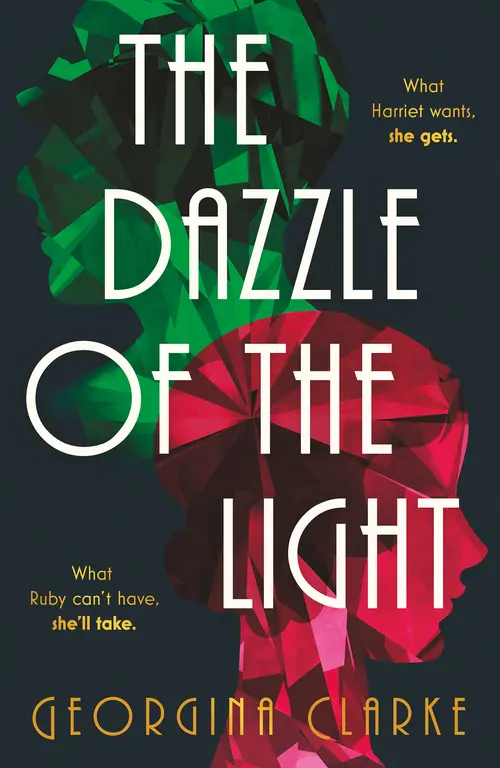
The Dazzle of the Light
Praise for Georgina Clarke
Praise for Georgina Clarke
‘Brava to this new, engaging voice’ – Karen Odden, author of A Lady in the Smoke
‘A gripping page-turner with a sassy and fabulously original heroine in the form of Lizzie Hardwicke – I loved it!’ – Annie Lyons, author of Not Quite Perfect
‘Razor sharp and brilliantly original’ – Joe Heap, author of The Rules of Seeing
‘Sparkling and twisty’ – Celia Anderson, author of 59 Memory Lane
‘A truly gripping story that is full of historical atmosphere and a devilish plot… Full of pace from beginning to end. I can’t recommend this book highly enough’ – Peter Donnelly, The Reading Desk
‘Irresistible’ – 5-star Reader Review
‘The author has razor-sharp wit and knows how to use it… An absolute delight’ – 5-star Reader Review
For Faith Claringbull and Jane Tillier.
My soul sisters and partners in crime.
1
1
London, February 1920
Saturday morning
Ruby Mills runs her knuckles along the mink collar, enjoying the softness of the fur. The coat is perfect. She will look like a queen.
‘I’ll try this one.’ The words are addressed to the shop assistant, but she talks to the coat.
She doesn’t need to see the girl. She’s already noted everything about her: lank hair, too many teeth and a badly picked spot on her chin. Trussed up in soulless navy – the uniform of one of London’s smartest stores. Ruby is indifferent to her. But if she bothered to turn her attention from the coat, she would observe the assistant staring, open-mouthed, at the shiny black bobbed hair, the powdered face, the deep red stain on the lips.
Ruby Mills, although barely older than the girl at the counter, could be a film star.
Ruby knows the shop assistant will be staring. She is used to the stares. It’s part of it. Part of the fun. She swings around now to repeat her demand, adding a hint of impatience.
‘This one?’
The girl starts out of her daydream, snaps her mouth shut and hurries from behind the wide mahogany counter to remove the coat from the hanger. She helps Ruby put it on, taking her own surreptitious stroke of the fur as she smooths the shoulders and breathes in the waft of expensive French scent.
Ruby admires her reflection in the full-length gilt mirror. Yes, this will be the one.
She frowns.
‘No. There’s something not quite right.’ She keeps her words crisp and clipped – a world away from the Cockney drawl she ordinarily uses. ‘It needs… It needs…?’ There’s a querying lilt in her tone now as she draws the girl into the game, stretching her neck to reveal a triangle of bare flesh at her throat.
‘A scarf of some sort, madam?’ The girl ventures. ‘We have silk…’
Ruby tilts her head, considering. It’s quiet in this corner of the store. She can take her time. Just the two of them in the side room and all these beautiful things laid out on the table and counter for her to look at. Scarves, gloves of buttoned silk, a chinchilla stole with light brown ribbons.
‘Yes… I think you might be right, you clever thing. Something in scarlet, perhaps.’
‘Scarlet silk?’ The girl repeats, more earnest now, wanting to get it right. Her manager will be most impressed. She imagines the commission.
Scarlet is a daring shade for a store like this, and, although they sell them, Ruby knows that there is no scarlet silk scarf on open display. The girl will need to go to the back room to fetch one.
She pulls a face, turning this way and that to examine how the coat hangs.
‘I have the perfect thing next door, madam, if you don’t mind waiting.’
Ruby smiles now at the reflection of the girl standing next to her. It’s her signature, her trick, the smile. Conspiratorial. She smiles as though she is sharing a secret.
‘I really mustn’t delay. My husband is expecting me home soon. Do you think you can find it quickly?’ She touches the curl of hair behind her ear with her ungloved left hand, making sure that the girl sees the size of the diamonds on the ring she’s borrowed.
The girl grins, delighted to be sharing the confidence. Her teeth are like disorganised tombstones.
‘You won’t know I’m gone.’
She scurries back behind the enormous counter and disappears through the door.
Ruby Mills pulls five pairs of silk stockings from the countertop and pushes them into the cotton bag that is secreted under her skirts. She folds her old coat and loops it through the thick belt she is wearing along with the chinchilla stole from the table. She grabs a handful of the silk scarves that are on display – not scarlet, but greens and blues, and someone will want them – and shoves them up the sleeves of her new full-length mink.
She buttons up the coat, pausing for a fraction of a second before sliding several brooches from the countertop into the pockets.
She reaches for a fur muff on the table. She has one at home, but this is sable and too tempting. It’s also useful. She presses three pairs of kid gloves into the hand space. She acts quickly, in one easy, fluid movement, with the poise of a dancer.
She takes a last look at herself in the mirror, wrinkling her nose at the bulkiness that she’s added; it’s spoiling the line of the coat. Then she shrugs, checks her wristwatch, and makes her way from this section of the department store towards the impressively gilded doors that will lead her to the street. She glides through them, safe in the knowledge that no one will stop her while she’s dressed like this. She doesn’t look like a thief.
Just beyond the doorway, another woman is waiting for her on the pavement. She nods to Ruby and tucks an arm through hers, squeezing her, and starts to walk immediately.
‘Nice coat, Ruby.’
Ruby smirks. ‘Thought I needed a new one.’
‘Why not?’ the woman says. ‘A girl deserves a treat now and again, don’t she?’
They merge with the crowds on the pavement, walking briskly east, towards Knightsbridge, but not so fast as to attract attention.
‘What else you get? You didn’t just pull the coat, did you?’
‘Course not. The pockets are enormous. I’ve got silk scarves, stockings, brooches – paste, but good. A fur stole. And there’s this.’ She lifts the sable muff.
‘Quality.’
‘Handy, too. I’ve got three pairs of gloves shoved in here. How about you, Maggs?’ Ruby tips back her head, to get a better view from under the rim of her hat. Maggs pulls her along, almost imperceptibly increasing the pace, staring only ahead, eyes fixed on the street and the direction they are heading.
‘Blouses. Silk underthings. They’re in my skirts. And there’s more than one hatpin holding down this hat. It’s like a pincushion right now.’
Maggs always does this: keeps her face rigid while trying to make Ruby laugh.
‘Shame it’s not windy at all, then,’ Ruby says.
‘I could do with a pin in my bloody knickers,’ Maggs grunts. ‘One of the blouses is slipping. Might have to stop and hitch it up before we reach the river.’
‘Are we doing anywhere else? It’s not afternoon yet.’
Maggs shakes her head. ‘Not today. We’ve done well enough between us, but word’ll soon be out that we’re in town and there’s no point risking getting caught. We’ll get these goods over to the warehouse for Grace to sort. And then I think we might deserve a trip to the pictures.’
‘Smashing.’ Ruby loves the picture house. She knows all the film stars. ‘Passion’s Playground is showing. Norman Kerry and Rudolph Valentino! And Katherine MacDonald – she was so good in Turning Point…’
Maggs lets her prattle on but ignores her. Ruby’s a dreamer, and someone has to stay alert. They turn the corner and she slackens her walk, her arm still linked through Ruby’s. Buckingham Palace is not far now.
Ahead of them, two women push through the doors of another store. One of them glances down the street and catches sight of Maggs and Ruby, but she makes no sign that she knows them. Instead, she nods to her friend and the pair set off towards the bridge. Neither Maggs nor Ruby passes comment as they follow at a distance.
They won’t acknowledge one another until they’ve crossed the river into Lambeth and they know they’re nearly home. That’s how it’s done. They all know the game. Hoisting. Lifting. They’ve been playing it since they were children, one way or another. Say nothing until you’re safe.
Ruby can see that Alice Dunning is limping. Her hip is causing her pain again and slowing her down. She says she fell off a ladder and injured herself trying to climb into someone’s house, or climb out of it. She laughs it off and says she can’t remember which way around it was, and anyway, everyone knows that’s not the truth. On her own, Alice looks like any other smartly dressed woman browsing the shops. Apart from the broken nose that makes her face look squashed. But next to Edith, she is clumsy, lumbering along.
Edith Lennox is wearing her new coat. It’s been specially made, lined with small pockets, so that she doesn’t have to push anything into her skirts. She’s not going to make herself uncomfortable. She’ll only have hoisted one or two items. Ruby watches Edith’s feet criss-cross as she walks. This makes her body sway, and the coat skimming her dainty frame swings at just the right length to show off her ankles. Edith is as vain as she is lazy.
Maggs is watching Edith, too, as she tries to hold the blouse between her thighs. She lets go of Ruby’s arm and clutches her skirt to keep the silk garments in place. It doesn’t matter, though. The bridge is in sight, and they are a long way from the store now.
The lank-haired shop girl emerges from the storeroom, holding up the red silk scarf in triumph: a tribute for the goddess of the silver screen. Her arm falls as she surveys the disruption of her station. The goddess, along with the mink coat and several items from her counter and carefully arranged table, have disappeared into thin air.
Later, wiping her nose on the stiff cuff of her sleeve, she will try to remember exactly what the customer had looked like and tell her story to her manager and several policemen. Over her head, the inspector will confirm to the manager that his store has been raided by a gang from Southwark. It will matter little to her that this gang is notorious – ‘the Forty Thieves’, they call themselves – she has never heard of them until now. A serious-faced young woman will record her words in a tiny black notebook, offering no words of sympathy as the shop girl gestures vaguely, red-eyed and sniffing, speaking of diamonds and film-star looks. The woman will lower her brows in a frown, tuck the notebook and pencil into her handbag and re-pin her hat. As she leaves, she will give the girl half a crown for her words – small compensation for the loss of her job. She will also give her, as an afterthought, a folded handkerchief which, by its very plainness, will seem so much at odds with the luxury on display.
2
2
Saturday evening
Ruby makes her way along Borough High Street as darkness falls. She passes the old timber-framed shops, set with angled lanterns that lean precariously from their fittings. The shops are crowded together, almost one on top of the other, as they have been since the days of Charles II, selling everything a person should want or need – sometimes in the same shop, according to the signs. She could, should she wish, buy a pint of tea for a penny at Shuttleworth’s, inspect the umbrella warehouse and then find elastic stockings at Chaplin’s.
None of these places sells the sort of goods she hankers after. Only Solly Palmer’s jewellery shop – where she lives and allegedly works – sells the stuff that sparkles, and for silks, satins and furs, she must visit a warehouse or travel over the river.
Behind the High Street lies a maze of streets and courtyards. The wall of the nearby lumber yard is so high that, even in the daytime, the sun fails to touch the melancholy, dark-bricked homes, and on a starless night, this part of the Borough is impenetrable to anyone who does not live here. The dwellings are flimsy and run-down but crammed so hard against one another that they have never yet collapsed. These tenements are stacked not with fancy goods, but with hundreds of dirty-faced children. They are nests and nurseries of criminality – although Ruby knows that even the children can be bought and sold as easily as a bag of trotters or a barrel of beer.
She walks without considering her surroundings. This is where she lives – where she’s always lived. But she’s imagining herself in a casino in Monte Carlo where everyone drinks champagne, just like in the pictures.
She stops outside a public house at the corner of the street. Through the frosted glass, the lights are bright and inviting. She pushes open the door, a broad smile fixed on her face, ready to greet those already inside.
The Crown is certainly busy tonight. It’s noisy, too, heaving with people having a good time. There is always a party when the Forty Thieves have returned from a raid up west, and the laughter is raucous. The scarves and gloves that were, this morning, tucked inside Ruby’s coat and skirts, have already gone to Grace Bartlett’s warehouse. By tomorrow, they’ll have been separated and sold through one of half a dozen shops between London and Kent that do business with the Forties. The paste brooches and the muff will have gone too. Ruby begged Maggs to let her keep the coat. It’s against the rules to keep your own steals. Unwise, too, to be caught wearing something you never paid for. But she told Maggs it was her birthday, and Maggs pretended she didn’t know otherwise, so she’s wearing it just for tonight.
Ruby eases herself into the wooden settle next to Maggs and takes a deep breath. The familiar mingled smell of beer, cigarette smoke and perfume hits the back of her throat, sharp and warm, and she snuggles into the fur collar.
Through the fog of tobacco, she watches Billy Walsh trying to talk his way into Daisy Gould’s knickers. He fancies himself a smooth talker, does Billy. He’s not tried it on with Daisy before, but her old man’s just been sent down for five years hard labour, so he’ll imagine he’s in with a chance tonight. He hasn’t a hope: Daisy’s pining for Harry, everyone knows that.
She presses a fingertip to the rough chip in the rim of her gin glass, remembering the last time she wrapped her own legs around his waist. Billy Walsh has been a rite of passage for several of the Forties, and she’d be happy enough to repeat the experience. A successful day’s hoisting, outrunning the coppers and not getting caught, always gives her the itch.
The women are sitting in their usual corner, set apart from the men. Maggs is deep in conversation with Edith, Alice and Grace. Ruby pulls her thoughts away from Billy Walsh and back to the table.
Margaret Wilson, also known as Maggs, Peg, Polly or Dolly – depending on which copper she’s talking to or which court she’s in – is a hard-eyed woman of around thirty. To Ruby, she’s like a mother – her own one long buried – but to most people, she’s more terrifying than a Zeppelin raid and about as lethal. Ruby once watched Maggs kick a man over and over, leaving him groaning in agony on the ground, before walking away to talk to Grace about a trip to the pictures, as if nothing had happened. Ruby never found out why she gave him a kicking. Perhaps he’d said something to upset Grace.
Grace Bartlett owns a clothing and fancy goods warehouse out towards London Bridge, which is well located for storing and re-selling anything the Forties have hoisted over the other side of the river. Her husband died some years ago, before the war. She never liked him much and only married because she was pregnant. She’s never bothered to find another husband. Her son’s old enough to be helpful now, and business is thriving and she prefers to remain in charge of her own life.
‘You’re getting slow, Alice,’ Edith says in her mean voice, taking a draw on her cigarette and blowing smoke into the air while she watches Daisy giggling at something Billy has said. ‘I can’t pull you along, you know. You’re too heavy for that.’
‘It’s my hip.’ Alice rubs the offending joint, laughing away the insult. ‘It’ll right itself soon enough. And I still lift more than you, you lazy cow.’
‘Neither of you lifted half as much as young Ruby,’ says Maggs, throwing an arm over Ruby’s shoulders and pulling her close. ‘You could both do with taking a lesson from her.’
Edith levels her gaze at Ruby, saying nothing for a second. Then she forces her mouth into a smile. ‘Yeah. Ruby’s our best now, we all know that.’
‘Cheers, Ede.’ Ruby raises her glass, returning the cold smile with an empty expression of her own.
The men jostle one another around the bar, beer glasses in their hands. From the gestures and jeers, Ruby knows they’ll be talking about sport – boxing, probably. There’s a big match coming up next week. Watching someone else fight makes a change from fighting yourself, they tell her. They’re always fighting. They call themselves the Elephant Boys – a nod to the Elephant and Castle at the end of the High Street, the southern tip of their territory. They fought the Germans alongside other local gangs, joining men from Clerkenwell, Bermondsey, Bethnal Green, and the Titanic Boys from Hackney, but, now they’re back home, the usual hostilities have resumed. The forthcoming match is focusing their attention. It’ll be a night out and an opportunity to settle some scores with the men of Clerkenwell. Few of them will come home without bruises.
Charlie Wagstaff, a mountain of a man with a shock of ginger hair, is talking loudly about the betting on the match. He’s the bookmaker, on the side, when he’s not working for the brewery – the occupation he always gives to the coppers.
A woman, known to everyone as Doll, sits peeling her potatoes a few seats away from Ruby. A sliver of dirty peel falls to the floor, and she reaches down to gather it up, mouthing a curse and then laughing. She blows off the sawdust and drops the curl into the pile that’s gathering on the sheet of newspaper spread over the table. She puts the naked potato into the pocket of her apron before taking another mouthful of her brown stout. She’ll make it last, that single pint, before making her way back to the chaotic crowd of children in her house. Not all of them are hers. She minds the babies for the women who travel over the river to char and launder. She’s always tired, is Doll. Not far past twenty-five, but she looks nearer forty. The old woman who lives in a shoe – like in the nursery rhyme.
A cheer rises from the other side of the saloon; men’s voices, nearer the door to begin with, but then the women join in. They’re chanting and clapping as a small crowd of people enters the pub. Everyone has been waiting for them. Ruby sets her glass down and claps along with the rising rhythm. Grace bangs the table, her rings smacking so hard on the wood that Ruby hears the crack, crack, crack above everything else. Maggs starts a low cheer. Ruby strains for a glimpse of the woman who will emerge through the crowd at any moment.
The chant grows louder, faster. ‘A-nnie, A-nnie, A-nnie!’ Even Billy Walsh is joining in. He’s given up on Daisy and is standing with the men, elbowing and shoving, laughing as he spills his beer over a nearby table.
The cluster of women in the centre of the saloon breaks apart, and one woman makes her way through them towards the bar. A drink has already been poured for her – a glass of stout, as always. She takes it, raises it in a toast to the company, and the company responds with a roar.
Annie Richmond has arrived. The Queen of the Forty Thieves.
Ruby’s heart beats faster. She loves this. Loves the thrill of it. Loves to imagine that, one day, it’ll be her name that’s chanted and her drink that’s waiting on the bar. When she’s the Queen and famous throughout London. One day. One day… Ru-by, Ru-by.
The Story Continues on BooksBarbecue!
Enjoyed this preview? ❤️ Do not stop here!
Read the complete book free online → 🔗
Continue reading now on BooksBarbecue and discover every page!
Love reading? Bookmark BooksBarbecue.com for more amazing books!
Happy Reading!