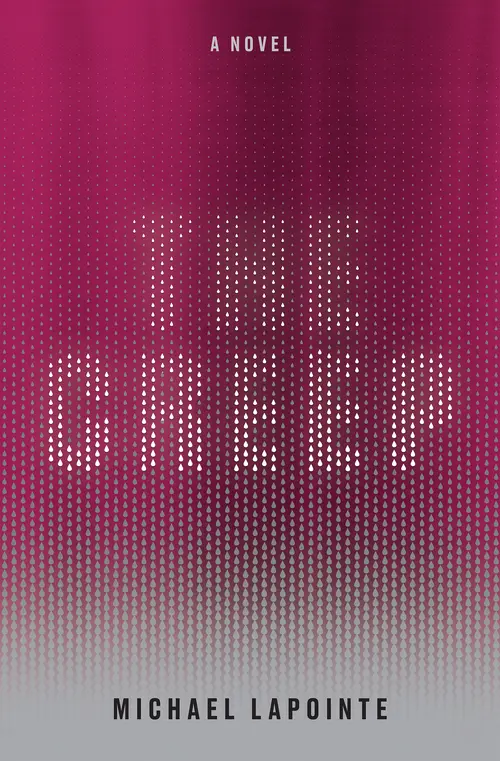
The Creep
Cover
THE BYSTANDER
1.
The girl from Vice stands at my office door. I left her no choice, she says. She tried calling, e-mailing. “Can we talk?”
I know she’s a novice by her posture of defiance. She’s worked herself up to this.
“I’m sorry,” I say, “I didn’t mean to leave you hanging. It’s been chaotic.” From behind my desk, I motion for her to come in. “Just close the door.”
The girl drops into the chair, cold cheeks flushed, snow melting in her hair. She’s maybe twenty-five. Without asking, she takes her iPhone out and starts recording.
“Sorry,” she says, catching herself. “It’s okay if I record?”
I nod and she roots through her tote bag for her notepad. By the time she produces it, scraggly white headphones pulled along, she’s out of breath and has to reset her focus. Then she takes out the heavy book and sets it on my desk: The Complete Bystander, 1999–2003. They’ve printed all thirty-three of the magazine’s issues to scale.
“Can I begin with a confession?” she says. “The Bystander was huge for me in high school, your work in particular.”
I loft a smile over the desk.
“In fact you’re one of the reasons I wanted to get into media.”
“How have you found it?”
“Obviously we’re living in a different time.” She glances quickly at her phone and then at me, at the bandage on my wrist. “Like Gordon Stone writes in the introduction, the Bystander was maybe the last magazine of its kind, the last to start up, I mean, and go all-in with print. What was the minimum rate, like, two-fifty a word? It feels like a million years ago.”
“How much are you getting for this?” I ask.
“One-fifty.”
“A word?”
“God no. A hundred-fifty bucks. It’s online only. I hope that’s okay.”
“Of course.” After a pause, I ask, “Do you regret becoming a journalist?”
“Every first of the month.” She laughs. “You get into it thinking you’ll have a life like your idols, but the economics have shifted. I guess that’s why so many people have gotten out.”
From my office at Diamond Communications, you can see the Hudson’s cobalt crawl between buildings. If you’d asked, when I was at the Bystander, what I’d be in fifteen years, I would’ve said editor-in-chief or even publisher, not some associate consultant. But it wasn’t money that drove me from the business.
“It’s funny, because we’re needed more than ever, don’t you think?” she says. “We have to sift the facts from the fiction.”
I nod in the direction of the book on the desk. “That’s what Mort Brewer always said.”
“It’s the truth, don’t you think?”
I wish I could talk about my years at the Bystander, my last in journalism, with such pride and self-importance, like some grand old dame of media. But I can only think of all the people I failed, all the dead.
The girl opens The Complete Bystander and begins asking about my pieces—profiles of John Malkovich and Madonna, reviews of Eyes Wide Shut and All About My Mother, a two-part essay on Napster.
“The Bystander seems like a golden age,” she says.
“It didn’t feel that way at the time.”
“Then take me back.”
I look at her phone. There would be room in there for everything, for the story I never wrote, the one I can never tell.
If I were being real with her, I’d begin with the bandage on my wrist. How on a night when I seemed nothing more than hair and fingernails and one cold skull, I’d sprawled on the couch with glass after glass, the untold dead pushing out. The glass dropped from my hand, it broke on the floor. I saw the shards on hardwood and chose one.
Then came the blood, and with it, a thought. It couldn’t happen like this. Slathering red over the screen, I managed to call 911.
And I would tell her about surfacing in the ambulance as they began the transfusion, how when I grasped what was happening, I yanked the IV from my arm. The medic lunged for the drip as it swung, dribbling blood.
They had to hold me down, there wasn’t much time. But by then I’d seen the color of the blood. It was red, it was fine.
2.
“The attacks were, for me, a personal catastrophe,” said Daniel Eastham. “Rogue Winter hit shelves that same morning. Do you think anyone bought novels on September 11?”
I glanced out the window at the snow falling over Brooklyn. You wouldn’t normally have been able to see the Towers from Eastham’s brownstone, but now there always seemed to be an absence in the sky. I’d arranged this interview months ago, but given the attacks, it had been put off to December. My first assignment back on the Bystander’s culture file, it was supposed to have been a coup. At thirty-seven, Eastham was the youngest, most adroitly aloof member of an exciting generation of New York novelists, and Rogue Winter, a 900-page postmodern comedy set several years in the future, was positioned to be his grand affirmation. But then, in just a single morning, it became clear that 2003 wouldn’t be like his version at all, the America he’d purported to capture had changed, and none of the jokes were funny anymore.
Eastham reached for his glass of red wine and said, “No one’s reading fiction right now, let alone author profiles.”
In the days immediately after the attacks, it had been all hands on deck at the magazine to cover the only story that mattered. With bridges and tunnels closed, we needed everyone on the streets reporting, including me, a culture writer. At first I panicked at the thought of asking people to describe what they’d seen, who was missing. I hadn’t done much hard reporting since my early days in Seattle. But once I entered the stream of events, I felt this other energy. The world around me crackled, true stories were everywhere. There was always someone rousing from their daze with a fresh account, using the presence of a journalist to reconstruct the catastrophe, pin it down with words. The pit still steaming downtown, I was a witness to history unadulterated.
I never got started with alcohol when I still had reading and writing to do, but Eastham poured more wine for himself and said, “Maybe a book like Rogue Winter has to be sacrificed for the Towers to be redeemed.”
I squinted at his overreach, but this is what people were capable of in their ill-fitting new sincerity. I understood the need to get serious. Ever since reporting on the attacks, I felt it every day at the Bystander. I wanted to get out of the culture file, into the rush.
“Please,” Eastham added, with a frightened glance at the recorder, “don’t print that.”
—
I went to the Bystander office in Chelsea to transcribe the tape and type up my notes. The freight elevator opened, and though it was late, I saw my colleagues still working to put the issue to bed before the winter holidays.
I greeted Ross Briggs, back from covering Enron in Houston, and Ben Hassan, making a rare cameo from his usual perch in Washington. I checked the window of Mort Brewer’s office and, as always, our editor was there, phone clenched between ear and shoulder, scribbling on a yellow legal pad.
In 1998, I first heard a rumor that Mort Brewer was leaving Harper’s to form a monthly magazine. He started giving interviews about the conglomerated state of media, singling out Rupert Murdoch’s greasy empire but not sparing Hearst and Condé Nast’s fine feelings. The media ecosystem was increasingly homogeneous, he said. It was time for a new, totally independent magazine.
He may have been on the back end of his career, but people listened to Mort. He’d trained half the journalists in New York at Columbia and given countless others their breaks, first at the Nation and later at Harper’s. His reputation was spotless. It was said he’d thrown Bob Bartley from the Wall Street Journal down a set of stairs at a party in the ’80s.
Mort’s name brought journalistic integrity, literary sophistication, and money. Donors wanted to be involved with a magazine that would compete with his former employers. It would be a New Economy insurgency. A dot-com entrepreneur provided start-up cash—his site was some kind of cut-rate jewelry retailer, I think—and when his fortune vaporized, a real estate magnate’s nephew stepped in. Now I know how precarious the magazine’s money was, but at the time, it seemed as if anything Mort wanted in New York was just a seductive phone call away.
I remember receiving one of those calls myself. At the time, I was freelancing as a culture writer. I was surprised that Mort called at all, and even more so when the venerable editor lauded my work not only in the New Republic and the Village Voice but also some old pieces for the Seattle Intelligencer, where I’d cut my teeth after college.
“The piece you wrote about the igloo,” he told me over the phone. “That was a breakthrough for you, wasn’t it?”
For a few months, the P-I had run a weekend series of personal memoir pieces. I’d seized the chance to run a little deeper than my usual work, frivolous city-life stuff—Nordstrom execs who played high-stakes Texas hold ’em, Midwestern tourists who came for Sleepless in Seattle–themed weddings—that the editors commissioned in a futile attempt to seem as cool as the Stranger and Seattle Weekly, the city’s alternative papers.
The memoir I wrote about the igloo inspired the best reception of anything I’d contributed to the P-I. Before that, my work profited off my easy generational access to a ’90s attitude my older bosses found mystifying, as if sarcasm were a confusing new technology that only young people could operate. But Mort was right. With the igloo, I dug deeper. Along with a few of my snappier clippings, it’s the piece I sent out when first trying to secure freelance work in New York.
“Thank you, Mr. Brewer.”
“Not to disparage your cultural writing,” he added. “That’s why I’m calling today. I intend to have the best culture file in the country, Whitney. I want you to think about writing for the Bystander.”
It was the first time I heard the name of the new magazine, and it instantly resonated. I attached myself to the word, like a logo.
If I was going to join Mort’s staff, however, I had to elevate my work. Over my first two years at the magazine, I’d never stopped seeking to impress him. As I sat at my desk that day in December and transcribed the Daniel Eastham interview, the author’s voice droning in my ears, I kept glancing over at Ross Briggs. His Enron piece was his second 12,000-word article of 2001. That’s what I wanted to do, something that mattered, not a profile of a soon-to-be-midlist novelist, as if I were just an extension of the publisher’s publicity arm. I wanted something to exceed what Mort expected of me, a story that would make him say, as he’d said about the igloo piece, “That’s when you reached a new level.”
3.
In the igloo, I went mute.
That’s how the story began in the Post-Intelligencer.
Mom never liked to talk about the accident, but over the years, I extracted enough from her to plug the gaps in my memory. By the time I wrote about it for the P-I, it was as if I remembered it myself.
When I was five, Mom and Dad took me to visit my grandparents in a Pittsburgh suburb over Christmas. Of the many cousins also visiting, I was the youngest, only barely tolerated in their group, which included some kids from the neighborhood. None of them could’ve been older than ten or eleven, but at age five, they seemed to me like the keepers of the secrets of adulthood. I allowed them to do what they liked with me: paint me like a clown, put me in goal to face slapshots, send me downhill on a trash can lid, it didn’t matter.
A few days before Christmas, my dad finally coaxed Mom away from the family to go to a bar in the city. He was always trying to get her to loosen up and quit organizing other people’s time. While my grandparents dozed by the TV, I followed my cousins to the front yard of one of the neighborhood kids. It was late afternoon. The dead stalks in the garden speared the crusted snow. The kid wanted to show off his igloo. At least that’s the word he used for a tunnel he’d burrowed into a tall snowbank that had been plowed off the street. He envisioned the igloo as a kind of clubhouse, but none of my cousins wanted to crawl into its cold black mouth. Whether I volunteered or was coerced, no one later confessed, and I don’t remember; there wasn’t any difference.
I see myself on hands and knees, wriggling into the hole, the attention of my cousins pushing me forward like a wind. In my purple snowsuit, it was a tight squeeze, but then the tunnel gave onto a shapeless cavern. The light of day faintly soaked the frozen walls, turning everything blue.
I lay on my stomach, I wrote, and pressed my cheek to the floor. It was soothing. I thought of the older kids, too afraid to follow. I had a glimmering sense of my courage.
And that’s when the roof fell in. A heavy rush, all the air clapped out of me, and then only dark, and weight.
Later, Dad’s family rallied around the cousins, protecting their version of events. The igloo simply collapsed, they said. One of my aunts went so far as to suggest I’d compromised the structure from within. But Mom said somebody must’ve gone up on the roof.
“Whitney!”
Very dimly, I remember someone shouting my name, how the sound struck my ears, warped by ice. I made no answer, dirty snow filled my mouth. I can taste the car exhaust, the rocks in my teeth.
“Whitney!”
My tongue went numb. I sucked the snow and swallowed, smothered, and that’s how it started. At the outer edge of perception, aged five, I knew I would die, that death was the name of this coldness and this darkness, and how good it was simply to lie there, let it happen—seep into the snow.
There came the circling sound of sirens. Adults had converged and were digging me out. Soon they uncovered my body and I was hoisted from the snow. It fell from my mouth.
Only when Mom and Dad got home tipsy and asked me what happened did anybody realize I hadn’t uttered a word since the accident. When they couldn’t coax me to speak, they took me to the ER, but there wasn’t any concussion, no problems with my chest or throat—just a blank where all my words had been.
You can see the change in photographs. Before the igloo, I seem energetic, natural. Unlike Mom, who always glanced away from the camera, as if the whites of her eyes were her most alluring feature, my tiny teeth shone, the blood-red orbs of my eyes open wide. But after, I look more like her, elusive, vague, as if the shutter always snapped at the moment I moved, blurring my face.
I stayed mute almost a year. I’ve asked myself a million times and still have no explanation. Or rather, I have too many—a crowd of expert opinions. Mom’s solution was to entrust me to science. She took me to speech therapists, art therapists, play therapists, and surely this was when I acquired the basic skills of my career, as I lay waiting behind the mask of my face, observing each attempt to explain me. It was guilt for having caused so much fear. No, it was a desire to punish my parents for neglect. No again, it was an anxious reaction to my mother’s expectations. No—
The sessions exhausted and confused me and didn’t change anything. Mom was disappointed, and I remember the disappointment being trained on me, as if I weren’t cooperating with the experts, as if I didn’t want to get better. She’d lose all patience and start pleading, furious: “Say something, anything—Whitney, make a sound.”
Dad would shelter me, that’s what I remember. When Mom wasn’t around, he’d ridicule the experts. It’s okay, he’d tell me, just hang in there, take your time. There wasn’t much worth saying anyway. As if to prove it, he began speaking to me in plain sound, subverbal, like a crude clay from which words were shaped. He’d make monkey talk in the grocery store or at the public pool, frustrating my mother, who found this whole approach unproductive. But I loved my constant jabbering companion—he made me comfortable being in the world. Sometimes he’d just hold me, his breath on my neck, muttering in our private language.
It seemed like nothing could unfreeze my tongue—not until the day at the hospital. Dad had always been a healthy, active man. He’d jog in the morning, play hockey in Burbank, dribble basketballs between my legs, a blood clot worming toward his heart.
He survived a few days after the attack, unresponsive in a hospital bed. Mom told me later that she debated bringing me to see him, but the doctors thought it might be worthwhile. I was told to put on my best black shoes, with the little gold buckles, and then Mom drove me to the hospital.
In the room, her hands on my shoulders, we approached the bed. I don’t recall any tubes or machines, just his open eyes, the face of my companion. That’s when I began to speak, softly at first, then louder—nonsense words, primordial sounds—Mom’s hands springing off my shoulders. Thinking I was having a fit, she rushed me from the room. I never spoke to him again.
—
As I wrote in the P-I, in the piece Mort liked so much, I’ve come to believe that whatever voice I developed—whatever readers heard as their eyes moved over my words—carried forward from the hospital, when I reinvented speech from scratch.
But there’s something else I didn’t write, something I could never admit.
I wasn’t the girl I’d been before, the girl who crawled into the igloo. Mom observed it first, a certain mischief on my tongue, a tendency to elaborate and embellish.
About a year after the hospital, a teacher called my house to report an obvious lie I’d told in class, something about witnessing a bank robbery downtown, an image off TV. Once I’d spoken the words, they seemed as good as memory. I loved everybody’s reaction. Suddenly my classmates wanted to get close to me, near to the source of excitement. It was the seriousness with which I told the lie that apparently troubled my teacher. I overheard Mom explain to her on the phone, “It’s a way she has, a creep toward fabrication.”
That’s what I came to call it, the creep, as if an unwelcome visitor were playing with my tongue.
It was only when I followed this passion for storytelling into journalism that I realized the scope of my problem. With excruciating clarity, I remember a professor at USC calling me into her office one day in junior year. My most recent assignment was on her desk. I’d written about a drunk driving accident involving some students. They’d survived, but the accident had sparked a broader discussion about the severity of campus drinking. The classmates I’d shown the assignment to all agreed I’d captured the terror of being in that car as the driver lost control.
“Heck of a story,” said the professor.
“Thanks.”
“So good, in fact, that I circled back on some of your reporting—like the minutes before the crash, and who said what, and when.”
She slid the paper across her desk. It was streaked with red lines, the creep diagrammed.
“You can see where this is going,” she added.
I had no words.
She got up and closed the door behind me, then sat down again. “What happened?”
My instinct was to spin another lie around the lie, but with a gulp, something cleared, and I broke. At first I covered my face. I’d heard Mom talk about crying students and assumed my professor would react with similar scorn, leaving me stranded with my weakness. But to my surprise, the professor came around the desk, kneeled in front of me, and held my hands.
“It’s okay,” she said, very softly. “Take your time.”
I looked down at my hands, her thumbs stroking my skin.
“That’s not me,” I said. “I promise, that’s not me.”
I still wonder what my life would be like if she hadn’t given me another chance.
The professor quietly placed me on academic probation, and I finished my time at USC actively fighting what had become an automatic, invisible force. From a certain viewpoint, my work declined—classmates weren’t amazed by my stories anymore, nobody was drawn to be near me—but I was writing solid, factual journalism. It was a start.
After my confession in her office, the professor took me under her wing, and when I graduated, it was she who recommended me for the internship in Seattle.
The Story Continues on BooksBarbecue!
Enjoyed this preview? ❤️ Do not stop here!
Read the complete book free online → 🔗
Continue reading now on BooksBarbecue and discover every page!
Love reading? Bookmark BooksBarbecue.com for more amazing books!
Happy Reading!