The Counterfeit Candidate
First published by Level Best Books 2021
Copyright © 2021 by Brian Klein
All rights reserved. No part of this publication may be reproduced, stored or transmitted in any form or by any means, electronic, mechanical, photocopying, recording, scanning, or otherwise without written permission from the publisher. It is illegal to copy this book, post it to a website, or distribute it by any other means without permission.
This novel is entirely a work of fiction. The names, characters and incidents portrayed in it are the work of the author's imagination. Any resemblance to actual persons, living or dead, events or localities is entirely coincidental.
Brian Klein asserts the moral right to be identified as the author of this work.
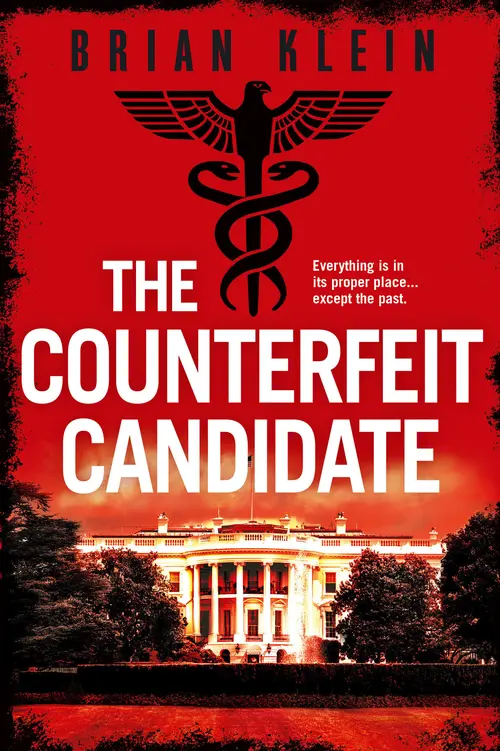
Cover photo credit: Colin Dewar/Shutterstock.com
First edition
ISBN: 978-1-953789-48-8
This book was professionally typeset on Reedsy
Find out more at reedsy.com

For Charmaine and Jessica.
My first readers, greatest supporters
and loves of my life.
Prologue
According to accepted twentieth century history, on 30 April 1945, Adolf Hitler and Eva Braun said their final goodbyes to a small group of close friends and colleagues who’d gathered in a sitting room, deep inside the underground bunker in Berlin. The pair retired to the Führer’s personal study where, a few hours later, they took their own lives. Braun bit down on a wafer-thin glass cyanide ampoule and Hitler shot himself in the right temple, using his own Walther PPK pistol. The bodies were then carried above ground, via the bunker’s emergency exit, and buried in the Reich Chancellery Garden, after being doused in petrol and set alight.
Thirty-six hours earlier, the couple had married in a simple ceremony, where they declared they were of pure Aryan descent and free of hereditary disease. The only witnesses were the Minister of Propaganda Joseph Goebbels, Hitler’s private secretary Martin Bormann and his personal valet, Heinz Linge. The service was followed by a modest lunch of spaghetti in tomato sauce, one of the Führer’s favourite meals, prepared by his personal chef, Constanze Manziarly.
Hitler was dressed in full Nazi uniform and Braun wore a calf-length black dress, broken up by a print of small white roses around the neckline. The Führer then dictated his last will and testament in which he declared he chose “death over capitulation” and left his vast personal fortune to the Nazi Party.
Three months after the Nazi regime declared unconditional surrender, the victorious political leaders met in the German city of Potsdam, just outside Berlin, for a post-war conference to discuss the new order in Europe. On 17 July 1945, Stalin and Truman sat down for an intimate lunch in one of the small banqueting suites inside the spectacular Cecilienhof Palace. The only people present were their respective foreign secretaries, Molotov and Byrnes, who acted as translators. Truman was astonished when Stalin disclosed that rumours of the discovery of Hitler and Braun’s bodies were fabricated and that a painstaking search by his Red Army soldiers of the Reich Chancellery grounds had failed to discover any sign of the Führer’s remains. Stalin was convinced Hitler had escaped his clutches.
Chapter One
6 January 2012
Buenos Aires
The tunnel was almost finished. It had taken three hugely determined men eight months to construct and ran straight from the basement of the Café Torino directly underneath the safe depository of the Banco Estero. The eminent bank was one of the oldest in Argentina and stood, imperiously, on Avenida Cabildo, deep in the heart of the fashionable Belgrano district of Buenos Aires in the north-east of the city. The hundred-foot tunnel had state-of-the-art ventilation, sensor-activated lighting and pure wool carpet flooring. The enormous underground structure was a magnificent feat of engineering. The small gang had worked every night and weekend for eight months and between them had moved over four thousand five hundred cubic feet of dirt, making nearly three thousand wheelbarrow trips.
Pedro García rested the drill by the side of the newly formed earth wall. He stopped chewing, carefully removed the gum from his mouth and stared up at the twelve-inch-thick concrete ceiling, appreciating they had finally reached the floor of the depository. Pedro allowed himself a rare smile as he stroked his straggly salt-and-pepper beard. He hadn’t shaved since the very first day the drilling had begun.
“Guys, this is it. We are standing directly underneath twelve hundred beautiful boxes and only God knows what’s inside them.”
One of his two comrades leapt across the shagpile carpet and bear-hugged his leader. “I’ll tell you what’s in them – new lives for all of us.” Ricardo Gonzales was the youngest of the three robbers and by far the most impetuous. “Pedro, you said we would do it and we have. I love you, old man.”
Ricardo was a stunning hulk of a man. He stood six foot six in his bare feet and his body was honed to within an inch of its life. When he wasn’t digging tunnels, he was working out seven days a week in his local gym and had done far more than his fair share when it came to heaving wheelbarrows full of dry earth.
The third man shook his head slowly. “Ricky, it’s not done yet. Nothing is done until we are lying on a beach somewhere faraway, with more money than we know what to do with.”
At sixty-three, Sebastian Ramos was the oldest of the three and by far the most cautious. He’d spent two long spells inside the notorious Caseros Prison, in the south district of the city, for robbery and firearms offences and that meant this job was his last roll of the dice.
Pedro picked up the power drill and started to walk back down the tunnel. “It’s 6 a.m. The world above us is waking up. Right now, we rest and at midnight we start the final drilling and then we have the whole weekend to enjoy those boxes.”
Pedro was a patient man. He’d been planning the job for over ten years. The financial crisis that hit Argentina in 2001 had been brutal. It had wiped out his meagre life savings, just as it had for millions of his fellow countrymen. The trigger for the economic meltdown had been a catastrophic run on the banks as people perceived they weren’t holding enough cash to cover their deposits. The public lost confidence in the banking system and chose to keep their cash and valuables at home or open safe-deposit boxes. Ten years after the crash, there were over five hundred thousand boxes being rented from banks. One for every eighty residents: a staggering ratio.
Pedro was one of them, but his box, located in the vault of the Banco Estero, was different from the rest. It was permanently empty.
He’d opened it in January 2009 and had made regular visits to the bank on the first Monday of every month. Over time, he’d memorised the internal layout of the vault and had mapped the exact positions of the twelve hundred boxes. The living room walls inside his tiny one-bed flat were covered with large hand-drawn designs. They displayed the layout of the boxes inside the vault and were colour-coded, depending on their size. Pedro knew that, even with a clear run of forty-eight hours over a quiet weekend, there wouldn’t be enough time to drill open all the boxes. He calculated that three men, working as a team, could manage roughly ten per cent, so that meant targeting the biggest ones, of which there were one hundred and twenty.
Pedro was a former soldier who’d left school at eighteen and served for seven years in the First Tank Calvary Regiment as a mechanic. Once he left the army, he’d landed a job as a heating and air-conditioning engineer and those skills proved to be invaluable when it came to constructing the ventilation system required for a hundred-foot tunnel.
In March 2011, the lease for a rundown café came up for sale in the Belgrano District and Pedro was the only person who showed any interest in acquiring it. Café Torino had first opened its doors in the mid-eighties and, twenty years later, had gone out of business, a casualty of trendier fast-food outlets that had sprung up around it. It may not have had any clientele or appeal to potential buyers but, for Pedro, its positioning was perfect. It was located just two buildings away from the Banco Estero. He only had enough money to cover the lease payments for twelve months, but knew he only needed eight to build the tunnel. Two weeks after he took it over, he plastered the two front windows with old newspaper so no one could see inside. A handwritten sign on the door simply said, Café Torino is being renovated and will reopen soon.
Once Pedro secured the café, he set about recruiting two associates. Although he had no personal background in crime, he knew exactly where to go. His first cousin, Sebastian Ramos, was a serial criminal whose signature crime was house robbery. He knew Sebastian had been caught and convicted on two occasions during the last thirty years but had successfully completed well over a hundred robberies. That gave him a ninety-eight per cent success rate, which was good enough for Pedro.
Ramos recruited the third member of the team, Ricardo Gonzales. He was a plasterer and small-time criminal who was literally built like an ox. And he worked like one too. Initially, for two months, the three men met up after work every Monday, Wednesday and Friday night. The meetings took place inside the deserted café, where they devoured Pedro’s home-made chilli and planned every step of the heist. Using a fake account, Pedro bought all the equipment and materials they needed on eBay and the purchases were delivered to the rear entrance of the café. The single most expensive item he sourced was a second-hand earth drill boring kit, normally used for excavating driveways.
At precisely midnight on Monday, 23 May 2011, the drilling began and continued every weekday night and weekend for the following eight months. Once a week, in the early hours, the freshly excavated earth was placed into large cloth bags, loaded onto a lorry and driven south out of the city to the Pinar del Norte forest where it was carefully dumped. The mining work was draining and relentless, but the three men grew to love their daily routine and finally, after many gruelling months, the tunnel was complete.
Ricardo only needed about forty minutes to drill through the concrete floor and, when he had finished, he’d created a hole about four feet wide. Pedro peered up into the murky darkness that seeped through the newly created opening.
“Guys, time is our only enemy now. Let’s get the lighting up there and then hit the shit out of those boxes. Remember, we only go for the ones on the list.”
Sebastian switched on a huge LED torch and climbed on top of Ricardo’s shoulders, a move they had practised dozens of times in the café. “Okay, big man, here we go.”
Fifteen minutes later, all three men were standing inside the giant vault, now illuminated by six 800 watt HMI movie lights on stands, cabled back through the tunnel to a small generator, which sat on the floor of the café.
All of them wore plastic monkey masks due to the six CCTV cameras inside the vault, which were now recording their every move. The cameras were only monitored live when the bank was open, so didn’t pose an immediate threat. Pedro had memorised the camera positions from his monthly visits to his empty box. A box that wasn’t on their hit list.
Over the next fifty-three hours, the three men worked tirelessly, without a break, meticulously drilling through the dual locks that protected every individual box. This was a tricky and tedious process, requiring finesse rather than brute force. Each time a box was opened, its contents were emptied into large, unmarked cloth bags. The haul was spectacular: government blue-chip bonds from over twenty countries and huge quantities of US dollars, euros, English pounds and Argentinian pesos. One box alone held twenty solid gold bars while others were crammed with jewellery, designer watches and hundreds of loose gemstones.
None of the men paid any attention to a battered black leather case that was tightly jammed inside Box 1321. Its contents included three large brown Manila files, two 8mm film cans and a small tobacco tin, containing a collection of ancient military medals.
Most of the time, they behaved exactly as they had rehearsed for the last ten months. All three of them knew their job descriptions inside out, part of which meant no talking.
“Shit, Pedro, look at the size of these beauties!” Ricardo was the first to break the vow of silence. In the palm of one of his clawlike hands he held a loose pile of enormous uncut diamonds, the smallest of which weighed at least ten carats.
Sebastian was busy pouring massive wads of US dollars into one of the bags but stopped for a moment to look up. “That’s a million dollars you’re holding right there, Ricky. Who are the bastards who own all this stuff?”
Pedro remained the calmest of the three. “It doesn’t matter. We own it now. No more talking until we are out of here.”
The deadline for leaving had been set for five in the morning, two hours before the bank was due to reopen.
At four forty-five, the three men stood beside the large hole in the floor of the dilapidated kitchen of the café. None of them had slept for two days and they were running on pure adrenalin. Pedro called time on the job.
“We’ve hit ninety of the one hundred and twenty boxes on our list. I’m guessing we’ve landed well over a hundred million dollars. The lorry is bulging, so I suggest we get the hell out of here.”
Sebastian took a long drag on his Marlboro, the first cigarette he’d smoked in two days. “Cousin, we’ve filled our boots, so it’s time to say goodbye to the Café Torino.”
Pedro turned to Ricardo, who was holding the van keys in his right hand. “Let’s go, and, Ricky, drive carefully. We don’t want to get pulled over by the police.”
Two hours after the bank raid was discovered, a phone call was placed on an encrypted line from an office in Buenos Aires to an impressive skyscraper block six thousand miles away in downtown San Francisco.
Richard Franklin, CEO of the Franklin Pharmaceutical Corporation, reached for the receiver of the red phone on his desk that hadn’t rung for over two years. There was only one person in the world who had the number.
“What’s up, Matias?”
There was a short pause on the line as the caller gathered his thoughts. Then, a cold, heavily accented voice broke the silence. “Señor Franklin, Box 1321 has been stolen in a bank heist that took place over the weekend. We will, of course, focus our entire resource into recovering it as soon as possible.”
The line went dead.
Chapter Two
9 January 2012
Buenos Aires
Chief Inspector Nicolas Vargas of the Buenos Aires Police Department stood in the middle of the safe depository, surveying the wreckage. He had already made a return trip through the hundred-foot tunnel, connecting the bank to the café, so he knew exactly how the thieves had pulled off the most daring robbery of the decade. He bent down and carefully picked up one of the ninety broken boxes that were strewn across the floor of the vault.
At forty, Vargas was one of the youngest and brightest chief inspectors on the city force. He was an impressive looking man. His six-foot-two frame and boyish film-star looks were complemented by a natural charisma that matched his physical attributes. Three years earlier, his life had been brutally derailed by a personal tragedy and, ever since, his mental energies had been focused entirely on his work. This intriguing, high-profile robbery was a welcome new distraction. He placed the box back on the floor and turned to Marcelo Morales, the general manager of the bank.
“Interesting M.O. The drilling on each lock is remarkably neat and precise and, by the look of things, they only targeted the largest boxes. Do we know exactly how many they hit?”
Morales was clearly in shock, still taking in the enormity of what had happened and the severe implications for both the bank and his career. In contrast to Vargas, he was short and rotund, his expanding waistline a casualty of too many client lunches at some of the city’s finest restaurants. It had taken him a lifetime to work his way up to the top of the tree, having started as a bank teller twenty-five years before, and he had no intention of being forced into early retirement. Morales nervously adjusted the waistcoat of his three-piece linen suit and slowly ran his hand through his thinning grey hair. His heavy jowls wobbled as he spoke. The man was a bag of nerves.
“We make it ninety and you are correct, inspector, they only went after the elite boxes.”
Vargas was now peering down the black hole that had been gouged out of the concrete floor. “These guys ran this like a military operation. The tunnel must have taken months to complete and it seems they took the lease out on the café last March. This job was a long time in the making.” Vargas paused for a few moments before continuing. “Señor Morales, I want the names and contacts for every box owner in the vault, regardless of whether their boxes were broken into or not. I’m particularly interested in anyone who rented one in the last twelve months. Also, we’ll need the footage from the monitoring cameras in here.”
Morales made copious notes in his diary before replying. “Of course, inspector. All the cameras record onto a massive hard drive, so you can take it away today. Unfortunately, the interior vault cameras don’t transmit through to our exterior monitoring operation and are only viewed internally when the bank is open. I’ll email you the owner list in the next hour.”
Vargas gestured to his colleague, Juan Torres, who’d been listening to the conversation between his boss and the bank manager. “Detective Torres will stay behind to collect the drive and I’d also like you to provide him with a list of any owners who have visited their boxes in the last year.”
Morales acknowledged Torres and turned back to face Vargas. “Inspector, obviously there are some very notable people who use our service, so I would ask you to use extreme discretion if you decide to contact any of them directly.”
Vargas nodded. “By the way, Señor Morales, did you ever frequent Café Torino?”
The bank manager gave a wry smile. “Regularly. I’m a creature of habit. Every morning, on my way to the bank, I would stop off for a cappuccino and a croissant. It was terribly run down but very authentic and I was quite upset when the owners went bust. It has a sign on the door saying it is being renovated and, ironically, I’ve been looking forward to it reopening.”
Chapter Three
9 January 2012
Buenos Aires
Theodor Consultants was founded in 1981 and, thirty-one years on, had established itself as one of the most respected private security companies in Buenos Aires. Its sprawling offices were located in the heart of the city, directly opposite the famed Recoleta Cemetery, arguably the most beautiful burial ground in the world and the resting place of Eva Perón, as well as other prominent Argentinians.
The CEO and founder of the company was Matias Paz. A former mercenary and lifelong fascist, Paz cut a truly intimidating figure. Although he was in his late fifties, he didn’t carry an ounce of fat on his body and his slicked back, dyed jet-black hair, with its Dracula-style widow’s peak, helped create the striking appearance of a much younger man who always looked immaculate in his high-end black Italian suits, American Pima cotton shirts and hand-stitched leather brogues. His employees called him the “Black Scorpion” due to the intimidating contents of a large glass terrarium that sat prominently on his office desk. It housed two glossy black-skinned emperor scorpions, which thrived on a daily diet of live crickets, locusts and mealworms. It was a nickname Paz pretended to be unaware of, but secretly relished.
Paz often spent hours walking through the fourteen-acre grounds of the graveyard, especially when he needed time to think. Recoleta Cemetery contained over six thousand grandiose mausoleums in an eclectic mix of architectural styles, including art deco, neo-Gothic and baroque. He always ended his walk sitting on a stone bench opposite a vault containing the body of one of his country’s greatest ever boxers, Luis Ángel Firpo. After the boxer’s death in 1960, he was buried in a relatively modest mausoleum but a stunning full-sized bronze statue stood outside its entrance. Paz idolised Firpo, who was regarded as one of the greatest punchers of all time and was known by millions of boxing fans across Argentina, affectionately, as “The Wild Bull of the Pampas”.
Today was one of those days when Paz needed some precious thinking time, as he urgently had to find a quick solution to placate the concerns of his most valuable client. Richard Franklin, the CEO of the Franklin Pharmaceutical Corporation, covertly owned seventy-five per cent of Theodor Consultants, having been instrumental in founding it thirty years earlier. Paz knew Franklin had the power to shut his beloved company down at any moment and wouldn’t think twice about it, if he deemed it necessary.
Paz had to use every resource at his disposal to locate the contents of Box 1321 before they were discovered by the thieves. He knew they were potentially worth far more than the jewels, cash and gold contained in the other stolen boxes. He flicked through the contacts on his iPhone and dialled his long-time assistant, Luciano Herrera. The phone answered after just one ring.
The Story Continues on BooksBarbecue!
Enjoyed this preview? ❤️ Do not stop here!
Read the complete book free online → 🔗
Continue reading now on BooksBarbecue and discover every page!
Love reading? Bookmark BooksBarbecue.com for more amazing books!
Happy Reading!