Chapters (35)
“Okay,” he said. “There was this physicist named Wilson who got the idea of building some kind of apparatus that would make it so we could see these cosmic rays, and other actual atomic particles, with the human eye. He constructed this sealed chamber to contain a supersaturated atmosphere of air and water, or alcohol vapor. The idea was that the vapor would condense in the form of tiny visible droplets. If there really were charged ions passing through the atmosphere of the chamber, like he thought, the droplets would attach themselves to the ions. The cloud chamber would make radiation visible. Inside the supersaturated container you’d be able to see the paths the ions made, like a vapor trail.”
“And it worked?”
Nate was studying one of the books they had open on the table. “In 1927, Wilson won the Nobel Prize for inventing the cloud chamber,” he said. “And I bet we could build one here.”
Naomi didn’t say, What’s the big deal? but he knew that she didn’t fully get the significance, either—that seeing cosmic rays was not the same as seeing something like steam from a tea kettle or hailstones on a hay field.
“The thing that’s so amazing,” he said, “is knowing where the rays have come from.”
“And where is that?”
“The far reaches of the universe. Light-years away.”
Naomi was quiet.
“The first time me and my dad read about this project, I was only nine or ten, and he said it was too tricky,” Nate went on. “But now I think we can handle it.”
Not that Naomi was likely to be much help. Still, if they could pull it off, Nate thought, it would be pretty cool. The others would be standing around with their dumb papier-mâché volcanoes and scraggly bean plants—Larry and Pauline and Kirk and Travis and Linda and the rest of them—and there they’d be with this box full of actual, visible radioactive ions.
Bent over the table in the reference room, Nate drew Naomi a diagram of the box they’d need to construct. It would have four glass walls, tightly sealed—like an aquarium, basically, but not as high on the sides—to keep the vapors from getting spread out. They’d set the box on top of a piece of dry ice.
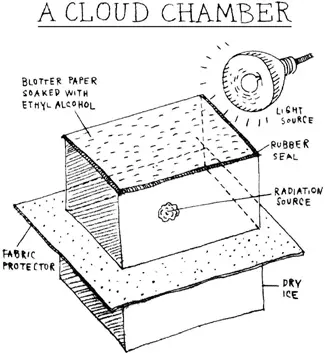
There’d need to be a piece of some absorbent material lining the top of the chamber—felt or blotting paper— soaked with ethyl alcohol, which, when chilled by the dry ice, would create a swirling, cloudlike mist inside the box. Then they’d shine a strong beam of light into the cloud chamber and watch for the rays to show up. If they were lucky, they might even get a photograph, like the one in the magazine.