Chapters (31)
- Publisher's Note
- Acknowledgments
- Epigraph
- Photo
- Epigraph
- Would You Buy a Used Galaxy From This Man?
- Introductory Essay
- Author's Note
- Perils of the "City"
- Endnotes
- Treatments
- March 21, 1966
- May 13, 1966
- Prologue
- Act One
- Act Two
- Act Three
- Act Four
- Epilogue
- Appendix
- Act One
- Afterwords
- WHO ARE THESE PEOPLE AND WHY ARE THEY IN THIS BOOK...
- Peter David
- D.C. Fontana
- David Gerrold
- DeForest Kelley
- Walter Koenig
- Leonard Nimoy
- Melinda M. Snodgrass
- George Takei
I won’t even go into my feelings about Mr. Alexander actually trying, in a court of law, to be named “official biographer” so no one else—including Joel Engel, who wrote that other, warts-and-all Roddenberry biobook—would be able to contradict the Martinized version Majel had hired Alexander to write. (March 17, 1994; Case #SP 000 741; Superior Court of the State of California, in and for the County of Los Angeles.)
But what I would like to dwell on for a moment, because it is so goddam ludicrous and bogus that I can’t even get pissed at it, all I can do is shake my head in dumbfounded disbelief at the bodacious chutzpah of Roddenberry and those who spent their time sucking up to him, is a little number Mr. Alexander and El Supremo ran in an interview in The Humanist (March/April 1991; Volume 51, Number 2).
Now remember, folks, before we tumble down this weird little rabbit hole into Roddenberryland, that nothing of the story or characters in “City” existed before I wildly dreamed up the plot and presented it to Star Trek. It was all outta my head, y’ know what I’m saying here?
But in The Humanist Interview titled “Gene Roddenberry: Writer, Producer, Philosopher, Humanist” by David Alexander, we find the eye-opening exchange reproduced here.
Alexander suggests to Roddenberry that Sister Edith Keeler, a character I created, and whom I based on the famous Aimee Semple McPherson, an historically-prominent evangelist of the 1920s and ’30s, was actually Roddenberry’s brainstorm, based on his father, whom he speaks of admiringly. (I won’t reprise what other books about Roddenberry have said in relation to the Great Bird and his father, and how Bird felt about the old man, and what their relationship was. I am sworn not to get into Roddenberry’s personal life here, for which pledge I am infinitely grateful.)
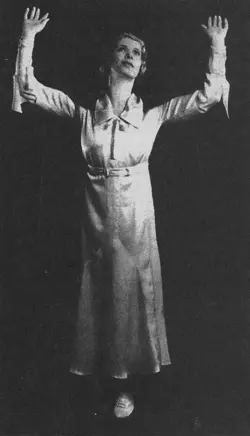
Above: Flamboyant Pentecostal preacher "Sister" Aimee Semple McPherson (1890-1944) was the first evangelist to recognize the potential of radio to reach a vast "congregation" (Library of Congress)
Now, doesn’t that absolutely fry the fish, folks! Don’t it just warm that illegitimate corner of all our hearts in which lies the most corrosive, mendacious beast of self-aggrandizement we can imagine?
Not only was the miserable, lying sonofabitch shameless in trying to grab credit for having written the script, he was not above tacitly acquiescing to the suggestion that it was all his own invention, right from the git-go.
Was I infuriated when one of my readers sent me that steaming Alexandrian turd? No, of course not. I am a sensible, rational person, ready to accept the fallaciousness of the existence of Santa Claus, the Tooth Fairy, and the ability of my poor, stunted brain to create a character so fully-formed and coherent that even now when she goes out on the book-signing circuit, Joan Collins is asked repeatedly about Sister Edith Keeler.
Which brings me to a beauty.
And I don’t mean Collins.