Chapters (31)
- Publisher's Note
- Acknowledgments
- Epigraph
- Photo
- Epigraph
- Would You Buy a Used Galaxy From This Man?
- Introductory Essay
- Author's Note
- Perils of the "City"
- Endnotes
- Treatments
- March 21, 1966
- May 13, 1966
- Prologue
- Act One
- Act Two
- Act Three
- Act Four
- Epilogue
- Appendix
- Act One
- Afterwords
- WHO ARE THESE PEOPLE AND WHY ARE THEY IN THIS BOOK...
- Peter David
- D.C. Fontana
- David Gerrold
- DeForest Kelley
- Walter Koenig
- Leonard Nimoy
- Melinda M. Snodgrass
- George Takei
Maybe now is the moment to suggest you leap ahead and actually read “The City on the Edge of Forever,” as it was originally conceived. Perhaps you’ll still like that abortive aired version, and perhaps you’ll understand why I was so pissed at the way Roddenberry and his minions screwed over my script. And then, if you feel like it, you can go on past the first draft teleplay and read my revised second draft, in which I had even eliminated the Beckwith-LeBeque element, and gave Gene a reasonable way in which Dr. McCoy could have run amuck.
That was one of five rewrites, without pay, that I did to try and retain the integrity of the story. But no, Gene preferred having an accomplished ship’s surgeon act in such a boneheaded manner that he injects himself with a deadly drug!
Yeah, sure, you were a sensational plotter and writer, Gene; and you can schvitz roses with Lysol to make ’em grow!
Such bullshit. Such never-ceasing, unapologetic, unabashed crapola. And this 1987 version of El Supremo’s inability to tell the truth was hardly the first instance, nor was it the last.
“He had my Scotty selling drugs…”
Geezus bleeding Kee-rist on a crutch! Scotty doesn’t even appear in the goddam script!
But it was a very different matter less than two months before the episode aired. According to Roddenberry in later years, I was persona non grata, a misfit who had cost the show a fortune. But on February 27th, 1967—a mere forty-five days before broadcast—the man who would lie about my ability and my creation for almost three decades sent me this telegram:
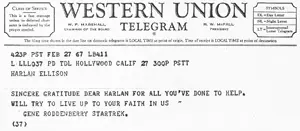
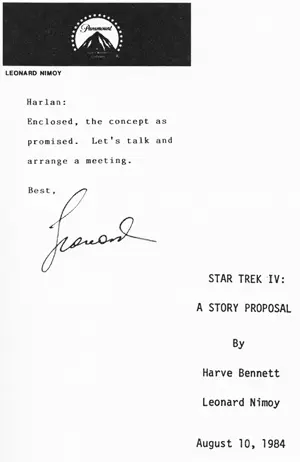
But Gene spread his goo so eloquently, and the stone righteous Trek zombies slipped and slid in it with so much élan, that in later years it was like a Greek Chorus from anyone who needed to explain why I hadn’t been writing anything for feature films or the series. Like, uh, here…a case in point. To be enjoyed after glomming the Paramount note attached to the cover sheet of the original story proposal for Star Trek IV, sent to me in December of 1984 by then Producer Harve Bennett, and Leonard Nimoy. (Please remember, as you read this anecdote, that you have seen me invited to talk about writing #IV, as the anecdote mentions #V)
In the 4 June 1989 Arts & Leisure section of the New York Times, appeared an article written—but not headlined—by Robert F. Moss, itchily titled “To Sci-Fi Writers Hollywood is Mostly Alien.” It is a longish piece purporting to explain the reasons “recognized” sf writers have not been more often hired to script sf/fantasy films.