The Christmas Egg
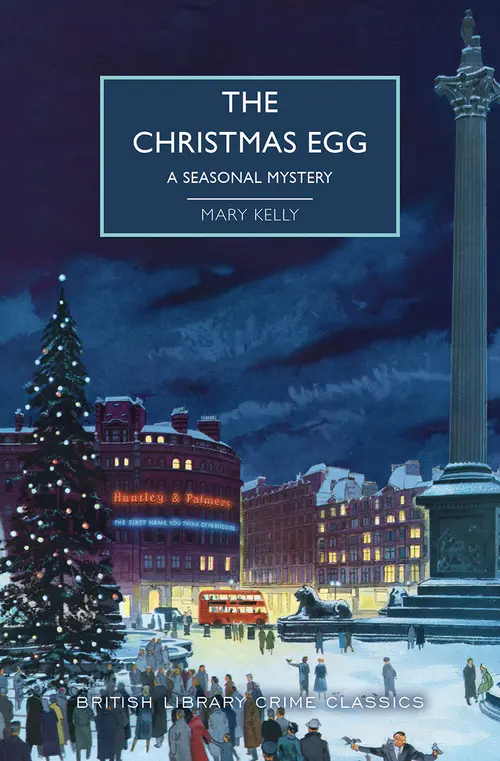
Front Cover
Title Page
Copyright
Introduction © 2020 by Martin Edwards
Copyright © 1958 by Mary Kelly
Cover and internal design © 2020 by Sourcebooks
Cover illustration © by Mary Evans Picture Library
Sourcebooks, Poisoned Pen Press, and the colophon are registered trademarks of Sourcebooks.
All rights reserved. No part of this book may be reproduced in any form or by any electronic or mechanical means including information storage and retrieval systems—except in the case of brief quotations embodied in critical articles or reviews—without permission in writing from its publisher, Sourcebooks.
The characters and events portrayed in this book are fictitious or are used fictitiously. Any similarity to real persons, living or dead, is purely coincidental and not intended by the author.
Published by Poisoned Pen Press, an imprint of Sourcebooks, in association with the British Library
P.O. Box 4410, Naperville, Illinois 60567-4410
(630) 961-3900
sourcebooks.com
Originally published as The Christmas Egg in 1958 in England by Secker and Warburg, London.
Library of Congress Cataloging-in-Publication Data is on file with the publisher.
Contents
Front Cover
Title Page
Copyright
Introduction
Part One
Part Two
Part Three
Back Cover
Introduction
The Christmas Egg, first published in 1958, is an unconventional Christmas crime novel by an unconventional writer. Mary Kelly was one of the most talented British novelists to write crime fiction in the post-war era, coming to the fore just before P.D. James and Ruth Rendell appeared on the scene. Having risen rapidly to the heights, she abandoned the genre after publishing a mere ten books over a span of eighteen years. Her disappearance from the scene was as mysterious as it was complete; she did not publish a novel after 1974, even though she lived until 2017.
This was her third book. Like its predecessors, A Cold Coming and Dead Man’s Riddle, it featured Detective Chief Inspector Brett Nightingale. In the run-up to Christmas, he is confronted by the puzzle of the death of the elderly Princess Olga Karukhina, who had fled her native Russia in the wake of the Revolution. But this is not an elaborate whodunit in the tradition of Agatha Christie or Dorothy L. Sayers. Nor is it a police procedural novel of the kind that John Creasey had popularised in the 1950s. Kelly’s principal focus is on the study of character and on the idiosyncrasies of British society.
The idea for the story came to her after she was sent, in error, a set of books about Russia to review. The books were meant to be sent to Marie-Noelle Kelly, and this prompted Mary Kelly to read the work of her not-quite-namesake. This in turn led her to attend an auction of Fabergé eggs. Her knowledge of Islington, an important setting in the story, came from evening walks in the neighbourhood after she and her husband had visited the opera at Sadlers Wells.