The Center of Everything
Cover
Praise for The Center of Everything
“This gorgeous novel is well worth your time.”
—People
“[A] wonderful cast of interesting characters . . . And it is really the way Polly thinks—about her children and her childhood, her memories and imaginings, her immediate circumstances and her place in the world, even the toothsome dishes she prepares (with occasional lapses lately)—that makes this book so engaging . . . Carrying us along, Polly conjures a richly textured, often lovely life of everyday loss and longing and endless speculation, where ‘everything goes missing but everything lives on, at least for a while, in the small kingdom of your head.’ Indeed, Harrison’s novel takes the unreliable narrator to a whole new place: in short, to the center of everything.”
—Ellen Akins, The Washington Post
“A meticulously crafted, graceful novel.”
—O, The Oprah Magazine
“Gorgeous . . . Harrison’s writing is as lush as the landscapes themselves . . . Harrison’s writing shimmers like light-sparkled water.”
—Caroline Leavitt, San Francisco Chronicle
“Between Polly’s fragmented thoughts and Harrison’s rich descriptions of the wild beauty of Montana, The Center of Everything does have a dreamlike quality. Still, its reflections on complex family relationships, the occasional unreliability of memory and the secrets we keep to protect ourselves and others ground it firmly in reality.”
—Sarah Stiefvater, PureWow
“Brilliant . . . Harrison plumbs complex family relationships and sheds insight on the power of memories and how they shape her characters. Harrison shines with passages of vivid imagery as Polly gains an added dimension of perception from looking at art and photographs. Readers will find themselves wishing this won’t end.”
—Publishers Weekly (starred and boxed review)
“Despite various mysteries and suspicious deaths in this story about a Montana woman uncovering secrets past and present, Harrison wisely concentrates less on plot twists than on exploring the trickiness of memory where love and family are concerned . . . Through small moments, particularly shared meals and drinks, the reader becomes intimately involved in Polly’s inner life and falls in love with a vividly portrayed Montana devoid of Western clichés. A sharply intelligent, warmhearted embrace of human imperfection—the kind of book that invites a second reading.”
—Kirkus Reviews (starred review)
“With ‘so many books and so little time,’ few beg to be reread. The Center of Everything, Jamie Harrison’s sixth novel, is one of those few . . . A family saga teeming with drama and no shortage of conflicts, detailed nature references (‘the alley rabbit—clear-eyed, dusty gravel-gray fur,’ a ‘gyre of birds,’ a ‘quiver of bats’) and family love and loyalty lend a gentle tone. Rereading reveals ‘a-ha’ moments cleverly tucked into this exquisitely crafted novel.”
—Cheryl McKeon, Shelf Awareness
“Lyrical, profound . . . Recommended for book clubs and fans of complex, literary fiction.”
—Booklist
“The Center of Everything is a bighearted, feet-on-the-ground, bracing, intelligent book. Its people will endure in readers’ memories, page after compelling page.”
—Thomas McGuane
“It’s so character driven, and you really feel as though it’s not a made-up story, that these are real people, and that you are getting a glimpse into their lives.”
—Nancy Pearl
The Center of Everything slips deftly through time, all the while taking the reader to the marvelous unfolding of secrets (both wondrous and murderous) that were right before our eyes. How beauifully our attention is distracted and illuminated in this resonant novel.”
—Joan Silber, author of Secrets of Happiness
“This doesn’ feel like a work of fiction. It feels real, like reading someone’s diary. I’m left convinced that these characters have immortal souls, and I find comfort in their familiarity. I want to spend more time in their world, urging them to whisper their secrets in my ear. A brilliant book—I wish I could write like this.”
—Jamie Ford, New York Times–bestselling author of Hotel on the Corner of Bitter and Sweet

ALSO BY JAMIE HARRISON
The Widow Nash
Blue Deer Thaw
An Unfortunate Prairie Occurrence
Going Local
The Edge of the Crazies
Title Page
Dedication
For Will and John
This beautiful sound. Like you’ve thrown a plum and an orchard comes back at you.
RICHARD FLANAGAN, The Narrow Road to the Deep North
. . . the thing I came for:
the wreck and not the story of the wreck
the thing itself and not the myth
ADRIENNE RICH, “Diving into the Wreck”
Part One
Part
One
1. Sunday, June 30, 2002
1
Sunday, June 30, 2002
When Polly was a child, and thought like a child, the world was a fluid place. People came and went and never looked the same from month to month or year to year. They shifted bodies and voices—a family friend shaved a beard, a great-aunt shriveled into illness, a doctor grew taller—and it would take time to find them, to recognize them.
Polly studied faces, she wondered, she undid the disguise. But sometimes people she loved disappeared entirely, curling off like smoke. Her father, Merle, told her that her mind was like a forest, and the trees inside were her people, each leaf or needle a memory. Her mother, Jane, said that memories were the way a person tried to turn a life into a story, and Papa, Polly’s great-grandfather, said that there was a story about everything. He would tell them something long and strange to explain the existence of tigers or caves or trees, but then he’d say, Well, the Greeks said the same thing, or the Finns; the Athabascans, the Etruscans, the Utes. Days were an Aztec snake swallowing its tail, water came from a Celtic goddess’s eyes, thunder was a deadly fart from a Bantu in the sky. There was nothing new under the sun, but nothing truly repeated. Papa would row down a stretch of the Sound and back at high tide, proving his point, slipping home before it was too late to recognize home, but the water and light and noises of the world they’d left were different than the one they returned to, except for his humming, the splash of the oars, the fact of his presence.
Lately, Polly thought her mind was a river, constantly scouring and pooling, constantly disappearing, filling with details that glinted and vanished. Even as an adult, every small thing meant a little too much to her, but these days she couldn’t go on like that, because though the world had become as strange as it had been when she was a child, she could no longer indulge it. She needed to buckle down, accept some objective reality.
On June 30, a Sunday morning, Polly Schuster and her mother, Jane, were having a carefully worded argument in Livingston, Montana. Polly had smacked her head in a bicycle accident a few months earlier, and during a bumpy recovery, a long period of confusion and doubt, she’d begun to point out all sorts of things she could still remember clearly: arcane facts from college Russian history courses, lines from Othello, houses and funerals and train rides from early childhood.
“These aren’t true memories,” said Jane, reaching into the back seat to fix her granddaughter Helen’s twisted car-seat strap. Polly was backing the car out of the garage; they were off to do errands. “They’re photographs you’ve turned into memories. Ninety percent of childhood memories are pulled from photographs.”
No one believed Polly about anything, and it was wearing her down. As she craned to check behind the car, she saw the alley rabbit by a neighbor’s gate, and the alley rabbit—clear-eyed, dusty gravel-gray fur, brain the size of a chickpea—watched back, sweetly framed by new green grass. Fritz, a black-and-tan mutt, saw the rabbit, too, and went on something close to a point, frozen with one paw up, tail straight. The old poodle watched, and Jane’s spaniel twisted on her lap, but the children in the back seat seemed oblivious. Sam was reading a comic, and Helen kicked her grubby sockless sneakers in time to a Clash song Polly was playing to annoy her mother.
One side effect of Polly’s head injury was a tendency to lose her train of thought. Once she saw the rabbit, which had waited for them every morning that week like some furry Pythonesque talisman, she might as well have been another dog. But Jane would not give up the argument, which was really about what Sam and Helen would remember about a drowning that had happened two days earlier.
“All those photos we have out for Maude’s party—you’re turning them into memories,” said Jane. “You’ve always been muzzy that way, but the head thing has made it harder to tell the difference.”
Muzzy; was that a word? Polly and the rabbit held their stare, and here was the thing: Polly wanted to reach behind and set Fritz free, give him a little joy. He’d never manage to catch it, and maybe this was a game for the rabbit, too.
“It’s possible that you remember that first apartment, or doing errands in the Village,” said Jane, oblivious.
If they kept this up, Jane would be putting her daughter in a book. Polly thought she might as well give her something to write about. She was reaching back with her left hand for the door handle when a flash of light glinted through the trees, like a bright-plumed bird, a noisy parrot: the helicopter looking for their friend Ariel Delgado.
“Give me another example,” said Jane. “And what are you doing with the back door? You need to concentrate on the car, honey. And Sam, put on your belt.”
“Nothing,” said Polly, bringing both hands to the wheel. This was the second time she’d driven in a month. In the rearview mirror, she watched Sam peacefully turn pages, Helen hug the spaniel now trampling her lap. Two women, two children, and three dogs in one car; a strange idea of fun. “Well,” she said, while Sam fumbled with his belt. “Another example, then. The drowning.”
“What do you mean?” said Jane.
“Not the one on Long Island. On Lake Michigan, with Rita and Tommy, when we were seven,” said Polly. A long, idyllic day on the beach with the Wards, but then a drowning, a young woman pulled out of the water after an hour of being churned against a harbor break wall, like a forgotten sock in a dryer or more pointedly a pebble in a rock polisher. Polly remembered the picnic basket of fancy food the Wards had brought, the quilt Jane spread on the sand, the wind spout that ran across the water toward them and disappeared just before it struck. The children lay on their bellies in the wet sand, letting the waves tug at their feet, watching everyone talk and laugh until a woman ran toward them from the harbor, calling for help.
“Another photograph,” said Jane abruptly. “Or Merle talking.”
There might have been a snapshot of the group together that day, but they certainly didn’t have a photo of the red-and-white body. Just a glimpse, but Polly could see the color, feel the water, hear the waves, hear the person who’d found the body scream. Which was only natural. Wouldn’t anyone scream?
“Not the picnic or swimming,” Polly said. “I remember the body.”
It was the wrong word to say out loud. Helen was tracking everything now, watching Polly’s face in the rearview mirror, and Sam gave up on the comic. He wouldn’t look at the helicopter anymore but she knew he could hear it.
“What body?” he asked.
“Years ago,” said Polly, putting the car in drive. “Put on your belt, now.”
Fritz gave a low keen, still locked on the rabbit, which squared off to face the car directly. Polly put her foot on the brake and turned in her seat, once again judging the distance to the back door handle. Fritz was trampling Sam, but he only held his comic higher and gave his mother a small, evil smile. “He just wants to play with the rabbit,” he said. “Aren’t you going to let him?”
People told Polly that she had the nicest children in town.
Jane tapped her leg. “Don’t do it.”
Polly honked and accelerated and focused on the street ahead. Look twice at stops, brake, be patient. The rabbit vanished into some browning lilacs.
“Do you think I don’t truly have a memory of the next summer, either, the man on the Sound?” asked Polly. “No cameras, that day.”
“No,” said Jane. “I’m sure you remember finding the man.”
Muzzy: Polly had close-cropped hair and a scar on her scalp; Polly had thunked her head on the pavement. Polly was bouncing back, sharpening up, vigilant, and on her way to being perfectly fine. To that end, at a doctor’s suggestion, she made at least one list each day, starting with everything she hadn’t managed the day before. She’d always loved lists, and she despised the doctor, and so she now believed the tactic had been her own idea.
REMIND PEOPLE blue tape for dates on walk-in
drop off food at restaurant
clean house! hahaha!
Maude party menu
Mom’s manuscript & tribute notes
call Helga about edit on Andalusian cookbook—okay by Sept
Drake’s stuff
PHOTOS
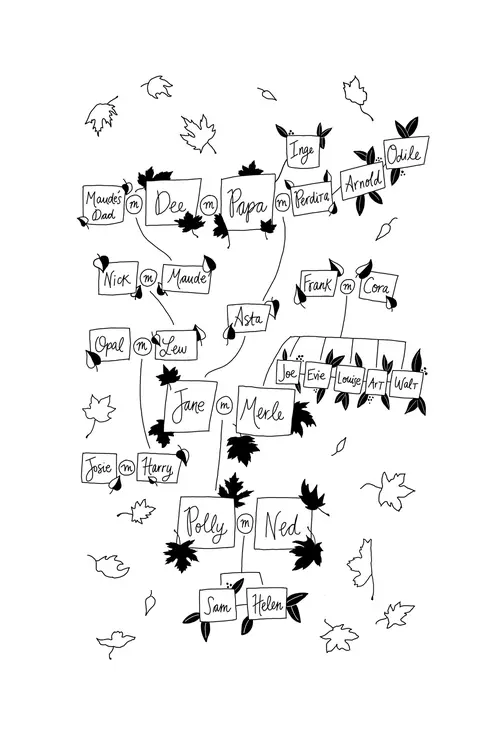
family tree
note to the Delgados? food to the Delgados?
Polly could have combined some of these lines, but she was trying for a sense of accomplishment. She’d forgotten to include errands on the list, a lost opportunity for a satisfying deletion. When she added it to the top later, she would not realize that she’d written errants.
The new morning drill, before they’d set out in the car that morning, Jane phoning from across the yard to ask if she could come over: Did Polly want to start editing Jane’s manuscript, just for practice? They could do something fun, or Jane could help with the kids, they could simply get ready for Maude. Or Jane could help Polly sort her projects, the great slipping piles of paper in the office, so that Polly could be ready to start working when she felt better.
A dizzying welter of shit, but it was meant to be face-saving, all around. If Jane didn’t approach it this way, if she didn’t dangle herself in multiple positions, Polly might act as if she didn’t have time for her mother, or Polly might feel that Jane was making the obvious point that Polly’s brain might be too damaged for much of anything.
Polly and her husband, Ned Berrigan, had moved to Livingston, Montana, fifteen years earlier from New York, and their two children—Sam, nine, and Helen, four—were born in the hospital six blocks from their frame house. Ned worked as an attorney for five years before they bought an old restaurant in the Elite Hotel, which they named Peake’s after an old family friend, with a small inheritance. As she had in New York, Polly edited (mostly mysteries, scripts, and cookbooks) and helped on a few shifts. They acquired two dogs, a cat, and good friends. Polly had piles of second cousins in town, and now more family was visiting: her parents, Jane and Merle Schuster, had driven out from Michigan the week before, and would stay another month in the alley cottage next to Polly and Ned’s house. They wanted to help; because of the accident, they thought Polly and her family needed help.
On a strange, warm day at the end of March, Polly had been riding her bicycle home from the restaurant when a car blew past a stop sign. It clipped her and sent her sideways, nothing like a horse fall, no midair time to think of how to handle it. Her head hit the pavement, but the first, larger feeling was the airless sucking and pain of her deflated chest, the fear that another car would come, rage at the person who got out of his car to scream at her.
The old man who’d hit her (twice, in emails to friends, she’d written bit) howled while witnesses waited with them for the police: Stupid girl, stupid girl, how dare you? He screamed harder when people insisted he was at fault. He was malign and narrow-faced; later, she learned he was the candy factory owner who lived on Yellowstone Street, collected old cars—he’d dented a Bentley on Polly’s bike—and, according to Josie Wall, spent too much time watching children through his plate glass window. When the sheriff, Cyrus Merwin, arrived, Polly said she felt fine—look at her talk, look at her move, look at her not beating this frail mutant bloody for nearly killing her. Cy stalled for the paramedics, but as they arrived in the town’s second-best ambulance, the radio went wild about an accident on the interstate. When the old man turned blue and collapsed into a heap, Cy forgot Polly.
She pushed her broken bike home with the police report crumpled in her shorts. If she thought at all, it was about whether the old shit would survive to buy her a new bike, and if her scraped legs—almost tan after a week of digging in the garden in the weird, balmy weather—would make a short skirt no longer an option for Josie’s wedding to Polly’s cousin Harry Swanberg that weekend. But before Polly let the bike drop in the grass in the front yard, she’d forgotten who was getting married, and she didn’t wonder at the absence of her children or her husband or her dogs, all off at a friend’s cabin at Mission Creek. She didn’t remember she had kids or Ned or pets, even though the cat was following her around the house. She climbed into bed and slept. When Ned came home at 9:00 and tried to wake her, Polly said “sick,” but she wasn’t hot, and she wasn’t fretful, and since she’d never done anything like this before he was worried but let it go. He put the children to bed and was asleep next to her within an hour. In the morning, when she wouldn’t get up, he saw some blood on the pillow and found the police report in her shorts and took her to the hospital. They sent Polly by helicopter to Billings and thought of transferring her to Seattle, but the bleeding was minor, and the swelling abated quickly, and Polly seemed like herself within a couple of days.
And so she went home with a stitched scalp and waited to feel normal after Josie buzz-cut the rest of her hair. Jane and Merle flew from Michigan the day after the accident to sit in the hospital. Polly’s three younger siblings, all in California, visited over the next few weeks. Jane and Merle talked of moving, saying they’d wanted to for years. Merle, who’d retired after thirty years of teaching high school biology, spent most of his time lulling Polly into playing card games.
The Story Continues on BooksBarbecue!
Enjoyed this preview? ❤️ Do not stop here!
Read the complete book free online → 🔗
Continue reading now on BooksBarbecue and discover every page!
Love reading? Bookmark BooksBarbecue.com for more amazing books!
Happy Reading!