The Black Maybe
Cover
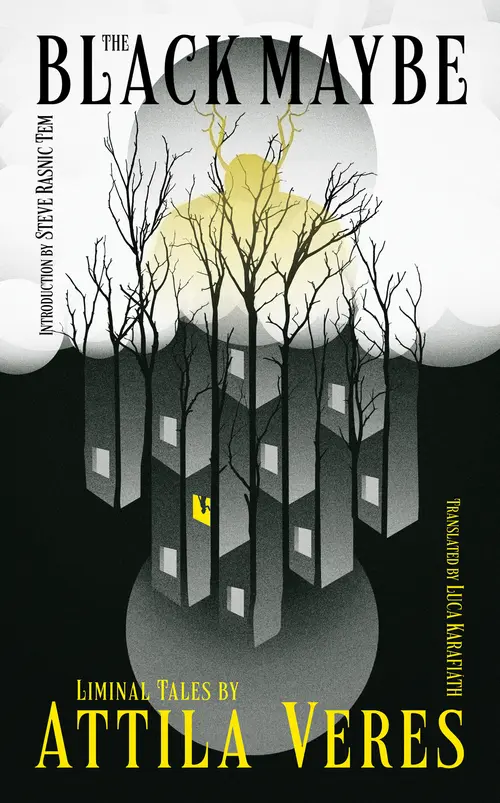
THE BLACK MAYBE
Liminal Tales
by
ATTILA VERES
Translated from the Hungarian by LUCA KARAFIÁTH
Introduction by STEVE RASNIC TEM
VALANCOURT BOOKS
Introduction by Steve Rasnic Tem
Introduction
The most enriching aspect of discovering new authors, especially those who toil in the same genre, is experiencing their unique perspectives on beloved themes.
I first read Attila Veres (b. 1985) in The Valancourt Book of World Horror Stories, volume 1. His tale, ‘The Time Remaining’ (included here), begins innocently enough. A grandmother gives her grandchild a plush toy, Vili. But the child never sees the grandmother again, and the mother lies about the reason. The mother lies again, thinking the child too dependent, saying that Vili is dying. Similar lies spread to other mothers and their children, and their plush toys fall ‘ill’. What follows is a cascade of extended rituals to keep these toys alive, with powerful visceral descriptions of the toys’ pain and the children’s involvement. It’s a riveting exploration of sympathetic magic and what happens when a fantasy goes on too long. The story was a fan favorite and led to this, Veres’ first English collection.
Attila Veres makes his living as an award-winning writer for film and television in his native Hungary. His first novel, Darker Outside, was a surprise success. An original blend of the personal and the weird, it falls into that rewarding gray area between genre and mainstream literature.
This was followed by the story collection Midnight Schools. Seven of the stories that appear here are taken from that volume. This book emerged at an opportune time, as other younger Hungarian writers began writing about their country and themselves through genre. A Year’s Best Hungarian SFF Short Stories series began in which Veres has been a regular contributor.
Attila Veres’ fiction is rooted in the Hungarian experience. His native readers recognize the seedy urban rock clubs, impoverished farms, and post-Soviet haunted landscapes and experiences as their own, yet Veres twists this reality in bizarre and original ways into unique weird mythologies appealing to an international audience. As someone who has read a great deal of horror fiction, I found myself consistently surprised by these liminal tales.
‘In the Snow, Sleeping’ is one of my favorites. A young woman travels to a distant spa with her oblivious boyfriend. She knows he carries an engagement ring, which fills her with unease. First they are given a foul, stinking room, and the cracks multiply in their ideal vacation: warnings the hot thermal waters will become harmful, the front door is left open letting wild animals in, the staff disappears. Through the walls she hears banging, crying, and screams. Some of the guests appear injured and bloody. Yet her boyfriend still insists on staying. Veres has a gift for contemporary settings and concerns. These feel like stories of the ‘now’, interrupted with intimations of the sinister and the strange.
Many of these stories can be classified as either ‘urban’ or ‘rural’, illustrating the separation and often antagonism between city and country life in Hungary. The urban stories feature protagonists whose obsessions intensify until a nightmarish climax is reached. Frequently they feature a background of rock or heavy metal.
In the pandemic story ‘To Bite a Dog’, a man asks his girlfriend about her various cuts and bruises. She has developed a habit of biting dogs, and this proclivity exacerbates as the story continues. In ‘The Amber Complex’ Gabor, a college dropout living with his mother, decides his natural talent, and mission, is to become an alcoholic. A surprise invitation brings him to a mysterious wine tasting within a vast, labyrinthine cellar. The participants are not tasting wine, but something called ‘complex’. Each succeeding color-coded complex produces a hallucinogenic vision, a strategy Veres uses to great effect, transporting the characters into frightening psychological states. Only Gabor is left to taste the final, seventh drink, the Amber Complex.
The rock music-themed ‘Fogtown’ is told as a series of blog posts, book excerpts, and interview transcripts concerning an unfinished book by a man named Balázs on local rock bands that never released an album. The band Fogtown keeps popping up in these interviews, a legendary group even though almost no one saw them play. Balázs becomes obsessed with Fogtown after discovering people have disappeared, committed suicide, or experienced odd visions following exposure to the band or their music.
‘Sky Filled With Crows, Then Nothing at All’ is another rock-themed story narrated by a demon created to tell the Antichrist his true nature and purpose. The Antichrist becomes a metal musician after the demon introduces him to the scene, thinking it would facilitate his future role.
Veres makes frequent nods to Lovecraft, but his cosmic horrors are original creations evolving out of his characteristic hallucinatory imagery and religious or cultish visions of horror.
‘Walks Among You’ concerns a Lovecraftian-like religion originally banned for its use of human sacrifice. The story follows a teenage girl bullied for her faith, a pensioner who helped get the church legalized, and a man married to a church member. Set at the funeral of a woman high up in the church who died of cancer, all three are questioning their faith in the Great Old and Nameless Gods after seeing her cancer-ravaged body.
‘Multiplied by Zero’ is an extreme portrayal of a descent into Lovecraftian madness. After the narrator’s old girlfriend informs him she aborted his child (she argues that a child reduces a woman’s value to zero), he takes a guided bus trip into a dangerous and unreal land. The story is told after the fact in the form of a travel guide, with overly deadpan advice given the horrendous events described. It’s a suicidal journey for the tourists who sign up.
The rural stories in The Black Maybe, inspired by the realities of farming and keeping and slaughtering livestock, continue these themes of cosmic horror by mythologizing those realities, creating weird cosmologies which at times resemble folk horror but which push far beyond.
‘Return to the Midnight School’ concerns the friendship of the narrator with another boy in his village. The local customs and harvest rituals are explored in loving detail, and it is gradually revealed how unique the biology and the metaphysics are in this region. Locals are born in a pit and some come back from the grave as mindless living dead. The peculiar harvest of their fields is a watermelon-like crop containing animals and humans sleeping in embryonic poses. Their bodies are turned into products from which the villagers profit.
This story was a curious, almost primeval experience, but even more peculiar is the title piece, ‘The Black Maybe’, one of the weirdest tales I’ve read in years.
‘The young ones collect the snails in the daytime, while the men oil the chains at night.’ Emese and her family are visitors living with a host family. They feel lucky to be there during the harvest, living in harmony with nature and discovering the outré knowledge possessed by the local farmers. They learn their roles in the harvest, cooking down the snails for their essence and oiling the silver chains and applying bait to the hooks. The chains and the hooks are dropped into earthen pits and then covered over.
‘They bite on it. But not like fish do.’
‘I know,’ Hugó said. ‘Because in fact they don’t really exist until they take the bait, right?’
Emese drinks a metallic booze which makes her speak in an altered voice and levitate. She is constantly pressured to have sex with a local boy, told she’d ‘be better off’.
Once they pull out the chains and the catch is delivered, Emese will only have twenty-four to thirty-six hours. Then it will be too late.
Given both the range and the originality of his dark fiction, Attila Veres’ career is one to watch.
Steve Rasnic Tem
January 2022
Steve Rasnic Tem has published nearly 500 short stories, seven novels, and ten collections during a career spanning forty years. He is a past recipient of the World Fantasy Award and the British Fantasy Award, and his 2014 novel Blood Kin won the Bram Stoker Award. Two of his story collections, Figures Unseen: Selected Stories and Thanatrauma, are published by Valancourt Books.
To Bite a Dog
To Bite a Dog
The room smelled like a used kitchen sponge. It was his flat. They lay in bed, waiting to be aroused again. Mutual attraction was inches away from turning into love.
‘Where did you get the scratches?’ he asked the girl.
This happened on their third date. It started as a Tinder relationship, but it had gotten off to a bad start. Their first date was at a park. The restaurant where they were supposed to meet was closed due to a sudden, unspecified tragedy. The park was nice, except that their rendezvous was somewhat disrupted by three homeless men fighting over the ownership of half a bottle of red wine. They promised each other a second date, feeling that circumstances had played against them. The second date was uneventful. Maybe even boring. They met in one of those hipster coffee shops that have popped up all over Budapest, promising the illusion of being somewhere abroad. They tried to maintain a conversation, but the coffee machine was shrieking the whole time, and the discussions they overheard seemed more interesting than their own. At the next table, a pair of sisters were talking about their father’s recent vasectomy, at another a man was trying to convince his friends to buy a house on the island of Krk, in Croatia, because he could get an excellent deal. Zoltán didn’t dare to order a second coffee; he barely had enough money for the first one.
The third date was their last chance, they both knew it. Nikolett arrived with fresh injuries. Scrapes on her knee, on her arm, and minor bruises basically all over her body.
A few hours later they were lying in his room, reeking of sweat and sex. The boy hated the room now for not being more glamorous. Zoltán had wanted to move out of it ever since he moved in, but he never had the money, and now he feared Nikolett would be turned off by the state of the place.
‘All right, I’ll tell you about the scratches,’ said Nikolett. ‘But you won’t believe it.’
Zoltán shrugged. ‘Try me!’
‘I bit a dog!’ the girl said, giving an imitation of laughter. Her voice shivered from anxiety. The boy got up on his elbows in the bed. Now it was getting interesting. She began her story.
Nikolett had promised a friend of hers she would watch his dog while he was away on vacation at a Croatian ski resort. She wasn’t a fan of dogs, but she didn’t hate them either. To her they seemed like practical tools. She never got the whole emotional aspect of owning a dog. Dogs were not man’s best friend. They were man’s subordinates. Still, she liked her friend well enough, and it was no problem looking after his dog for a few days. She and the dog got along well.
The dog was a large mixed breed named Zeus. Nikolett took him to a nearby dog park twice a day. One morning Zeus got into a fight with a smaller but far more ferocious dog. The other dog was called Bandido. The cause of the clash between the animals was unclear. Maybe just as there are people who are meant for each other, there are dogs who are meant to be mortal enemies.
The park turned into a battlefield. Zeus aimed his teeth at his rival’s throat, while Bandido attacked Zeus’ cheek and nose. It was a chaos of bared teeth, of growling, of blood and violence. A bearded man shouted: ‘Bandido, spit it out! Spit it out, Bandido!’
Nikolett threw herself on her knees and, grabbing his collar, tried to drag Zeus away from the fight. She was unprepared for the animal’s strength. The dog swept Nikolett off her feet, dragging her along on the gravel. Hence the scratches.
Nikolett panicked, and since she had never had a dog, she didn’t know what to do in a situation like this. Bandido’s owner didn’t know either. ‘Spit it out, Bandido!’ he repeated over and over again, and the meaningless sentence became emptier with each repetition. He stood in a pose that made him look like he was about to jump into a pool, but he didn’t move.
Finally Nikolett launched herself at Zeus, although in hindsight it was a rather stupid and – considering Bandido’s uncontrolled fury – dangerous move. She acted on instinct.
She bit Zeus on the ear. Blood poured out.
The dog let out a surprised howl; Nikolett kept biting until Zeus let go of Bandido. Everyone at the dog park went silent. Even Bandido retreated, tucking back his ears and tail. Nikolett held Zeus and smiled at the other dog’s owner, trying to make a good impression before the inevitable argument over who was responsible. Bandido’s owner looked at Nikolett, then stepped away from her just like his dog had.
Only later did the girl notice that her teeth were bloody. She had a dog’s blood in her smile.
‘What did it feel like?’ Zoltán asked in bed. ‘What did it feel like biting Zeus?’
Nikolett took a deep breath, her mouth open, as if ready to formulate an answer right away. Her mouth hung open, then it closed. She didn’t say anything. She didn’t need to. She had goosebumps all over her body. They laughed at this, then fucked again, even more ferociously than before.
That date was an icebreaker. Afterwards everything went smoothly. They met almost every day at his place or hers and continued their explorations of each other. Each time they met they found yet unconquered or undiscovered territories, or new pleasures in the lands they had already mapped out. A few weeks later Nikolett lost her apartment because it was turned into an Airbnb. They decided to move in together. With their combined incomes, they could get a bigger and nicer apartment than either could afford on their own.
The new flat smelled like fabric softener and plywood. The kitchen window and the tiny balcony looked onto a park from the building’s seventh floor. One Sunday the sun shone with such magical golden intensity through the kitchen window that Zoltán sat down on the floor looking at the honey-colored light and let the feeling wash over him: he was in the right place. After so many years spent wandering, this was finally home.
Nikolett felt likewise. They bought a bottle of Prosecco at Aldi; they drank it on a Thursday night sitting by the open kitchen window, and when they were sufficiently drunk they confessed their love for each other. They both loved the apartment just as much as they loved each other, but neither of them minded that. After that night, whenever they cleaned the floor or washed the kitchen counter they felt they were caressing the body of some great lover.
It was a liberating feeling to be in a relationship; it made everything easier. At dawn, before work, they would often make love; the warmth they generated in these moments helped them through the coldness of the days. They shared the bills, so by the end of the month they managed to save some money. They hadn’t decided yet what to spend it on, but they cherished the idea of savings as if it were some kind of precious seed, from which an unknown, exotic plant would gradually grow. Even when the pandemic started they didn’t feel threatened. They switched to working from home and saved even more money by not having to commute. She sometimes needed to go to the office, but she rode a bike.
‘Is it this easy?’ Zoltán would ask himself from time to time. ‘Is it this easy to be happy?’
It seemed like it was, and he hoped that these days would turn into weeks, months, years, and an eternal life.
He was at the greengrocer’s picking out onions when he first heard the news of the bitten dog. A middle-aged woman was selecting cucumbers. She recounted the news.
‘The Budai family, from the seventh floor,’ said the middle-aged woman as she made a grand show out of picking the freshest cucumbers. ‘It was their dog. The daughter took it for a walk in the park. She let it off the leash, and after a while the dog came running back to her whimpering. It was bleeding from a wound. A bite, apparently. Terrible, isn’t it?’
Surely it had been wounded by another dog. Or some other kind of predator. Maybe a hedgehog acting in self defense, or a cat. These wounds happen all the time in a dog’s life.
Zoltán had a hard time falling asleep that night. He watched Nikolett, who was turned away from him, sleeping soundly. He watched for so long that the girl’s body parts turned into abstractions in the obscurity of the night. She was nothing but a pale stain here, a small purple blur there. Zoltán watched these abstractions the girl had become in her sleep and searched for any telltale signs of change. He couldn’t find any, so finally he fell asleep and dreamed of the park at night.
A few days later a new case of a bitten dog was reported at the grocer’s. This second incident gave rise to more concern than the first. It had happened at night again; the dog was bitten on its nose. This bite led to the discovery of yet another incident that had happened the previous night. In that case the animal was bitten on its belly. From these two bites it became obvious that the perpetrator was not a beast – the wounds were shaped in the pattern of human teeth. The owners drifted towards panic and had a million questions nobody could answer. Should they take the dog for a vaccination against infections? Could a man be rabid and pass it on to a dog? Should the police be involved? Do they even handle this sort of case?
Zoltán decided to get his produce at the local Spar, a more impersonal place, in order to stay away from the news and rumors. He didn’t have a dog, so he really saw no reason why he should be involved. Still, he was anxious. He knew he shouldn’t be; just because Nikolett had bitten a dog once didn’t make her the serial dog-biter.
By the shop’s counter tiny plush dogs were being sold as part of some promotional campaign. Zoltán put one of the stuffed toys into his cart, just to prove that he didn’t take his own silly thoughts at all seriously. Everyone in line wore a mask, including him. For several months now he had seen human faces only on television, in reruns of old sitcoms and crime shows. He was even starting to doubt whether people still had faces; maybe this last year everyone’s faces had vanished, leaving nothing behind but long rows of teeth that everyone covered up now for aesthetic reasons.
Or for safety. Masks are like a muzzle on a dog, protecting us from our own teeth. Zoltán looked at the queue and had a thought that disturbed him. All he saw was hundreds and hundreds of teeth, all standing in line to buy ham and discount laundry detergent, hiding away behind these black and green and blue masks. Before paying, he threw the stuffed toy back where he had found it.
Nikolett was young and cared about her physical fitness, so she often went for a run in the later hours of the night, even if it was against the law now with the curfews kicking in. Legally only people walking their dogs could be on the street after dark. Still, she went running night after night.
She purchased the proper attire for this purpose: black pants, black T-shirt and jumper, and a black mask, so if the police stopped her she wouldn’t be fined for not wearing one. As soon as she came back from running, she headed straight to the shower to wash off the grime of physical exercise. Only when she stepped out of the bathroom would she talk to Zoltán, as if she hadn’t only washed herself but also changed her face, and if they were to talk before she entered the bathroom Zoltán might see some other Nikolett, the one behind the mask when she was out running in the streets.
Out running in the park.
One night, however, Nikolett didn’t enter the bathroom. Zoltán was already lying in bed, waiting for her to return home. The TV was on at a low volume, but Zoltán wasn’t paying attention to the program. He heard her enter the flat, kick off her shoes, and head straight for the bathroom. There she paused. She changed direction; Zoltán heard her walking towards the bedroom door. Then she stopped. Zoltán could hear her breathing, but maybe it was just his imagination. There was a long stretch of silence, and Zoltán started to doubt she was out there. Maybe he’d just fallen asleep and dreamt the whole thing. Maybe she was still out there, outrunning the police.
‘Turn off the TV!’ said the girl in a hoarse, raw voice.
The Story Continues on BooksBarbecue!
Enjoyed this preview? ❤️ Do not stop here!
Read the complete book free online → 🔗
Continue reading now on BooksBarbecue and discover every page!
Love reading? Bookmark BooksBarbecue.com for more amazing books!
Happy Reading!