The Beloved
Title Page
BOOKS BY KAHLIL GIBRAN IN THIS SERIES
BOOKS BY KAHLIL GIBRAN IN THIS SERIES
Spirit Brides
The Storm
The Vision
The Beloved
Broken Wings
Note on texts
The pieces translated in this volume are taken from Michail Naimy, ed., al-Majmu‘ah al-kámila li-mu’allifát Jibrán Khalíl Jibrán, Beirut, 1961, and were originally published in various Arabic papers and journals. They are “Ala Báb al-Haykal,” pp. 370-372; “Aghniyat al-Layl,” p. 595; “Aghání,” pp. 328—331; “Warda al-Hání,” pp. 81—95; “al-Jiníya alsáhira,” pp. 376—377; “Hayát al-Hubb,” pp. 236—237; “Hikáya,” pp. 238—240; “al-Rafíqa,” pp. 287—288; “Malikat al-Khiyál,” pp. 281—282; “al—Sulm,” pp. 306—307; “Hadith al-hubb,” pp. 302-304; “Munáját,” pp. 284—285; “Qabl al-intihár,” pp. 378—379; “Bayn al-Khará’ib,” pp. 253—254; “Ibtisáma wa-Dam‘a,” pp. 247—249; “Munáját arwáh,” pp. 316—319; “Madja‛ al-‛Arús,” pp. 106-115; “Bi’lláh yá Qalbí,” p. 592; “Makhb’át al-Sudúr,” pp. 293-295; “Banaát al-Bahr,” pp. 245-246; “Bil-Ams wa’l-Yawm wa-Ghadan,” p. 218; “Ayyuha’l-Layl,” pp. 373-375.
Dedication
To the spirit that embraced my spirit, to the heart that
poured its secrets into my heart, to the hand that kindled
the fire of my emotions, I dedicate this book.
GIBRAN
This was Gibran’s dedication of his collection Rebellious
Spirits, in which the stories “Rose al-Hani” and
“The Bridal Bed” appeared. It is addressed to his
friend and patron Mary Haskell.
Translator’s dedication:
To Linda, from whom I came to understand such things
Introduction
INTRODUCTION
Kahlil Gibran was born in 1883 in Bisharri, a Maronite Christian village in the mountains of northern Lebanon. His mother was from a family of priests; his father was a minor agent of the local warlord. His childhood was spent in desperate poverty in this place of great beauty. A family friend taught the young Kahlil how to read. When he was 12, his mother attempted to escape her troubles by emigrating to the United States with her children. From the ethereal beauty of the Lebanese mountains, Kahlil found himself amidst the squalor of the Boston slums. His mother scraped out a meager living for herself and her children as a peddler.
The young Kahlil’s lovely drawings attracted the attention of a social worker, who put him in touch with Fred Holland Day, an avant-garde photographer and publisher, who used Gibran and his family as models and introduced Gibran to the literary world of 1890s Boston. His new friends, charmed by this talented Lebanese boy, introduced him to modern art, gave him books to read by such authors as Nietzsche, and took him to plays and concerts. Thus, although his education in America was very uneven—he never really learned to spell, for example, and was always more comfortable writing in Arabic—he became accustomed to traveling in literary circles while still a teenager living with his family amidst the poverty of the Syrian ghetto in Boston’s South End.
In 1896, he returned to Lebanon for high school, where he acquired the rudiments of an Arabic literary education. He returned to America and his intellectual friends in 1902. Soon after his mother, sister, and half-brother died, leaving him alone in America with his surviving sister. During the next few years he began working seriously as an artist and attracted somewhat wider attention, even exhibiting in a small way. He also began to write for the Arabic newspapers published in America. His prose poems, simple parables written without the rhetorical elaborations of traditional Arabic poetry, quickly made him a major figure among Arabic writers in America. In 1908 one of his American friends, Mary Haskell, supplied the funds for him to go to Paris to study art.
Returning to America in 1910, he worked continuously on his drawings and paintings and continued to write for the Arabic newspapers. In 1912 he moved to New York to be closer to the centers of art and Arabic literature in America. His art earned him only a precarious living, and he was forced to depend on the assistance of friends, particularly Mary Haskell, a talented and independent woman who was the headmistress of a girls’ school in Boston. When Gibran began writing seriously in English, she served as his editor; the form of his English writings owes much to her assistance and judgment. His first English work was The Wanderer, a collection of prose poems and parables. By this time he was well established as a major modern Arabic writer. The Prophet, his best known work, was written over a number of years and finally published in 1923. This and the other English works that followed it eventually gave Gibran a degree of financial independence. He continued to work on his paintings, but his health began to deteriorate. He died on April 10, 1931. Despite the objections of the church authorities, who had been offended by his anti-clerical writings, he received a religious funeral. At his instructions, his body was taken back to be buried in his home village of Bisharri and the royalties of his books were divided between his sister, the only surviving member of his immediate family, and his village.
Gibran is first of all an Arabic writer. Arabic was his native language and the language he was always most comfortable with. Even after living in America for most of his life, he would still write a poem first in Arabic and then translate it into English. His Arabic works are remarkable, free of the exaggerated rhetoric and strict traditional forms characteristic of Arabic poetry up to his time. His simple diction and new forms revolutionized Arabic literature. Except for a short novel, Broken Wings, a verse dialogue, Processions, and some one-act plays, all of his Arabic writings were in the form of short pieces— stories, parables, and prose poems—written for newspapers and magazines. Many were later collected and published as books.
The themes of his Arabic works are familiar to readers of his English works: nature against society, spirituality, natural beauty, human injustice, and the destruction of the spirit by society. Most of his Arabic works were written before his books in English. They are more passionate and fresh, on the whole, than the English work, being products of his youth. The influences that shaped his writing were obvious. Most important was the contrast between the beauty of his native Lebanese mountains and the squalor of Boston and New York, where he lived most of his life. Lebanon, romanticized by exile, is the real setting of all his works. He championed the freedom and simplicity of the individual against the rigidities of society and protested the oppression of the weak, the poor, and women. He denounced the hypocrisy of organized religion, particularly his own Maronite church. Though his romanticism and anarchism may seem naive, the intensity of his feelings, the energy of his ideas, and the universality of the disquiet which he voices speak to modern men and women.
Gibran’s Arabic writings were translated after his death. These translations are not particularly good. Most are more or less inelegant and some are extremely inaccurate and misleading. Gibran’s reputation has suffered from them. We undertook the present series to provide fresh, contemporary, and accurate translations of Gibran’s significant Arabic work. The translations follow the original as closely as practical without doing violence to English style. We have not tried to imitate Gibran’s English style since we think that his Arabic works deserve to be judged on their own considerable merits.
The pieces in this volume each deal with romantic love. Romantic love, like life, was an absolute ideal for Gibran. Many of these pieces tell of the bitter unhappiness caused by the subordination of romantic love and personal happiness to worldly calculation. He saw women as the particular victims of rigid social customs and expectations and of standards that made marriage an economic transaction. The love of a man and a woman was a pure emotion, more spiritual than sexual, and was not to be compromised.
Gibran was deeply fond of women, understood them, and sympathized with their plight. He himself never married, so his ideal of love always remained the ethereal delights of courtship rather than the calmer happiness of stable marriage. His life was marked by a series of profound friendships with women: his mother and his two sisters, to whom he was devoted; Josephine Peabody, the Cambridge society intellectual who befriended him as a teenager; Hala al-Daher, the woman in Lebanon who was his first love; Micheline, a beautiful French artist; May Ziadeh, the Arab writer whom he never met in person; Barbara Young, his supporter in his last years; and, most important, Mary Haskell, who was his friend, patron, and editor for half his life. The most important of these friendships were platonic, marked by deep and thoughtful friendship. These relationships shaped his art, his writing, and his life.1
In the absence of a critical edition, we have followed the text of the collected edition of his Arabic works published by his friend Mikhail Naimy.
John Walbridge
AT THE GATE OF THE TEMPLE
AT THE GATE OF THE TEMPLE
I purified my lips with sacred fire that I might speak of love, but when I opened my mouth to speak, I found myself mute.
I sang the melodies of a love I did not yet know, but when I came to know it, the words became a muffled whisper in my mouth, the songs in my breast a profound silence.
In the past, O people, you asked me about the wonders and delights of love, and you found satisfaction in what I told you. But now, when love has draped me with its robes, I in my turn come to ask you about its ways and virtues. Is there one among you who can answer me? I come to ask you about what is in me and wish you to tell me of my own soul. Is there one among you who can explain my heart to my own heart, who can explain my essence to my essence itself?
Will you not tell me what is this fire kindled in my breast? It consumes my faculties and melts my emotions and desires.
What are these invisible hands, soft yet coarse, that grip my spirit in my hours of solitude and loneliness? Into my heart they pour wine mixed with the bitterness of pleasure and the sweetness of pain.
What are these wings rustling about my couch in the silence of the night as I watch wakeful for what I know not, listening to what I do not hear, staring at what I do not see, pondering what I do not comprehend, aware of what I do not apprehend, sighing because in sighs are the groanings more beloved to me than the echoes of laughter and joy, submitting to an unseen power that slays me, then give me life, then slays me again and again until dawn breaks and light fills the corners of my room. Then I sleep. Yet behind my spent eyelids forms of wakefulness dance and on my stoney blanket sway the phantoms of dreams.
What is this which we call “love”?
Tell me what is this hidden mystery concealed beyond the ages, lurking behind appearances, yet making its home in the heart of being?
What is this unconditioned thought that comes as the cause of all effects, as the effect of all causes?
What is this wakefulness that encompasses both death and life and molds them into a dream stranger than life and deeper than death?
Tell me, O people, tell me! Who among you would not wake from the sleep of life if love were to brush your spirit with its fingertips?
Who among you would not forsake your father and your mother and your home if the girl whom your heart loved were to call to him?
Who among you would not cross the seas, traverse deserts, go over mountains and valleys to reach the woman whom his spirit has chosen?
What youth would not follow his heart to the ends of the earth to breath the sweetness of his lover’s breath, feel the soft touch of her hands, delight in the melody of her voice?
What man would not immolate his soul that its smoke might rise to a god who would hear his plea and answer his prayer?

Yesterday I stood by the gate of the temple and asked passersby about the mysteries and virtues of love.
A man of middle years passed by, his body wasted, his face dark. Sighing, he said, “Love has made weak the strength I inherited from the First Man.”
A youth, his body strong and brawny, passed by. In a voice of song he said, “Love is resolution added to my being, linking my present to generations past and future.”
A woman, her eyes melancholy, passed by and, sighing, said, “Love is a deadly poison, the breath of black adders writhing in Hell, flowing and swirling through the sky until it falls covered in dew, only to be lapped up by thirsty spirits. Then they are drunk for a moment, sober for a year, dead for eternity.”
A rosy cheeked girl passed by and said, smiling, “Love is a fountain whose waters the spirit brides pour into the spirits of the strong, making them to ascend in prayer among the stars of night and to sing songs of praise before the sun by day.”
A man passed by. His clothes were black, his beard long. Frowning, he said, “Love is blind ignorance. It begins at youth’s beginning and ends with its end.”
A handsome man with open features passed and gaily said, “Love is celestial knowledge that lights our eyes and shows us things as the gods see them.”
A blind man passed, tapping the earth with his cane, and weeping, he said, “Love is a thick mist enshrouding the soul on all sides and veiling the outlines of existence from it—or allowing it to see only the spectres of its desires wandering among the rocks, deaf to the sounds of its own cries echoing in the valley.”
A youth carrying a guitar passed and sang out, “Love is a magical ray of light shining out from the depths of the sensitive being and illuminating all around it. You see the world as a procession traveling through green meadows, life as a lovely dream erected between wakefulness and wakefulness.”
An old man passed. His back was bent, his feet dragged like pieces of cloth. In a quavering voice he said, “Love is rest for the body in the silence of the tomb, peace for the soul in the depths of eternity.”
A child of five years passed and laughed back to me, “Love is my father, love is my mother. Only my father and my mother know love.”
The day went by. The people passed before the temple, each describing himself as he spoke of love, revealing his hopes and telling of the mystery of life.
When evening came and the movement of passersby was stilled, I heard a voice from within the temple: “Life has two halves: one patient and one afire. Love is the fiery half.”
At that I entered the temple and bowed down in earnest, silent prayer, “Make me, O Lord, food for the flames. Consume me, O God, in the sacred fire. Amen.”
NIGHT SONGS
NIGHT SONGS
Silent is the night, but in the robe of silence
dreams lie waiting.
The moon rolls overhead.
Its watchful eyes observe
the passing days.

Let me take you,
daughter of the fields, to the
lovers’ vineyard.
The wine we press will quench the
fires of longing.

Can’t you hear the nightingale out in the fields
pour out melodies?
The breathing of the hills has filled
the sky, their breath
the scent of herbs

You need not fear, my love,
for never have the stars on high
told what they know.
Night’s thick mists swirl in these vineyards;
they will veil our secrets.

You need not fear the spirit bride
will come out from
her magic cave.
She lies in drunken sleep, unseen by all
save houris’ eyes.

The spirit king, if he should pass, let passion
give him due praise.
Like me he is in love and will not punish love,
for he burns too!
SONGS
SONGS
In the depths of my soul there are songs unwilling to take the garb of words, songs living as seed in my heart. They will not flow with ink onto paper. Like a translucent veil, they are wrapped about emotions that can never flow sweetly on my tongue.
Yet how can I even whisper them when I fear what the particles of the æther may do to them? To whom shall I sing them when they have become accustomed to live in the house of my soul and fear the harshness of other ears?
Were you to look into my eye, you would see the image of their image. Were you to touch my fingertips, you would feel their quick movements.
The works of my hands reveal them as the lake reflects the twinkling of the stars. My tears disclose them as the mystery of the rose petal is disclosed at the moment the heat dissolves the drops of dew.
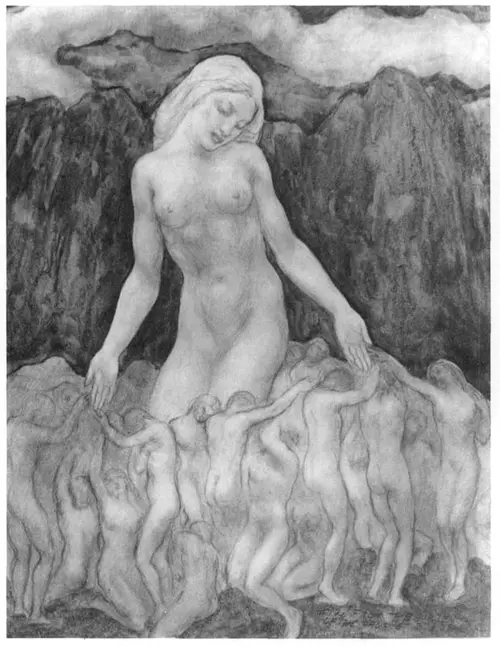
Songs spread out by silence and rolled up by noise, echoed in dreams and concealed by wakefulness.
They are songs of love, O people! What troubadour will sing them? What David shall chant these psalms?
More fragrant are they than the breaths of the jasmine flower. From what throat shall they go forth? More chaste are they than virgins. What violin will reveal them?
Who can combine the roaring of the sea and the warbling of the nightingale? Who can link the crashing thunder with the baby’s sigh? What flesh can sing the songs of the gods?
SONGS OF THE WAVE
The shore and I are lovers, drawn together by desire and pulled apart by the wind. I come from beyond the blue dusk to mix the silver of my foam with the gold of his sand. I cool the heat of his heart with my mouth. At dawn I recite the law of passion into the ears of my lover, and he gathers me to his breast. In the evening I chant the prayer of longing, and he draws near.
I am importunate and uneasy; my lover is a patient comrade, a faithful friend.
As I rise, I embrace my lover. When the ebb follows, I throw myself upon his feet.
How often have I danced about the daughters of the sea when they rose from the depths and sat upon the rocks to delight in the sight of stars? How often have I heard the lover lament his passion for a lovely girl, and with him I have moaned and sighed? How often have I caroused with the rocks, though they are solid? Laughing I caressed them, yet they did not smile. How often have I rescued bodies from the chasms of the sea and carried them to the living? How often have I stolen pearls from the depths and given them to beautiful women?
In the silence of the night, when the phantoms of sleep have embraced all creatures, I watch, sometimes chanting, sometimes whispering. Woe is me, for watching by night has laid me waste. But I am a lover, and the essence of love is wakefulness.
This is my life, and that which is my life I must do.
SONGS OF THE RAIN
I am silver thread that the gods throw from on high. Nature seizes me and adorns the valleys.
I am lovely pearls fallen from Astarte’s crown. The daughter of the morning stole them and studded the fields with them.
I weep, and the hills smile. I am abased, and the flowers hold high their heads. The cloud and the field are lovers, and I am that servant who goes between them. I weep and quench the thirst of the one and cure the disease of the other.
The crash of thunder and lightning swords herald my approach. The rainbow is the triumphal arch at my journey’s end. This earthly life begins beneath the feet of angry matter and ends in the hands of peaceful death.
I rise from the heart of the lake and soar on ethereal wings. When I see a lovely garden, I descend and kiss its blossoms and embrace its branches.
In silence I drum my dainty fingertips upon the window glass, and that drumming blends into a song that perceptive souls can understand.
I am begotten by the heat of the air, yet I slay the air’s heat. Thus may a woman master a man through power she draws from man.
I am the sighing of the sea. I am the tears of the sky. I am the smile of the field. So too is love a sigh from the sea of emotions, a tear from the sky of love, and a smile from the field of the soul.
SONGS OF BEAUTY
I am love’s guide. I am the wine of the soul, the food of the heart. I am the flower that opened its heart when the day was young. A girl took me, kissed me, and placed me on her breast.
The Story Continues on BooksBarbecue!
Enjoyed this preview? ❤️ Do not stop here!
Read the complete book free online → 🔗
Continue reading now on BooksBarbecue and discover every page!
Love reading? Bookmark BooksBarbecue.com for more amazing books!
Happy Reading!