The Bedeviled
Cover
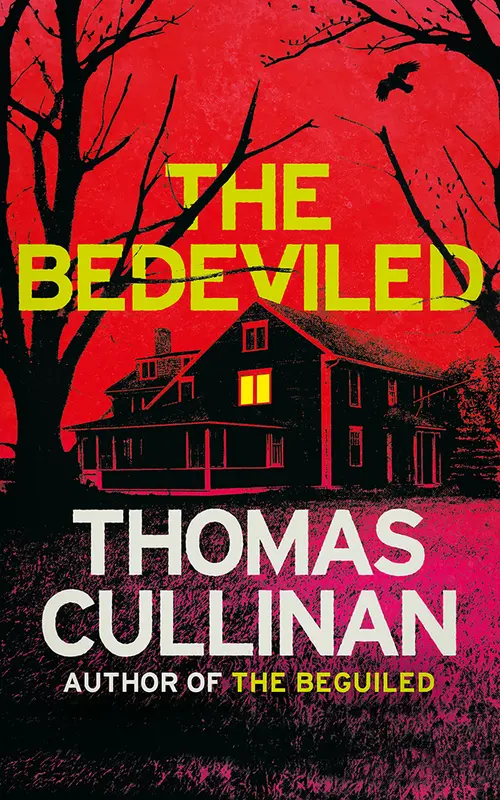
Thomas Cullinan
THE BEDEVILED
VALANCOURT BOOKS
BOOK ONE
Book One

1
Chapter One
I spend much of my time lately watching Franny, and wondering what she’s thinking about. If she’s in bed when I visit the nursing home, she just stares at the ceiling. If she’s in her chair, she stares at the wall.
Is this a good way to begin a journal? As good as any, I suppose. The motel manager gave me an unused ledger. I presume he thought the work might persuade me to turn off his television set that has been on day and night when I’m in my room. I don’t watch the programs, but I’m hoping the sound will cause certain people to think I’m taking an interest in life.
I went to the farm a few days ago, although Father Jackson disapproved. He loaned me his car to drive out there, but he didn’t offer to go along. I’m sure he was afraid to go. I was afraid myself, more so after I got there, and I didn’t stay after dusk.
I don’t know what to do with the place. There seems to be plenty of money—all that Franny and I will need for years, since my husband, Jack, had a lot of insurance—but I’m just not ready to make any definite plans to leave. One of the reasons, I guess, is the fact that two members of my family are buried in the graveyard behind the Caine house.
New beginning. I suppose it was Jack’s second heart attack that started it all, that followed by the loss of his job at Marks and Chapman. They gave him a year’s salary and maybe that was generous enough, since he’d been creative director for only three years.
Then in the middle of June the real estate man telephoned. The four of us were having a late breakfast—one of the advantages of Jack’s unemployment and the kids’ school vacation—when Jack took the call.
“Does anyone here realize that we’re living in a ninety-five- thousand-dollar house?” he asked after hanging up.
“Far out,” Franny said and continued eating her grapefruit. Duff was reading a new flute score, I remember, and he didn’t even look up.
“It’s probably worth more than that,” I said. “You haven’t been reading the ads. But where would we live if we sell? We’d need ninety-five thousand and maybe more to buy another house around here.”
“We could move to that farm of Dad’s in Ohio,” Duff said. He mentioned it first, I remember, although I’m not sure that’s of any significance. He still didn’t look up from his flute score.
And Franny said, “Why not?”
Franny was an outgoing, gregarious child, something Duff had never been. He had his music and his books and he didn’t seem to want anything else. He was a good swimmer and tennis player and a half dozen strokes better than his father at golf, but he just wasn’t very interested in competitive or social activities.
“Do you think you’d like it out there in the sticks away from your friends?” I asked Franny. I wasn’t taking the matter seriously at that point.
“I haven’t any friends,” she said. She was suffering from not being invited to a fifth grade end-of-term party, apparently the fault of the post office and not the party giver’s mother.
“Maggie, it isn’t exactly wilderness country anymore,” Jack said to me irritably.
He hadn’t seen the farm for years, except for the time last fall when he went there for his Aunt Hannah’s funeral. She was his great aunt, his grandfather’s sister, a spinster who had lived alone on the place for many years. After a crippling stroke, she had employed a housekeeper-nurse who stayed with her until she died.
Jack had inherited the property, but he was unwilling to sell it because it had been in his family for so many years. A real estate company in the area had tried to rent it for him, but with no success.
“It may not be wilderness,” I said now, “but it must lack something, if no one wants to live there.”
“It’s out of the way,” Jack said. “It’s a good distance from any large city and there aren’t many jobs around there. Anyway we’re not all that attached to this place, are we?”
“I’m not,” said Franny.
“What about you, Mozart?”
Duff looked up from his score and considered it. “I guess I’m not,” he said.
“What about his music?” I wanted to know.
“There must be music teachers around there somewhere. And the Cleveland Orchestra isn’t too far away.”
“What about schools?”
“I’m sure the schools in Ashland and Cainesville are as good as those in Scarsdale.”
“You don’t believe that any more than I do. And Duff’s in his last year here.”
“But he has credits enough to graduate now, hasn’t he? And he’s already practically accepted at Yale for the year after next.”
“We’d need quality medical care too, a good hospital and good doctors. Also, that house is probably a wreck.”
“It isn’t,” Jack said. “At least it wasn’t last fall. And the furnishings are pretty good too. What will I tell the man? I said I’d call back.”
“I’ll never agree to sell this house until we’ve made definite arrangements for another place,” I said firmly. “And I won’t commit myself to a farm in Ohio until I’ve seen it and the facilities around it.”
Jack agreed to that and a couple of days later—with plenty of misgivings on my part—we flew to Cleveland and rented a car to drive to the farm. Jack wanted to drive all the way in the Oldsmobile station wagon, but I felt he wasn’t up to it.
It took about an hour from the Cleveland airport to reach the Ashland real estate office where a Mr. Siebold gave us the keys to the Caine house.
“If you decide not to stay, I’ll be happy to try and rent the place again,” he told us. “I’m sure I can eventually, especially if you’d be willing to come down a bit in what you’re asking.”
“It seems to me that two hundred a month is little enough for a furnished house that size and a hundred and fifty acres of land,” Jack said.
“Farms are going begging around here, Mr. Caine, especially rental farms.”
“Has anyone even considered renting it?” I asked.
“Three or four families have looked at it,” Mr. Siebold said.
“And turned it down because of the price?”
“They didn’t say, but I assumed that’s what it was. I don’t know of any other reason, do you?” He ushered us to the door, seemingly anxious to be rid of us. “If any problems come up, you might want to talk with Mrs. Reddy, your aunt’s housekeeper. She lives with her daughter and son-in-law, the Emil Webers. They’re a mile and a half or so down your road on the same side.”
“What sort of problems would you expect to come up?” I inquired.
“Oh, I just mean that Mrs. Reddy could probably give you the names of reliable repair people, if you ever need them. Incidentally there’s no telephone on the place. I guess your aunt wouldn’t have one. If you want one installed, you’ll have to make arrangements with the company here in Ashland.”
“We won’t bother about it right now,” I said.
Mr. Siebold wished us luck and we started off with the hand-drawn map he had given us. Jack wasn’t sure he remembered how to get to the farm, which was located on a secondary road about ten miles from Ashland.
When I saw the road, I was even more discouraged. It was gravel and I wondered what it would be like in winter, although I was determined then never to see snow on it. On each side the fields were overgrown and seemingly abandoned, with patches of what I took to be second-growth timber here and there.
“Didn’t the Caine family have any neighbors?” I asked.
“Not too many close ones.” Jack was trying to steer around the washed-out places in the road. “There are more farms on the other side of our place and the road is paved there too. A lot of these places were abandoned years ago.”
“Why?” Duff asked from the back seat. Jack had offered to let him drive, but Duff had never been much interested in driving.
“To tell you the truth, some of the people around here didn’t like your great-great-grandfather. He wasn’t a very popular fellow.”
“You never told me that,” I said.
“I guess the subject never came up. Anyway, the old man was hard to get along with, as I understand it. He had a lot of disputes over property lines and water rights—there’s a creek that borders the farm—and his dogs killing neighbors’ chickens or their dogs killing his chickens, things like that. He was just plain cantankerous, I guess. Of course, on the plus side, he was a Civil War hero.”
“A hero?” shrieked Franny, who had just begun to take an interest in American history.
“Well, he was a general anyway.”
“An army general?”
“Yep, a brigadier. I’ve told you about him, haven’t I, Duff?”
“I think you may have,” said Duff diplomatically. Duff could never work up any enthusiasm for warfare more recent than Greek or Roman.
“You were named after your great-great-grandfather. I’m sure you knew that.”
“What battles was he in, Dad?” Franny wanted to know.
“Let’s see. Shiloh, I guess. Chickamauga maybe. There are books at the house that will tell you all about his career.”
We came upon the farm suddenly then, coming up to the Caine mailbox and the lane from a dip in the road. The lane was narrow and rutted. Not many cars had ever driven over it, I thought, as we bounced along. It had been made for wagons and carriages and never improved.
The house was a surprise. It was half hidden behind a grove of trees and we didn’t get a good look at it until we were almost on it. I don’t know what I expected, but it wasn’t what I saw. Maybe I thought it would be a Victorian monstrosity, with towers and turrets and shutters creaking in the wind.
Well, it looked Victorian all right, but not like a Victorian house. It looked like a nineteenth century factory or warehouse. It was built in unequal parts of brick, stone and wood, as though the builder, having run out of one material, made do with another.
Jack shut off the motor. “What do you think of it? It’s supposed to look like Libby Prison.”
“What’s that?”
“A Confederate prison in Richmond. The old man was captured and confined there during the war. I guess his stay made such an impression on him that later he built this house to look like it. The first house was a log cabin.”
“I’ve seen pictures of Libby Prison and there is a resemblance,” Duff said.
“I’m sure General Caine would be pleased at your approval,” said Jack grinning. He seemed happier than he had been for weeks.
The house had been painted recently and the slate roof was in good repair too. Grudgingly I admitted that the building wasn’t all that ugly. It could be taken for a large school or a meeting hall of some kind.
The front door was of heavy planks bound with iron—I suppose like a prison door. Jack opened it with the large key and we entered a dark hallway and an even gloomier parlor. It was like something out of a turn-of-the-century Sears Roebuck catalogue.
There was a horsehair sofa, a smaller settee with leather cushions, a couple of rocking chairs with cane seats and, in the center of the room, a pot-bellied stove. The two small, high windows were covered with heavy double curtains.
“What do you think?” Jack asked. He spread the curtains on one window and coughed as the dust flew.
“Charming,” I said. “For a museum.”
“Come on. Aunt Hannah lived to be ninety-two here. That says something for a place, doesn’t it, if a person can live to be that old in it. And, heck, if you wanted to change anything, it would be no problem. We could put in central heating—”
“There’s no central heating?” I hadn’t considered that the stove might be necessary.
“Not now, but it would be easy to install it. Also, we could put a big picture window in the front here, throw out all of this old furniture—”
“Some of it might be worth a lot of money to collectors,” Duff said.
“That’s right,” said Jack. “We could probably make enough on it to pay for the renovation. Anyway, let’s take a look at the rest of the house before we turn around and go home.”
He didn’t want to go, I knew that. He wanted to live here, maybe because he felt that in this place he could put aside all the defeats he had suffered and make a fresh start. Also, maybe he thought that if he stayed on the farm, some of his aunt’s longevity would pass on to him. On the other hand, maybe he sensed that his end was approaching and he had some primeval urge to be near the place of his ancestors when it came.
2
Chapter Two
Franny was examining a framed photograph on a table. It was a tintype of a little girl in ruffles standing beside a seated woman who was holding a baby.
“That’s Aunt Hannah,” said Jack, “and that’s her mother, my great-grandmother. The baby is my granddad, John Caine.”
“And those kids were the son and daughter of the General?” Franny asked.
“That’s right.”
“Do you have a picture of the General?” asked Duff.
“I don’t think I’ve ever seen a picture of General Caine, but there must be one around here somewhere,” Jack said. “By the way, there are electric lights.” He flipped the wall switch and grinned.
“Thanks,” I said. “I wondered.”
We toured the rest of the house and I must admit my antipathy lessened a bit. There was a fairly large dining room, as well as two small bedrooms and a bathroom downstairs, and the kitchen was a complete surprise. It was dominated by a huge wood-burning stove, but near it stood a modern electric range, and next to that a seemingly almost new refrigerator and freezer.
Upstairs were two more bedrooms and another bathroom. The rest of the second floor area was an enormous storeroom. It would have been an antique dealer’s heaven. Piled on top of one another were pieces of eighteenth and nineteenth century American furniture, as well as a number of items that must have been imported. There were certainly some Louis XV chairs and a Queen Anne chest and a long oak table that looked positively Elizabethan. Taking up a lot of space between the articles of furniture were a great many old trunks, as well as piles of newspapers and books, including scrapbooks.
Duff opened one of these and started to read some yellowed clippings.
“What’s all that stuff?” Franny asked him.
“Newspaper stories about the Civil War mostly. May I take some of these books downstairs and read them, Dad?”
“Later,” Jack said. “There will be plenty of time later.”
I didn’t agree with that, but I held my peace. Then we went out to the back yard, where we found a sizeable barn with cow and horse stalls and lots of rusted farm equipment. From the appearance of the overgrown fields, no farming had been attempted here in many years.
Next to the barn was a wagon shed, containing a collapsed wagon and an even more decrepit two-seater buggy. Beyond, a weed-grown path led toward a woods maybe three hundred yards away. Halfway to the woods was the family burial plot. It was perhaps fifty feet square and surrounded by a rusted iron fence.
“I wonder if Aunt Hannah is buried here,” Jack said. “You remember there was a dispute about where she was going to be buried?”
“Something about a local priest.”
“Right. He’d been visiting Aunt Hannah occasionally and he evidently thought she wanted to become a Catholic. I think he wanted to bury her in the Catholic cemetery near Cainesville. Mrs. Reddy insisted that Aunt Hannah had told her that she wanted to be be buried here with the family. Anyway, I left it for Aunt Hannah’s lawyer to decide. When I flew home, the body was still at the funeral home.”
Franny opened the gate and went into the graveyard. “Aunt Hannah’s here now,” she reported, “or somebody new is.” There was an apparently new grave near the fence on the far side.
“I suppose I should arrange for a stone to be put up,” Jack said. “I probably should’ve done it before this.”
The engravings on some of the stones had worn away, but most were still legible. The oldest stone was on the grave of Thankful Caine, who had been born in 1775 and died in 1825. Near Thankful were the graves of her husband, Hosiah, and her infant children, Charity and Bountiful.
“They must have come here from the East,” I said. “Those are New England given names.”
“They did,” Jack said. “The Caines along with some other families moved west from Cape Cod around the turn of the nineteenth century.”
“There must have been Indians here then, Dad,” said Franny.
“There were. In fact, I remember a stone here for one of Hosiah’s sons who was killed by Indians.”
We looked for it among the graves of Thomas, William, Patience and Rebecca. There were many graves of children, pitiful evidence that only the most hardy could survive the diseases and perils of early America.
In a corner was the stone of Brigadier General Duffin Hadley Caine who had been born in 1825 and died in 1890. The inscription also revealed that he had been commander of the Second Ohio Cavalry Brigade from June 5, 1863 to October 26, 1863.
“That date in 1863 must have been when he was captured,” Jack observed. “It’s strange, but I don’t remember the placement of some of these stones. That’s Ada, the General’s wife, next to Aunt Hannah. Now where’s my grandfather’s grave?”
We finally found it, almost hidden by weeds, beside the grave of his wife, Martha. They had both died in the 1930s and theirs were the most recent stones in the plot.
“My father never lived here and my mother didn’t want him buried here,” Jack said. “My grandfather left here as a boy and didn’t return until he was shipped back in a coffin.”
“Why did Aunt Hannah live here then, if nobody else wanted to?” Franny asked.
“Maybe she didn’t have anywhere else to go. Or maybe she found a secret charm in the place, as we will too.”
“I doubt that I’ll ever find it,” I said. I was ready to head for the nearest telephone to make reservations on the next flight back to New York.
“Let’s stay here tonight anyway,” Jack said.
“Here?”
“Sure. Where else?”
“If anywhere, I suppose a motel. There must be something around Cainesville or Ashland.”
“But why? We have a perfectly good place here with plenty of room.”
“What about food?”
“We can go to a restaurant—or, better yet, get some steaks in Cainesville and bring them back here.”
“What about towels, soap, bed linen?”
“The beds are all made—you saw them—and there must be towels in the cupboards. Soap we can buy, if we have to. Let’s go see Mrs. Reddy.”
We found the Emil Weber place without difficulty. The house and small barn were newly painted and the fields were freshly mowed. In the drive was a station wagon with tools and ladders in it, seemingly indicating that Emil Weber was some sort of handyman rather than a farmer. A small boy on a dappled pony came up to greet us, then dismounted and ran to tell of our arrival.
Mrs. Reddy and her daughter came out and invited us into the house. We sat in a pleasant, sunny living room, furnished in Early American style, and Mrs. Weber served lemonade and cookies.
Mrs. Reddy was plump and jolly, like a little old Mrs. Santa Claus in a starched housedress. I took her to be in her mid seventies, while Rose Weber, blonde and equally plump, was perhaps a little more than half that age.
“So you’ve come to live in the family home,” said Mrs. Reddy.
“To visit it,” I said.
“That house needs to be lived in. It needs children in it. It was an old folks’ home too long.”
“That’s right,” Mrs. Weber agreed. “It’s a good farm and it’s a shame to see it deserted.”
“We’re not farmers,” I said.
“You could get help to work it. There’s plenty of young fellows looking for work around here.” Mrs. Reddy poured more lemonade and passed the cookies again.
“But no one willing to rent the place?” Jack said.
“That’s something different. That takes cash and there’s a shortage of that nowadays.”
“The kitchen seems to have been modernized,” Jack said—to change the subject, I hoped.
“Your aunt spent a packet of money on that. And my son-in-law, Emil, installed the dishwasher and the rest of it. He put in that new shower upstairs too. If you need any other work done, just let us know. Emil is very familiar with that house.”
“We’re planning on going back to New York tomorrow,” I said.
“Oh, that’s not fair—not to the house or your aunt,” Mrs. Reddy protested. “I don’t mean to interfere in your affairs, but your aunt always hoped you folks would come and stay in the house after she was gone. Of course, if you’ve got pressing business elsewhere . . .”
“It’s not that,” I said. “It’s just that our home is in the East.”
“On the other hand we’ve been considering selling that,” Duff said. While eating cookies he had been staring as though fascinated by Mrs. Reddy. She in turn was watching him and smiling and nodding in grandmotherly fashion.
The Story Continues on BooksBarbecue!
Enjoyed this preview? ❤️ Do not stop here!
Read the complete book free online → 🔗
Continue reading now on BooksBarbecue and discover every page!
Love reading? Bookmark BooksBarbecue.com for more amazing books!
Happy Reading!