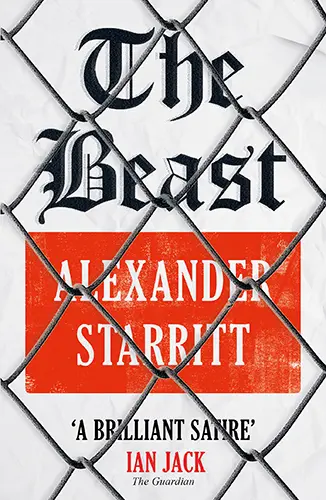
The Beast
Cover

THE BEAST
Alexander Starritt
Start Reading
About this Book
About the Author
Table of Contents
About The Beast
 |
Jeremy Underwood is a long-suffering subeditor on The Daily Beast, Britain’s mightiest tabloid. Returning from holiday, he notices two burqa-clad figures lurking outside the paper’s Kensington offices. Two male terrorism suspects have recently escaped from a mosque disguised as women; suspicion and fear have made everyone alert. Jeremy’s casual observation sets off a chain of events that spins out of control, as the great Beast feels that it is the next target of terrorism.
Alexander Starritt’s darkly funny novel is a vivid anatomy of that most uncontrollable of large creatures, the British tabloid newspaper. The ferocious professionalism and manic rivalries of a newsroom have rarely been so well described. And at the heart of the newsroom is the brooding, dictatorial figure of its editor, Charles Brython, the booming voice of Middle England. His world is under threat, and he will do whatever it takes to defend it.
This is a story in which comedy teeters on the edge of horror.
Contents
Welcome Page
About The Beast
Epigraph
Tuesday
Chapter 1
Chapter 2
Chapter 3
Chapter 4
Chapter 5
Chapter 6
Chapter 7
Chapter 8
Chapter 9
Chapter 10
Chapter 11
Chapter 12
Chapter 13
Chapter 14
Wednesday
Chapter 15
Chapter 16
Chapter 17
Chapter 18
Chapter 19
Chapter 20
Chapter 21
Chapter 22
Chapter 23
Chapter 24
Chapter 25
Chapter 26
Chapter 27
Chapter 28
Chapter 29
Thursday
Chapter 30
Chapter 31
Chapter 32
Chapter 33
Acknowledgments
About Alexander Starritt
More from Apollo
About Apollo
Copyright
Epigraph
Real blood, real intestines, slither down
the likeness of a tree.
—BRIAN PATTEN
Tuesday
1
You know that feeling where everything suddenly seems more real than it did before? It struck Jeremy Underwood, a paunchy, slightly downtrodden sub-editor in his mid-forties, when he arrived back at the office from a week’s holiday and – while pausing outside to have a cigarette and adjust to the idea of re-entering the uproar within – noticed two figures hanging around the entrance, both of them draped in the lazy folds of rich black burqas.
He worked at a newspaper that in liberal London was a synonym for brazen bigotry, hypocrisy and enraged hatred of those on whose fears it fed; and that in the rest of England was bought and read every day by two million decent people. No name was emblazoned on the wall above its revolving doors. The entrance was functional, like the short gangplank and side door by which you board a huge transatlantic liner. But a pale clock face marked with Roman numerals was bracketed above it in an octagonal iron case, and the crown it wore was the paper’s name, hammered out in the heavy gothic type that adorned its masthead: The Daily Beast.
One of the burqa-draped figures pointed up at the building while they spoke in what Jeremy presumed was Arabic. The other one bulged slightly at the right-hand side, as if carrying something under her cloak. Conscious of a slight acceleration in the labours of his tired, smoke-clogged heart, Jeremy remembered a story he’d worked on just before going away: a group of terrorists – how many? Four. Four terror suspects on bail – had escaped the oversight of the law by joining the crowd at their mosque, cutting off their electronic tags and leaving dressed in burqas.
The Beast’s leader column had been incensed by a police spokesman’s offhand remark that, even if the squad cars had arrived in time, they were hardly going to strip-search the lot of them. The column had excoriated ‘a country so enfeebled that its “authorities” are unwilling even to defend it’. The heads of the mosque and various Muslim community groups had been incensed in turn, and ‘vowed’ that they would not stand for this harassment.
And now these two shapeless figures were here, on the Beast’s own doorstep, carrying something under their cloaks.
From deep within him emerged a memory of having been struck by this sort of shock once before. It had been when he was a cub reporter in Margate, long ago. He’d been in the cinema on a date, hypnotized by the huge lights and colours, when, with startling speed and size, a gargantuan black shape loomed across it. The illusion was ruptured and, with a flash of vertigo, he was pulled backwards into his surroundings of movie theatre, Margate, the rustle of hands in popcorn.
He’d flinched in his seat, and his date – one of the assistants on the paper – laughed at him, thinking he was clowning. It was just someone sticking a hand in front of the projector. But he’d been confident then, and young, and hadn’t minded her laughing. He’d actually clowned a little more, amusing them both; and, despite a lingering unease, he’d soon slipped back into the movie.
Now, as he stood outside the Beast’s offices, the two black-clad figures gave him that same vertiginous shock. Around them all was normal: the workaday lunchtime backdrop was going on with its business. But they were here. He kept smoking, trying not to give away that he’d noticed them, and realized that his fingertips were trembling. He’d drunk half a litre of coffee in the car. Were they trembling more than usual?
He listened in, but couldn’t understand what they were saying. They continued to talk. And as he watched them, the shock receded. He told himself he was being paranoid, his perceptions warped by too many years of news. They were doubtless just two perfectly ordinary Muslim women dressed in burqas. Bombs and terrorists might appear in some places, but what he saw before him was the entrance to the paper’s offices after a week off, spent with his wife in Dublin. He’d felt almost free over there, without his daughters or any obligation to work; and, even though Louise had made him carry their passports everywhere in a scratchy security belt, he’d been lifted by a certain lightness that was still with him.
Implicit beyond the entrance was his mind’s habitual setting: the shift pattern and the late finish; the print deadline and the pension plan; the front bench and the back bench; the commute and the catchment area. Jeremy decided to think no more about terrorists, and pressed the stub of his cigarette into the soil of the raised flowerbed beside him. Then looked at the rotating doors. On every panel was stamped ‘Cardholders Only’. His card was in his pocket.
But he’d still not fully shaken off the feeling of disorientation, and to settle he addressed himself by his secret nickname, which he’d not told even his wife or his closest colleague and friend, Max. He spoke to himself in a needling but encouraging tone, the way he imagined a public-school games master might address a hopelessly un-athletic child. ‘Come on, Drudge. Come on, Drudgy. One foot after the other. Card out, through the door, up the escalator. You can manage that, can’t you?’
And up he went.
2
The escalator carried him at a stately pace up to the vast, sun-flooded atrium, six storeys high, and deposited him full in the marble glare of Lord Copper. His glory was magnified by two tall black-backed waterfalls that slid silently past him on either side, and by the gold letters inlaid above him in elegant Roman type: Copper House. In front of him, facing each other, stood an honour guard of six more busts on slim pedestals, lesser viscounts and founders, their heads set two feet lower than the great man’s. And down this avenue Lord Copper stared in undimmed fervour at all those who entered.
Jeremy gave him a nod of recognition. Despite everything, the tired old charger in his chest did still paw the ground as he came once more into this last confident stronghold of the Press. How could it not, when it felt the sheer self-belief of a paper that built in marble, that commissioned busts, that constructed waterfalls and imported carp to patrol their lower pools in seamless tessellations of red and gold?
And not just the self-belief, but the bullishness. The two newspapers in the building that were not part of the Daily Beast Administrative Trust – the Impartial, which reported mainly on conflicts in the Middle East, and the London Trumpet, which reported mainly on parties in Mayfair – were permitted no visible sign of their presence. That applied most blatantly in the new ‘Editors’ Hallway’, a Doric arcade in smooth Italian marble that led – because there was nowhere else for it to go – from the canteen to the service lifts. Inside it hung the black-and-white portraits of every man who’d achieved the highest rank on his paper: Editor of the Daily Beast, the Beast on Sunday or BeastOnline.
When the arcade was opened, the current Editor’s portrait photo had attracted sightseers from every floor of the building. By some complex system of grimaces and contortions, he’d succeeded in twisting his features into the perfect semblance of a light-hearted, affable grin. Only a man with his keen sense of posterity would have put himself through it.
Underneath Jeremy’s deep reluctance to return to work, under the slow despair engendered by years of every day doing things that he didn’t want to do, he had, in some peculiar way, missed being here, as someone moving away from a railway line misses the clanking of the trains. But even the atrium and the arcade were only outworks of what was upstairs, the Beast’s most sacred citadel.
He took the glass lift up the side of the atrium, rising above his Lordship; above the pools where the carp’s stubby snouts breached the surface to engulf spiders that had fallen from the ceiling; above the raked-gravel Zen gardens where the reporters made their phone calls, and the terraced cafe-bar where they did their scheming, and finally arrived at the outer edges of the organ from which the Beast’s bellow issued forth: the newsroom.
He pulled open the glass door and heard the relentless sound of a thousand fingers rattling across their keyboards. These belonged to the rows of exhausted twenty-five-year-olds who wrote BeastOnline. They were kept in a battery of ten desks with the most senior furthest from the door through which Jeremy had entered. On one side they had a bank of windows on to the atrium; on the other was a wall of filing cabinets and a narrow passageway. As Jeremy walked along it he watched the fever with which they gobbled whatever scraps of information they could, trying to keep up the unrelenting pace that the Beast’s website required: ‘Whinging mass murderer hunger strikes for PlayStation’ – ‘Is overpopulated Britain on the brink of CANNIBALISM?’ – ‘You’re fired! ISIS executes downed pilot with flamethrower.’
None gave him so much as a glance. They were leaning into their screens, racing, racing, always racing to be first in the world. ‘Peanut butter contains cancer-causing fungus’ – ‘Shocking pictures: Law students forced to fund degrees by stripping online’ – ‘Yew were always on my mind: the tree that looks like ELVIS.’
He was lucky, he thought, that he’d been born early enough for the print edition to see him through to retirement. Some friend of his wife’s had asked whether he could arrange work experience for her teenage son, who wanted to be a journalist. He’d prevaricated, sort of agreed to look into it, and done nothing, out of equal parts apathy and protectiveness. But really he should show the boy and his mother the state of those who wrote for BeastOnline: young skin made pasty by lack of sunlight, dulled gazes, lank hair, stress-related acne and forearms that cramped with repetitive strain injury as they lifted the Maltesers, crisps, chocolate biscuits and tea that kept the onliners alive and awake while they ruined their eyes, their health and their profession. Office legend had it that if you stood outside the BeastOnline toilets at any time of day or night you would hear the sound of weeping.
It made Jeremy want to tell them that they were still childless and re-trainable and not yet inescapably committed to this life. For him, his two daughters were like hostages – beloved, all-important hostages – held against his continued compliance. Particularly the elder one, Elsa – who was already a teenager but whom he could somehow still picture most vividly at about four or five, when her hair had been a brighter, purer hue of blonde and every feature of hers that was strangely his but not his own had enslaved him with love. She especially was a beautiful little blonde hostage, whose power to condemn him to work he accepted absolutely. With the younger one, Jenny, it was somehow less complicated and less intense; she was simply another hostage, of course also adored, backing up the first.
But even if he warned this teenage candidate to stay away before he ended up trapped in it and having paranoid thoughts about women in burqas, what good would it really do? Every kid thought he’d be the Editor one day. He himself hadn’t believed in the shackles until he was wearing them.
He walked on, past the onliners and their overseers, who were huddled around a screen and peering at a photo of the environment minister posing on a beach in skimpy Speedos. One was saying, ‘Is that a wink? Is he winking? Oh, he’s going to regret that.’
Beyond them, the noise grew louder and more diffuse as the space opened up. The whole of BeastOnline occupied just one outlying arm of the newsroom.
Before him, hundreds of people typed or talked on the phone or asked each other questions in a low maze of desks spreading out under a pressboard ceiling. It was broken up by square pillars festooned with rotas, complaints and marked-up pages, and at the distant edge was a glowing strip of frosted windows on to Kensington High Street, whose natural light hardly encroached on the room’s artificial brightness. Everywhere were loose sheaves of printed paper, empty cups and sandwich wrappers, and all of it and everyone was slightly scruffy, slightly neglected; the computers old, the bins full, the desks not decorated with anything personal.
Demarcating the territories within the newsroom were flimsy partitions on which the departments pinned A3 prints of their best work. Features had a picture of an apparently decapitated Princess Beatrice pulling her own head out of a top hat. Health had one that looked like a malevolent crab. In front of this the Health editor, a carelessly dressed woman in her fifties, was saying into a phone, ‘Then find out what kind of fucking growth it fucking well is. And if you can’t find out, get one yourself and ask a fucking doctor.’
To Jeremy’s left, on the wall towards which the newsroom pointed, was a grid of bright, fuzzy squares. These were the English and American news channels, projected there soundlessly alongside an unending scroll of BeastOnline. In one square, a serious blonde in a trouser suit was belabouring a group of surly proletarians. In another, a reporter was talking earnestly into a microphone while behind him dense black smoke chugged from a burnt-out petrol station. The slug at the top left of the screen read ‘TERROR’, and Jeremy’s mind jumped to the two people in burqas he’d seen outside; he wondered whether they were still there. In the next square, someone in Parliament was shaking a roll of paper at the indifferent opposition, the green benches almost empty. Beside that was the spool of BeastOnline: ‘How romcoms can turn you LIBERAL’ – ‘Shhh! 60% of women can’t keep secrets’ – ‘Rejected migrants given luxury mosque, and YOU’RE paying for it.’
Set just off from the flat but ceaseless movement on these screens was his own department, around which all others were arranged: Production, the very belly of the Beast. From this cluster of grey desks were reporters sent out to sleep in hedges and pick through bins; from here were photographers told to get closer to the fighting; from here were envelopes of cash dispatched to prostitutes, to PAs, to political advisers. And to here copy was returned, to have its grammar disentangled, its ignorance corrected and its significance identified; it was here that raw, mud-caked nuggets of information were cut and polished to have revealed in them the shine and sparkle of the news. And fixed to one of this department’s pillars was the symbol of the newspaper’s – of all English newspapers’ – true home, prised loose and taken the night they went into exile: a metal road sign reading ‘EC4 Fleet Street’.
In the line of desks closest to the TV wall, and facing away from it into the newsroom, the bosses were already seated and typing. That meant the Editor was in personal charge today; otherwise they would still be standing around drinking coffee. In front of that back bench were the subs’ desks, taken out of their traditional rows by management consultants and arranged into what Jeremy had reluctantly become modern enough to call ‘pods’. Some of the men who’d traditionally been middle-bench subs and were now ‘pod leaders’, men his age, were already at their desks. Of the younger generation, only one, Lauren, was wandering around. She must have come in early.
Max stood up when he saw him, took the pencil he was chewing from his mouth and raised his hand in a loose salute.
Jeremy broke into a wide grin and on impulse gave him the finger.
Max made his swaggering walk towards him. By right of being generally acknowledged as the best sub, he was allowed to come as close to not wearing a tie as a news sub ever could: a black one that was almost invisible against his black shirt. The shirt was tucked loosely into black trousers, from which it escaped behind him. His black hair was gelled, and it glistened as if newly glued along the deep comb-furrows from forehead to nape. He hunched a little from years at the keyboard, one shoulder slightly higher than the other.
He put out his hand and said, ‘Alright, Jez?’
Jeremy shook it. ‘Alright?’
Max didn’t usually stoop to the banterous riffing that was the newsroom’s idiom and pastime, but was so pleased to see Jeremy that, not knowing how to express it, he reached for the nearest mode. ‘Your face is a bit blotchy. You didn’t shave all week, did you, till this morning? Were you trying to hide your ugly mug from the Irish?’
‘Thanks for that.’ Jez was very pleased to see him too.
‘Go on then, get your holiday anecdotes out of the way. How are you?’
‘Oh, you know, glad to be back.’
Max chuckled. ‘You lie so well, my friend.’
Before they could pick up all their threads, the chief sub bustled up, bald, voluble and menacingly avuncular. ‘Hold on,’ he said. ‘Did I just hear you say you were glad to be back?’
Jeremy slipped into the newsroom tone: ‘Back in England, not back here. I’ve not gone mad.’
The chief sub pretended to wipe his expansive brow. ‘Phew. I thought you must have caught some sort of brain disease out there. Where were you again?’
‘Dublin. It was—’
The chief sub pantomimed horror and grasped for Max’s arm to steady himself. ‘He has gone mad. You went on holiday to Ireland? What’s wrong with you? Don’t you get enough violence and alcoholism in this office?’
Max watched, amused.
The chief sub carried on. ‘Did you like it?’
Jeremy shrugged. ‘Well, it wasn’t—’
‘Of course not! No one likes Ireland. Not even the Irish. Why do you think they’re always swarming off to other people’s countries? Australia, America, New Zealand. Imagine wanting to move to Australia – what a noxious fart your life must be.’
‘Or Canada,’ prompted Max.
‘Canada, right. Canada’s lovely. No one for thousands of miles. It’s like being dead. Wonderful. Of course, the food’s shit, but they don’t know any better. Go there next time. You won’t come back spouting gibberish about being glad to be here.’
‘Look at him,’ said Max, egging on the chief. ‘He’s gone on holiday and not even managed to get a tan.’
The chief sombrely shook his blocky head, as at someone beyond the reach of reason. Jeremy was smiling openly at all this attention and went to speak. But the chief was already back to thinking about edition, and spoke over him: ‘I’ve put you under the supervision of Max today, just in case you do anything mental now you’ve had a sniff of freedom.’
‘What do you mean, under his supervision?’
‘You’re not on the middle bench, Little Miss Shamrock. Just one of Max’s grunts. Front bench. Front rank. Cannon fodder. Just like the Irish.’
‘What do you mean?’ Jeremy flushed as if he’d drunk too much hot tea at once, and his shirt collar seemed to tighten around his neck. ‘I’m not one of the grunts. I’ve been on the middle bench for… since I came here.’ He heard how plaintive it sounded. ‘That’s fourteen years.’
‘Not today, Gerry Adams. Britain says no.’
‘But who’s on the middle bench instead of me?’
‘Lauren.’
‘Lauren? But she’s about eight years old.’
Max tried to explain. ‘She started doing it while you were in Dublin.’
The Story Continues on BooksBarbecue!
Enjoyed this preview? ❤️ Do not stop here!
Read the complete book free online → 🔗
Continue reading now on BooksBarbecue and discover every page!
Love reading? Bookmark BooksBarbecue.com for more amazing books!
Happy Reading!