Tank Water
Cover
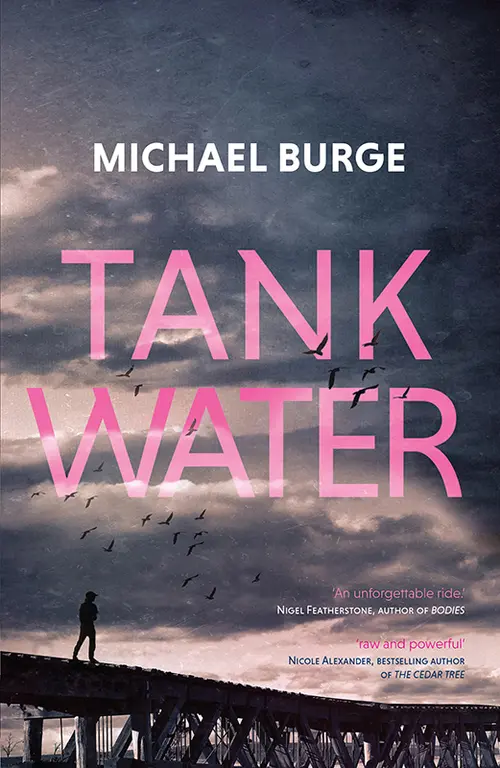
TANK WATER
‘An absolute page-turner.’
Rosalie Ham, bestselling author of The Dressmaker
‘The parochial under-belly of rural Australia is laid bare in this raw and powerful story that delves into the emotional toll and tragic consequences of gay-hate crime.’
Nicole Alexander, bestselling author of The Cedar Tree
‘Clear-eyed and suspenseful, Tank Water exposes more than one taboo of Australian life away from the big cities. An unforgettable ride.’
Nigel Featherstone, author of Bodies of Men
‘Written in a matter-of-fact way, Mike’s confrontational first novel made me think about life, death and sexuality in the country, because Burge has the rural lineage to make it real.’
Margo Kingston, author and journalist
‘It’s time to move beyond a city perspective on rural gay Australians – so often imbued with pity, condescension and silly stereotypes – to hear our own voices on our own terms. Michael Burge is one of our most compelling, nuanced and enjoyable voices.’
Rodney Croome AM, LGBTIQ equality advocate
‘The writing had me there; right inside the story. Tank Water is such a poignant insight into the dynamics of an extended rural family with all the secrets, contradictions and prejudices that family members inevitably confront.’
Mary Moody, author and broadcaster
Title Page

Dedication
For Pat Burge
Prologue 2005
PROLOGUE
2005
Daniel listened to his son’s idiotic answering machine for the fourth or fifth time, waited for the beep, cleared his throat and went to say everything; but when the right words still wouldn’t come, he threw the receiver down and went for another drink.
Bottles rattled in the fridge door as he yanked it open. He twisted the top off one and threw his head back for the first gulp. From that angle the leftover sausages on the top shelf looked like his best option for tea, but their yellowed skin reminded him of his nephew’s bloated body inside the freezer at the police station.
Even after shutting his fridge the smell was there. It’d been hanging around for days, like there was mortuary fluid on his shoes. Whenever he noticed that sickly blend of chemicals, Daniel couldn’t help but picture the photographs of Tony’s remains before they’d removed him from the river below the Kippen Bridge.
He turned to the sink and washed his hands again, but the mossy scent coming down the pipes from the tank didn’t help. What water did to a corpse — filling it with more death than it seemed to have room for — was the very worst thing he’d seen in twenty-five years of police work. The head, shoulders and most of the torso had been submerged, swelling the guts. The legs were broken and lying at awkward angles, entirely concealed by reeds and the thicket of poplars.
Daniel reached for his beer and flicked the radio on. Music he didn’t recognise unsettled him, but the news would come on in a few minutes. Word was already getting around town. He hoped no one had contacted the Kippen station with the worst of the stories. Tony would probably still be lying there if a jogger’s dog hadn’t sniffed him out. The park below the bridge was known for attracting lonely types, and his nephew certainly fit the bill. Every ten years or so, one of them jumped.
He reached into the bread bin. Only crusts left. Everything else was in the fridge, but Daniel wasn’t game to open that again. Nothing much in the cupboards. He wasn’t in the habit of going into Kippen just for shopping, not since he’d finished up at the police station. Anyhow, there were beers left from his retirement party on the back seat of his car.
As he pushed through the screen door onto the verandah, rabbits scurried off the last patch of lawn by the tap. A cloud of dust in the middle distance partly shrouded his brother inside his tractor cabin, heading for home. Beyond that, already out of the sun’s reach, Deloraine’s homestead blended into the dark furrows that would push up Bill’s cheeky early sorghum crop soon enough.
Daniel sucked at his drink and swirled each mouthful around his teeth before swallowing, testing whether it could somehow be right to head over there and hang around for something to eat. For more than twenty years, Doris had told him to come around for a meal whenever he needed. He had a whole unopened carton of beer to offer.
Sitting up in his cabin, Bill was a bloody wonder. He never let the farm go, even after the worst life threw at him. With the chance of frost right through to November it was dicey to plant so early, but Daniel knew why his brother did things that way. It was like they couldn’t lose no matter how much they gambled. Bill planted crops even if the conditions were all wrong. He loved feeling like a winner in spite of the weather reports, and there was no one out here to overlook your failures. It had been a huge risk, but he’d pulled the tough older brother act and forced Daniel into sowing sorghum on every square inch of Deloraine and The Mulgas, less than a month after little Gregory had died.
Daniel gnawed the inside of his cheek, remembering his own dead boy.
The hard work of that huge crop had paid off richly for them, but it had been Daniel’s last full season of farming before he’d pulled the skittish younger brother act, sold the land and applied to become a cop. Harvesting his share of nearly five thousand acres in the solitude of his cabin while he’d sobbed for Gregory had done him in. All that was left of The Mulgas’ perfect cropping country was the home yard.
‘Thank Christ,’ he muttered as though someone was there. His colleagues were right. He’d started talking to himself. Former colleagues.
Bill changed gears and the tractor disappeared behind the tall pine trees that obscured the machinery shed at Deloraine. As Daniel watched, he felt the air cool and noticed the gloom of his own house stretching over the field between the homesteads. The unmistakeable shadow of The Mulgas’ water tank steadily covered the dried grass, the gravel laneway and the bare fruit trees along the fence.
He shouldn’t go and bother his brother and sister-in-law. The Mulgas had him in its grasp, and staying in was better than witnessing poor old Bill having to go home to Doris. He’d be trying to disappear into the woodwork even more than usual, and she would be busy with funeral arrangements like it was a bloody dance at the town hall.
Daniel heaved a sigh, drowned it with another mouthful, and prepared to sit with the sorrow in the homestead that once rattled with a wife and kids. There was just one more thing to do before he’d put the lock on the top gate, fetch the beers in and call it a night.
He flung the door open, killed the radio, went for the phone and dialed the number he’d circled in the newspaper next to his son’s photograph. While he waited for the comedy act of Jamie’s message, still with that girlish tone, Daniel finished his beer.
‘You’ve reached James Brandt, journalist at the newspaper everyone loves to hate. I’m not available to take your call at the moment, but please leave me a message if you’ve got the scoop.’
Right off the beep, Daniel spoke.
‘Jamie,’ he said and burped. He wasn’t about to let his son imagine anything had changed. ‘It’s Dad. Look, I’ve been trying to catch you for a few days. It’s just that, well there’s no easy way to say it. There’s been a death in the family. Just call me, son. Funeral’s next week. There’s a couple of things to discuss, but you don’t need to be here.’
One 2005
ONE
2005
James woke to the announcement of the small aircraft’s descent into the border country, and the couple sitting in front of him started to point out the landmarks below. But the sight of isolated farms along the meandering river left him unmoved. Sunlight was reflecting off dams as the plane cut through a layer of low cloud onto the tarmac, without a hint of turbulence. Touchdown was so smooth it felt surreal.
He was the only one getting off at Wishaw. An older couple waiting to board the last leg to the coast smiled in the tiny glass-walled terminal, but James gave them nothing. The coffee cart and car rental desk were closed. An envelope with his name on it contained the key.
The squat blue hire car was the only vehicle beyond the main entrance. James threw his bag into the passenger seat and let the road take him down the heavily-wooded ridges around Wishaw. After an hour the dense forests gave way to farmland, then James glided back into Kippen just as the towering pair of cylindrical concrete water towers emerged silently from the mist.
At the crossroads, the town’s century-old pub left him completely devoid of nostalgia. The heritage train station looked like it had been renovated into a tourist centre with a café. It was closed. No chance of a coffee yet, so James accelerated straight ahead up the ramp onto the Kippen Bridge.
It seemed right to take a look. That’s what journalists did.
As he crossed the road bridge the reflections coming off the adjacent railway viaduct made him blink. He squinted in order to find the turnoff at the far side, braked at the new-looking gate, turned onto the concrete road that had replaced the old track, and descended into the parkland below the pair of bridges.
The place couldn’t have appeared less like the scene of a suicide. James took in the signs of recent landscaping: a curved planting of native saplings and a sign about wildlife. As he pulled to a stop he also noticed the utes parked at the margins of the bitumen car park and let out a groan, picturing the headline:
Prodigal son goes straight to sex spot.
Since he was already thinking up screamers to avoid the angst of new situations, it was no wonder James found himself drawn to the frosty shadows below a lonely bridge at a gay beat, a journalist exhibiting enough anxiety for his boss to suspect it was starting to affect his work.
As he emerged into the cold air he heard waterfowl calling sweetly from the far bank. Kids were walking to school across the footpath high above, singing. This harmless place was where Dad said Cousin Tony had jumped to his death sometime in autumn. Judging by the bare branches of poplars reaching up towards the bridge, their leaf buds looking ready to unfurl in a matter of days, winter was swiftly coming to an end in the border country.
James spied the broad thicket of trees beneath the bridge, strode across the car park and pushed through a nettle-filled ditch into the shadows under the concrete span. After about twenty metres, the water’s edge stopped him. On the far side of a wide pool dammed by concrete pylons, scraps of police tape had been left tied around some of the timber struts that held up the railway line. As he scanned the thick layers of greenery that concealed the place where Tony’s body must have been found, a flock of birds shook the long reeds and took off towards the cliffs.
The parklands sat at the lowest point of a high-sided gorge. From down here, both road and railway bridge connected the rocky walls that rose each side of the river. Their undersides looked about ten metres higher than the tops of the tallest poplars. James dropped his head and squeezed his eyes shut against the many dangerous looking gaps that someone could have jumped through.
‘Fuck, Tony. What the fuck?’ he said.
Images of victims came to him, all the black-and-white death masks he’d encountered in police photographs while working the crime rounds; restless souls who’d overdosed, severed, gassed, poisoned or jumped their way out of life, often for no apparent reason.
But James had an idea why the body of Kippen’s favourite son lay undiscovered in the river for almost two months before anyone noticed he was missing. As soon as he’d arrived and spotted the public toilet with the utes parked at a distance, the angle of this suicide story had revealed itself.
Detective Constable Daniel Brandt would have missed all the clues. Yet James felt absolutely no sense of superiority over his father, the way his newsroom colleagues did whenever they bitched about how cops always downplayed the obvious.
Looking back towards the safety of his hire car, James sensed that he might be about to pass beyond reason. The unstable feeling came creeping into his gut like the ripple of nausea, just as his counsellor had predicted.
The man assigned by James’s newspaper to give him six free sessions looked depressed and aloof himself, right on cue, every third Thursday afternoon of the month. That made it very easy, in the neutral tones of the consulting room, for James to brush aside any suggestion that coming home for the first time in two decades might result in feelings of detachment. But now that he was back at Kippen, he was desperate to recall his counsellor’s throwaway advice about being self-aware.
He pushed impatiently back through the tall weeds until he could see the tops of the vehicles parked by the toilets. Morning sun was sharpening everything in the park at the bottom of the short, steep hill behind the shops. Retreating was an option, but returning to his car, driving back to the main street and waiting for the vague appointment he’d made at the real estate office wasn’t going to make him feel any better than going into the toilet block, pretending to take a piss, and just seeing what there was to see.
‘If you feel yourself starting to go emotionally numb, pause and make sure you’re experiencing your home town as it is, not as it was. Name the feelings, make notes if you need.’
That had been his counsellor’s suggestion. Then, true to form, James had started treating Tony’s death like it was a news assignment, made room on his schedule, booked his flights, and packed for two days away as though anaesthetised.
Fuck it, James thought. Let’s see how detached I really am.
He passed quickly up the slope away from the river, feeling like he could be a stranger just seeking directions. The gritty sound of his footfalls seemed dangerously loud as he crossed the car park and approached the brick toilet block with its fresh coat of paint. Only when he was standing in the deserted entranceway, its blazing squares of light illuminating the ceiling, did James start to feel an unwelcome warmth. Turning back now would only put him in the pathway of any man following from one of the vehicles.
Around the corner, two backs greeted him at the urinal. A tall guy in a cowboy hat made fleeting eye contact and James could see he was thick-jawed. The other was older, in a grey farmer’s parka and a wide, flat-brimmed hat.
James moved into a stall and almost immediately the door pushed open. Hoping to see the blunt, handsome face of the cowboy, James turned. But it was the old guy reaching one red, creased hand through and covering the place where the bolt would go.
Suddenly cold to his core, James pushed him out and locked the door. There was a scuffle of shoes and the sound of a zipper closing.
The cowboy laughed from the urinal. ‘Nice to see someone young, for once.’
James swore under his breath.
‘You come here at night?’ the cowboy said.
James wrenched the door open, prepared to push past if he had to, but the cowboy was busy manhandling himself, bottom lip glistening below a much older face than James had imagined.
Outside, a white ute sped up the steep rise towards the main road as James crossed to the hire car. He got in feeling as though the real James had been left watching in the warmth of the vehicle while a spineless shell had gone looking for the site of a suicide but ended up cruising for sex.
Another headline came to him with relief and an embarrassed laugh as he turned the key.
Local graziers in public sex sting.
Back in town for just one hour. Reasons why this trip home is different:-
I’m only here for two days max (calm down).
Kippen has a gay beat (who knew?).
Local farmers are cruising for sex with men (can’t believe I’m even writing that down).
I shouldn’t be going to beats (Dylan will kill me if he finds out).
Tony might have killed himself because of what happened in 1985.
Two 1985
TWO
1985
James couldn’t decide what was worse: being forced to stay with Dad or having to waste most of the school holidays on meeting his father’s new girlfriend.
For weeks, he’d weighed these options ahead of the day-long rail journey from the city to Kippen with his brother, which involved two changes of train and started with their mother embarrassing James and Alan during her big farewell from Sydney’s Central railway station.
‘I don’t want either of you to get drawn into any talk about land, or inheritance, or stuff like that, okay? There’s bound to be talk because Tony’s getting married,’ she said, pushing the packed lunches and bottles of juice on them.
‘Okay, Mum,’ James said, rolling his eyes because people had noticed.
‘The new floozie might be with your father when he collects you from the train station, so be nice,’ she said in her pre-school teacher’s voice, slow and falsely polite when directed at anyone over three feet tall.
‘Rightyo.’
‘Stick with your brother, and see you up there in a couple of days. Tell them all Rebecca Brandt is coming back, and she’s fabulous!’ she said, one hand on her hip, the other behind her head, laughing.
James smiled and waved to cover up his intention to do whatever he wanted.
He ate the packed lunch before they reached Newcastle, ditched the juice on the platform, and used his emergency telephone money to buy coffee from the canteen while they waited for the rear carriages to be uncoupled.
‘Mum said you’re supposed to sit with me,’ Alan said, not looking up from his electronic game when James returned to their seats.
There it was. Alan was seventeen. James was supposed do whatever he said, like almost sixteen wasn’t almost seventeen. He ignored his brother and sat at the other end of the carriage while the train rattled through dry uplands to an isolated station. Here, in sight of machines cutting endless wheat fields, they waited an hour for a very late, single-carriage railcar to arrive from the north, unload nobody to connect to Newcastle, and collect only the brothers for Kippen.
The familiar final leg across the vast, harvested plain did nothing to settle James’s rising panic at having come a very long way only to end up nowhere. When the carriage eventually slowed to cross the bridge over the gorge that split Kippen in two, he looked down and saw the surface of the river far below in the shadows.
Even before they trundled to a complete stop, Alan left James to his mood and ran to find Dad. James lingered, not wanting this dumb holiday to begin, but Cousin Tony suddenly popped his bright, blond head through the carriage door and smiled so broadly it made James feel like laughing.
‘He’s in here!’ Tony shouted, filling the doorway with his big frame and scooping up James’s backpack. ‘Your dad’s on night duty until the wedding so you’re staying with us now,’ he added, stepping back onto the platform and marching off with giant strides.
There was no end to the cousins’ inside information about the entire Brandt family. Their long shadows stretched out to James across the empty car park by the huge timber structure that marked the very end of the line. Leaning against the familiar white station wagon, parked in the deep shadows cast by Kippen’s enormous concrete water towers, Alan was already showing off to Tony’s sister Yvonne, and Aunty Doris was brushing away blowflies.
‘Hurry up,’ his aunt said, getting in and starting the car. ‘I have to telephone your mother and let her know you’re both here in one piece.’
After the crossroads, the way out of town took them back across the bridge, past the motel and the abattoir, and gradually climbed into higher country.
James made eye contact with Aunty Doris a few times in the rear-vision mirror, while she nodded at whatever Alan was saying about his school reports and the gun club. Yvonne sat quietly on her brother’s lap in the front seat while Tony kept up the questions about life in the big city.
As the sun levelled with the horizon, they approached Brandt Lane and James stopped trying to keep up with the conversation.
First, he looked for the three white drums on their timber posts; letterboxes mounted in a row for three family farms. That’s how you knew where to turn off the long, straight Kippen Road, between stretches of the same knee-high yellow grass that ran for miles.
The Story Continues on BooksBarbecue!
Enjoyed this preview? ❤️ Do not stop here!
Read the complete book free online → 🔗
Continue reading now on BooksBarbecue and discover every page!
Love reading? Bookmark BooksBarbecue.com for more amazing books!
Happy Reading!