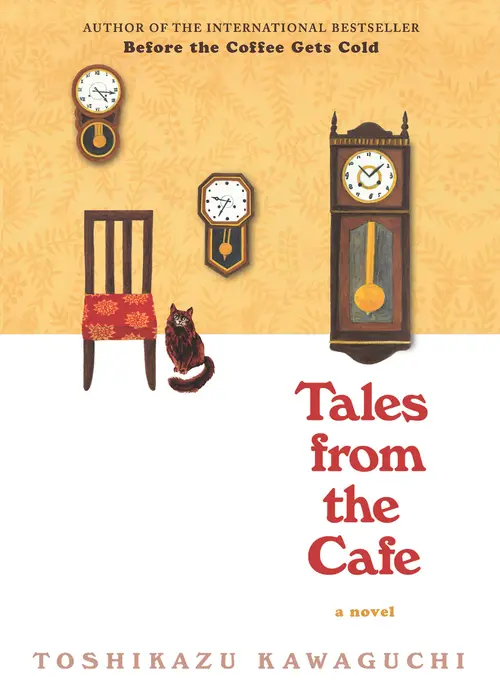
Tales from the Cafe
Cover
Praise
Praise for Before the Coffee Gets Cold
“Heartwarming, quirky, and wistful.”
—Huffpost
“The narrative is deeply moving.”
—Chicago Review of Books
“The story is gold. Before the Coffee Gets Cold is perfect for anyone who wants to feel connected right now.”
—Bookreporter
“Kawaguchi...has a surprising, unerring ability to find lasting emotional resonance. Interwoven into what initially feels like a whimsical escape are existential conundrums of love and loss, family and freedom, life and death.”
—Christian Science Monitor
“This charmingly magical novel is about discovering happiness despite the pasts that we desperately want to revisit.”
—The Harvard Crimson
“Kawaguchi’s tender look at the beauty of passing things...makes for an affecting, deeply immersive journey into the desire to hold onto the past.”
—Publishers Weekly
About the Author
Toshikazu Kawaguchi was born in Osaka, Japan, in 1971. He has produced, directed and written for the theatrical group Sonic Snail. His works as a playwright include COUPLE, Sunset Song and family time. His play Before the Coffee Gets Cold won the grand prize at the Suginami Drama Festival. Before the Coffee Gets Cold has become an international bestseller and has been adapted for the screen in Japan.
i
Best Friends
Gohtaro Chiba had been lying to his daughter for twenty-two years.
The novelist Fyodor Dostoevsky once wrote, “The most difficult thing in life is to live and not lie.”
People lie for different reasons. Some lies are told in order to present yourself in a more interesting or more favorable light; others are told to deceive people. Lies can hurt, but they can also save your skin. Regardless of why they are told, however, lies most often lead to regret.
Gohtaro’s predicament was of that kind. The lie he had told plagued him. Muttering things to himself, such as “I never wanted to lie about it,” he was walking back and forth outside the café that offered its customers the chance to travel back in time.
The café was a few minutes’ walk from Jimbocho Station in central Tokyo. Located on a narrow back street in an area of mostly office buildings, it displayed a small sign bearing its name, “Funiculi Funicula.” The café was at basement level, so without this sign, people would walk by without noticing it. Descending the stairs, Gohtaro arrived at a door decorated with engravings. Still muttering to himself, he shook his head, swung round and began walking back up the stairs. But then he suddenly stopped with a thoughtful expression on his face. He went back and forth for a while, climbing the stairs and descending them.
“Why not stew over it after you come in?” said a voice abruptly.
Turning around, startled, Gohtaro saw a petite woman standing there. Over her white shirt she was wearing a black waistcoat and a sommelier’s apron. He could tell instantly she was the café’s waitress.
“Ah yes, well...”
As Gohtaro began to struggle with his response, the woman slipped past him and briskly descended the stairs.
clang-dong
The ring of a cowbell hung in the air as she entered the café. She hadn’t exactly twisted his arm, but Gohtaro descended once again. He felt a weird calmness sweep over him, as if the contents of his heart had been laid bare.
He had been stuck walking back and forth because he had no way of being certain that this café was actually the café “where you could return to the past.” He’d come there believing the story, but if the rumor his old friend had told him was completely made up, he would soon be one very embarrassed customer.
If traveling back to the past was indeed real, he had heard there were some annoying conditions that you had to follow. One was that there was nothing you could do while in the past that would change the present, no matter how hard you tried.
When Gohtaro first heard that, he wondered, If you can’t change anything, why would anyone want to go back?
Yet he was now standing at the front door of the café thinking, Even so, I want to go back.
Had the woman read his mind just now? Surely a more conventional thing to say in that situation would be, Would you like to come in? Please feel welcome.
But she had said, Why not stew over it after you come in?
Perhaps she meant: yes, you can return to the past, but why not come inside first before deciding whether to go or not.
The bigger mystery was how the woman could possibly know why he had come. Yet he felt a flicker of hope. The woman’s offhand comment was the trigger for him to make up his mind. He reached out, turned the doorknob, and opened the door.
clang-dong
He stepped into the café where, supposedly, you could travel back in time.
Gohtaro Chiba, aged fifty-one, was of stocky build, which was perhaps not unrelated to him having belonged to the rugby club in high school and at university. Even today, he wore an XXL-sized suit.
He lived with his daughter Haruka, who would be twenty-three this year. Struggling as a single parent, he had raised her alone. She had grown up being told, Your mother died of an illness when you were little. Gohtaro ran the Kamiya Diner, a modest eatery in the city of Hachioji in the Greater Tokyo Area. It served meals with rice, soup and side dishes, and Haruka lent a hand.
Entering the café through the six-foot-high wooden door, he still had to pass through a small corridor. Straight ahead was the door to the toilet, in the center of the wall to the right was the entrance to the café. As he stepped into the café itself, he saw a woman sitting at one of the counter chairs. She instantly called out, “Kazu...customer!”
Sitting beside her was a boy who looked about elementary school age. At the far table sat a woman in a white short-sleeved dress. With a pale complexion and a complete lack of interest in the world around her, she was quietly reading a book.
“The waitress just got back from shopping, so why don’t you take a seat. She’ll be out soon.”
Obviously caring little for formalities with strangers, she spoke to Gohtaro casually, as if he was a familiar face. She appeared to be a regular at the café. Rather than replying, he just gave a little nod of thanks. He felt the woman was looking at him with an expression that seemed to say, You can ask me anything you like about this café. But he chose to pretend he hadn’t noticed and sat down at the table closest to the entrance. He looked around. There were very large antique wall clocks that stretched from floor to ceiling. A gently rotating fan hung from where two natural wooden beams intersected. The earthen plaster walls were a subdued tan color, much like kinako, roasted soya flour, with a hazy patina of age—this place looked very old—spread across every surface. The windowless basement, lit only by shaded lamps hanging from the ceiling, was quite dim. The entire lighting was noticeably tainted with a sepia hue.
“Hello, welcome!”
The woman who had spoken to him on the stairs appeared from the back room and placed a glass of water in front of him.
Her name was Kazu Tokita. Her midlength hair was tied back, and over her white shirt with black bow tie she wore a black waistcoat and a sommelier’s apron. Kazu was Funiculi Funicula’s waitress. Her face was pretty with thin almond eyes, but there was nothing striking about it that might leave an impression. If you were to close your eyes upon meeting her and try to remember what you saw, nothing would come to mind. She was one of those people who found it easy to blend in with the crowd. This year she would be twenty-nine.
“Ah...um... Is this the place...that er...?”
Gohtaro was completely lost as to how to broach the subject of returning to the past. Kazu calmly looked at him fluster. She turned toward the kitchen and asked, “When do you want to return to?”
The sound of coffee gurgling in the siphon came from the kitchen.
That waitress must be a mind reader...
The faint aroma of coffee beginning to drift through the room sparked his memory of that day.
It was right in front of this café that Gohtaro met Shuichi Kamiya for the first time in seven years. The two had been teammates who played rugby together at university.
At the time Gohtaro was homeless and penniless, having been forced to surrender all his assets—he had been the co-signer on a loan obligation for a friend’s company that had gone bankrupt. His clothes were dirty, and he reeked.
Nevertheless, instead of being disgusted by his appearance, Shuichi looked genuinely pleased to have met him again. He invited Gohtaro into the café, and after hearing what happened, proposed, “Come and work at my diner.”
After graduation Shuichi had been scouted for his rugby talent by a company in a corporate league in Osaka, but he hadn’t played even one year before an injury cut short his career. He then joined a company that ran a restaurant chain. Shuichi, the eternal optimist that he was, saw this setback as a chance, and by working two or three times as hard as everyone else he rose to become an area manager in charge of seven outlets. When he got married, he decided to strike out on his own. He started a small Japanese restaurant and worked there with his wife. Now he told Gohtaro that the restaurant was busy and that some extra help would be welcome.
“If you accepted my offer, it would be helping me out too.”
Run down by poverty and having lost all hope, Gohtaro broke down in tears of gratitude. He nodded. “Okay! I’ll do it.” The chair screeched as Shuichi stood up abruptly. Grinning cheerfully, he added, “Oh, and wait till you see my daughter!”
Gohtaro still wasn’t married and he was a little surprised to hear that Shuichi had a child.
“Daughter?” he responded with his eyes widening.
“Yeah! She’s just been born. She is so—cute!”
Shuichi seemed pleased with Gohtaro’s response. He took the bill and strolled over to the cash register. “Excuse me, I’d like to pay.”
Standing at the register was a fellow about high-school age. He was very tall, close to six feet in height, and had distant, thin almond eyes.
“Comes to seven hundred and sixty yen.”
“Here, from this please.”
Gohtaro and Shuichi were rugby players and bigger than most, but they both looked up at the young fellow, then looked at each other, and laughed, probably because they were thinking the same thing, This guy is built for rugby.
“And here’s your change.”
Shuichi took the change and headed for the exit.
Before he was homeless, Gohtaro was quite well-off, having inherited his father’s company that made over one hundred million yen a year. Gohtaro was a sincere kind of guy, but money changes people. It put him in a good mood, and he started squandering it. There was a time in his life when he thought that if you had money, you could do anything. But his friend’s company to which he had co-signed as guarantor folded, and after being hit with this huge debt obligation his own company went under too. As soon as his money was gone, everyone around him suddenly started treating him like an outcast. He had thought those close to him were his friends, but they deserted him, one even saying openly to his face, What use are you without money?
But Shuichi was different; he treated Gohtaro, who had lost everything, as important. People willing to help someone struggling, without expecting anything in return, are rare indeed. But Shuichi Kamiya was one such person. As he followed Shuichi out of the café, Gohtaro was adamant in his resolve: I’ll repay this favor!
clang-dong
“That was twenty-two years ago.”
Gohtaro Chiba reached for the glass in front of him. Wetting his parched throat, he sighed. He looked young for fifty-one, but a scattering of grey hairs had begun to show.
“And so, I started to work for Shuichi. I put my head down and tried to learn the job as fast as I could. But after a year, there was a traffic accident. Shuichi and his wife...”
It had happened more than twenty years ago, but the shock of it had never left him. His eyes reddened and he began choking on his words.
Sluurrrp!
The boy sitting at the counter began noisily sucking the final drops of his orange juice through his straw.
“And what happened then?” Kazu asked matter-of-factly, not pausing in her work. She never changed her tone no matter how serious the conversation. That was her way of keeping herself at a distance from people, perhaps.
“Shuichi’s daughter survived, and I decided to bring her up.”
Gohtaro spoke with his eyes cast down as if muttering to himself. Then he stood up slowly.
“I beg of you. Please let me go back to that day twenty-two years ago.”
He bowed long and deep, bringing his hips to a near right angle and dropping his head lower.
This was the café Funiculi Funicula. The café that became the subject of an urban legend some ten years ago as being the one where you could go back in time. Urban legends are made up, but it was said that at this café, you could really return to the past.
All sorts of tales are told about it, even today, like the one about the woman who went back to see the boyfriend she had split up from, or the sister who returned to see her younger sister, who had been killed in a car crash, and the wife who traveled to see her husband who had lost his memory.
In order to go back to the past, however, you had to obey some very frustrating rules.
The first rule: the only people who you can meet while in the past are those who have visited the café. If the person you want to meet has never visited the café, you can return to the past, but you cannot meet them. In other words, if visitors came from far and wide across Japan, it would turn out to be a wasted journey for practically all of them.
The second rule: there is nothing you can do while in the past that will change the present. Hearing this one is a real letdown for most people and normally they leave in disappointment. That is because most customers who want to return to the past are wishing to fix past deeds. Very few customers still want to travel back after they realize they can’t change reality.
The third rule: there is only one seat that allows you to go back in time. But another customer is sitting on it. The only time you can sit there is when the customer goes to the toilet. That customer always goes once a day, but no one can predict when that will be.
The fourth rule: while in the past, you cannot move from your seat. If you do, you will be pulled back to the present by force. That means that while you are in the past, there is no way to leave the café.
The fifth rule: your stay in the past begins when the coffee is poured and must end before the coffee gets cold. Moreover, the coffee cannot be poured by just anybody; it must be poured by Kazu Tokita.
Regardless of these frustrating rules, there were customers who heard the legend and came to the café asking to go back in time.
Gohtaro was one such person.
“Let’s say that you do travel back to the past, what are you planning to do?” asked the woman who had told him to take a seat when he had entered. Her name was Kyoko Kijima. She was a full-time wife and mother, and a regular. It was just coincidence that she was in the café then, but she stared at Gohtaro with intense curiosity—perhaps he was the first customer she had met who wanted to return to the past. “Forgive me for asking, but how old are you?”
“I’m fifty-one.”
Gohtaro seemed to have taken the question as a criticism, as in, Why are you, a man of your age, blathering on about going back in time? He sat hunched over the table staring fixedly down at his clasped hands.
“...I’m sorry. But don’t you think it would be a little freaky? Totally unprepared, Shuichi, or whatever his name is, suddenly finds himself face-to-face with a twenty-two-year-older version of you?”
Gohtaro didn’t lift his head.
Kyoko continued, “Don’t you think that would be a bit weird?”
She looked over the counter to Kazu for agreement. “Well, maybe,” Kazu answered, in a manner that suggested she did not fully agree.
“Hey, Mum, isn’t your coffee going to get cold?” muttered the boy, who was starting to fidget now his glass of orange juice was empty. His name was Yohsuke Kijima. He was Kyoko’s son, and beginning this spring, he would be in grade four. His hair was midlength and arranged untidily, he had a sunburnt face and he was wearing a sports strip that read “MEITOKU FC” with the number 9 printed on the back. He was a soccer nut.
He was talking about the takeaway coffee in the paper bag on the counter beside Kyoko.
“Oh, it doesn’t matter. Grandma hates hot drinks anyway,” Kyoko said as she moved her face up to Yohsuke’s ear and whispered, “Just wait a little longer and we’ll go, okay?”
She glanced over at Gohtaro, anticipating a response of some kind.
Gohtaro was sitting up again, looking composed. “Yeah, I guess it would freak him out,” he admitted.
“Uh-huh,” responded Kyoko, nodding knowingly. While listening to this exchange, Kazu handed Yohsuke a new orange juice, which he silently accepted, with a quick nod of thanks.
“If it is the honest truth that you can go back in time, then there is something I really want to tell Shuichi.”
Though Kyoko had asked him the question, Gohtaro had answered looking at Kazu. His words had no effect on her expression.
Looking as nonchalant as always, she came out from behind the counter and stood in front of him.
Every now and then, a customer like Gohtaro would come to the café after hearing the rumor that you could travel back in time, and the way Kazu responded to each of them never changed.
“Are you familiar with the rules?” she asked briefly—there were customers who rolled up at the café with no idea of them.
“More or less...” he replied hesitantly.
“More or less?” Kyoko shouted. Of everyone in the café right now, she alone was a little excited. Kazu glanced at Kyoko without comment and then looked back at Gohtaro and stared. Answer the question.
Gohtaro shrugged apologetically. “You sit in a chair, someone makes you a coffee, and you return to the past—that’s all I’ve heard,” he replied awkwardly. His nervousness must have left him dry-mouthed as he reached for the glass in front of him.
“That’s a bit simplistic... Who’d you hear that from?” Kyoko quizzed him.
“From Shuichi.”
“If you heard it from Shuichi eh? You mean you heard about it twenty-two years ago?”
“Yes, when we first came to this café, I heard it from Shuichi. He must have known of the legend.”
“I see.”
“So, even if a much-older version of me were to suddenly appear, apart from giving Shuichi a fright, I think it would be okay,” he said, returning to Kyoko’s question.
“What do you think, Kazu?”
Kyoko spoke as if the right to decide for returning to the past belonged to her and Kazu alone. But Kazu did not comment. Instead, she spoke in a cool, stern manner.
“You know that even if you return to the past, reality won’t change, right?”
What she meant was, You know you can’t stop your friend from dying!
So many customers had come to the café hoping to go back and prevent someone from dying. Each time, Kazu explained this rule.
It wasn’t that she was impervious to the grief that people felt from losing someone precious to them. There was just no getting around this rule—no matter who you were, regardless of your reason.
Having heard Kazu’s words, Gohtaro showed no sign of agitation.
“I am aware of that,” he replied in an even-tempered, soft voice.
clang-dong
The doorbell rang. A girl. When Kazu saw her, instead of saying, Hello, welcome, she said, “Welcome home!”
The girl’s name was Miki Tokita, daughter of the café’s owner, Nagare Tokita. She was proudly bearing a bright red randoseru elementary-school backpack.
“Moi is back, darlings!” Miki announced in a voice that reverberated loudly throughout the café.
“Hello, Miki darling! Where did you get that wonderful randoseru?” Kyoko asked.
“She bought it for moi!” Miki said, smiling broadly, pointing at Kazu.
“Wow! It looks fantastic!” complimented Kyoko.
Kyoko looked at Kazu. “Doesn’t school start tomorrow?” she asked in a quiet whisper.
She didn’t mean to criticize Miki’s conduct, nor did she mean to poke fun at her. In fact, it genuinely brought a smile to her face that Miki was so happy to have received a brand-new randoseru that she had been parading around the neighborhood with it on her back.
“Yes, it’s tomorrow,” Kazu said, also pursing the beginnings of a smile in the corners of her lips.
“How is Madame Kinuyo? Is she well?” Miki asked, still carrying on the conversation in a voice loud enough to reverberate through the café.
The Story Continues on BooksBarbecue!
Enjoyed this preview? ❤️ Do not stop here!
Read the complete book free online → 🔗
Continue reading now on BooksBarbecue and discover every page!
Love reading? Bookmark BooksBarbecue.com for more amazing books!
Happy Reading!