Take Me Home Tonight
Cover

Morgan Matson
New York Times bestselling author
Take Me Home Tonight
A Novel
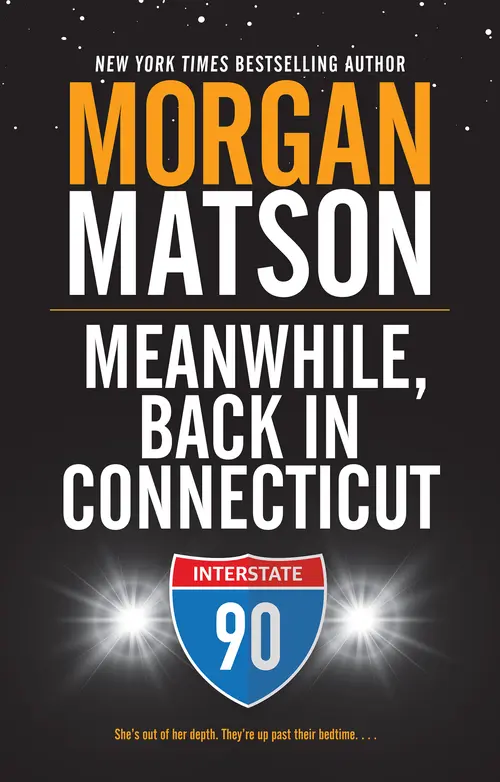
New York Times bestselling author
Morgan Matson
Meanwhile, Back In Connecticut
Road Sign: Interstate 90
She's out of her depth. They're up past their bedtime…
Title Page

Dedication
For Maux, Sarah, and Derick TCMC forever
ACKNOWLEDGMENTS
Justin!I
Thank you to Emily van Beek, my brilliant agent. And many thanks to the entire Folio team—Elissa Alves, Melissa Sarver White, Katherine Odom-Tomchin, and Madeline Froyd.
I’m beyond grateful to get to work with the best of the best at Simon & Schuster, my home for the last decade. Thank you to Chrissy Noh, Alyza Liu, Anne Zafian, Anna Jarzab, Lisa Moraleda, Jenica Nasworthy, Devin MacDonald, Chava Wolin, Christina Pecorale, Michelle Leo, and Jon Anderson. And thank you to Lucy Ruth Cummins, the genius cover designer I’m so lucky to work with. You knocked it out of the park again!
Thank you so much to Anna Carey, Jennifer E. Smith, Jenny Han, Adele Griffin, and Diya Mishra. And a big hug to Rebecca Serle, my write or die, who kept me on track during the first draft.
This book exists because of a conversation I had with my brilliant friend Siobhan Vivian, as we drove across Western Pennsylvania. Thank you for your early encouragement, brainstorming help, and fifteen years of friendship.
Thank you to my family—Jane Finn, Jason Matson, Katie Genereux, and Catherine Matson.
And finally, I would not have been able to write this book—or get through this year—without Maurene Goo, Sarah Enni, and Derick Tsai. Thank you for the text thread that is my lifeline, the conversations, the boba and fried chicken deliveries, the pizza and rosé nights, the movies and the hangs. You’re the best, fronds.
I. Jus-tin Chan-da! (Clap, clap, clap, clap.) What can I even say? As ever, there is no book without you. I would be lost without your patience and brilliance and good humor during the hardest time. Let’s not revise books in a pandemic ever again, deal? Thank you for everything—I’m the luckiest author ever to get to work with you. (Also, you were right about the footnotes but I couldn’t leave the book without just one, mwahahahaha.)
PART ONE 1:30 p.m.–4:15 p.m.
All those theater kids
With bigger dreams than this auditorium can hold
Kiss me after curtain call
I’ll wait for you backstage.
—The Henry Gales

CHAPTER 1
By the time the bell rang, I was already halfway out the door.
I didn’t look behind me as I hustled down the hallway of Stanwich High School, knowing I was missing last-minute assignments and instructions, but at the moment, not caring.
I had honestly not been paying the slightest bit of attention in the second half of AP US History. I’d spent the last twenty minutes of class with my eyes fixed to the clock on the wall, willing it to go faster, not taking in a word of what Mr. Batcheler was saying about the Continental Congress. Because the sooner class ended, the sooner I could get to Advanced Acting… and the sooner I’d find out the casting for King Lear.
And that cast list—seeing that piece of paper—would answer the question that had been keeping me up nights. It would let me know if I’d gotten the part that would determine the rest of my year, college acceptances, and, potentially, my entire life going forward.
I had been so fast out the door that the hallways weren’t too full yet, but even so, I was surrounded by people walking just as fast as I was, and not because they had life-changing news they needed to get. (I mean, as far as I knew. Maybe the kids who were really into forensic science or coding were also waiting on big news. I didn’t know their lives.) Stanwich High was huge—over two thousand kids—and as a result the building had been expanded over the years to try and accommodate everyone, sprouting wings and annexes and ad hoc trailer classrooms. But even though the school had gotten bigger, the time allotted to get from one class to another had not gotten longer, which meant that everyone just tended to hustle in the hallways, like this particular public school in suburban Connecticut was home to a surprising number of speed walkers.
And today, I was among them as I beelined for my locker.
It wasn’t technically mine. I shared the locker of my best friend, Stevie Sinclair. I’d misplaced my combination the first week of school, and rather than go through the hassle of dealing with the front office, I’d just started using Stevie’s. It worked out, since we could drop off and pick up things for each other, and leave notes on the occasions our phones got confiscated.
I grabbed my coat, tossed three books in my bag, then after a moment’s hesitation, grabbed Stevie’s coat for her too. The first play meeting was always right after school, after the cast list was posted. And since we had Advanced Acting as our last class of the day, this way we could just stay in the theater and Stevie wouldn’t have to come trekking back over here to get her long black puffer.
I slammed the locker shut and gave the dial a spin. I wanted to get over to the theater as soon as I could, to be in the building where it happened. I couldn’t help but think that the next time I saw this door—the next time I opened this locker—I would know. About the cast list, and everything after.
I would know if I’d gotten Cordelia.
“Kat!” I looked over to see Zach Ellison speed-walking toward me. Stevie had been mentioning lately that she thought he was cute, and Zach always seemed to be hanging around the locker when she was here too, so I was subtly trying to nudge them together. Stevie hadn’t expressed any interest in anyone since her boyfriend of a year had dumped her at the end of the summer. As it was now early November, it was well past time for her to be crushing on someone new, and Zach seemed like a promising rebound.
“Hey,” I said. “What’s up?”
“Can you give this to Stevie for me?” he asked, digging in his messenger bag and coming up with a marine biology textbook. He held it out and I took it with a silent sigh. Why were boys so stupid? Why didn’t he realize that he could have used this opportunity to give it back to Stevie himself?
“Sure,” I said, tucking it under my arm, since my bag was getting pretty full. It wasn’t surprising that he’d given something of Stevie’s to me. Since we were always together, people tended to treat us like we ran an old-timey post office or something, knowing we could get whatever it was—clothes, books, messages, veiled threats, and one time an oversized teddy bear—to the other one. “But you could also give it to her yourself,” I said, raising an eyebrow.
Zach just blinked at me. “But you’re right here.”
“Okay,” I said, giving up. I didn’t have time to give Zach Ellison instructions on flirting opportunities. I had to get to the theater building. “See you.” I headed down the hall, which was now more crowded than before. I made it to the end of the hall, then pushed out of the doors of Lansing House and joined the crowd going down the stairs to the student center. Stanwich High was divided into four houses, like a fancy British boarding school, but with less cricket and more AXE body spray.
I crossed my fingers as I took the curving staircase down to the student center. It felt like maybe—hopefully—everything was lining up. In my experience, you didn’t get many moments like this, and I wanted to savor it. It was a Friday, my favorite day, in November—my favorite month. It wasn’t freezing yet, but there had been a bite in the air all week, the good kind of cold, the kind that made you dig for your thicker sweaters in the cedar closet and search for last year’s gloves, the kind that let you know that winter really was on its way.
The first semester of senior year hadn’t been quite as hard as we’d all been led to believe, which was a huge relief, since junior year had come close to doing me in. My bangs had finally grown out enough that I could tuck them behind my ears (never, ever get breakup bangs. You will regret them. Stevie and my stylist and all the people who answered my Insta poll had told me this, but I hadn’t listened), and I was wearing my new purple cashmere turtleneck sweater, the one with little puffs at the top of the sleeves.
And I was potentially less than an hour away from finding out if I’d gotten my dream role.
Cordelia, King Lear’s youngest daughter, was a great part, and I already had most of her lines memorized. I’d gotten chills the first time I’d read her speech to her father—the inciting incident that kicks off the whole play. Lear is dividing up his kingdom between his three daughters and demands they all pay homage to him, something her older sisters Goneril and Regan are only too happy to do, promptly telling the king what he wants to hear. But when it comes to Cordelia, she can’t do it. She can’t suddenly profess emotion on command. She has one of my favorite lines in the whole play: “I cannot heave my heart into my mouth.” As soon as I’d read that, I knew it was the role I wanted.
And it was a real possibility I could get it—I was a senior, after all, and I’d been regularly getting leads since the end of my sophomore year. Nothing was guaranteed—I knew that—but I was still allowing myself to hope.
I’d been a part of Stanwich High School’s drama department since the first month of my freshman year. I had never acted before—never been in any of the plays in middle school—because I’d been dancing.
I’d taken ballet since I was three, and had spent all my time after school—and every summer, at sleepaway ballet camps—dancing. My life was a blur of leotards and convertible tights, bobby pins and hairnets, breaking in pointe shoes and comparing calluses and bloody blisters after class like war wounds, like battle scars. I had fully believed that it was what I was going to do with my life. I wasn’t going to go to college—I was going to dance professionally.
And it wasn’t like it was out of the realm of possibility to think that I could do it. Gelsey Edwards, two years older than me and the star of our dance school, became an apprentice at the New York City Ballet when she was fifteen and joined the company the following year. But right before my freshman year started, my teacher sat down with me and my parents and told me she didn’t think I’d be able to make it. That while I was technically proficient, she didn’t “anticipate” I’d get an offer from a company. I still auditioned for the School of American Ballet—but didn’t get in. And suddenly, all my plans—all I’d thought my life would be—were thrown up in the air. I wasn’t going to SAB and Professional Children’s, in the city. I was going to Stanwich High and would have to figure out something else to do with my life.
At fourteen, I was all washed up.
But during the second week of school, there was an announcement about auditions for the fall play. I dragged myself there, not expecting anything, just to have something to do. But there in line behind me had been Stevie Sinclair. We were both cast as maids in The Cherry Orchard, and I fell in love. With all of it. With my new best friend, with the camaraderie, with the long rehearsals, punchy tech run-throughs, sitzprobes and opening nights, striking the sets and cast parties. I loved it all. Joining the theater department turned what had been the lowest moment in my life into something better than I ever could have imagined. I was all in, 100 percent. And I’d barely danced since.
“Kat, wait up!” I stopped crossing the student center and turned around, seeing my friend Teri running toward me, her brown hair flying behind her.
“Hey,” I said, giving her a smile. “Where are you coming from?”
Teri (short for Teresa) Tsai had been in middle school with me, but we’d never really gotten to know each other until we were in theater—and a surprising number of classes—together as freshmen. Teri was my closest friend who wasn’t Stevie, and I think this was mostly because Teri’s best friend was always whoever she was dating. She usually had a boyfriend, and they usually seemed to live out of state. Stevie and I had never pressed the issue, but we honestly weren’t sure these boyfriends of Teri actually existed. At any rate, we’d never managed to meet any of them.
“Just had French,” she said, pausing to catch her breath and then straightening up again. She frowned. “Why do you have two coats?”
“This one’s Stevie’s,” I said, trying to squish it down over the arm that was carrying her textbook. We fell into step together as we headed toward the north exit.
“Heard anything about the list?”
“It won’t be up yet,” I said with confidence, even though hearing her say the list sent an excited, nervous thrum through me. There was an order to this, one we had never, in four years, deviated from. Mr. Campbell, the head of the theater department, had a routine.
Auditions and callbacks started on Monday and went all week, and the cast lists were always posted on Friday just after classes let out—typed up and taped to the front door of the theater building. You were supposed to initial next to your name to indicate that you were accepting the part, and then the first meeting was held right after—just a quick one, everyone getting their scripts and either celebrating or pretending they were okay with being the butler who’s only in two scenes. It was the first time we all sat around together, as a cast, and even when I was a freshman, with silent walk-on roles, I’d loved it. The sense of possibility that came with that first day—the beginning of the adventure.
The Stanwich High theater department, to put it plainly, was a big effing deal. We’d won tons of awards, including a few national ones. We had a tech and costume shop that did near-professional work, and everyone on the crew side took things just as seriously as we did. All our productions got reviewed in the Stanwich Sentinel, and we had at least one famous, nearly movie-star alumna. And our shows were good.
It wasn’t like the theater programs at the schools my cousins went to, where they did one musical at the end of the year, and that was it. We did three main-stage productions a year: a play, a Shakespeare, and a musical. This didn’t include the musical revue or the improv shows or the Shakespeare Competition or the volunteering we did at senior centers and elementary schools. Auditions for the next production started the week after we’d closed the last one, rehearsals were every day after school, and weekends too as we got closer to tech. It was a full-time commitment, something my parents frequently complained about. But I never did. There was nowhere else I ever wanted to be.
“Erik and Jayson were heading over early to see if it was up,” Teri said, sliding the R charm on her necklace back and forth, her expression worried.
I shook my head. “It’s not going to be. Mr. Campbell isn’t going to do that before we all have to be in class together. Can you imagine?”
Teri sighed deeply. “I’m just bracing myself,” she said, “to see the whole cast and then at the bottom, ‘Teri, see me about assistant directing.’ ”
I bit my lip as we negotiated around a group of sophomore girls walking five across, which was not good student center etiquette. The truth was, while Teri was good, she wasn’t one of the best actors in the department. And so twice, when he couldn’t cast her, Mr. Campbell had asked her to assistant direct. I understood why you might be disappointed by this, since you wouldn’t have all that much to do. But it meant that Mr. Campbell still wanted you to be a part of the show. You’d still get to come to the rehearsals and be a member of the team. You just had to do it from the sidelines. Sometimes when he offered assistant director to people, they turned it down—and then they never got cast in anything again. Some people thought this was harsh; I thought it was completely understandable. You didn’t get to decide when you were going to be a part of this department—you were either all in or out, and that was just how it was.
But it was senior year, and Teri had been dedicated—I was sure she’d get cast. “I don’t think you need to worry about it,” I said, and Teri brightened.
“So what are you thinking?” she asked. “Jayson will be Lear, Stevie will be Goneril…”
“Erik will be Gloucester,” I said. We all paid incredibly close attention at the callbacks, since it was our best window into Mr. Campbell’s thought process. Who he paired up, who he read multiple times, and who got told they could head home early—the worst thing of all.
“Not Kent?”
“I don’t think so. He read Perry more for it.”
“You’ll be Cordelia—”
“Don’t jinx it,” I said, even as butterflies swooped in my stomach. “He read Emery for her too.”
“Yeah, but not as much. I think you’re a lock.” The first bell—which meant hurry up and get to class—rang. We picked up our pace as we left the student center and headed down the long hallway that would lead us to the north exit.
We were only a few steps in when I saw Stevie walking toward us. I grinned at her, throwing my arms up in an exaggerated what the heck gesture. “You’re going the wrong way!” I yelled, and saw her smile even though she widened her eyes at me, and I knew she thought I was being too loud. Stevie often thought I was being too loud; I usually thought she was being too quiet. And I was certain that I was always at the exact right volume.
“Was going to pick up my coat,” Stevie called, as she closed the distance between us. I held it up for her and she grinned. “Thanks, frand.”
“I’ve got you, frond.”
She caught up with us, tucking her long, dark hair behind her ears. I was incredibly jealous of her hair, which was so thick she could legitimately hide behind it, like she was a character in a Victorian novel, and she regularly popped her ponytail holders and sent them flying. And despite the fact that I’d been taking prenatal vitamins for years in an attempt to get my hair to grow thicker (pro tip: don’t leave these sitting out unless you want to have a very uncomfortable talk with your mother), it was to no avail.
Stevie Sinclair and I looked nothing alike—in fact, it was almost like we were opposites of each other. I was pale and freckled, she had olive skin that tanned perfectly; I was tall, she was petite; I had fine blond hair, Stevie’s was dark and wavy; I was lanky, she was curvy. But despite all this, when we were walking around together, or shopping, or hanging out at Paradise Ice Cream, people would ask us if we were sisters. This delighted us to no end, because it meant that they weren’t seeing that we didn’t look anything alike. It meant that whoever had asked this was asking because of how we were together. An energy, a sameness, a kinship that had been there from the very first day.
The Story Continues on BooksBarbecue!
Enjoyed this preview? ❤️ Do not stop here!
Read the complete book free online → 🔗
Continue reading now on BooksBarbecue and discover every page!
Love reading? Bookmark BooksBarbecue.com for more amazing books!
Happy Reading!