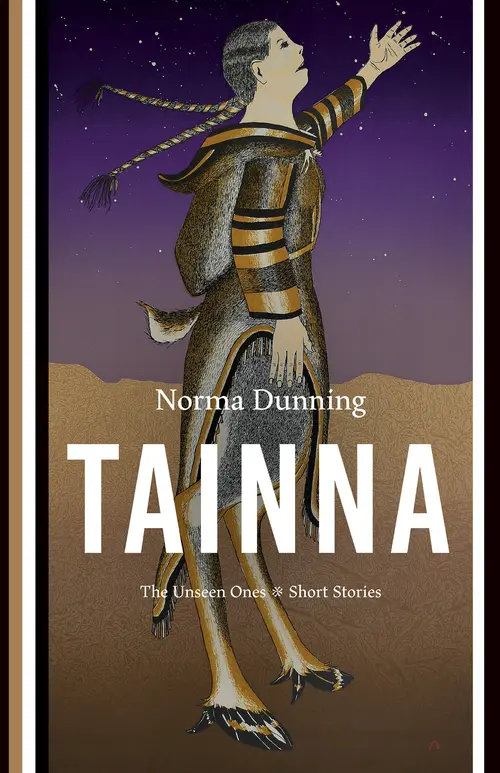
Tainna
Dedication
This book is dedicated to all of us Inuit who live beyond the tundra, we who get up and live our lives in the Southern areas of Canada.
We are Inuit no matter where we stand.
Inuttigut: We the Inuit—we are here.
Author’s Note
The stories and characters contained within this work are fictional.
Acknowledgements
I would like to thank my agent, Stephanie Sinclair, for seeing the value in this work and for believing that others will love reading it.
I would like to thank Anna Comfort O’Keeffe from Douglas & McIntyre for seeing the publication of this work through to the finish.
My biggest thanks goes to Peter Midgley for his humour, patience and for knowing when to hug me at the end of it all. We did it again, Peter. Ma’na my friend.
Amak
Our collision was cosmic. Nothing could stop us from smashing into each other. No other object could get in the way of that hug. That first hug. We had been apart for so long. More than eleven years. Eleven years of silenced voices. No touch. No harm. No foul. I knew her voice before she took the breath that started our first phone conversation in over a decade. You never forget the voice of someone you have loved so hard. It was her, sounding nervous and far away.
The connection made it sound like she was out of the country. That brought me relief. Perhaps she was living abroad, putting an ocean between us. I remember how the tension in my shoulders eased momentarily. Several times over the last decade, I had longed to hear her voice but never wanted to be the person who dialled out first. Time lets life bloom without family members in it. It’s easier that way.
“I’m old now.” Her first three words reminded me what she was like. Always speaking about herself first. Not asking how I was. Never thinking of others. I thought about how the passage of time, in length and in breadth, does not mean that people change within that same span of time. I reminded her that we all were old now. All of us over the age of fifty. All of us past the middle of our middle ages. She blurted out that she had left her long-time husband two years before.
I rallied back with a happy cheer: “Good for you!” Again, the younger one comforting the older one. The one that I had always thought was so much more than me. Taller. Smarter. Prettier. Skinnier. I never hit the mark of any of the standards that she had created to measure me by. I felt childhood shame wrap itself around me like it always did when I was in her presence. There it was again, a cloak of insecurity wrapping its jagged edges around my shoulders.
She continued to talk about her ex. I let her ramble on. It wasn’t that I didn’t like the guy. I just knew I had to be careful around him. We each wore a mask of pretence when we were around one another. I would initiate conversations about sporting events that I had never watched, stuff that I had seen in the sport page headlines.
Words with him were always difficult. His eyes never met anyone’s. He was always looking east or west of the person he was speaking to, or at a skyline that he created above their forehead. He was openly less than tolerant of my family members. I was happy that she had left someone who, I thought, had never acknowledged that she lived under the same roof as him.
Finally, she asked me, “What’s new?” A hard question, especially when trying to recover from the shock of an unexpected phone call. “What’s new?” puts the receiver of the question into a place of obligation, turning their life into a lineup of what was most important before they answered the phone.
I found myself wanting to say something incredible, but my mind was muddled with the details of earlier in the day when my middle son had come over to talk about wanting to leave his lovely and long-time girlfriend. This was something that I didn’t want to share with Sister. There was nothing in the world I felt less like talking about than my Lance. He was not a topic to lead with. Not yet and perhaps not ever. Tenacity and trust are things that must be earned.
The only way to answer the question was to make something up, to find something that lay on the periphery of my life and bring it forward. Now was the time to find that safe spot. I talked about university and how happy I was to be there. How invigorating it was to be the old lady student in the classroom, to be around young people, to read and learn. I talked about how long I had waited to do that. I was always putting the people I loved best first. Something she had intentionally forgotten to do even though we had been raised in the same home where it was taught.
There had always been someone else who came first. Someone else who needed my attention. Bills to pay, children to raise and that eternal drive to “get ahead.” Always hoping for that financial nest egg. But those eggs broke every fiscal quarter in my household. Then one day, I decided to do something that I had always dreamed of, and that dream had come true. I made myself sound like a hero on the phone. Sister cooed her approval and told me that I was brave. Perhaps I needed that reassurance.
She asked about our siblings. I had no idea how any one of them was doing. Since I started university, every one of them had dropped out of my life. I was tired of the way they made fun of me, of their lack of support. Like contestants in a reality TV show, they got voted off one by one. Staving off the rising feeling of negativity inside me, I simply told her that I had no idea.
How could someone close a door for eleven years and then expect to pop their head in and ask, “How is everyone?” I told her that these days, only me and my sons remained in each other’s orbits. I had no new information to offer her.
We were about two minutes into our talk when I decided to put up the barrier. Anger came over me. Don’t indulge it, I told myself. I tugged at the edges of the cloak of shame that was choking me, fighting it. I straightened my shoulders. I pulled the cloak away from my throat. She was the one who had hung up the phone eleven years ago. Who was she to be able to dial out and ask, “What’s new?”
I held my ground behind the barrier. Sister seemed stuck at the other end of the phone, looking for things to talk about. Or wanting to say something but not knowing how.
Eventually, she told me that she had lost her only child, her son. Her boy, Matt, who is three months older than my Lance. She had not lost him to death, but to the divorce. I reminded her that no matter how old children are, divorce affects them in different ways. After a short silence, she remarked that she had heard that my partner and I had split up years before. I nodded and then realized she couldn’t see me nodding from the other end of the line.
“Yes. The best thing we ever did for each other!” I said. I am sure she could hear the smile in my words. It’s the truth—his leaving was the best thing we had ever done for each other. I smiled because I remembered the day that he left and the sadness I felt at the time. But three weeks later, an incredible sense of happiness had flooded me.
I had jubilantly gone out and bought a new queen-sized bed, scrubbed the walls, hung up all the pictures I was never allowed to show off in all the decades of our marriage. Within three weeks I had become ecstatic over the fact that one of us had had the good sense to make a change. My heart was free at last.
She returned to the subject of our siblings and I felt pressured to come up with an answer. I told her that I really didn’t know any of them anymore. Once our parents had left this world, so had the one thing we had in common. There was nowhere left to go home to. Without the parents to hold us together, the old family squabbles resurfaced and our relationships disintegrated. It all fell flat like a deflated balloon. She giggled. It reminded me of being little girls together. Laughing ourselves to sleep in the double bed that we shared. Sometimes I missed that. The small worries and stories of small girls. She was fun once.
She asked if I’d visit her on the next long weekend. I wanted to, but I was afraid to. She went off on a long description of how to find her country home. She’d left Banff and moved about two hours away into the country, the Deep Country as she called it. I tried to write things down, getting excited about the possibility of seeing her. I told her I’d call her the next night with an answer. After all, I did have obligations and I needed to arrange to take time away from the university. We hung up. I lay in bed that night, unable to sleep.
I lay there thinking about how random all of this was and how unsettled I’d always felt around her. I asked myself if I needed this kind of interruption in my life again. She had always treated me like a doll that she wanted to play with for a short time. And she was always the one who decided when the game would end, when she had become bored with me, and who then placed me on the shelf for at least another decade, only to be dusted off when she felt like playing with me again.
Years and years had passed since she had last put her plaything aside, and the accumulation of time had taken the shine off it even more. We had literally stopping thinking of one another . . . and now an invitation and the expectation of an answer in the morning.
I won’t go alone, I decided.
When the Saturday of the long weekend arrives, I make two of my sons jump into the car with me. Off we speed down the highway, the open road breezing around our sense of freedom. Happy to be leaving our city and all those problems. Sister and I have talked twice a week for the last month. An ease has settled over us and we are less cautious with each other on the phone now. I am excited at the thought of being able to look at her in real life.
I wonder what she looks like. If she is still the tall, slim one. The one I always felt substandard next to. The one I envied all the days of my childhood and into early adulthood. The one who I looked to for acceptance but never felt like I received it.
Music jumbles away in my rusty old Ford. My youngest son and I sing along to the songs on the radio. After a while, we put in a CD that he compiled years before. One that he titled Songs for a Rainy Day. My old Ford does not have iPod outlets and we are forced into using old technology. We laugh at the choices he’s selected. My youngest son always knows how to take that nervous edge off me.
My unemployed middle son has come with us to get away from his life too. He never sings out loud, but he does lip-sync all the words. Even as a little boy he never sang or whistled or hummed. My hope is that one day he just will.
A trio of excited people, approaching the unknown. The farther south we drive, the darker the clouds are across the sky. The radio mentions the possibility of sleet. We may be driving into a storm, but we keep driving, two voices singing out the words to the songs on the radio while the third nods in rhythm to the music.
I burst out laughing when “Bad Moon Rising” starts to play.
“What’s so funny?” asks Lance. I tell them the story of how my mother, their grandmother, used to sing “Don’t go out in your nightie!” instead of the real lyrics and how we’d laugh and laugh when she did that. All the simple fun she made for us kids. All the things she did that made us laugh. All the love she poured out onto each of us. I tell them all of that. How she filled us up with the good parts of life. My childhood memories free-wheel around on the open road.
We each have our own way of expressing our excitement as we approach the small country town where Sister asked us to meet her. She doesn’t live there. She lives in the high country, thirty-five miles away in a remote trail-riding camp along the Ghost River. A speck of a place according to Google Maps. She will be our guide.
My sons leave the car first, looking for their auntie from long ago. I stay inside, telling them to text me when they find her. My heart racing. A cigarette burning yellow lines into my fingertips. I glance into the rear-view mirror and moan, thinking about how I should have pulled my hair back into a ponytail. My hair, the first thing she’ll critique. That will be followed by my inflated tire tube waistline. I debate putting on lipstick. My phone pings. That’s my youngest texting to tell me they’ve found her. Time to get out and face Sister. I wish I could turn around and head back home.
Sister is at the local grocery store on the other side of the parking lot from where I had parked. I get out of my car and put some gum in my mouth. Then I start a slow walk toward them. I see the familiar silhouette that is her. Her hair long and flowing, her slim, curvy body looking the same as it always did. I want to run and jump into her arms or wrap my hands around her eyes from behind and whisper, “Guess who?” but instead I contain myself and walk at an even slower pace, thinking about what I should say first.
I don’t utter one word as I approach. She turns and falls into my arms, and the orders begin once the tears dry. “Put your car here—no, not there, here—under the trees.
“Of course, it’s all right—no, you won’t get ticketed. This is a small town. Everyone parks here for days on end.
“No, you don’t need anything from the store. We have everything we need where we’re going. The high country—you’ll see.”
The three of us jump into her Jeep. The seat feels so high up that I am as dizzy as the hills moving past us. The radio is on and BBC is telling us world events as we drive along. No one says anything. We listen to an announcer speaking to us in a soothing voice, telling us that children were bombed in schools in the Middle East. The emotionless tone tells us what the royal family is up to. I can’t hold the silence any longer.
“I really hate BBC news. Everything sounds the same to me. Babies getting killed have the same emotion as whether or not Kate has had that baby yet.”
“I’ve never noticed,” Sister replies, reaching for the radio dial and turning it off. “Tom,” she says, glancing into her rear-view mirror, “Sing us a song.”
Tom grins. He’s the youngest, her favourite of all my four baby boys. She fussed over him when he was a toddler. She never has even begun to like Lance. Lance represents all the things that her boy, Matt, is not. Strong. Tall. Athletic and so very handsome. She has barely acknowledged his presence in the vehicle. She has always been like that with him. Only looked at him to reprimand him, to speak stern words of discipline. We hadn’t been raised that way. Children are to be disciplined through words of love and patience, not anger and finger-pointing. She lost our ways or chose to not acknowledge or absorb them.
Tom begins to tap his lap, a single beat rises and he starts, “We’re drivin’ on the Ghost River Road, we’re driving on the Ghost River Road—Hey-ho—Where do you go when you’re driving on the Ghost River Road?” Sister and I join in. Lance clears his throat and looks out the window.
His memories must be meeting up with mine somewhere along the top of the foothills. He’s remembering too. All the times she laughed at him tripping as a baby. How she always brings up his failing Grade Six and goes on and on about his dropping out of high school, while bragging up her son, Matt, as though he was the only success in our family. I can feel it. Not every reunion is filled with happy memories. Each one of us must wrestle with those unhappy times. The things that we’ve buried in a deep hole at the back of our heads.
“Want to sing too, Lance?” I ask, hoping to break the homecoming of unhappiness we both feel. In the passenger-side mirror, I see him shake his head.
Sister deliberately raises her voice. The Ghost River Road song is drowning out the truth. Tom pipes up and tells his auntie the “Don’t go out in your nightie” story. Sister turns her head toward me and says with a long sigh, “You’re still not telling them the truth, are you?” Here it comes. I can feel it like I did as a kid. The question that begins to line up her verbal assault weapons. I’m about to say something when she continues, “And by the way, your hair?” She shakes her head as though she’s correcting a child and pokes her right index finger into my gut. “A little bit too much of the old Pillsbury Doughboy happening there!”
She’s lasted longer than the expected ten minutes. I shake my head like Lance did and turn my eyes toward the passenger mirror. I don’t reply. I’ll never measure up. How did we ever come out of the same womb? How did we ever exist under the same roof? There are hard things that lie in our past, as sisters. Events that I never share with my sons. I will never infect the next generation with unnecessary pain. I wish I had brought my car instead of leaving it in town. We are now her hostages.
Driving along the bumpy dirt road, Sister begins a long story about the cougars that roam the area. For now, she’s let the past lie where it should stay. She is telling us everything she knows about her latest cause. I begin to remember that she always had this know-it-all air about her. I tell myself that it’s been too much. Her remark about our childhood was unnecessary. Reunions are not about ruining the present. I look at her profile and wonder what has really happened to her.
Her skin is the colour and texture of burned pie crust. Her skin has always been darker than mine, yet she’s the one who lies in a tanning bed once a week. I’ve always been a lighter shade of Eskimo. Her hair has been dyed so often that I can see how it’s thinning in the front. I wonder if she still starts each day with a wire push-up bra and two Spanx camisoles. One thing that pushes her tits up and the other that sucks her guts in. Her own version of being a shape-shifter. Her eyelashes are coated in layers of mascara. Her nose remains the biggest part of her. She broke it often as a kid. I grin and can still hear our middle brother and me laughing together in the basement on a cold winter’s day.
That winter’s day. The day when out of boredom we ended up playing Blind Man, wrapping a scarf around our eyes to shut out the daylight. After turning themselves in a circle ten times, the blind man would jut their arms out in front of themselves, zombie-like, and go searching for the other two hidden players. Feeling only the frozen cement under our woollen socks, hearing each other’s whispered snickers. We would hide behind boxes or the washing machine, or near the rack of rifles my father had attached to the wall.
The Story Continues on BooksBarbecue!
Enjoyed this preview? ❤️ Do not stop here!
Read the complete book free online → 🔗
Continue reading now on BooksBarbecue and discover every page!
Love reading? Bookmark BooksBarbecue.com for more amazing books!
Happy Reading!