Stuck
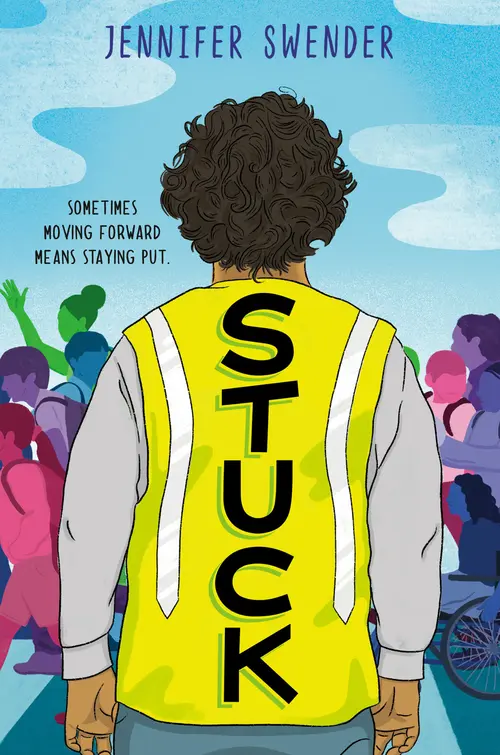
Cover
Also by Jennifer Swender
Solving for M
Dedication
For P.J.
1. Razzmatazz, Pacific Blue
The first day you show up at a new school, some teachers give the person bringing you in a real earful. They say something like “Don’t you see how many I’ve got in here?” Then they make a face and look you up and down. One teacher pointed at me and made an outline of me in the air. Like I was so big, where was she going to put me?
I have a right-before-the-school-year-starts birthday, so whatever age everybody’s turning that year, I’ve already turned it before the year’s even gotten started. Plus, one time when we moved, they made me do second grade a second time.
But this teacher didn’t point at me when I showed up at the door. She didn’t roll her eyes and breathe out sharp like I was the last thing she needed that day. She smiled, and I don’t even think it was a fake grown-up smile.
“Welcome,” she said. “I’m Ms. G.”
She wasn’t one of those young teachers who try too hard to be your best friend, but she didn’t seem like one of those old-fashioned, super-strict ones, either. She looked like just a normal teacher, except that she was tall, tall, tall. She was maybe the tallest teacher I’d ever had. Even I had to look up to really see her.
The kids were sitting all curled over their desks like a bunch of fiddlehead ferns. Maybe they were taking a test. That’s one of the only good things about your first day at a new school. If there’s a test, most teachers will say “Oh, don’t worry about this. You weren’t here when we learned it.”
She pointed to a desk smack-dab in the middle of the checkerboard room. I would rather have a back-row desk or at least an on-the-edge desk, but this was the only empty one, except for a seat way up at the front, where everyone could see you all the time, and I definitely didn’t want that.
On top of the desk was a book. Its cover was bright pink and shiny, and on top of all the razzmatazz, a bunch of numbers were floating out of some kid’s head. Math. Good.
It was the kind of book with pages you can write in. Most teachers barely ever really check them. They just glance them over to see if all the blanks are full.
“Page one hundred and seventy-eight,” she whispered to me. Almost the end of the book because it was almost the end of the year.
My last school told my mom we should maybe wait to move, that it would be better for me to “finish out the term.” But my mom said it was time for us to go, even if it was the beginning of June.
“Need a pencil?” the teacher asked next.
I nodded.
Don’t bring anything in until your second day at a new school. You have to see what kind of class you’re in so you don’t stick out too much. And if you think at least a pencil would be a safe bet, you’d be surprised. I was in one place where everybody got their own laptop and another one that used these old-fashioned mini-chalkboards. You don’t want to be the only kid holding a pencil when everybody else has a piece of chalk.
But this seemed like your basic pencil class. She handed me one that was long and new and still had a full eraser. And when she turned to walk away, I saw she had about five more, pointing in all different directions through her ponytail. The back of her head looked like some kind of flying sea urchin.
I sat down and bent over my desk like everybody else. The math was easy. I looked at the numbers, and the answers showed up. Even if it’s supposed to be letters that tell you things loud and clear, numbers talk to me a lot louder.
I finished the page and went on to the next one. I didn’t know if we were supposed to, but I never met a teacher who got mad and upset because a kid did more pages than they were supposed to do. The next page had some wordy problems, though. I watched the letters moving from one line to the next.
But before I could worry about which blanks looked like they wanted letter-answers, and which blanks looked like they wanted number-answers, the teacher rang a little bell. It was the kind you ding at a store counter when you need somebody to help you—round and silver and very shiny.
The kids closed their books and put them away. I did, too. I’m good at following directions. If you don’t give teachers any problems, nine times out of ten, they won’t give you any problems.
Then I realized what was coming next—The Introduction.
The teacher would say she had an announcement to make. She’d tell everybody my name and that they should be welcoming to me. Then she would ask me to say a few words about myself, like what I enjoyed doing in my free time and why my family had moved.
I have a couple of speeches all made up and memorized. I always say my hobby is snorkeling. It’s the kind of hobby that could be normal where we used to live but is really hard to do here. And it’s not the kind of hobby that a lot of people have and then want to talk about. I’ve never met another kid who said, “Oh, you’re a snorkeler? Hey! Me too!”
Then I say we moved either because my dad got a new job or because my mom wants to be closer to her sister who is “quite ill.” I can do these introductions so well, even I half believe them.
“I have an announcement,” the teacher said. Told you.
And even though I’ve done The Introduction, like, a million times, I still get that feeling. I don’t understand why people call it “butterflies in your stomach.” Butterflies are happy and colorful and free, and this feeling is none of those things. This feeling is spiky and tricky, and it stings. I call it “yellow jackets in your stomach.”
But all she said was: “Time for lunch.”
Huh. I stood up and walked to where I thought the line would be. But the kids were still hanging around, like they were waiting for something.
“Okay,” the teacher finally said. “Alphabetical order by first name.”
I didn’t get it.
“And by the way,” she added, “our new friend’s name is Austin.”
A short girl with big glasses came right up to me. She showed me a smile all railroad-tracked with braces and stuck out her hand to shake mine. “Hi,” she said. “I’m Bertie.”
I didn’t say anything. I just shook her hand and nodded a little. I mean, I didn’t really shake her hand—more like I squeezed her fingers for a second.
“You’re first,” Bertie said. “Because you’re A and I’m B. Except for Bodhi, but he’s B-O.” She slapped her palm to her forehead and giggled. “I mean, he’s not B.O. His name starts with B-O and mine starts with B-E, and E comes before O, but you knew that already.”
I scooted around her to get to the front of the line. It was kind of cool to be the kid standing in the doorway with a view into the hall. This school had very shiny floors.
“My real name is Beatrice.” Bertie was still right behind me. “But I don’t like being called Bea because I don’t like bees. I’m not allergic or anything. I just don’t like them.”
Bertie’s words were buzzy like bees, but not like yellow jackets in your stomach. They were more like those puffy bumblebees just flying around, looking for a flower or something.
“Do you have any nicknames?”
I shook my head no.
“Well, it’s nice to meet you, Austin.” She smiled all the way back to the rubber bands on her braces, which made one side of her face squish down more than the other. But her eyes were still twinkly-crinkly, and her braces were a cool-blue color, like pacific blue.
Still doesn’t mean I smiled back.
2. Pacific Blue, Outrageous Orange

I followed the teacher to the cafeteria. I was glad she was in front of me because I had no idea where I was going. I think all the schools should get together and decide to build themselves the same way. Then you’d always know where the cafeteria was.
“Mission control to Austin. Mission control to Austin.” Bertie was still behind me. She made a noise like static on a walkie-talkie. “You need a tray. And a milk.”
I picked up a tray. I picked up a milk.
“Now slide down toward the main course,” Bertie said. She used her tray to push mine along the little track.
Bertie was acting like she thought I’d never, ever been in a lunch line before, or that this school’s lunch line was somehow way different from every other lunch line. Or maybe she was just the kind of kid who really liked being a helper.
“Spaghetti or sandwich?” the lunch server asked me.
“Now you say if you want spaghetti or a sandwich,” Bertie whispered into my arm. I think she was trying to whisper it into my ear, but I’m that much bigger than she is. You could fit about a hundred Berties into a classroom and still have plenty of space when someone brought a big new kid to the door.
“That’s the spaghetti.” Bertie pointed to the spaghetti. “And that’s Chef Gail.” She pointed to a woman in a chef’s hat, stirring a big pot.
“Hi, Chef Gail!” Bertie called.
“Hi there, Bertie!” the woman called back.
“Um, spaghetti, please,” I said.
“You new, sweetie?” the server asked me. She scooped a big pile of spaghetti onto my plate and ladled on the sauce. A lot of schools are stingy with the spaghetti, or the sauce is all gloppy and cold. But this looked pretty good.
“Yes, Ms. Jackie,” Bertie said. “This is Austin.”
“Welcome, Austin,” Ms. Jackie said, and she handed my plate across the counter. “Don’t forget your bread and fruit.”
“He won’t forget,” Bertie said.
I didn’t care so much about Bertie answering all the first-day questions for me. It made it easier to keep track of things. I picked up some bread. I picked up some fruit.
Now, most schools have another person at the end of the tray track, who you pay unless you get free lunch. And when that person waves you through with a little phhhp sound, like the air escaping out of a hole in a balloon, everybody knows you get free lunch. But when I got to the end of the track, nobody was there.
“That’s our table.” Bertie pointed with her chin. And even though she stayed behind me the whole time, she steered me to the right place.
She reminded me of this cute dog my mom and I saw at the fair last summer. It held back and kind of nosed at the air, but it still got all these baby ducks over the little bridge and into the kiddie pool without ever touching them.
“Slide down to the end,” Bertie said, “on account of the fact that you’re the line leader. Then I’m next. Then Bodhi. Then Carlos. Then Charlene. Then David A. Then David C. Then Destiny. Then George. And so on and so on.”
This seemed like a good spot. There was only Bertie on one side of me and nobody else on the other side of me. Across the table were two girls sitting so close together, it looked like they shared the same hair. I didn’t think I had to worry about not talking to them. If you don’t talk to the other kids too much, pretty soon they’ll stop talking to you.
“Mia and Nia,” Bertie said. “They love it when we line up in alphabetical order by first name. They’re, like, best, best friends. I don’t really have a best, best friend. I’m just equal friends with everybody, you know what I mean? But tomorrow we’ll line up a different way, like favorite color in the spectrum or birthday.”
I looked around the cafeteria. I figured this school must have a rule about not getting up once you sit down. Some places, kids are always getting up—they want an extra packet of ketchup, or they forgot to get a milk. You never know if getting up is really allowed, or if the teachers just get tired of telling everybody to sit down.
“I’m always line leader when we line up by birthday,” Bertie said. “January second. Unless you’re January first. So when’s your birthday?”
Bertie stopped talking long enough to take a bite of spaghetti. She opened her milk while she chewed. She looked at me from behind her big glasses, and her eyes were so open, it felt like I couldn’t not tell her.
“August—” I said.
“Let me guess!” she said. “August fourth!”
“Uh, no,” I said.
Bertie squeezed one eye shut like she was thinking about it real hard as she peeled her clementine.
“Is it the twenty-ninth?” she shouted, all excited. “Because if it is, it depends on what time you were born because David A. is also August twenty-ninth, but he wasn’t born until twelve minutes before midnight, so chances are you’d still be ahead of him.”
I looked down at my spaghetti. I wasn’t sure how I’d gotten into this whole conversation. Maybe if I told Bertie the answer, she would stop talking to me.
But when I looked up, Bertie’s pacific blue smile had suddenly turned, like, outrageous orange. She’d taken the peel from her clementine and stuck it over her teeth. I almost smiled at that.
“Five-minute warning, Ms. G.’s class,” someone called from the head of the table.
It wasn’t a teacher. It was a kid wearing this weird yellow thing that crossed from her shoulder to a yellow belt around her waist. It looked like she had a big, bright greater-than sign across herself. In all the schools I’d been to, I’d never seen a kid wearing a big, bright greater-than sign across themselves.
“That’s Kayla,” Bertie said, pulling the orange peel out of her mouth. “She’s our lunch Safety.”
I didn’t know what Bertie was talking about, but I didn’t want to get into a whole other conversation about it. I took a few more bites of spaghetti and a last swig of milk. Some school food is pretty yuck, but this was a good lunch. I wondered if they ever let you get seconds.
“You’re still the line leader,” Bertie said, and she stuck with me the whole way, telling me where to put my tray and my garbage and where to line up. “It’s round-trip employment, unless you get sick or you have to go to the bathroom or something. One time, Carlos suddenly got sick, so the second-in-line had to step in. You don’t feel like you’re going to throw up, do you?”
“Uh, no,” I said.
As soon as we were in a line—me, Bertie, Bodhi, Carlos, Charlene, David, David, Destiny, George, and so on—the teacher showed up.
“How was lunch?” she asked. I didn’t know if she was asking me specifically, but nobody else was saying anything.
“Um, good,” I said.
“If you cook spaghetti too long, it tastes like paste,” Bertie said to me. “In first grade, Ms. Chengarian saw me tasting the paste, and she sent me to the nurse. I wasn’t sick, but I don’t think she wanted me around, in case I did get sick. I think it was…preemptive.” Bertie said the last word real loud. “Did you hear that, Ms. G.? That’s a point for me.”
Bertie stood on her tiptoes to say something into my ear. I bent down a little to help her out. “If you use a vocabulary word in regular conversation,” she said, “you get a point. When you hit twenty points, you get a prize.”
I wondered if it was a real prize, like a fancy multicolored pen or a key chain to clip onto your backpack. Or a stupid prize, like getting your name on a bulletin board or something.
3. Tumbleweed

I followed Ms. G. until we ended up right back in the classroom. Everybody went to their desks and took out a book.
I didn’t know if this was “Drop Everything and Read” or “Stop, Drop, and Read” or “Stop and Read Together,” but whatever they called it here, it was time for reading. A lot of schools do it right after lunch, like it helps you digest.
But one different thing about this class was that the kids could sit wherever they wanted. Weird places, too. George crawled under his desk like he was in a fort. It looked cool, but I wasn’t sure if I would fit. Or if I did fit going in, I wasn’t sure if I’d get out again. I sat down the normal way, in my chair.
Bertie went to the back of the room and disappeared inside the closet. Then she came out hugging two pillows that were almost as big as her. She set them down on the floor close together. They were light brown, like tumbleweed, and when she sat down on one, she reminded me of a little bird perched in the middle of its gigantic nest.
When I looked at Ms. G., she was reading, too. She wasn’t grading papers or checking her phone or watching the kids to make sure they were reading. She was just reading and rearranging the pencils in her hair.
She looked up at me. But she didn’t yell my name or even speak to me. She pointed to the bookshelf under the window and nodded a little.
The bookshelf was real long, like almost one whole side of the classroom. I walked next to it, running my hand along the edges of the books to feel the buppa-buppa-buppa-buppa.
When I got to the end, I turned around and came back. My hand stopped at a spot that was more pushed in than the others. I pulled out the book that was making the space. It was small, but it was still a real book with lots and lots of pages.
I looked at the title. The first word was Bridge. We used to live at a place called Bridge View Estates, and I passed that sign, like, every day. The second word was to. What fourth grader doesn’t know that word? But the last word was big and pretty complicated.
Under the words, there was a picture of two kids, small and fuzzy. They looked like friends. And next to the friends, there was a golden sticker. I figured any book with a golden sticker on the cover was a good one to choose. But that sticker must have been there for a real long time because its edges were all roughed up and curling. I rubbed my thumb on it to press it down.
I turned the book over. The words on the back didn’t look all that complicated, mostly six- and seven-letter words. If I can get somebody to read me the back, I’m usually okay. And Ms. G. definitely seemed like the kind of teacher who let kids take the books home. Maybe my mom could read it to me if she wasn’t too tired or too busy.
“Find something?” Ms. G. asked. She was so quiet, I didn’t even hear her come up behind me.
I turned the book over and showed her the front. A lot of the time, it’s okay not to answer a teacher’s question, as long as they know you heard the question.
“Believe it or not, that one was mine when I was your age,” she whispered. “Let me know what you think.”
I nodded and went back to my desk. I could see Bertie out of the corner of my eye. She was flapping her arms like some kind of crazy bird trying to take off. She kept waving to me and pointing to me and pointing to the empty tumbleweed pillow. I pretended not to see her.
I sat at my desk and opened up Bridge to Wherever. The letters were tiny and inky and very close together. They looked like busy ants, but the ants weren’t telling me a story, the way I think they do for most kids. They were gathering their food and marching across the paper. I waited for a bit. I turned the page.
If you turn the pages too fast, teachers notice. And if you don’t turn the pages fast enough, they notice. And if you don’t turn the pages at all, they really notice. In my head, I always say My name is Austin ten times looking at the page on the left. Then I say My name is Austin ten times looking at the page on the right. Then I turn the page.
But this book seemed a little bit more grown-up and complicated. I decided to say My name is Austin fifteen times.
The Story Continues on BooksBarbecue!
Enjoyed this preview? ❤️ Do not stop here!
Read the complete book free online → 🔗
Continue reading now on BooksBarbecue and discover every page!
Love reading? Bookmark BooksBarbecue.com for more amazing books!
Happy Reading!