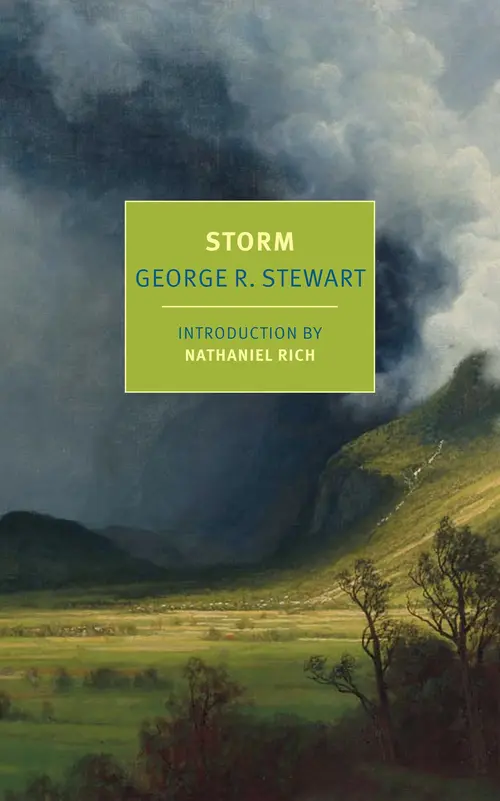
Storm
Chapters (20)
Cover
Biographical Notes
george r. stewart (1895–1980) was born in Pennsylvania and educated at Princeton. He received his PhD in English literature from Columbia in 1922 and joined the English faculty at the University of California, Berkeley, in 1924. He was a sociologist, toponymist, and founding member of the American Name Society, as well as the author of more than twenty books, including the highly successful novel Earth Abides and several works of American history. In addition to Storm, NYRB Classics publishes his study of American place names, Names on the Land.
nathaniel rich is the author of Second Nature; Losing Earth, a finalist for the PEN/E. O. Wilson Literary Science Writing Award and a winner of awards from the Society of Environmental Journalists and the American Institute of Physicists; and the novels King Zeno, Odds Against Tomorrow, and The Mayor’s Tongue.
Title Page
STORM
GEORGE R. STEWART
Introduction by
NATHANIEL RICH
NEW YORK REVIEW BOOKS

New York
INTRODUCTION TO THE 2021 EDITION
Storm is the second-strangest book ever written about a storm. The strangest, which has never been published in its entirety, is a memoir by the self-taught artist Henry Darger. At approximately 5,000 pages, The History of My Life was one of the shortest things Darger ever wrote (his first novel, The Story of the Vivian Girls, for which his illustrations brought him posthumous celebrity, was three times longer). Darger begins with an account of his difficult childhood on Chicago’s North Side, his abandonment to the Illinois Asylum for Feeble-Minded Children, and his escape from the asylum at the age of seventeen. Though the asylum is about a hundred miles from Chicago, Darger has no choice but to walk home. Several miles into his journey, two hundred pages into the memoir, Darger is stopped short by a “stupendous and shocking” vision: a great storm racing across the plains. “It had far more wallop than even a powerful atomic bomb,” he writes. “It was a wind convulsion of nature tremendous beyond all man’s conception, immeasurable beyond all man’s conception, immeasurable beyond measure.” Darger’s description of the storm’s reign of destruction across southern Illinois fills his memoir’s remaining 4,878 pages.