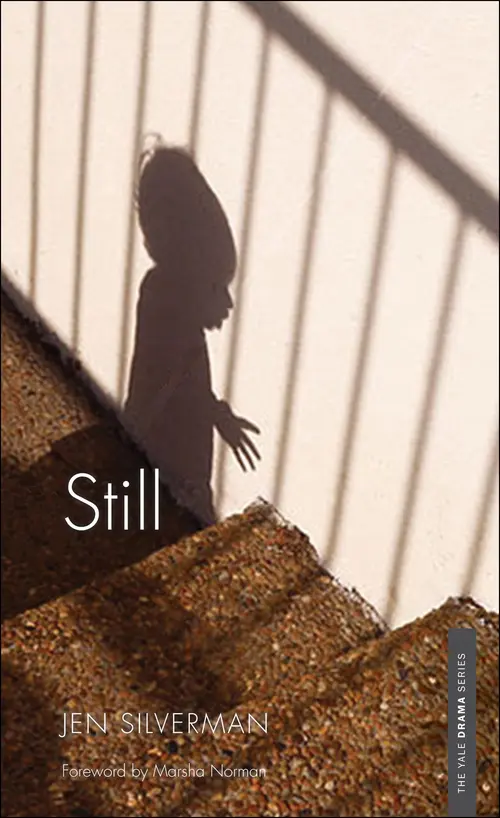
Still
Cover Page
THE YALE DRAMA SERIES
 David Charles horn Foundation
The Yale Drama Series is funded by the generous support of the David Charles Horn Foundation, established in 2003 by Francine Horn to honor the memory of her husband, David. In keeping with David Horn’s lifetime commitment to the written word, the David Charles Horn Foundation commemorates his aspirations and achievements by supporting new initiatives in the literary and dramatic arts.
Still
JEN SILVERMAN
Foreword by Marsha Norman

Foreword
The Yale Drama Series is unique among prizes given to emerging playwrights. It honors the memory of David C. Horn, a man who, though very successful, always wanted to have his own writing published. It is judged by a single judge, not a panel, not a committee, though the single judge always needs about eighteen readers to help screen the more than a thousand plays submitted each year. The winning playwright receives a check for $10,000, for which no future writing is expected; the money may be spent to travel or to pay rent, or it may be frittered away on books and food. This year’s winner also received a reading at the Lincoln Center Theater’s Claire Tow Theater, and this publication by the Yale University Press. There is no entry fee, a model more prizes should follow, and anyone can enter, provided the play has not received a professional production. Plays need not be sponsored or vetted, but are submitted by the playwrights themselves. Because of this generosity of spirit, many manuscripts that are entered are not plays at all, as you can imagine. But a great many of them are very, very good. And three or four are excellent. It has been my great honor to follow Edward Albee, Sir David Hare, and John Guare as a judge of this prize. I salute the fabulous Francine Horn, whose labor of love this is, as well as her board of directors and supporters at Yale University.
I’ve read thousands of new plays in my time as a teacher and a reader for various prizes. The best ones are always about something large, and usually terrible, coming into someone’s life, usually someone who is completely unprepared and consequently ill equipped to deal with it. These stories make the best plays because these terrible things are the ones that terrify us, that change us; they are the things we think we could not survive. We watch these plays as if they were happening to us. We watch for clues to how we might navigate the treacherous territory. We ask ourselves questions like “Why has this terrible thing happened?” and “Who is at fault here?” and “What must I do to ensure that this never happens to me?” Finally, depending on the skill of the writer and his or her knowledge of human life, the best plays always lead to the same point, a moment of recognition and relief. Sometimes there is redemption, sometimes there is forgiveness, but there is always a kind of peace that descends as the playwright brings order to the disorder, lifting the veil of shame and banishing the fear and violence that have ruled the stage.
Jen Silverman’s play Still is such a play. It was discovered by an early reader, and heartily endorsed by the rest of the reader panel. When I read it, I knew immediately it was our winner. I have read other plays on the subject of a stillborn child, but none that live in such an existential plane, none as elegant in formal structure, none with language both surreal and trashy, none as funny, and none as moving. The refraction of the unbearable grief through the lives of all the characters, not just that of the mother, is the truly distinguishing characteristic of this play. The presence of the child himself is the mark of a master in the making.
We live with the dead child, Constantinople, for nearly a week as he searches for his mother, as his just born–just dead consciousness struggles to reconnect with someone he knows only by the sound of her crying. That he first encounters a pregnant dominatrix and a guilt-stricken midwife is no more surprising than his tall pale body and his operatic vocabulary. His delights and fears, his experiments and observations are made all the more acute by the life that is fading from him as we watch. He is the eternal wanderer, caught between birth and death, fearing he will never know love, only loss.
His mother, Morgan, is a portrait of grief, her own stillness also a powerful subject of the play. While the dominatrix and the midwife flail about trying to find ways to exorcise their guilt, she simply survives. And in this way she is still present when her child returns and she can open her arms to him at last. If he is the eternal wanderer, then she is the eternal woman waiting for him to return home.
The play’s classical antecedents are clear. Its contemporary resonance is profound. This is no more a simple play about a stillborn child than the Odyssey is a story about a man who has angered the gods. This is a play about being Lost, with Time running out. This play is about how we all walk the path without a map, seeking help from strangers and learning as much as we can, all the while preparing for the end. That it is both graceful and eerie I will leave you to discover for yourself. Still is a stunning achievement by a young writer of great promise.
All writers have what we at Juilliard call their “stuff”—that is, the topic that draws the best writing from them, the situation that scares them the most, the subject that made them want to write in the first place. If this subject, the appearance of the unbearable and unpredictable into the life of an innocent who might as well be every member of the audience, is Jen Silverman’s “stuff,” then we can look forward to many more great plays from this year’s Yale Drama Series winner.
Marsha Norman
Still
Characters
(3F, 1M)
| CONSTANTINOPLE | He is a giant newborn baby, dead. He should be played by a fully grown, very tall man. He is slippery, as unclothed as possible. Unearthly, disturbing, and charming |
| MORGAN | Constantinople’s mother, 41, fierce, grieving, all angles |
| DOLORES | 18, at odds with the world, from time to time a dominatrix |
| ELENA | A young 30, a midwife, strongly principled, scared |
Time: Now
Places: A rundown hotel on the outskirts of a city Morgan’s basement
Playwright’s Note: Actors must not cry in any moments except those that are specifically indicated. Then (with the exception of Constantinople’s wailing, in Scene 9) they never give themselves over to expressing grief fully—all crying is subtle and understated. There is no moment in which these characters let themselves become sentimental. It is crucial that actors find and play the dark humor and moments of real joy.
There is no intermission.
Scene One
A light on CONSTANTINOPLE.
He looks around. He looks at us.
He’s delighted.
He has a plastic hospital bracelet around his ankle.
CONSTANTINOPLE Wow.
Hi.
You’re really beautiful.
I … That’s great. How beautiful you are. That’s … wow.
I’m not good with words yet. I’m learning them.
I learned a new one today. “Audacious.” I overheard it. I don’t know how to use it yet.
(beat)
So. About me. I was born two days ago. I’m learning that people may want to know this, about me, why I don’t know things yet.
(beat)
Things are just great here. Have you noticed? They’re great. Everything is so strange and great. I need more words. I don’t have enough words yet. Wow. You know? Words are great.
(beat)
So that’s me. I hope you like it. Being beautiful. Being here. I hope you like it a lot. I was dead when I came out. That was two days ago. Did I tell you that? I forget if I told you that. I’m just having a look around. I just want to see it—what I should have had.
(shift—darker)
Like you. I should have had you. Your faces. Your hands. Your words.
(beat)
Don’t feel bad or anything.
(listens for something, then stills as he hears it)
Oh. That’s my mother. She’s crying again.
She’s very far away. I’m not sure where. I hear her in here.
(touches his stomach, where the umbilical cord was)
I don’t know what she looks like. If you see her anywhere, let me know.
I’d better go. I’m getting stiffer. I don’t have much time.
CONSTANTINOPLE leaves.
Scene Two
A seedy hotel. Elegance faded, dilapidated, a grime that sort of shines.
DOLORES sits on a pool table, cue in hand.
She is dressed in hardcore dominatrix gear.
She plays pool against herself.
DOLORES Your shot.
(she takes it, misses)
Ooh. Suckerrrr, my shot.
(she takes it, misses—as her opponent)
Pathetic.
(annoyed)
Fuck you.
(annoyed)
What did you say to me?
DOLORES checks her watch.
Then she moves the pool ball, sets up for a shot.
Then, spoiling for a fight with herself:
DOLORES You can’t do that!
—Watch me.
Put that back.
—Make me.
Girrrrl do not make me take out my combat boots.
A WOMAN comes in, out of breath, in a hurry.
She’s wearing formal work clothes. She wears a carnival
mask, and we can’t see her face.
WOMAN I’m sorry I’m late, I tried to call but I realized I don’t have a number for you and—
DOLORES You’re five minutes overdue. You’re five minutes ripe. You’re a woman?
WOMAN The traffic was crazy. I’m sorry.
DOLORES You are a woman.
WOMAN … Yes.
DOLORES That’s weird.
I usually get men.
WOMAN I’m not a man.
DOLORES Yeah, well, I’m aware of that. Now.
You gonna use that mask for Halloween?
WOMAN
(blurts out)
I’m a failure.
DOLORES Yeah, I’m sure, but that wasn’t what I asked.
Halloween, yes or no?
WOMAN I’m sorry?
DOLORES Whatever, stop talking. Sit down.
The WOMAN sits on the edge of the pool table nervously. She checks over her shoulder.
WOMAN Nobody I know would be here, right? I mean, this seems like the sort of place nobody I know would ever go, but then again I’m here, so …
DOLORES Listen, we need to establish some rules right off the bat. I’m here to be mean to you. I’m good at that. And mean feels very honest to me, and I’m a very honest person, so it’s great how my personality and my life goals line up. But I don’t do clichés, because clichés are not honest, so I don’t want to hear about how terrible you are or what a naughty girl you’ve been because blah blah blah WHATever NEXT. Are we clear?
Beat.
WOMAN I’ve never done anything like this before.
DOLORES Other house rules: If I get bored, I stop. If I get tired, I stop. If you don’t suffer in a manner that I find enjoyable, I stop. I don’t need to know your name, your occupation, or how you feel. Please for the love of God, don’t talk about your feelings, this isn’t a date. Which reminds me: you pay up front. Any questions?
WOMAN This is all very new to me.
DOLORES Cliff Notes version goes: pay up and shut up.
She holds out her hand.
The WOMAN puts a roll of bills into it.
DOLORES counts them, then pockets them.
WOMAN It was a moment. A split-second. And then disaster. I look back on it again and again and I’m still not sure if it was my fault. But either way, I failed.
DOLORES Look … you’re not all that special. You know? Most of us aren’t. So whatever you did is probably not all that special. Next to Hitler, you’re … mediocre.
WOMAN I try to tell myself that some failure is inevitable. But I don’t think it is. I think if you’re good at what you do—if you’re prepared and educated and precise—then you won’t fail. But then I start asking myself—where did I go wrong? And I don’t know. I’m prepared, I’m educated, I’m precise. I’m not boasting, these are just facts. And I can’t really sleep anymore. And I can’t eat. And the question shifts, you know. It becomes: How can i ever atone? And I don’t know that either. But maybe you do.
DOLORES Only the bourgeois upper middle class can afford to worry about that shit. Do you want me to beat you or not?
WOMAN I don’t know. Is that what we do here?
DOLORES You’re paying, you tell me what you want. Slapping is OK. Hair-pulling. Some people like to be kicked. Spanked. Thrashed.
WOMAN Maybe if you just … shouted at me? A little? There are certain phrases I remember from my childhood, they were very upsetting to me. Maybe they’d be appropriate in this context as well.
DOLORES You want to be yelled at.
WOMAN Well, yes, I thought that perhaps—
DOLORES If you wanna be yelled at why don’t you just call your mother? People come here for hardcore shit. I’m a hardcore person. You don’t look like a hardcore person.
WOMAN I’m not, I’m not a hardcore person. But I was researching happiness on the internet, raw diets and Buddhist mantras—and it all seemed just … very … insincere.
DOLORES Insincere?
WOMAN Weak. Diluted. Redemption for beginners. I need advanced redemption. And then I saw your website. And it seemed like a very extreme solution, true, but I’m in a very extreme place right now.
(DOLORES looks ill.)
What’s wrong?
DOLORES throws up.
The WOMAN is nervous but she’s good at this kind of thing; she holds DOLORES’S hair back gently. DOLORES lets her briefly, then sits up, already better, and shoves her away.
WOMAN Did I say something?
DOLORES Don’t flatter yourself, it’s just food poisoning.
WOMAN What did you eat?
DOLORES Or allergies.
WOMAN Those are pretty intense allergies.
DOLORES I’m allergic to food poisoning.
(she straightens, already back to business)
You should go.
WOMAN Go?
DOLORES Reschedule.
WOMAN I didn’t mean to upset you.
DOLORES You look stupid in that mask.
The WOMAN takes off her mask. it is ELENA.
She leaves. DOLORES sits on the pool table. She rubs her stomach.
DOLORES
(to her stomach)
Fuck.
Scene Three
CONSTANTINOPLE Wow. Hello. I just, the weirdest thing just happened. I was walking and then my hands were wet. And then my head was wet. And then everything was wet! The—
(points up, to the sky)
Up there was wet. And the wet was falling, so down here was wet. It was—
(struggling)
Wow.
So that happened.
HardCORE.
(delighted)
Oh I learned that one too. It’s new. There were two
(gestures: male teenagers, chains and tattoos)
big. people. and they were all FuckYou
NoFuckYouMuhfucka and then they said: hardCORE.
(beat, tries the word)
Muhfucka.
(out to the audience)
Can you tell me what that means?
(beat)
Maybe later.
(beat)
My mother played me The Ramones. She played The Grateful Dead. She played me recordings of the collected calls of all the insects in the Northern Hemisphere, and parts of the Southern Hemisphere as well. She likes insects. She read me the dictionary. I learned a lot of words that way but not all of them. Some of them got stuck in her throat before they reached me. Sometimes she didn’t enunciate.
(listens)
She’s not crying today.
I’d like to find her. When she starts crying, I walk and walk. My joints are getting stiffer. Sometimes I have to stop. I wait for her voice to get closer but it hasn’t yet.
(listens)
Oh! There she goes.
He walks off.
Scene Four
MORGAN’S house. The basement.
A single window, high up, at ground level.
Dirt floor. Dim.
MORGAN, despondent, in her bathrobe, sits on the floor. ELENA sits with her.
MORGAN I did everything right.
ELENA I know.
MORGAN The things I ate. The things I didn’t eat. The things I drank or didn’t drink. Nine months without wine. Water aerobics. Everything you told me to do. Why is it my fault?
ELENA It’s not your—
MORGAN Why do I feel like it’s my fault?
(cuts ELENA off)
Don’t answer that.
I don’t want to see anybody. Ever again.
ELENA OK.
MORGAN I just want to sit here. Moss will grow. Up over my face. Like a burka of moss. Moss will grow over the basement. Over the door. Over the house. I’ll just sit here forever in a subterranean pocket of moss. It will get hard to breathe and everything will be very green but at least nobody will drop by with casseroles.
ELENA Morgan …
MORGAN What.
ELENA The casseroles are people being nice. It’s a midwestern thing I guess.
MORGAN Fuck nice. I don’t feel nice. I don’t want anybody else to feel nice. I want everybody to be miserable. More miserable than me. I know I’m competitive, but this time I want everybody else to win.
(beat)
Don’t you have somewhere to be?
ELENA Do you want me to go?
MORGAN I didn’t say that, I just asked if you had somewhere to be.
Don’t answer that.
I feel crazy. I’m sorry.
ELENA Do you want some casserole?
MORGAN Which kind?
ELENA The one with the pink stuff in it.
MORGAN Bacon, that’s bacon.
ELENA No, the gray stuff is bacon.
MORGAN The pink stuff is also bacon.
Beat.
ELENA Is that a yes?
MORGAN Yeah, whatever, no, OK.
ELENA gets MORGAN casserole.
MORGAN holds it throughout but doesn’t eat.
ELENA Maybe we could go eat upstairs.
In the dining room. Or the kitchen. Or the living room.
Or you could take a hot shower? Change your clothes?
MORGAN They didn’t want to see the photos. I said: Wanna see the photos? But none of them did.
ELENA I know.
MORGAN He was beautiful.
ELENA I know.
MORGAN He was dead but he was beautiful.
(beat)
They think it’s my fault.
ELENA Nobody—
MORGAN Everybody, Elena, everybody—and they think if I’d had him in a hospital he would have been fine—this whole crazy thing of a homebirth, they’re thinking, it sounds Greenpeace and hippie and Little House on the Prairie and in the end her baby is dead. That’s what they’re thinking. And if they’re not thinking it’s my fault, then they’re thinking it’s yours. The midwife, after all.
A beat. This hits hard.
ELENA It’s neither of our faults. We took every precaution. Every care. It was a safe and healthy delivery—
MORGAN Until it wasn’t.
Beat.
ELENA Do you think it’s my fault?
Beat.
MORGAN I didn’t say that.
ELENA There was nothing Little House on the Prairie about any of this, Morgan, and you know that. We followed the designated standard of care, I’ve delivered hundreds of babies without incident and this one time—
MORGAN There was incident.
Beat.
ELENA Yes.
MORGAN Say it.
(beat)
“There was incident.” Say it.
(beat)
Just say it!
ELENA “There was incident!”
Morgan, this isn’t easy for me either. I’ve never lost a child before. Never.
MORGAN Well me neither, Elena, I’ve never lost a child either.
(beat)
I would have wanted to see the photos. If it was somebody else’s baby. I would’ve wanted to see. Wouldn’t you?
ELENA I would. I would have too.
She touches MORGAN’S hand.
MORGAN lets her.
MORGAN Where do you think he is?
ELENA They’re preparing him.
MORGAN He should be here. With me. They can’t prepare him for anything I wouldn’t prepare him for better.
ELENA
(gently)
They’re preparing him to be buried.
MORGAN I don’t care.
A coin on his tongue. Coins on his eyes. Snacks for the road.
That’s what I would have done.
I want to see him. When can I see him?
ELENA Let me get you some more casserole.
MORGAN I WANT MY FUCKING SON.
(beat)
I never got to hold him.
I was scared when they said, “Do you want to hold him?”
I was scared of him.
I wish I’d held him.
ELENA I’m sorry.
MORGAN
(turning away, cutting)
It’s not your fault.
Scene Five
In the dilapidated hotel.
DOLORES, sprawled on the pool table.
She tells dead baby jokes to her stomach.
DOLORES What do you call a dead baby in a swimming pool?
(beat)
Bob.
(beat)
What do you call a dead baby on a beach?
(beat)
Sandy.
(beat)
What do you call a limbless dead baby in a pile of leaves?
(beat)
Russel.
(beat)
What’s funnier than a dead baby?
(beat)
A dead baby in a clown costume!
(to her stomach)
The Story Continues on BooksBarbecue!
Enjoyed this preview? ❤️ Do not stop here!
Read the complete book free online → 🔗
Continue reading now on BooksBarbecue and discover every page!
Love reading? Bookmark BooksBarbecue.com for more amazing books!
Happy Reading!